Why Automate Campaign Reporting: A 2026 Guide
Posted on
Marketing
Posted at

Automated campaign reporting connects marketing platforms through APIs to save time, reduce errors, and enable real-time decision-making. It prevents spreadsheet failures and scales easily without extra staff by providing consistent data across channels. Small teams benefit from faster testing, improved ROI, and stronger client relationships when adopting automation early.
Campaign reporting automation is the process of connecting marketing platforms through API integrations to collect, consolidate, and display performance data without manual intervention. For marketing professionals and business owners at small to medium-sized companies, the case for automating this process is direct: manual reporting costs time, introduces errors, and delays the decisions that protect your ad budget. Automated reporting, the industry term for technology-driven data pipelines that replace spreadsheet workflows, delivers near real-time visibility across every channel you run. The result is faster optimization, fewer mistakes, and measurably better ROI.
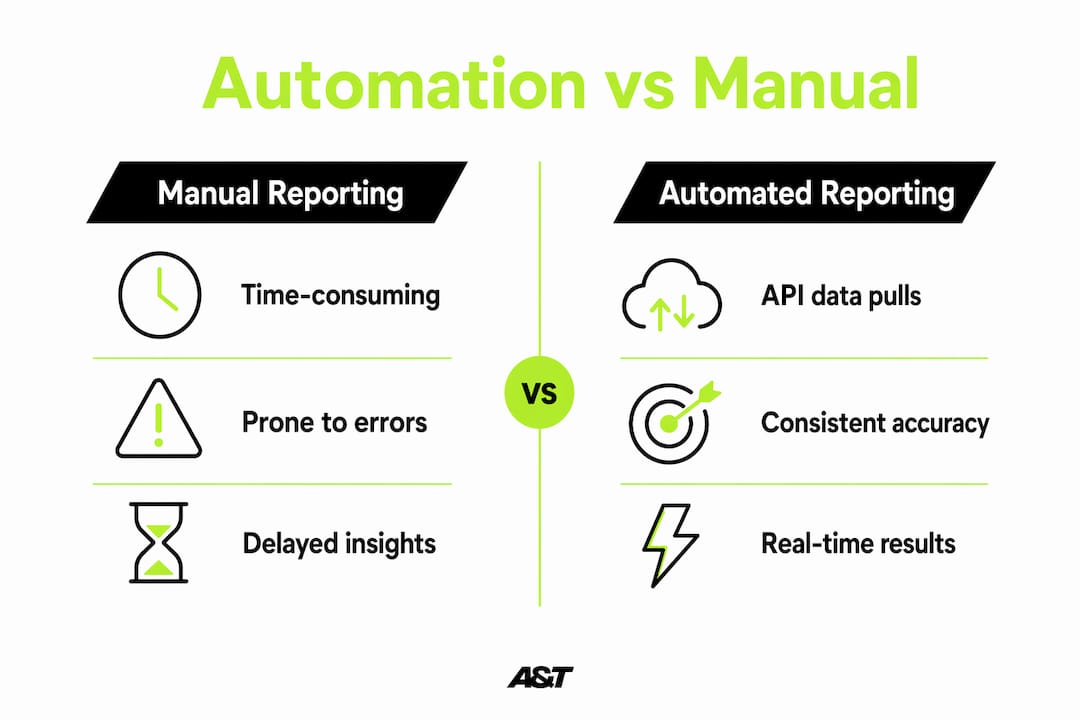
Why automate campaign reporting instead of sticking with spreadsheets?
The short answer: spreadsheets break at scale, and the cost of that failure is real. Broken formulas and inconsistent date ranges in manual workbooks have caused multimillion-dollar strategic mistakes. This is what practitioners call the "Excel Ceiling," the point where data volume and complexity exceed what any spreadsheet can reliably handle.
Automated reporting replaces that fragile setup with API-based data pipelines that pull directly from Google Ads, Meta, and any other platform you run. The connection is live, not a monthly export. That means your numbers are consistent, your date ranges match, and your team is working from a single source of truth rather than three different versions of last month's file.
The benefits of automated reporting compound quickly. Here is what marketing teams gain immediately after switching:
Time recovery. Agencies have reported spending over 70 hours per month on manual reporting alone. Automation cuts that assembly time to under 30 minutes per client.
Fewer errors. Manual data entry introduces inconsistencies that distort performance reads. API connections remove that variable entirely.
Faster decisions. When data is live, you can catch a failing ad set today, not three weeks from now.
Better ROI allocation. Automated attribution reporting produces a 15–30% improvement in marketing ROI within 60–90 days by showing exactly which channels drive revenue.
Scalability without added headcount. Automated pipelines handle ten clients as easily as two. Your reporting capacity grows without your labor costs growing with it.
Pro Tip: Before you build any dashboard, list the three decisions your team makes every week based on campaign data. Build your automated report around those decisions first. Everything else is noise.
How does automation change your approach to campaign optimization?
Manual reporting is reactive by nature. You collect data, build a report, review it, and then decide what to change. By the time that cycle completes, the report is already outdated, showing last month's performance weeks after the campaign events occurred. Automation collapses that cycle.
With live data, your team shifts from explaining what happened to deciding what to do next. Automated reporting changes client and agency dynamics from reactive to proactive strategic discussions. That shift matters because it changes the quality of every conversation you have about your campaigns.
"Automated reporting shifts client meetings from explaining metrics to making strategic decisions, increasing agency value perception. When you walk into a meeting already knowing what the data says, you spend the hour on strategy, not on reading numbers aloud."
The strategic advantages of automation go beyond speed. They include:
Iterative testing within campaign cycles. Time saved on reporting enables three extra tests per week, compounding your learning rate over a quarter.
Cross-channel comparison with standardized metrics. Automated pipelines normalize data from Google Ads, Meta, and other platforms into one attribution model, so you compare apples to apples.
Anomaly detection. Effective automated systems flag performance drops and provide diagnoses rather than just displaying raw numbers. That is the difference between a dashboard and a decision tool.
Budget protection. Reporting latency is the hidden cost of manual workflows. Every week you wait to detect underperformance is a week of wasted spend. Automation stops that waste early.
The teams that use automation well do not just move faster. They run more experiments, catch problems sooner, and reallocate budget with confidence. That is a compounding advantage over competitors still building pivot tables.
What are the most common manual reporting problems automation solves?
Manual campaign reporting fails in predictable ways. Recognizing these failure modes helps you understand exactly where automation pays off.
Time drain. Pulling data from five platforms, formatting it consistently, and building a readable report takes hours every week. That time comes directly out of strategy and execution.
Platform fragmentation. Fragmented data across multiple platforms makes accurate manual reporting nearly impossible at scale. Each platform uses different attribution windows, different metric names, and different export formats.
Reporting latency. The gap between when a campaign underperforms and when you detect it is the most expensive problem in manual reporting. That latency wastes weeks of ad spend before anyone catches the issue.
Human error. A wrong cell reference, a mismatched date filter, or a copy-paste mistake can corrupt an entire dataset. Those errors lead to wrong decisions about real budget.
The Excel Ceiling. As your campaign count grows, manual data consolidation fails due to complexity and volume. The spreadsheet that worked for two campaigns breaks under ten.
Manual reporting problem | What automation does instead |
|---|---|
Hours of weekly data collection | API pulls run automatically on a set schedule |
Inconsistent metrics across platforms | Unified data model with standardized definitions |
Reports delivered weeks after events | Live or near-real-time dashboards |
Formula errors corrupting datasets | Direct API connections with no manual data entry |
Scaling requires more staff hours | Pipelines handle additional accounts without added labor |
Each problem on that list represents a real cost. Automation does not just save time. It removes the conditions that produce bad decisions.

How can you implement automated campaign reporting effectively?
Getting automation right requires a deliberate sequence. Start by connecting your data sources for immediate efficiency gains, then add advanced features gradually to avoid building dashboards that nobody maintains.
A practical implementation path looks like this:
Audit your current workflow. Map every step your team takes to produce a report. Identify which steps consume the most time and which decisions each report actually drives.
Prioritize API integrations over manual exports. Connect your platforms directly. This is the foundation of reliable data pipelines that support scaling without errors.
Build templates with automated data population. Create report structures once, then let the data fill them on schedule. This also supports consistent delivery to stakeholders.
Add anomaly detection progressively. Once your data pipeline is stable, layer in alerts for significant metric changes. A 30% drop in conversion rate should trigger a notification, not wait for a weekly review.
Keep human commentary in the report. Automation handles data assembly. Your team handles interpretation. A report without narrative context tells stakeholders what happened but not why or what to do about it.
Pro Tip: Avoid building a 20-metric dashboard on day one. Start with the five metrics that directly connect to your business goal. Add complexity only when a specific decision requires it.
The role of campaign automation for small and medium businesses is not to replace judgment. It is to give your team accurate, timely data so their judgment is applied to the right problems. The teams that get this right treat their automated reports as decision tools, not static deliverables. They review anomalies, run systematic response cycles, and use the time they save to run more tests and make better bets.
Key Takeaways
Automated campaign reporting is the most direct way for small and medium-sized marketing teams to improve decision speed, reduce errors, and increase ROI without adding headcount.
Point | Details |
|---|---|
Automation eliminates reporting latency | Live API connections replace weekly manual exports, catching underperformance days earlier. |
ROI improves measurably | Automated attribution reporting produces a 15–30% ROI gain within 60–90 days by directing spend to revenue-driving channels. |
The Excel Ceiling is a real risk | Manual spreadsheet workflows fail at scale; API-based pipelines maintain data integrity as campaign volume grows. |
Reports should drive decisions, not just display data | Effective automation includes anomaly detection and review cycles, not just scheduled data delivery. |
Human narrative remains essential | Automation handles data assembly; your team's interpretation and commentary turn numbers into strategy. |
The compounding advantage most small teams underestimate
Most resistance to automated reporting comes from the same place: the assumption that it is a tool for large agencies with dedicated ops teams. That assumption is wrong, and it is costing smaller businesses real money.
I have seen marketing teams at small companies spend entire Fridays building reports that were already outdated by Monday. The data they were working from reflected decisions made three weeks earlier. By the time they acted on it, the budget had already been wasted. That is not a workflow problem. That is a competitive disadvantage that compounds every single month.
What automation actually does for a small team is level the playing field. When your reporting cycle shrinks from weeks to hours, you run more tests. You catch bad campaigns faster. You reallocate budget before the loss accumulates. The analytics-to-optimization connection becomes a real-time feedback loop instead of a monthly postmortem.
The other thing I have observed is what happens to client relationships when reporting improves. When you walk into a review meeting already knowing what the data says, the conversation changes entirely. You stop defending numbers and start proposing next moves. That shift in dynamic is worth more than any single metric improvement. Clients feel the difference between a team that reports and a team that leads.
My honest advice: do not wait until you are managing ten campaigns to automate. Start with two. Build the pipeline, get comfortable with the data flow, and add complexity as your needs grow. The marketing automation checklist for SMBs approach, connecting sources first and adding features second, is the right sequence regardless of your team size.
— Ann
A&T agencyʼs approach to campaign reporting and performance
At A&T Digital, we build paid advertising systems where reporting is not an afterthought. It is part of how we manage every campaign from day one. Our team runs Google Ads management and Meta Ads management with data pipelines that give clients live visibility into what their spend is doing. You do not wait for a monthly PDF. You see performance as it happens, and we act on it in real time. If you are spending on paid ads and still relying on manual reports, you are making slower decisions than your competitors. We can fix that.
FAQ
What is campaign reporting automation?
Campaign reporting automation is the use of API integrations to collect, consolidate, and display marketing performance data without manual data entry or spreadsheet assembly. It replaces periodic manual exports with live or scheduled data pipelines.
How much time does automated reporting actually save?
Agencies that previously spent over 70 hours per month on manual reporting have reduced that to under 30 minutes per client after switching to automated systems. That time goes back into strategy and campaign management.
Does automation improve marketing ROI?
Automated attribution reporting produces a 15–30% improvement in marketing ROI within 60–90 days by identifying which channels drive revenue and enabling faster budget reallocation.
What is the biggest risk of staying with manual reporting?
Reporting latency is the primary risk. Manual workflows typically deliver last month's data weeks after campaign events, meaning underperformance goes undetected and ad spend is wasted during that gap.
When should a small business start automating campaign reports?
Start as soon as you are running campaigns across more than one platform. The complexity and error risk of manual consolidation grows with every additional channel, and the cost of delayed decisions scales with your ad budget.