Types of Retail Discount Campaign Ads That Drive Sales
Posted on
Marketing
Posted at

Retail discount campaigns use targeted offers to influence customer behavior and boost sales. Selecting the right discount type for specific goals, like percentage-off for higher order value or BOGO for inventory clearance, is essential for maintaining margins. Personalized segment targeting and strategic promotional design significantly improve campaign effectiveness and customer engagement.
Retail discount campaign ads are structured promotional offers delivered through paid or organic channels to move customers from interest to purchase. The right discount type does not just cut price. It drives a specific behavior: a first purchase, a larger cart, a repeat visit, or a cleared inventory line. Percentage-off and amount-off formats dominate the market, but the most effective types of retail discount campaign ads depend entirely on what your campaign needs to accomplish. Choosing the wrong format costs you margin without delivering the result you need.
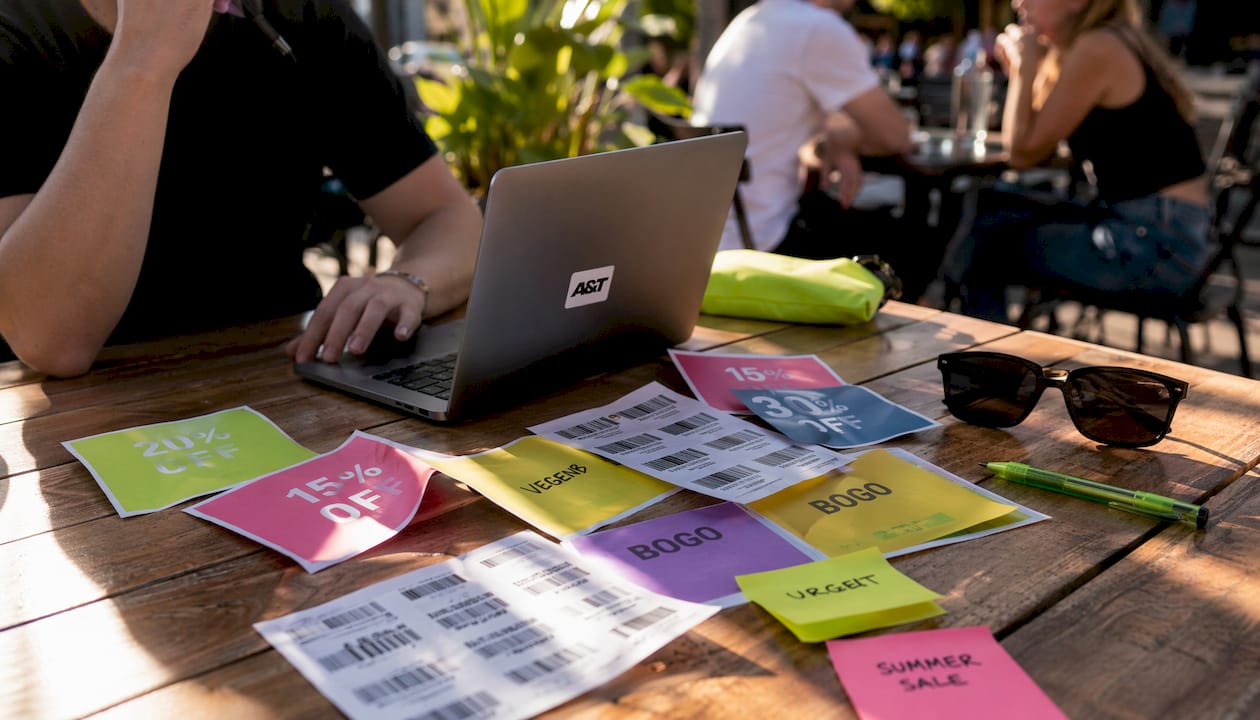
What are the most effective types of retail discount campaign ads?
The choice of discount format is a strategic decision, not a creative one. Each format drives a different customer behavior, and matching format to goal is the single most important decision you make before launching a campaign.
Percentage–off discounts
Percentage-off is the most widely used format in retail advertising. 91% of discount codes in 2026 offer 20% off or less, with 15% off being the most common depth at 26.5% of all codes analyzed. That concentration tells you what the market has tested and validated. Percentage-off ads generate higher average order values (AOV), with data showing an AOV of $95.75 compared to $67.35 for amount-off formats. Use this format when your goal is revenue per transaction, not raw redemption volume.
Amount–off discounts
Amount-off discounts ("$10 off your order") produce higher redemption rates than percentage-off formats. The redemption rate for amount-off codes reaches 0.87% versus 0.69% for percentage-off. Pair this format with a minimum spend threshold and you get both volume and cart lift. A "$15 off orders over $75" offer pushes customers to add one more item rather than check out early.
Free shipping offers
Free shipping is one of the most effective discount marketing techniques for reducing cart abandonment. Customers treat shipping costs as a penalty, not a price. Removing that friction at checkout converts browsers who were already close to buying. Free shipping works best as a threshold offer ("free shipping over $50") rather than a blanket promotion, because the threshold protects margin while still changing behavior.
Buy One Get One (BOGO)
BOGO promotions move inventory fast. They work for replenishment categories where customers naturally buy multiples: personal care, food, apparel basics. BOGO frames the offer as a gain rather than a discount, which aligns with how urgency and perceived value drive impulse purchases more reliably than price cuts alone. Use BOGO for clearance or end-of-season inventory without training customers to expect a permanent price reduction.
VIP and segment–targeted insider discounts
Segment-restricted codes are rare but powerful. They represent only 4% of offers yet deliver a 50–68% lift in AOV and a 5x redemption rate compared to broad seasonal campaigns. Insider discounts for loyalty members, email subscribers, or students create exclusivity. That exclusivity increases perceived value without broadcasting a lower price to your entire customer base.
Pro Tip: Run VIP discount ads on Meta using custom audiences built from your email list. The targeting precision means your best customers see the offer, and your full-price shoppers never do.
How promotional label design shapes discount perception
Discount size is not the primary driver of purchase intent. Perceived savings and urgency matter more than the actual percentage removed from the price. This is the most underused insight in retail advertising.
"Consumer purchase intention relies more on perceived savings and urgency feelings than discount size alone. Various discount formats elicit similar reactions, making value framing and time limits critical."
The design of your promotional label changes how much value a customer assigns to the offer. Textual-visual promotional labels that combine icons, colorful typography, and stylized text increase perceived value and impulse purchases more than purely numeric labels. A badge with a flame icon and "Today Only" outperforms plain text showing "15% off" in the same position. The psychology of colors in marketing reinforces this: red and orange in promotional labels trigger urgency responses that neutral palettes do not.
Three design principles that improve discount ad performance:
Add a visual anchor. Use an icon, badge shape, or color block to frame the offer. Visual framing increases mental simulation of the purchase.
State the end date explicitly. "Ends Sunday" outperforms "Limited time" because specificity makes the deadline feel real.
Show the before price. Displaying the original price next to the discounted price makes the saving tangible, not abstract.
A savings-oriented customer responds differently to the same offer than a convenience-oriented one. Segment your ad creative accordingly. Customers who respond to email discount campaigns are already savings-oriented. Customers reached through Google Shopping ads may need the urgency signal more than the savings frame.
How to structure discount codes for margin protection
The structure of a discount code determines whether a campaign generates profit or erodes it. Minimum order thresholds on amount-off discounts significantly increase AOV. A threshold forces customers to spend more to unlock the saving, which offsets the margin cost of the discount itself.
Parameter | Automatic discount | Coupon code |
|---|---|---|
Best use case | Eligibility-based, seamless checkout | Partner campaigns, attribution tracking |
Customer experience | Frictionless, no code entry needed | Requires action, adds a step |
Attribution | Harder to isolate by channel | Easy to track by code per channel |
Abuse risk | Lower, tied to cart rules | Higher if code leaks publicly |
Segment restrictions protect your full-price customers from seeing offers they did not earn. Employee discounts, student codes, and loyalty-tier offers all restrict eligibility to specific groups, which prevents margin leakage from customers who would have paid full price anyway.
Timing matters as much as structure. Running a discount immediately after a competitor promotion anchors your price reference downward. Dynamic timing of promotions to match or counter competitor activity protects your brand's price reference and avoids long-term margin erosion. Blanket sales run too frequently train customers to wait for the next deal rather than buy at full price.
Pro Tip: Calculate your breakeven lift before launching any discount. Divide your gross margin by your margin after the discount, then subtract one. That number is the minimum sales increase you need for the campaign to pay for itself.
How to match discount ad types to specific business goals
Every discount campaign should have one clear job. Defining a specific job for a discount campaign and matching the discount type to that job leads to better results and tighter margin control. Vague goals produce vague results.
Here is how to align discount format with campaign purpose:
New customer acquisition: Use a percentage-off first-purchase code delivered through Google Ads or Meta prospecting campaigns. The percentage format signals a meaningful saving to someone who has no prior relationship with your brand.
Cart recovery: Use an amount-off code with a minimum threshold sent via email or retargeting ads. The fixed dollar amount feels more concrete to a customer who already knows what they want.
Inventory clearance: Use BOGO or a tiered discount ("buy 2, get 30% off") to move volume fast without permanently repricing individual SKUs.
VIP retention: Use a segment-restricted insider discount delivered through a loyalty email or Meta custom audience. The exclusivity reinforces the customer's status and drives repeat purchase.
Seasonal promo ads: Combine a percentage-off headline with a free shipping threshold. Holiday retail promotions perform best when they remove two friction points at once: price and shipping cost.
Aligning your ad creative with the discount type closes the loop. A cart recovery ad that says "Your cart is waiting, here's $10 off" works because the message matches the customer's context. A broad seasonal sale ad with the same $10 offer lacks that context and converts at a lower rate. For a deeper look at how these formats perform across channels, retail ad campaign examples show the real numbers behind each approach.
Targeted offers consistently outperform broad seasonal sales on a per-dollar basis. The analytics behind campaign ROI confirm that segmented campaigns generate higher returns because they reach customers at the right moment with the right offer. Broad discounts reach everyone, including customers who were never going to buy.
Key Takeaways
The most effective retail discount campaign ads combine the right format, the right audience segment, and a clear behavioral goal to protect margin while driving measurable sales lift.
Point | Details |
|---|---|
Match format to goal | Percentage-off drives AOV; amount-off drives redemptions; BOGO clears inventory. |
Segment your audience | Restricted codes deliver up to 5x redemption rates versus broad seasonal offers. |
Design for perception | Visual labels with icons and urgency cues outperform numeric-only discount displays. |
Protect margin structurally | Use minimum spend thresholds and calculate breakeven lift before every campaign. |
Time campaigns deliberately | Avoid frequent blanket sales that train customers to wait for discounts. |
What Iʼve learned running discount campaigns for retail clients
The biggest mistake I see retail marketers make is treating discount depth as the primary lever. They go deeper on the percentage when a campaign underperforms, and they erode margin without fixing the actual problem, which is usually audience targeting or creative framing.
The campaigns that consistently outperform are the ones built around a single behavioral job. When a client comes to us wanting to "run a sale," the first question we ask is: what do you want the customer to do that they are not doing right now? That question changes everything. It shifts the conversation from "how much off" to "who, when, and why."
Personalization is no longer optional in retail discount advertising. Insider discounts and segment-targeted offers are not just performing better on paper. They are changing how customers relate to brands. A customer who receives an exclusive offer feels recognized. That feeling drives loyalty more reliably than any blanket promotion.
The retail campaign planning process we use with clients always starts with margin math, then moves to audience segmentation, then to creative. Most marketers do it in reverse. They build the creative first, then figure out who sees it. That sequence produces generic ads and unpredictable results.
My honest view: the brands winning with discount advertising in 2026 are not the ones offering the deepest cuts. They are the ones with the most disciplined campaign calendars and the clearest customer segments.
— Ann
How A&T agency helps retail brands run discount campaigns that pay off
Running discount campaigns without a clear structure costs more than it returns. A&T Digital's performance marketing team builds and manages multi-channel paid ad systems for retail brands across Google Ads and Meta, with campaign architecture designed around margin protection and measurable conversion goals. We handle the full cycle: audience segmentation, discount structure, ad creative, and post-campaign analysis. Retail clients get campaigns built for a specific job, not generic promotions pushed to everyone. If you want discount ads that generate real revenue without training your customers to wait for the next sale, we are the team to call.
FAQ
What types of retail discount campaign ads drive the highest AOV?
Percentage-off discounts generate the highest average order values, with data showing an AOV of $95.75 compared to $67.35 for amount-off formats. Use percentage-off when revenue per transaction is the primary goal.
How deep should a retail discount be?
91% of retail discount codes offer 20% off or less, with 15% off being the most common depth. Going deeper than 20% is rare and rarely necessary to change customer behavior.
What is the difference between automatic discounts and coupon codes?
Automatic discounts apply at checkout without customer action, making them ideal for eligibility-based offers. Coupon codes require manual entry and are better suited for partner campaigns and channel-level attribution tracking.
How do segment–targeted discount ads perform versus broad promotions?
Segment-restricted discount codes deliver a 50–68% lift in AOV and a 5x redemption rate compared to broad seasonal campaigns, despite representing only 4% of all offers in the market.
How do I protect margin when running discount campaigns?
Calculate your breakeven lift before launching: divide gross margin by margin after discount, then subtract one. Pair amount-off discounts with minimum spend thresholds to offset the cost of the discount with increased cart size.