Meta Ads in Retail: Boosting Sales and ROI
Posted on
Marketing
Posted at

Running a successful retail business online means standing out from the constant flow of digital advertising. The power of Meta Ads comes from their ability to harness detailed audience insights and advanced targeting tools, creating personalized marketing experiences that drive real sales. For American retailers, choosing the right Meta Ad strategies provides a direct path to reaching the customers who matter most and maximizing every dollar spent on advertising.
Table of Contents
Defining Meta Ads for Retail Success
Choosing the Right Meta Ad Formats
AI Automation and Audience Targeting Explained
Creative Development and Performance Optimization
Managing Costs, Risks, and Compliance Issues
Avoiding Common Mistakes With Meta Ads
Key Takeaways
Point | Details |
Utilize Meta Ads for Targeted Marketing | Retailers can leverage Meta Ads on Facebook and Instagram to precisely target demographics and improve customer engagement. |
Select Appropriate Ad Formats | Choosing the right ad format, like Video or Carousel Ads, enhances communication and aligns with specific marketing goals. |
Implement AI for Audience Targeting | Utilizing AI-powered audience targeting enables more effective segmentation and personalized advertising experiences. |
Monitor Costs and Compliance | Developing strong cost management and compliance strategies is crucial for sustainable and effective digital advertising. |
Defining Meta Ads for Retail Success
Meta Ads are sophisticated digital advertising tools specifically designed to help retail businesses target potential customers with precision and effectiveness. These ads leverage the extensive user data available on Meta’s platforms to create highly personalized marketing experiences that can dramatically improve sales performance.
Retail businesses can utilize Meta Ads across Facebook and Instagram to strategically map customer journeys by targeting specific demographics, interests, and behaviors. The platforms offer advanced segmentation capabilities that allow retailers to design campaigns reaching exact customer profiles most likely to engage with their products. This means a boutique clothing store can target women aged 25-40 interested in sustainable fashion, while a tech retailer can focus on young professionals interested in the latest gadgets.
The impact of Meta Ads goes beyond simple targeting. Advertising research demonstrates these platforms influence consumer attitudes, emotions, and purchasing behaviors through carefully crafted messaging. Successful Meta Ads combine compelling visuals, strategic copywriting, and precise audience selection to create campaigns that not only attract attention but also drive meaningful conversions.
Pro tip: Develop a comprehensive audience persona before launching Meta Ads to ensure your targeting strategy aligns perfectly with your ideal customer profile.
Choosing the Right Meta Ad Formats
Meta Ad Formats are critical strategic tools that enable retailers to communicate with potential customers through visually engaging and highly targeted digital advertising channels. Each format offers unique advantages for connecting with specific audience segments and achieving distinct marketing objectives.
Retail businesses can leverage multiple ad formats on Meta platforms, including targeted advertising strategies that match specific audience demographics and behaviors. The primary ad formats include:
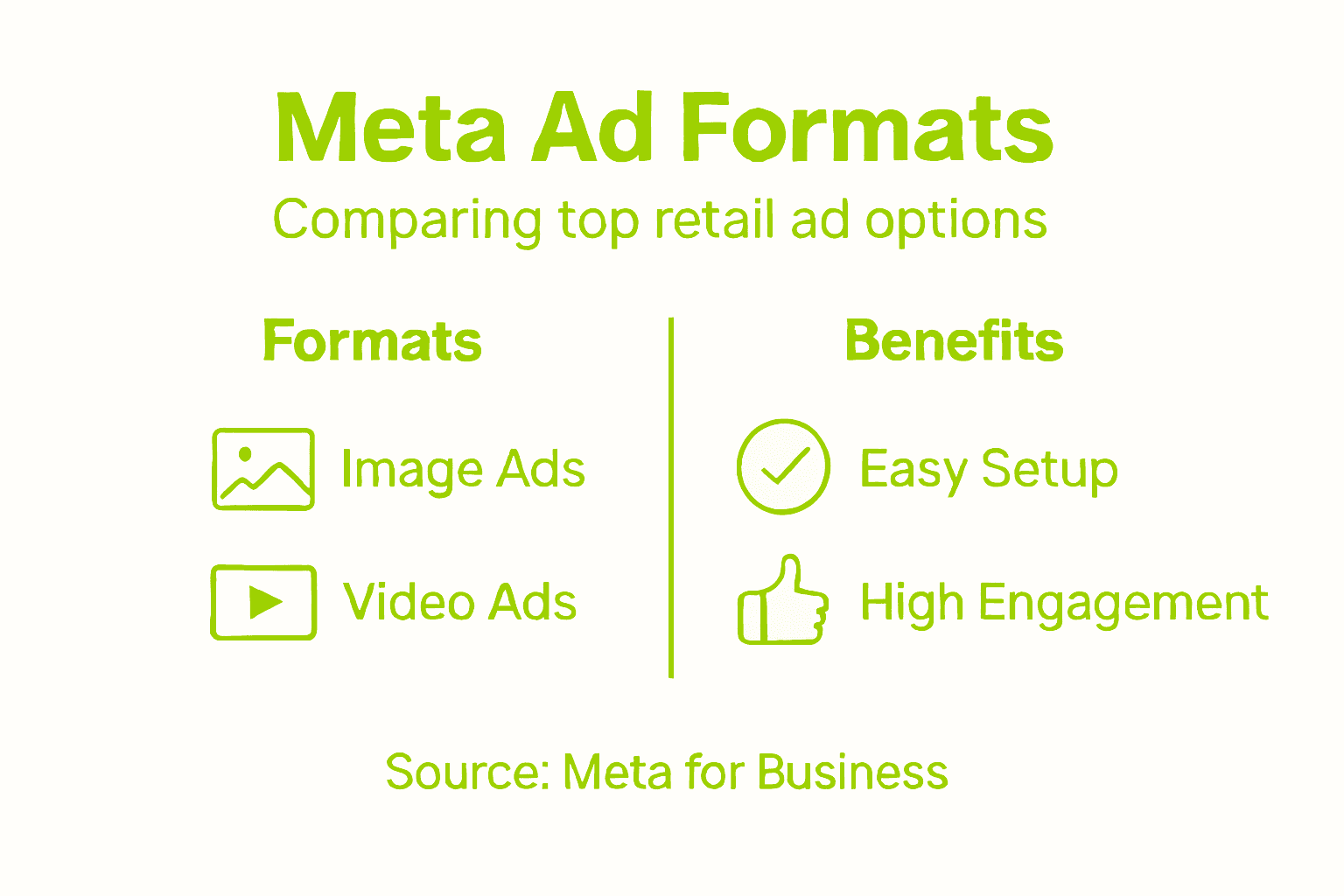
Image Ads: Simple, direct visual communication perfect for showcasing products
Video Ads: Dynamic content that captures attention and demonstrates product features
Carousel Ads: Multiple images allowing retailers to display product ranges or tell a visual story
Story Ads: Full-screen immersive experiences ideal for creating emotional connections
Collection Ads: Interactive formats enabling direct product browsing within the ad
Successful retail marketers understand the importance of choosing transparent advertising formats that align with platform guidelines and consumer expectations. Native ads that seamlessly blend with platform content can significantly improve engagement while maintaining ethical marketing practices.
Here’s a summary of Meta Ad formats and their best uses for retail marketers:
Ad Format | Best Use Case | Key Advantage |
Image Ads | Single product focus | Simple and quick impact |
Video Ads | Product demonstrations | High audience attention |
Carousel Ads | Show product collections | Storytelling opportunity |
Story Ads | Event or promotion launch | Immersive experience |
Collection Ads | Mobile shopping journey | Direct product browsing |
Pro tip: Rotate and test different ad formats systematically to discover which resonates most effectively with your specific target audience.
AI Automation and Audience Targeting Explained
Artificial Intelligence has transformed digital advertising by introducing unprecedented levels of precision and personalization in audience targeting for retail businesses. Modern Meta Ads leverage sophisticated machine learning algorithms to analyze vast amounts of consumer data and create highly targeted marketing experiences.
AI marketing technologiesenable retailers to segment audiences with remarkable accuracy, using complex behavioral patterns and predictive modeling. This means businesses can now target consumers based on intricate criteria such as:
Previous purchasing behaviors
Real-time browsing interactions
Demographic and psychographic profiles
Predicted future purchasing likelihood
Engagement history across digital platforms
The core strength of AI-powered audience targeting lies in its ability to continuously learn and adapt. Automated AI systems analyze consumer interactions in real-time, dynamically adjusting ad delivery to maximize relevance and engagement. This intelligent approach allows retail marketers to move beyond traditional demographic targeting, creating personalized advertising experiences that feel uniquely tailored to individual consumers.
This table compares manual and AI-powered audience targeting in Meta Ads:
Targeting Method | Core Approach | Business Impact |
Manual Segmentation | User-defined audience rules | May miss hidden patterns |
AI-Powered Targeting | Dynamic algorithmic modeling | Higher relevance, efficiency |
Pro tip: Configure your Meta Ads AI targeting to include lookalike audiences that mirror your most successful existing customer profiles for enhanced marketing efficiency.
Creative Development and Performance Optimization
Creative Development in Meta Ads represents a sophisticated blend of artistic expression and data-driven strategy for retail businesses. Successful advertising requires more than visual appeal - it demands a deep understanding of consumer psychology and precise performance measurement.
Rigorous experimental frameworksenable retailers to systematically test and refine ad creative elements. This approach involves:
Developing multiple creative variations
Conducting systematic A/B testing
Measuring specific performance metrics
Iteratively improving ad content
Tracking audience engagement signals
Advertising content strategies focus on creating emotional resonance and cognitive engagement. Effective Meta Ads should evoke specific emotional responses while clearly communicating product value. This means crafting visuals and messaging that simultaneously capture attention, trigger emotional connections, and provide clear value propositions for potential customers.

The optimization process is continuous, requiring constant monitoring and adaptation. Successful retail marketers treat each ad as a living experiment, using data to guide creative decisions and maximize return on advertising investment.
Pro tip: Create a structured testing matrix that systematically tracks creative performance across different audience segments to identify your most compelling ad variations.
Managing Costs, Risks, and Compliance Issues
Cost Management in Meta Ads requires a strategic approach that balances financial efficiency with marketing effectiveness. Retailers must develop robust frameworks to monitor and control advertising expenditures while maintaining campaign performance and legal compliance.
Economic guardrails for advertising are critical for preventing budget overruns and ensuring sustainable marketing investments. Key strategies include:
Setting precise return on ad spend (ROAS) thresholds
Implementing daily and total budget caps
Continuously monitoring ad performance metrics
Adjusting bids and targeting in real-time
Establishing clear financial benchmarks
Legal compliance in digital advertisingdemands rigorous attention to anti-discrimination standards and ethical targeting practices. Retailers must proactively:
Avoid discriminatory audience segmentation
Ensure transparent ad targeting
Respect consumer privacy regulations
Maintain comprehensive documentation
Implement regular compliance audits
Successful risk management combines financial discipline with legal awareness, protecting both the advertising investment and the brand’s reputation. Retailers who develop comprehensive compliance strategies can confidently navigate the complex digital advertising landscape.
Pro tip: Develop a monthly compliance and performance review checklist that systematically evaluates your Meta Ads against financial, legal, and ethical standards.
Avoiding Common Mistakes With Meta Ads
Meta Ad Campaigns require meticulous strategic planning to prevent costly errors that can undermine marketing performance. Retailers must understand the nuanced landscape of digital advertising to maximize their return on investment and avoid common pitfalls.
Digital advertising experimentation reveals several critical mistakes that can derail campaign effectiveness. The most significant errors include:
Inconsistent attribution tracking
Using underpowered sample sizes
Making mid-test campaign modifications
Implementing overly flexible performance metrics
Failing to establish clear experimental controls
Advertising strategy researchhighlights additional critical mistakes retailers must avoid. These include:
Developing unclear or unfocused messaging
Ignoring subtle target audience nuances
Making unsupported marketing claims
Neglecting comprehensive performance tracking
Overlooking audience segmentation details
Successful Meta Ad campaigns demand a disciplined approach that combines rigorous data analysis, strategic creativity, and continuous performance optimization. Retailers who develop systematic methods for identifying and mitigating potential mistakes can significantly improve their advertising effectiveness.
Pro tip: Create a pre-launch checklist that systematically evaluates your Meta Ad campaign against potential experimental and strategic vulnerabilities.
Unlock Your Retail Potential with Expert Meta Ad Strategies
Struggling to navigate the complex world of Meta Ads for retail growth. Keep your campaigns focused with precise audience targeting, AI-driven optimization, and creative development that truly connects with your customers. The article highlights critical challenges such as managing ad costs, avoiding common mistakes, and creating emotionally engaging content. At A&T Digital, we understand how overwhelming this can feel for small to medium-sized retailers aiming for measurable sales uplift and improved return on ad spend.
Take control now and transform your digital advertising approach. With our boutique team, you get personalized service combining strategic insight and data-driven execution to build and scale Meta Ads campaigns tailored to your retail business goals. Discover how our performance marketing solutions can help you craft compelling creatives, manage costs ethically, and optimize for maximum sales impact. Ready to overcome retail advertising hurdles? Visit A&T Digital and start growing your ROI today while avoiding costly mistakes and boosting conversions.
Frequently Asked Questions
What are Meta Ads, and how do they work for retail businesses?
Meta Ads are digital advertising tools designed for retail businesses that utilize user data from Meta’s platforms to create personalized marketing experiences, enhancing targeting and improving sales performance.
What ad formats are available for Meta Ads, and which ones are best for retailers?
Meta Ads offer various formats, including Image Ads, Video Ads, Carousel Ads, Story Ads, and Collection Ads. Each format serves different purposes, such as showcasing products or creating immersive experiences, making it essential for retailers to choose based on their marketing objectives.
How can artificial intelligence enhance audience targeting in Meta Ads?
Artificial Intelligence enhances audience targeting by using machine learning algorithms to analyze consumer data, allowing retailers to segment audiences based on behaviors, demographics, and engagement history, resulting in more personalized advertising experiences.
What are common mistakes to avoid when running Meta Ads campaigns?
Common mistakes include inconsistent attribution tracking, unclear messaging, and neglecting performance tracking. Retailers should develop systematic methods to identify and mitigate these mistakes to improve campaign effectiveness.