What Is Paid Media: Driving Growth for Telehealth
Posted on
Marketing
Posted at

Marketing budgets are tight, and competition among American telehealth providers is fierce. Finding patients ready to book consultations takes more than generic ads or vague targeting. Understanding paid media gives you immediate access to high-intent patients on platforms like YouTube and Facebook, where American adults spend the most time online. This article helps clarify what paid media truly delivers, how to avoid the biggest mistakes, and how to use targeting to drive actual revenue instead of wasted spending.
Table of Contents
Key Takeaways
Point | Details |
Importance of Strategic Targeting | Effective paid media requires intentional targeting based on patient demographics and behaviors to maximize conversion rates. |
Clear Campaign Goals are Essential | Establish specific and measurable goals to track success and optimize campaigns effectively, avoiding vague objectives that lead to wasted spend. |
Monitor the Right Metrics | Focus on metrics like cost per patient acquisition and conversion rates rather than vanity metrics like impressions to assess campaign effectiveness. |
Adapt and Optimize Campaigns | Continuously optimize ad performance based on real-time data to improve ROI and prevent budget drains from underperforming ads. |
Paid Media Defined and Common Misconceptions
Paid media is any promotional content you fund to reach audiences across search engines, social platforms, or websites. Unlike earned media (free word-of-mouth) or owned media (content you control on your own channels), paid media requires a budget but delivers immediate visibility.
For telehealth marketers, this distinction matters. You’re competing for attention in a crowded digital space. Paid channels let you target patients actively searching for healthcare solutions and those who haven’t discovered you yet.
What Paid Media Actually Includes
Paid search adsrespond to consumer searches in real-time. When someone searches “online doctor consultation,” your ad appears instantly. Display ads reach audiences browsing websites relevant to healthcare. Sponsored social media posts appear in feeds on platforms where patients spend time.
You’ll also find:
Video ads on platforms like YouTube and TikTok
Pop-up advertisements on high-traffic sites
Sponsored posts on social media platforms like Facebook, Instagram, and LinkedIn
Retargeting ads that follow users who visited your website
Each format serves a purpose. Search ads work for urgent patient needs. Social ads build awareness. Video drives engagement.
The Biggest Misconception About Paid Media
Most telehealth leaders think paid media is simply “spending money to show ads.” That’s backwards. Paid media is a strategic system where you buy access to audiences, then convert them through smart targeting and creative execution.
The misconception creates wasted budgets. Companies throw money at ads without defining who they’re reaching or what they want those audiences to do. They measure vanity metrics like impressions instead of actual patient acquisitions.
Strategic paid media isn’t about spending the most; it’s about reaching the right people at the right moment with a message they actually care about.
Here’s what separates effective paid media from budget burn:
Intentional targeting based on patient demographics, behaviors, and healthcare needs
Clear campaign goals like appointment bookings, consultation requests, or patient retention
Audience selection to avoid showing ads to the wrong people
Performance tracking tied to actual business outcomes, not just clicks
Telehealth companies that win use paid media as a conversion tool, not a brand-awareness vanity project. You’re buying direct access to high-intent patients who are ready to take action.
Why This Matters for Your Growth
Patient acquisition costs matter in telehealth. You need measurable results from every dollar spent. Paid media lets you test different messages, audience segments, and offer types quickly. You see what converts before scaling.
Unlike traditional healthcare marketing, paid media gives you real-time feedback. Stop ads that underperform. Double down on those that drive patient signups.
Pro tip: Before launching any paid campaign, define your target patient clearly—age range, health concern, current search behavior—and set a specific goal like “200 new patient consultations at under $45 per acquisition.” This single step prevents most wasted spending.
Major Types and Platforms for Paid Media
Paid media comes in several distinct types, each designed to reach patients at different moments in their decision journey. Understanding which type works best depends on your telehealth goal—whether you’re driving awareness, generating leads, or converting patients.
Core Types of Paid Media
Search ads appear when patients actively search for healthcare solutions. Someone types “virtual dermatologist consultation,” your ad shows instantly. These are high-intent audiences ready to act.

Display ads are banner advertisements shown across websites relevant to healthcare. They reach patients browsing health content but not actively searching. These build awareness over time.
Social media ads appear in patient feeds on platforms like Facebook and Instagram. You control exactly who sees them based on demographics, interests, and behaviors.
Video ads play before or during YouTube videos, TikTok content, or streaming services. These capture attention through motion and storytelling.
Retargeting ads follow patients who visited your website but didn’t convert. They remind potential patients about your services as they browse other sites.
Other formats include sponsored posts, influencer partnerships, and native advertising that blends with editorial content.
The Platforms That Matter for Telehealth
YouTube dominates with 84% of American adultsusing the platform, making it ideal for educational health videos and patient testimonials. Facebook reaches 71% of adults and excels at targeting specific patient demographics.
Instagram captures younger patients through visual health content. TikTok reaches Gen Z with short-form video. LinkedIn works for B2B telehealth partnerships and provider recruitment.
Here’s where your telehealth patients actually spend time:
Here’s how major paid media platforms align with telehealth goals:
Platform | Best Patient Demographic | Strength for Telehealth | Key Use Case |
YouTube | Adults of all ages | Educational video outreach | Health tips, patient testimonials |
Adults 30+, caregivers | Precise demographic targeting | Appointment reminders, retargeting | |
Young adults, parents | Visual brand storytelling | Patient stories, health tips | |
TikTok | Gen Z, young parents | Short-form video engagement | Awareness, pediatric campaigns |
Google Search | High-intent patients | Urgent need capture | Immediate consultation bookings |
Healthcare professionals | B2B and recruitment | Provider referrals, hiring |
YouTube for video content and educational material
Facebook for demographic targeting and retargeting
Instagram for visual patient stories and health tips
TikTok for reaching younger age groups
Google Search for capturing urgent patient needs
LinkedIn for healthcare provider networking
The best platform isn’t the most popular one—it’s where your specific patient demographic spends time and is ready to take action.
Choosing Your Platform Strategy
Don’t try to be everywhere at once. Your telehealth budget is limited. Pick platforms where your ideal patient actually exists and where your message fits naturally.
A pediatric telehealth service? Instagram and TikTok reach parents and younger patients. Mental health counseling? Facebook and Google Search capture adults actively seeking help. Specialist consultations? LinkedIn targets physicians referring patients.
Each platform has different strengths for conversion. Search ads convert fastest. Social builds awareness that converts over weeks. Video drives engagement.
Pro tip: Start with two platforms maximum: Google Search for immediate patient acquisitions and one social platform (Facebook or Instagram) where your target patient demographic spends the most time. Master these before expanding.
How Paid Media Targeting Works
Targeting is the engine that makes paid media work. Without it, you’re just throwing money at random audiences. With it, you reach patients most likely to book a consultation or purchase your services.
Paid media targeting matches your ads to specific audience segments based on data about who they are and what they care about. The platform’s algorithm decides which patients see your ads and when.
The Core Targeting Methods
Demographic targeting reaches patients by age, gender, location, income, and education level. You decide: “Show my ads to women ages 25-45 in California interested in fertility services.”
Behavioral targeting focuses on what patients do online. Their search history, websites visited, and previous purchases reveal interests. Someone researching anxiety treatments becomes a target for mental health telehealth ads.
Interest-based targeting reaches patients based on declared interests and hobbies. Fitness enthusiasts see nutrition counseling ads. New parents see pediatric telehealth services.
Contextual targeting shows ads based on the content patients are currently viewing. Display ads for dermatology appear on skincare blogs. Workout videos get fitness coaching ads.
Retargeting follows patients who already visited your website. They see your ads across other sites as a reminder to convert.
Here’s what gets tracked:
The table below compares key targeting methods in paid media for telehealth marketers:
Targeting Method | How It Works | Sample Benefit |
Demographic | Uses age, gender, location | Reaches specific age groups |
Behavioral | Tracks online actions | Targets active health seekers |
Interest-based | Segments by stated hobbies | Engages by health interests |
Contextual | Matches ad to site content | Increases relevance on sites |
Retargeting | Shows ads to past visitors | Boosts conversions |
Age, location, and income level
Search and browsing behavior
Pages visited and time spent
Previous interactions with your brand
Device type and operating system
Health interests and conditions
Why Targeting Matters for Telehealth
Targeting increases relevance by matching ads to audience segments most likely to respond. A patient seeing an ad for their specific health concern is far more likely to click than someone seeing a generic health ad.
Better targeting means lower costs per patient acquisition. You’re not paying to show ads to people who will never convert. Your budget goes toward high-intent patients ready to take action.
Precise targeting reduces wasted ad spend by showing your message only to patients most likely to need your services.
Many telehealth companies make this mistake: they target too broadly. “Anyone ages 18-65 interested in health” casts a massive net but wastes budget. “Women ages 30-45 searching for virtual gynecologist consultations” reaches people ready to book.
Building Your Targeting Strategy
Start by defining your ideal patient with specificity. Not “anyone with anxiety,” but “working adults ages 25-40 in urban areas searching for therapy options on weekday evenings.”
Then layer your targeting:
Choose demographics that match your patient profile
Add behavioral signals like health-related searches
Include contextual placements on health and wellness sites
Set up retargeting for website visitors
Don’t over-complicate it. Research shows that simple, single-attribute targeting often outperforms overly complex microtargeting across too many traits. Focus on your strongest patient indicators first.
Pro tip: Start with demographic and behavioral targeting combined—age, location, and specific health interest searches—then measure what actually converts before adding more targeting layers.
Costs, ROI, and Budgeting Considerations
Paid media requires upfront investment, but the returns can be substantial when executed correctly. For telehealth companies, understanding costs and ROI separates profitable campaigns from budget drains.
The question isn’t “Can I afford paid media?” It’s “Can I afford not to?” Competitors are already capturing patients through paid channels. Without it, you’re losing market share.
Understanding Paid Media Costs
Cost per click (CPC) varies by platform and competitiveness. Google Search ads for popular health terms might cost $2-8 per click. Less competitive terms cost less. Social media ads average $0.50-3 per click, depending on audience specificity.
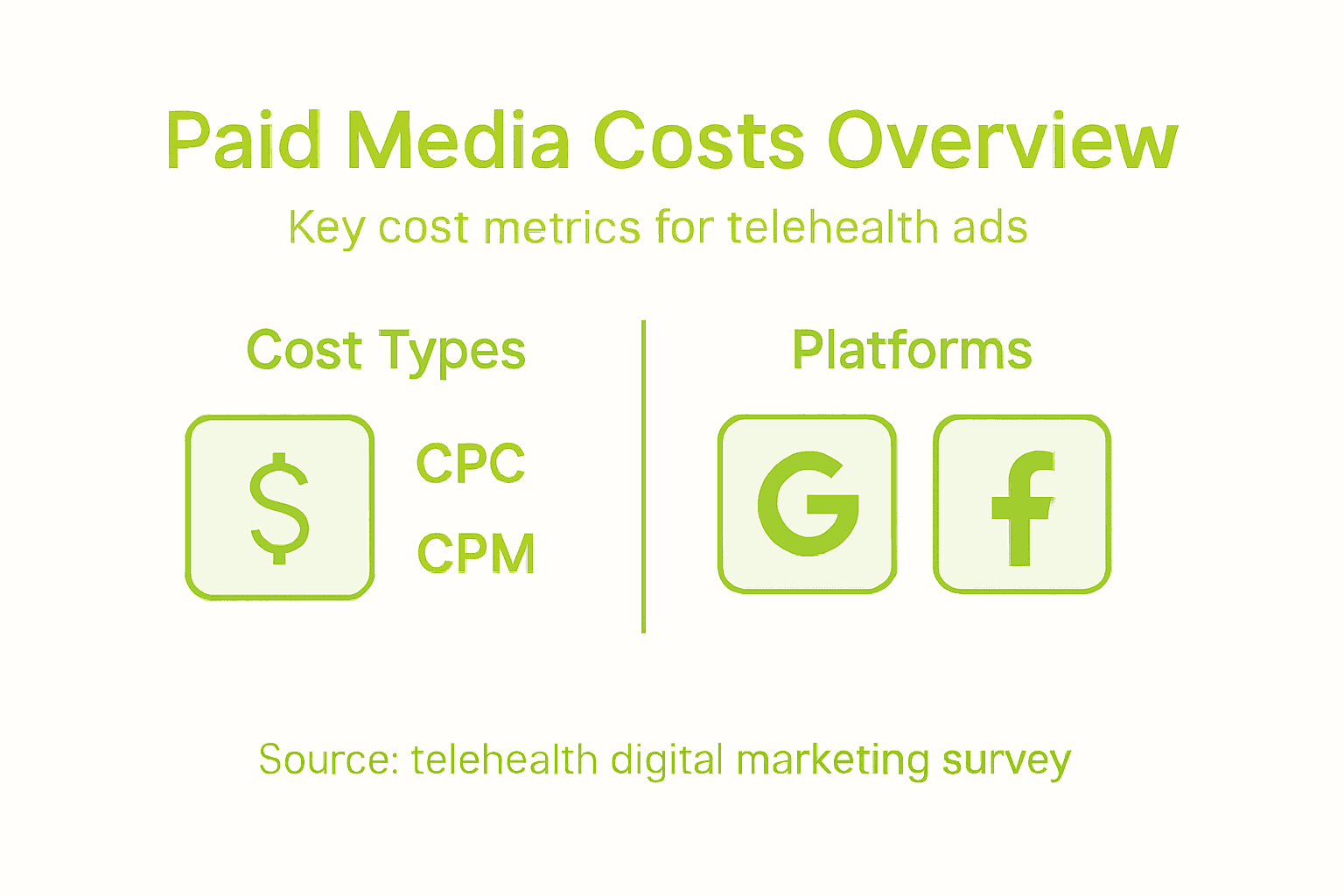
Cost per impression (CPM) is what you pay per 1,000 ad views. Display ads might cost $5-15 per thousand impressions. Video ads run higher, around $10-25 CPM.
Cost per action (CPA) or cost per conversion is what matters most. You pay only when someone books a consultation or completes a signup. For telehealth, expect $30-100+ per patient acquisition depending on your service and market.
Your actual costs depend on:
Platform (Google costs more than Facebook for healthcare searches)
Audience competitiveness (popular demographics cost more)
Ad quality and relevance scores
Targeting specificity
Campaign seasonality
Calculating ROI That Actually Matters
Media buyers optimize budgets by focusing on high-intent audiences and tracking performance across platformsto maximize value per dollar spent. This means knowing your patient lifetime value (LTV) before you spend anything.
If a new telehealth patient generates $500 in first-year revenue and you acquire them for $50, that’s a 10x return. Profitable. If acquisition costs $300, you’re losing money initially but might break even over time.
Calculate ROI by comparing total revenue from paid media patients against total ad spend, factoring in patient lifetime value, not just first visit revenue.
Here’s the framework:
Determine patient lifetime value (annual revenue × average years as patient)
Set maximum acceptable customer acquisition cost (typically 20-33% of LTV)
Track which campaigns deliver patients below that cost
Scale profitable campaigns, pause underperformers
Budgeting Strategy for Telehealth
Don’t start with a number. Start with a goal. “I need 200 new patients per month” is different from “I have $5,000 to spend.”
Smart budgeting allocates advertising intensity based on goals and market datato optimize effectiveness and prevent overspending. Work backwards from your patient acquisition goal.
If you need 200 patients monthly and your average CPA is $60, you need $12,000 monthly. If that’s unaffordable, you either lower patient targets or improve conversion rates.
Budget allocation:
50-60% on proven platforms (Google Search if you have conversion data)
30-40% on scaling channels (social media showing promise)
10-15% on testing new channels or audiences
Start small. Test with $2,000-5,000 monthly. Measure. Then scale the winners.
Pro tip: Set a maximum cost per patient acquisition before launching any campaign, then pause ads that exceed it weekly—this single discipline prevents most budget bleed.
Common Mistakes in Paid Media Campaigns
Telehealth companies waste thousands monthly on paid media mistakes that are completely preventable. Most errors stem from launching without clear strategy rather than platform or creative issues.
Understanding what kills campaigns helps you avoid the same traps that drain budgets across the industry.
Launching Without Clear Goals
This is the most common error. You set up a Google Ads account and start running ads because “we need more patients.” That’s not a goal. That’s a hope.
Clear goals look like: “Acquire 50 new mental health consultation patients monthly at under $75 each.” Vague goals look like: “Increase brand awareness.”
Without specific targets, you have no way to measure success or failure. You can’t optimize toward anything. You just spend money and hope.
Many companies fail to align their paid media strategy with clear business objectives, leading to wasted spend and missed opportunities. Define what success looks like before you launch.
Choosing the Wrong Platforms
You’re marketing to elderly patients with mobility issues but running ads on TikTok. That’s a platform mismatch. Your audience isn’t there.
Many telehealth companies pick platforms based on popularity, not patient presence. Facebook reaches older demographics. Instagram reaches younger adults. Google Search captures urgent health queries regardless of age.
Choose platforms where your specific patient demographic actually spends time.
Terrible Ad Creative
Generic health ads don’t convert. “Get healthcare online” could apply to 500 companies. Your ads must speak to a specific patient problem.
Weak ad: “Virtual doctor appointments available.”
Strong ad: “Same-day anxiety counseling from licensed therapists. Book a 30-minute session in 2 minutes.”
The second ad is specific, benefit-driven, and action-oriented. It answers why a patient should click.
Not Tracking the Right Metrics
You monitor impressions and clicks but ignore conversions. Clicks mean nothing if they don’t convert to patient acquisitions.
Track these metrics instead:
Cost per patient acquisition
Patient lifetime value
Return on ad spend (revenue generated divided by ad spend)
Conversion rate (clicks to consultations booked)
Cost per consultation booked
If you’re not measuring these, you’re flying blind.
Never Optimizing Based on Data
You launch a campaign, let it run for weeks, then check results. By then, you’ve wasted budget on underperforming ads.
Optimize weekly. Pause ads with high click costs and low conversions. Double down on ads converting below your target CPA. Test different audiences and messaging constantly.
Campaign optimization isn’t a one-time event—it’s an ongoing process that separates profitable campaigns from budget drains.
Common optimization mistakes:
Waiting too long to pause losing ads
Not testing different patient segments
Running the same creative for months unchanged
Ignoring seasonal trends in patient demand
Underestimating Patient Lifetime Value
You calculate ROI based only on first-visit revenue. A telehealth patient seeing multiple providers over years generates far more value.
Underestimating LTV makes you think your CPA is too high when it’s actually profitable long-term.
Pro tip: Document your actual patient retention and lifetime value before launching paid campaigns—this single metric determines whether your CPA targets are realistic and profitable.
Unlock Measurable Growth with Strategic Paid Media for Telehealth
Struggling to turn paid media spend into real patient acquisitions? The article highlights common challenges like vague goals, wasted ad budgets, and poor audience targeting that hold telehealth marketers back. If you want to move beyond “spending money to show ads” toward a strategic system that delivers conversions and lowers patient acquisition costs, you need expert guidance tailored to your unique telehealth goals.
At A&T Digital Agency, we specialize in building and scaling paid advertising systems focused on Google Ads and Meta campaigns that drive measurable results. Our boutique team combines strategic insight with creative execution to reach the right patients at the right moment with compelling messages. We emphasize data-driven campaign launch, ongoing analysis, and optimization that maximizes your ROI and patient lifetime value.
Ready to stop wasting budget and start acquiring more telehealth patients efficiently? Visit our website to discover how our personalized performance marketing solutions can transform your paid media efforts. Learn why telehealth companies trust A&T Digital Agency to deliver revenue growth and higher conversions. Take the next step toward scaling your telehealth practice with proven paid media strategies at A&T Digital Agency today.
Frequently Asked Questions
What is paid media in telehealth marketing?
Paid media refers to any promotional content that is funded to reach specific audiences through platforms like search engines, social media, and websites. It is distinct from earned media and owned media, as it requires a budget but provides immediate visibility and targeting capabilities.
How should telehealth companies set goals for paid media campaigns?
Telehealth companies should establish clear and specific goals for their paid media campaigns, such as acquiring a set number of new patient consultations at a defined cost per acquisition. This helps ensure strategic alignment and allows for better performance tracking and optimization.
What are the main types of paid media used in telehealth marketing?
The main types of paid media used in telehealth marketing include search ads, display ads, social media ads, video ads, and retargeting ads. Each type serves different purposes, from reaching high-intent patients to building brand awareness.
Why is targeting important in paid media campaigns?
Targeting is crucial in paid media campaigns because it matches ads to specific audience segments based on demographics, behaviors, and interests. Improved targeting leads to higher engagement and lower costs per patient acquisition, ultimately maximizing the effectiveness of the advertising budget.


