Digital Ad Spend Management for Measurable ROI
Posted on
Marketing
Posted at

Pouring money into digital ads and hoping for the best leaves too much to chance. For CEOs and marketing leaders at growing e-commerce brands, getting control over ad budgets means more than just impressions or clicks. With digital ad spend management, you decide where each dollar goes, avoid waste, and tie every campaign to actual results. This guide explores how smarter allocation and ongoing measurement give you a clear edge against competitors still taking a random approach.
Table of Contents
Key Takeaways
Point | Details |
Digital Ad Spend Management | Strategically allocate and optimize your ad budget across channels to drive measurable business results. |
Ongoing Cycle | Continuously plan, execute, and analyze to adapt your spending based on performance. |
Budget Flexibility | Treat your budget as an investment, adjusting based on real-time data rather than fixed expenses. |
Effective Measurement | Utilize KPIs to measure campaign success and make data-driven decisions for future investments. |
Defining Digital Ad Spend Management
Digital ad spend management is the strategic allocation and optimization of your advertising budget across paid channels to achieve measurable business results. It’s how you decide where your marketing dollars go and ensure every dollar drives real returns.
For small to medium-sized e-commerce brands, this isn’t about throwing money at ads and hoping for conversions. It’s a deliberate process of planning, executing, and measuring your paid advertising investments across platforms like Google Ads and Meta.
Here’s what digital ad spend actually covers:
Display ads that appear on websites across the web
Search engine ads on Google and other platforms
Social media advertising on Meta, Instagram, and similar channels
Email marketing campaigns that drive traffic and sales
Retargeting ads that bring back interested visitors
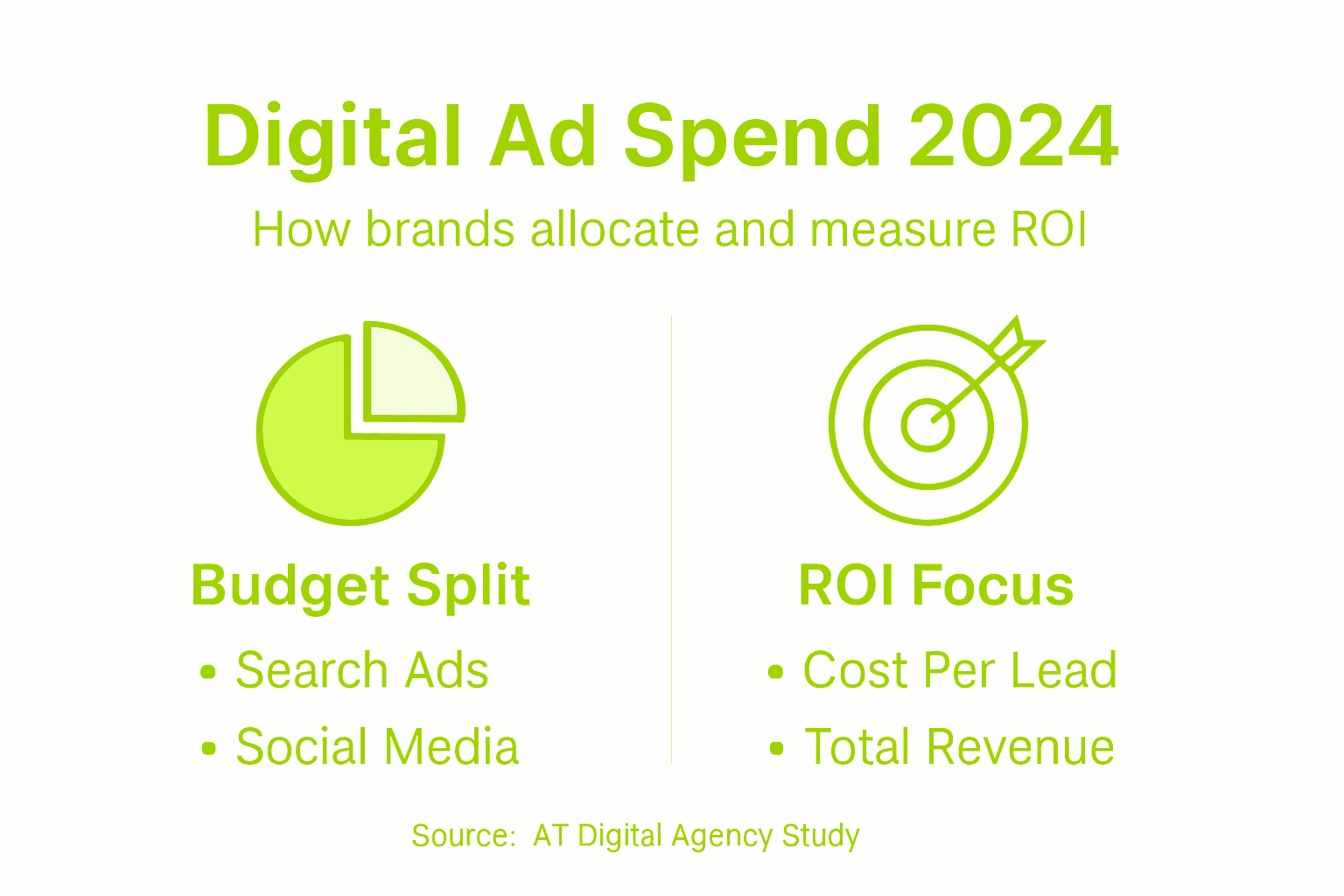
On average, companies allocate between 30% to 50% of their total advertising budgets to digital marketing. For e-commerce brands especially, this percentage often runs higher because digital channels offer direct tracking and attribution capabilities.
Why does this matter for your business? Your competitors are already managing their ad spend strategically. They’re tracking which campaigns generate revenue, which channels produce qualified leads, and where their budgets are being wasted. You need to do the same.
The core difference between random ad spending and managed ad spending is accountability. Random spending feels productive because you’re “doing something.” Managed spending proves it through data.
Digital ad spend management involves three key activities:
Planning your budget allocation based on historical performance and growth goals
Executing campaigns with strategic targeting, creative testing, and bid optimization
Analyzing results to identify what’s working and adjusting future investments
This isn’t a one-time effort. It’s an ongoing cycle where each month informs the next month’s decisions.
The goal of ad spend management is simple: spend less to achieve more results, and eliminate spending that doesn’t move the needle on your business goals.
Many e-commerce brands fail because they set a monthly ad budget and treat it like a fixed expense rather than an investment to optimize. Your budget should flex based on what’s actually converting, not rigid planning spreadsheets.
When you properly manage digital ad spend, you gain control over your customer acquisition costs, scaling profitable campaigns while cutting losing ones. You stop guessing about ROI and start proving it.

Pro tip: Start by auditing your current ad spend across all platforms—Google Ads, Meta, and any other channels you use. Calculate your actual cost per acquisition and revenue per ad dollar spent. This baseline becomes your foundation for optimization.
Key Types of Digital Ad Spend
Not all digital advertising dollars work the same way. Different platforms, formats, and strategies deliver results through distinct mechanisms. Understanding where your budget goes helps you allocate smarter and track performance more accurately.
Paid search advertising is your most direct channel. When someone searches for “best running shoes” on Google, your ads appear at the top of results. You pay only when someone clicks your ad, which is why it’s called pay-per-click. For e-commerce brands, this is often the highest-converting channel because intent is already there.
Social media advertising spans Meta (Facebook and Instagram), TikTok, LinkedIn, and emerging platforms. You target audiences based on interests, behaviors, demographics, and past interactions. Unlike search, you’re reaching people who aren’t actively looking yet. These campaigns build awareness and drive consideration before someone searches.
Here are the primary categories of digital media types you’ll invest in:
Search ads on Google, Bing, and other search engines
Social media ads on Meta, TikTok, YouTube, and LinkedIn
Display advertising across networks of websites
Video ads on YouTube and streaming platforms
Email marketing to existing customer lists
Retargeting ads that follow users across the web
Display advertising reaches people across thousands of websites as they browse. These ads build brand awareness and remind people about your products. They typically cost less per impression than search, but convert at lower rates.
Video advertising is increasingly important. YouTube ads, in-stream video on websites, and connected TV ads reach audiences while they consume video content. Video drives higher engagement than static images, though costs are typically higher.
Email marketing targets your owned audience. While technically not “paid ads” in the traditional sense, email campaigns require budget allocation and generate direct responses. This channel has the highest ROI for most e-commerce brands because you’re reaching people who already know you.
Different advertising tacticsrequire different budget approaches and measurement strategies. Your job is to match the right type to your business goal.
Each ad type serves a specific purpose in your customer journey. Search captures demand. Social builds awareness. Display maintains visibility. Email converts existing interest into sales.
Most successful e-commerce brands don’t rely on a single channel. They build a portfolio where search handles immediate conversions, social builds the pipeline, display maintains brand presence, and email maximizes customer lifetime value.
Your budget allocation should reflect your goals. If you need immediate revenue, prioritize search and email. If you’re building brand awareness, increase social and display investment.
Here is a comparison of common digital ad types and their typical impacts for e-commerce brands:
Ad Type | Customer Intent Level | Typical ROI Potential | Recommended Goal |
Search Ads | High (ready to buy) | Highest | Immediate sales |
Social Media | Medium (considering) | Moderate to high | Awareness, pipeline grow |
Display Ads | Low (passive browsing) | Moderate | Brand visibility |
Video Ads | Varies (engagement) | High if targeted well | Engagement, education |
Existing audience | Highest overall | Repeat sales, loyalty |
Pro tip: Track your cost per acquisition and return on ad spend separately for each ad type. You’ll quickly see which channels deserve more budget and which are draining resources without results.
How Effective Budgeting and Allocation Work
Effective budgeting isn’t about spending more. It’s about spending strategically based on what actually works for your business. This requires aligning your ad budget with your business goals and adjusting as market conditions change.
Start with your objective. Are you trying to drive immediate sales, build brand awareness, generate qualified leads, or scale a profitable campaign? Your answer determines where your budget flows. A furniture e-commerce brand chasing immediate revenue allocates differently than one building market presence.
Strategic alignment means your ad spend supports your wider business strategy. If your goal is 30% revenue growth this year, your budget should reflect that ambition. Too often, brands set marketing budgets based on “what we spent last year” rather than what’s needed to achieve targets.
Here’s how effective allocation typically works:
Set clear financial targets and business objectives for the quarter
Analyze historical data showing which channels and campaigns generated revenue
Allocate budget proportionally to high-performing channels, with reserve funds for testing
Monitor weekly performance and adjust spend based on real-time results
Reinvest profits from winning campaigns into scaling them further
Cut or reduce the budget from underperforming channels
Most brands allocate substantial portions of their budgets to digital channels, often more than 50% of total marketing spend. Within digital, allocation varies by industry and business model. E-commerce typically leans heavily on search and social, while SaaS might prioritize LinkedIn and content marketing.
Agility matters tremendously. Markets shift. Competitor activity changes. Your budget needs flexibility to respond. If a particular social media platform suddenly becomes saturated, you need to redirect funds. If search costs drop unexpectedly, you should capitalize on the opportunity.
Many e-commerce brands use a 70/20/10 rule: 70% to proven channels, 20% to scaling growth, 10% to experimentation. This balances consistency with innovation.
Effective budgeting combines data-driven decisions with rapid experimentation. You need both the discipline to cut losing campaigns and the courage to test new channels.
Budgeting requires continuous learningand leveraging quantitative metrics to evaluate what’s working. Your numbers tell a story: which keywords convert best, which audience segments have the highest lifetime value, and which creative variations drive engagement.
Don’t set your budget once and forget it. Winning brands review performance weekly and make adjustments monthly. A campaign that looks mediocre at week two might hit its stride by week three as your audience builds and your creative optimization kicks in.
Pro tip: Use a simple spreadsheet to track cost per acquisition, return on ad spend, and total revenue by channel. This becomes your decision-making compass, showing exactly where to add or cut budget next.
Risks, Common Pitfalls, and Industry Trends
Not everything that looks like a win is actually driving your business forward. This is the uncomfortable truth many e-commerce brands discover after spending thousands on ads that generated clicks but no revenue.
Attribution blindness is the biggest pitfall. You see a click, assume you caused the sale, and celebrate. But what if that customer had bought it anyway? What if they saw your ad, ignored it, then came back three days later through a Google search? Your ad spend gets credit for a sale it didn’t directly cause.
Digital advertising effectiveness is often overstatedbecause performance metrics like clicks and conversions include consumers who would have purchased regardless. Overreliance on surface-level metrics leads to inefficient spending and false confidence in underperforming campaigns.
Here are common pitfalls that drain budgets:
Optimizing for clicks instead of actual conversions
Trusting platform attribution without cross-channel verification
Scaling campaigns before validating true profitability
Running the same creative for too long without testing variations
Ignoring seasonality and market timing in budget allocation
Spreading budget too thin across too many channels
Budget creep happens when successful campaigns expand beyond profitability. A campaign generating a 3:1 return on ad spend looks great. But when you double the budget, competition increases, cost per acquisition rises, and you might hit 1.5:1 return. Many brands keep scaling anyway, chasing vanity metrics.
Another risk is channel dependency. If 80% of your revenue comes from Google Ads and Google changes its algorithm or ad policies shift, your business suffers immediate impact. Smart brands diversify while maintaining focus on highest-ROI channels.
Industry trends show movement toward better measurement. Brands increasingly demand improved attribution models that account for multiple touchpoints in customer journeys. Privacy changes from Apple and others have made platform-provided data less reliable, forcing marketers toward first-party data strategies.
The trend toward personalized measurement is critical. Rather than trusting platform metrics alone, leading brands implement their own tracking and analytics systems. They tie online ad spend directly to actual customer purchases and lifetime value.
The shift is clear: vanity metrics are dying. Smart spend managers demand proof of true business impact, not just platform-reported conversions.
Real-time optimization is becoming standard. Instead of monthly budget reviews, winning brands adjust daily or weekly based on actual performance data. This requires discipline to cut underperformers quickly rather than hope they improve.
Pro tip: Implement a simple rule: pause any campaign where your cost per acquisition exceeds 25-30% of your average customer lifetime value, regardless of how many clicks it generates. This forces focus on true profitability instead of inflated metrics.
Optimization Tools and Measuring Success
You can’t improve what you don’t measure. This is the foundation of effective ad spend management. Without clear metrics, you’re flying blind, making decisions based on gut feeling rather than data.
Key performance indicators (KPIs) are your compass. They tell you if campaigns are working or wasting money. For e-commerce brands, the most critical KPIs differ by campaign stage and business objective.
Important KPIs include impressions, engagement rates, conversion rates, and sales revenue. Each metric reveals different aspects of campaign health. Impressions show reach. Engagement rates show audience interest. Conversion rates show how many interested people actually buy. Revenue shows bottom-line impact.
Here’s what to track at each stage:
Awareness stage: Impressions, reach, cost per thousand impressions (CPM)
Consideration stage: Click-through rates, engagement metrics, cost per click
Decision stage: Conversion rates, cost per acquisition, average order value
Retention stage: Customer lifetime value, repeat purchase rate, email engagement
Most platforms provide built-in analytics. Google Ads shows conversion data. Meta provides detailed audience insights. But these platform dashboards often tell incomplete stories. Smart brands build custom dashboards combining data from multiple sources.
Optimization tools range from simple to sophisticated. At minimum, use Google Analytics 4 to track user behavior on your website. This shows which traffic sources actually convert. For paid advertising, connect your ad platforms directly to your analytics to see complete customer journeys.
Advanced teams use marketing automation platforms or custom data warehouses. These consolidate data from Google Ads, Meta, email platforms, and website analytics into unified views. You see which campaigns drive profitable customers, not just clicks.
Measuring impact effectively uses continuous tracking and real-time analyticsto optimize campaigns. Test-and-learn methodologies support ongoing campaign refinement and enhance measurable ROI from digital ad spend.
The critical distinction is leading vs. lagging indicators. Leading indicators (clicks, impressions, engagement) happen immediately. Lagging indicators (revenue, customer lifetime value, repeat purchases) take weeks or months to materialize. Many brands obsess over leading indicators while ignoring lagging ones.
Use this table to understand the difference between leading and lagging ad KPIs:
KPI Type | Measured Metric | Time to Results |
Leading | Clicks, impressions, CPM | Immediate (daily) |
Lagging | Sales revenue, lifetime value | Delayed (weeks/mo.) |
Revenue is the only metric that truly matters, but it’s also the slowest to measure. Track leading indicators to optimize daily, but judge overall success by lagging indicators.
Set up weekly reporting that shows this hierarchy. How many clicks did you get? How many conversions? What’s your cost per acquisition? What’s your return on ad spend? Which channels are profitable at scale?
Automated reporting saves countless hours. Tools like Data Studio create dashboards pulling from multiple sources. These update automatically, eliminating manual spreadsheet work and reducing errors.
Pro tip: Create a simple dashboard showing cost per acquisition and return on ad spend for each channel, updated daily. Check it every morning to spot underperformers before they drain your monthly budget.
Take Control of Your Digital Ad Spend and Maximize ROI
Managing digital ad spend effectively is the key to turning every advertising dollar into measurable business growth. If you are tired of spending on ads with unclear returns or struggling with attribution blindness and inefficient budgets, you are not alone. The challenge lies in strategic planning, continuous optimization, and data-driven execution—all essential to avoid common pitfalls like budget creep and wasted spend on low-return campaigns.
At A&T Digital Agency, we specialize in performance marketing tailored for ambitious small to medium-sized businesses. Our boutique team focuses on building and scaling profitable paid advertising systems using platforms like Google Ads and Meta. We help you with everything from strategic campaign planning and creative development to detailed analysis and rapid optimization. Our proven approach keeps your customer acquisition cost under control while maximizing revenue and ROI.
Ready to stop guessing and start proving your ad spend delivers?
Partner with us for data-backed ad spend management that drives real results. Visit https://atdigiagency.com to learn how our tested strategies and personalized service can transform your digital marketing performance. Don’t wait — optimize your budget now and scale with confidence.
Frequently Asked Questions
What is digital ad spend management?
Digital ad spend management refers to the strategic allocation and optimization of your advertising budget across various digital platforms to achieve measurable business results. It involves planning, executing, and analyzing your advertising investments across channels like Google Ads and social media.
How can I improve my return on investment (ROI) from digital advertising?
To improve your ROI, start by auditing your current ad spend, tracking key metrics like cost per acquisition and revenue per ad dollar spent. Allocate your budget to the best-performing channels, regularly analyze campaign performance, and adjust your strategies based on real-time data.
What are the key types of digital advertising?
The key types of digital advertising include paid search ads, social media ads, display ads, video ads, and email marketing campaigns. Each type serves a specific purpose in the customer journey, from building awareness to driving conversions.
What common pitfalls should I avoid in digital ad spend management?
Common pitfalls include optimizing for clicks instead of conversions, relying solely on platform attribution, scaling campaigns prematurely, and ignoring seasonal trends. It’s vital to continuously monitor and adjust your strategy based on actual performance data.


