Why Choose Paid Advertising for Measurable Growth
Posted on
Marketing
Posted at

More than 60 percent of American businesses report wasted budgets due to ineffective paid advertising campaigns. For CEOs and marketing directors in e-commerce and healthcare, distinguishing fact from fiction is essential to avoid costly missteps. Uncover the real value of paid advertising, debunk common myths, and discover how to achieve smarter spending and measurable results for your business in this crowded, fast-paced market.
Table of Contents
Key Takeaways
Point | Details |
|---|---|
Effective Targeting is Key | Precision targeting through advanced segmentation maximizes ad relevance and engagement. Regularly analyze performance data to refine your strategies. |
Treat Paid Advertising as a Dynamic Strategy | Continuous optimization is essential for success; campaigns should be regularly assessed and adapted based on performance metrics. |
Leverage Different Platforms Wisely | Tailor your advertising content to suit the strengths of each platform, recognizing that different strategies yield varying results. |
Balance Paid and Organic Marketing | Combining paid advertising with organic strategies can enhance your overall marketing effectiveness and achieve a variety of growth objectives. |
Defining Paid Advertising and Common Myths
Paid advertising represents a strategic communication method where businesses invest financial resources to promote their products, services, or brand messages across various digital and traditional channels. Digital advertising's complex landscape requires understanding its fundamental characteristics and dispelling persistent misconceptions.
At its core, paid advertising involves a mediated, persuasive communication from an identifiable source designed to prompt specific audience actions. Unlike organic marketing strategies, paid advertising provides immediate visibility and precise targeting capabilities. Businesses can strategically place advertisements on search engines, social media platforms, websites, and traditional media to reach potential customers who are most likely to engage with their offerings.
Several common myths prevent businesses from maximizing their advertising potential. Contrary to popular belief, paid advertising is not a one-size-fits-all or set-it-and-forget-it strategy. Successful campaigns require continuous optimization, data analysis, and strategic refinement. Another prevalent misconception is that only large corporations can benefit from paid advertising - in reality, businesses of all sizes can leverage targeted ad campaigns to drive growth and achieve measurable results.
Pro Tip: Conduct regular performance audits of your advertising campaigns, tracking key metrics like click-through rates, conversion rates, and return on ad spend to continuously improve your strategy.
Key Platforms: Google Ads vs Meta Campaigns
Digital advertising platforms like Google Ads and Meta Campaigns offer distinct strategies for businesses seeking targeted audience engagement. Google Ads scaling strategies provide powerful search intent-based targeting, while Meta Campaigns excel in demographic and interest-based audience segmentation.
Google Ads operates primarily through search and display networks, allowing businesses to reach potential customers actively searching for specific products or services. The platform's strength lies in its keyword targeting, enabling advertisers to appear precisely when users are seeking solutions. Advertisers can choose between search ads, which appear in search results, display ads that show across websites, and shopping ads for ecommerce businesses.
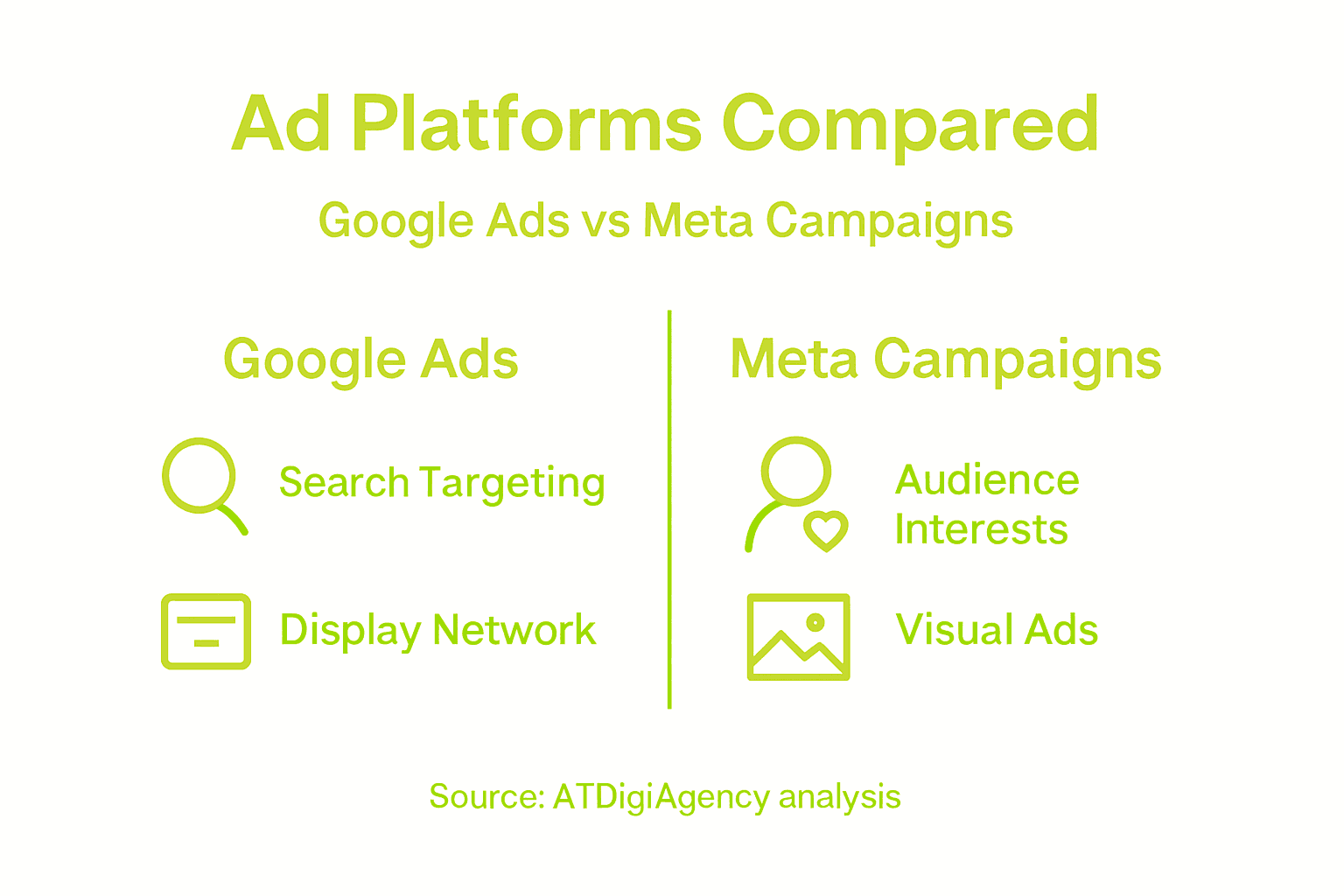
Meta Campaigns, encompassing Facebook and Instagram advertising, offer a more visually driven approach with exceptional targeting capabilities based on user behaviors, interests, and detailed demographic information. These platforms excel in brand awareness, engagement, and retargeting strategies, allowing businesses to create highly personalized ad experiences that resonate with specific audience segments. The visual nature of Meta's platforms makes them particularly effective for industries requiring strong visual storytelling and emotional connection.
Pro Tip: Develop platform-specific creative strategies, recognizing that ad content successful on Google might not perform equally well on Meta, and always customize your approach to each platform's unique audience characteristics.
Here's a concise comparison of Google Ads and Meta Campaigns key strengths:
Platform | Primary Targeting Method | Ad Formats | Best For |
|---|---|---|---|
Google Ads | Keyword search intent | Text, Display, Shopping | Immediate conversions, direct response |
Meta Campaigns | Demographic & interest-based | Visual, Video, Carousel | Brand awareness, engagement |
How Paid Advertising Delivers Results
Paid advertising delivers transformative results by enabling businesses to precisely target and convert potential customers through data-driven strategies. Measuring ROI in digital marketing requires a comprehensive approach that tracks critical performance metrics beyond simple click-through rates.
The core mechanism of paid advertising success lies in its ability to generate measurable, attributable outcomes. Businesses can track specific metrics like conversion rates, customer acquisition costs, and lifetime value, allowing for unprecedented insight into marketing performance. Unlike traditional advertising methods, digital paid advertising platforms provide granular data that enables real-time optimization, helping companies adjust strategies instantly based on actual performance indicators.

Successful paid advertising strategies leverage advanced targeting capabilities that go beyond demographic information. By utilizing sophisticated audience segmentation, businesses can create highly personalized ad experiences that speak directly to potential customers' needs, preferences, and behavioral patterns. This precision targeting dramatically improves ad relevance, increasing the likelihood of engagement and conversion while simultaneously reducing wasted ad spend.
Pro Tip: Implement a robust analytics framework that tracks multi-touch attribution, allowing you to understand the complete customer journey and accurately assess the true impact of your advertising investments.
Targeting and Optimization for High ROI
Precision targeting represents the cornerstone of high-performance paid advertising strategies, enabling businesses to connect with their most valuable potential customers. Empirical targeting strategies demonstrate that strategic audience segmentation can dramatically improve campaign profitability by reducing wasted ad spend and increasing conversion potential.
Successful optimization requires a multi-layered approach that goes beyond basic demographic targeting. Advanced marketers leverage behavioral data, interest patterns, and predictive analytics to create granular audience segments that respond most effectively to specific messaging. This approach allows for dynamic ad customization, where creative content and targeting parameters are continuously refined based on real-time performance metrics, ensuring maximum relevance and engagement.
The most effective paid advertising strategies incorporate continuous testing and data-driven refinement. By implementing robust tracking mechanisms, businesses can analyze key performance indicators such as click-through rates, conversion costs, and customer lifetime value. This analytical approach enables marketers to make precise, incremental adjustments that compound over time, transforming advertising from a cost center into a strategic growth engine that delivers measurable, scalable results.
Pro Tip: Develop a systematic A/B testing protocol that systematically evaluates different audience segments, ad creatives, and messaging variations to incrementally optimize your advertising performance.
Costs, Risks, and Comparing Alternatives
Navigating the complex landscape of paid advertising requires a strategic understanding of potential costs, inherent risks, and alternative marketing approaches. Digital advertising spend challenges reveal an increasingly competitive environment where businesses must carefully balance investment against potential returns.
The primary risks in paid advertising include rapidly fluctuating digital marketing costs, evolving privacy regulations, and the potential for diminishing returns. Businesses must consider factors like audience targeting precision, platform-specific algorithm changes, and increasing competition for digital ad spaces. Each advertising channel presents unique challenges - social media platforms might offer lower initial costs but require sophisticated targeting, while search engine marketing demands higher per-click investments but potentially delivers more direct conversion opportunities.
Comparing alternatives requires a nuanced approach that evaluates not just immediate costs, but long-term marketing effectiveness. Organic marketing strategies like content development, search engine optimization, and social media engagement provide cost-effective alternatives with sustainable growth potential. However, these methods typically require longer timeframes to generate meaningful results, making paid advertising an essential complementary strategy for businesses seeking immediate market visibility and quick customer acquisition.
This table summarizes major costs, risks, and alternative marketing approaches:
Aspect | Paid Advertising | Organic Marketing | Hybrid Strategy |
|---|---|---|---|
Typical Cost | Higher, varies by platform | Lower, mainly time-intensive | Flexible, scalable budget |
Speed | Immediate results | Slow, builds over time | Balances short and long term |
Main Risk | Rising costs, ad fatigue | Slow ROI, competitive space | Complex management required |
Growth Type | Quick market visibility | Sustainable long-term growth | Maximized performance |
Pro Tip: Develop a comprehensive marketing mix that combines paid advertising with organic strategies, allocating budget dynamically based on real-time performance metrics and overall business objectives.
Unlock Measurable Growth with Expert Paid Advertising Support
If you are struggling to navigate the complex world of paid advertising and crave clear, data-driven results amid rising costs and fierce competition you are not alone. This article highlights how precision targeting, continuous optimization, and strategic platform-specific campaigns can transform your marketing efforts from guesswork to measurable growth. Many businesses face challenges such as ad fatigue, fluctuating costs, and the need for dynamic adjustments but with the right partner, these obstacles become opportunities.
At A&T Digital, we specialize in building and scaling paid advertising strategies focused on Google Ads and Meta Campaigns that deliver real revenue growth and lead generation. Our boutique team combines strategic insight with creative execution to maximize your return on ad spend. Whether you want to optimize conversion rates or continuously refine your campaigns through rigorous A/B testing and data analysis, we provide personalized service without unnecessary meetings to keep your marketing efficient and impactful. Learn more about our performance marketing offerings and how we help businesses like yours harness paid advertising to drive measurable outcomes.
Take the next step in turning paid advertising myths into actionable growth tactics. Visit A&T Digital today to discover how our expert team can tailor data-driven campaigns that exceed your business goals. Don’t let rising digital ad costs hold you back. Act now to secure high ROI campaigns designed for competitive digital spaces.
Frequently Asked Questions
What is paid advertising and how does it work?
Paid advertising is a marketing strategy where businesses invest money to promote their products, services, or brand messages across various channels. It works by allowing advertisers to place ads that target specific audiences, prompting them to take desired actions, such as making a purchase or visiting a website.
How can paid advertising deliver measurable results?
Paid advertising offers measurable results through precise tracking of performance metrics like click-through rates, conversion rates, and customer acquisition costs. This allows businesses to analyze the effectiveness of their campaigns and make data-driven adjustments to improve performance over time.
What are the key differences between Google Ads and Meta Campaigns?
Google Ads focuses on keyword search intent, allowing businesses to target users actively seeking specific products or services. In contrast, Meta Campaigns leverage demographic and interest-based targeting, making them ideal for visual storytelling and generating brand awareness on platforms like Facebook and Instagram.
What are the risks and costs associated with paid advertising?
The primary risks include fluctuating advertising costs, evolving privacy regulations, and the possibility of diminishing returns. Costs vary by platform, with some requiring higher per-click investments. It's essential for businesses to evaluate their advertising strategies to balance their budget against potential returns.