Role of Campaign Planning in High-ROI Ad Success
Posted on
Marketing
Posted at

Every dollar counts when your ad budget is on the line. Without a clear campaign planning roadmap, even the most creative ads for telehealth or e-commerce risk falling flat and wasting resources. Solid planning defines your goals, organizes your team, and turns daily work into measurable progress. In a competitive American market, learn how a well-documented approach makes your campaigns flexible, well-coordinated, and ready for high returns.
Table of Contents
Defining Campaign Planning in Digital Advertising
Types of Ad Campaigns and Approaches
Key Stages of Effective Campaign Planning
Common Pitfalls and How to Avoid Them
Measuring ROI and Scaling Success
Key Takeaways
Point | Details |
Strategic Campaign Planning | Effective campaign planning is essential for digital advertising success, involving measurable objectives, targeted audiences, and resource allocation. |
Types of Campaigns | Different business goals require appropriate campaign structures, such as brand awareness, lead generation, and conversions, each needing unique messaging strategies. |
Data-Driven Decisions | Companies that plan campaigns typically achieve 2-3x better ROI by prioritizing high-value audiences and continuously optimizing based on performance metrics. |
Regular Monitoring and Adjustment | Continuous performance reviews and budget adjustments are crucial for maintaining campaign effectiveness and ensuring high returns on ad spend. |
Defining Campaign Planning in Digital Advertising
Campaign planning is your strategic foundation for paid advertising success. It’s the deliberate process of setting clear goals, mapping out your strategy, and organizing your team, budget, and timeline to achieve specific business results.
Without campaign planning, you’re essentially throwing budget at ads and hoping something sticks. With it, every dollar has a purpose.
What Campaign Planning Actually Means
Campaign planning involves three core elements:
Setting measurable objectives tied to business outcomes (revenue, leads, conversions)
Defining your target audience and how you’ll reach them across channels
Allocating resources (budget, team members, creative assets) strategically
Strategic roadmaps guide campaignsthrough daily activities toward specific objectives. For telehealth and e-commerce companies, this means knowing exactly which audience segments you’re targeting, what message resonates with them, and how you’ll measure success before you launch a single ad.

A solid plan creates coordination across your team. Your creative team knows what messaging to develop. Your data analysts know what metrics matter. Your account managers know when to pause underperforming ads and scale winners.
Why This Matters for Your ROI
Companies that plan campaigns typically see 2-3x better returns than those running ads reactively. Here’s why:
You identify your highest-value audiences first, not after burning through budget. You allocate spend based on data and strategy, not hunches. You have clear benchmarks to measure performance, so you catch problems early.
A comprehensive digital marketing plan ensures focus, budget optimization, and adaptability to market changes, making your advertising efforts significantly more effective.
For a telehealth platform running Google Ads, this looks like mapping out which patient conditions drive the highest lifetime value, then structuring your campaigns and budgets to prioritize those segments. For an e-commerce brand, it means understanding which product categories have the strongest margins and adjusting your Meta spend accordingly.
The Planning Process at a Glance
Here’s what effective campaign planning covers:
Define your business objective (revenue growth, lead generation, customer acquisition)
Identify your target audience and their pain points
Set realistic, measurable goals with specific timeframes
Choose your channels (Google Ads, Meta, or both)
Develop your messaging and creative approach
Establish your budget and bid strategy
Plan your timeline and launch dates
Define success metrics and reporting cadence
This isn’t about creating a massive document that sits in a folder. It’s about clarity. You need to know your answers before you start building ads.
Pro tip: Document your campaign plan in a shared format your entire team can access—whether that’s a Google Doc or project management tool. When team members understand the “why” behind your strategy, execution becomes faster and more aligned.
Types of Ad Campaigns and Approaches
Not all campaigns are created equal. Different business goals require different campaign structures, messaging strategies, and channel selections. Understanding which campaign type aligns with your objective is where smart planning begins.
Your goal might be building brand recognition, generating qualified leads, or driving immediate sales. Each requires a distinct approach.
Main Campaign Types
Most advertising campaigns fall into one of these categories:
Brand awareness campaigns: Build recognition and trust with your target audience through consistent messaging
Lead generation campaigns: Capture contact information from interested prospects for follow-up
Conversion campaigns: Drive immediate purchases or sign-ups with urgency-focused messaging
Remarketing campaigns: Re-engage users who visited your site but didn’t convert
Customer loyalty campaigns: Build repeat purchases and long-term relationships
Marketing campaigns vary by objective and method, including brand-building and product promotion approaches. For a telehealth platform, a lead generation campaign captures patient inquiries and appointment requests. For an e-commerce store, a conversion campaign targets users ready to buy with specific discount offers.
The key difference? Each type uses different messaging intensity, targeting parameters, and success metrics.
Here’s a quick comparison of major ad campaign types and their typical business impact:
Campaign Type | Primary Goal | Typical Channel | Key Business Impact |
Brand Awareness | Build recognition and trust | Meta, Display Ads | Increased audience reach |
Lead Generation | Capture prospect information | Google Ads, Meta | Growth in potential customers |
Conversion | Drive purchases or sign-ups | Google Ads, Meta | Immediate revenue boost |
Remarketing | Re-engage interested users | Meta, Email | Improved conversion rates |
Customer Loyalty | Foster repeat business | Email, Loyalty Programs | Higher lifetime customer value |
Channel Selection Matters
Once you know your campaign type, you choose where to run it. Targeted promotional campaigns connect with specific audiences across social media, email, search, and display networks.
Google Ads works best for conversion and lead campaigns when users actively search for solutions. Meta (Facebook and Instagram) excels at awareness and remarketing because of detailed audience targeting. Email campaigns nurture existing leads into customers.
Your campaign plan should specify which channels match your audience behavior and campaign type.
Blending Approaches for Better Results
The strongest campaigns don’t rely on a single type or channel. They combine multiple approaches strategically.
Consider this real-world example: An e-commerce brand launches a new product line. They run awareness campaigns on Meta to reach new audiences, conversion campaigns on Google to capture high-intent searchers, and remarketing campaigns to follow up with site visitors who didn’t buy.
This multi-channel approach creates multiple touchpoints, increasing the likelihood of conversion.
Effective campaigns maintain consistent messaging across channels over time, enhancing brand recognition and customer trust while driving measurable business results.
Consistency across channels means your messaging, visual style, and value proposition stay aligned whether someone sees you on Google, Instagram, or email.
Pro tip: Start with one campaign type that matches your most urgent business need, then layer in additional campaign types as you generate data and budget becomes available. This prevents overwhelm and lets you optimize each campaign type before scaling.
Key Stages of Effective Campaign Planning
Effective campaign planning doesn’t happen all at once. It unfolds through distinct stages, each building on the last. Understanding these stages helps you stay organized and catch problems before they drain your budget.
Think of it like construction. You need a solid foundation before you build walls, and walls before you add the roof.
Define Goals and Success Metrics
Start by answering one question: What does success look like?
Effective campaign planning involves defining clear goals that drive all subsequent decisions. For a telehealth platform, that might be “acquire 150 new patients in 60 days at $85 cost-per-acquisition.” For e-commerce, it could be “generate $50,000 in revenue with 3:1 return on ad spend.”
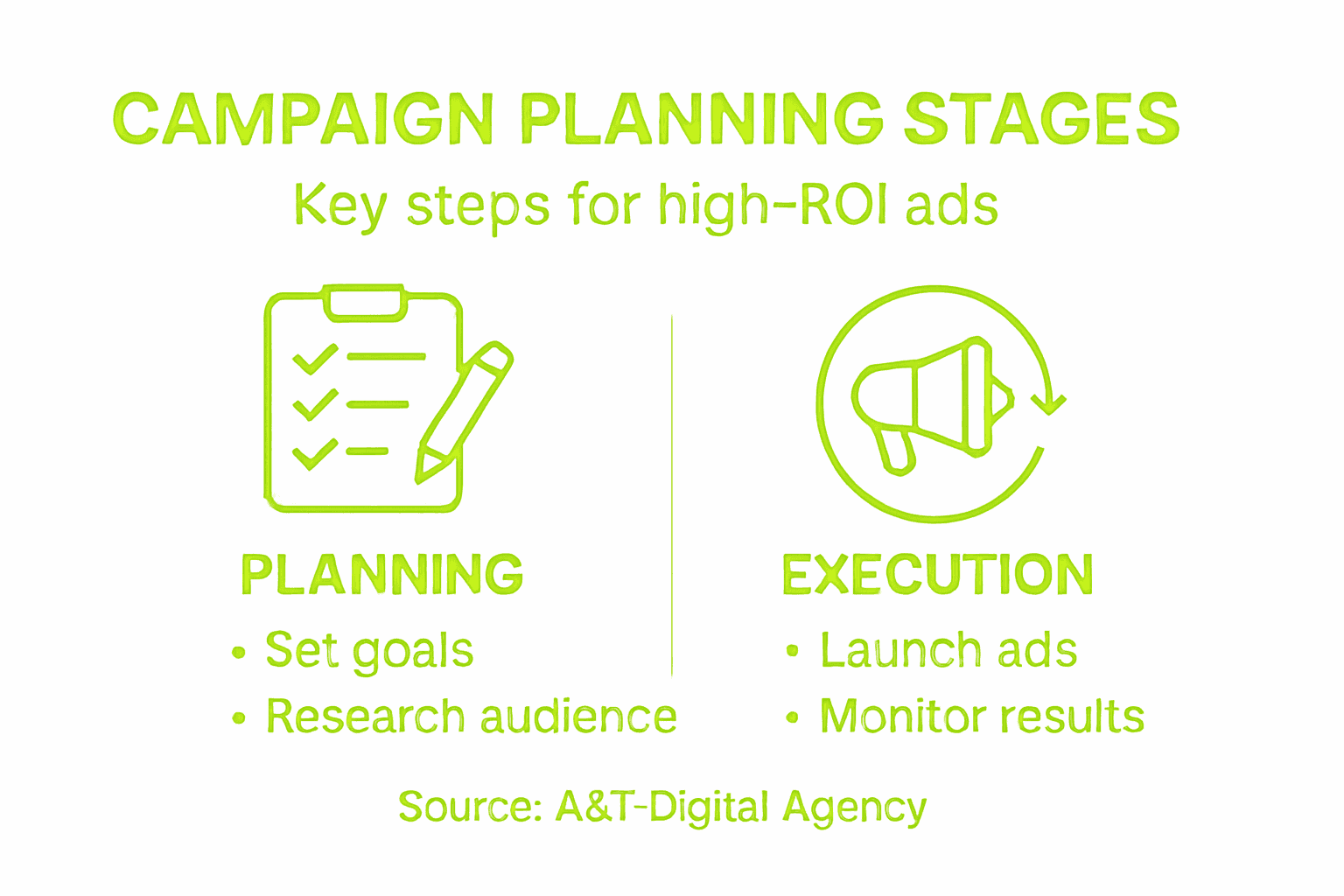
Vague goals like “increase sales” don’t work. You need specific, measurable targets tied to business outcomes. This clarity becomes your decision-making filter throughout the campaign.
Research Your Audience
You can’t reach the right people without understanding them first.
Research reveals:
Who your ideal customers are (demographics, job titles, pain points)
Where they spend time online (Google, Instagram, LinkedIn)
What messaging resonates with them
Which competitors are already reaching them
This research informs every creative decision and targeting parameter you set later. A telehealth platform targeting busy professionals needs different messaging and timing than one targeting elderly patients managing chronic conditions.
Develop Your Timeline and Budget
Campaigns progress through phases, each requiring different resource allocation.
The typical progression looks like:
Awareness phase: Build recognition with broader audiences, typically 30% of the budget
Engagement phase: Target interested prospects with deeper messaging, typically 40% of the budget
Conversion phase: Focus on users ready to buy or sign up, typically 30% of the budget
Your timeline specifies when each phase launches, how long it runs, and what budget supports it. This prevents you from burning through your entire budget in week one.
Build and Organize Your Team
Campaigns require multiple skill sets working in coordination.
You typically need:
Strategy owner: Oversees the overall plan
Creative lead: Develops ad copy and visuals
Media buyer: Manages bids, budgets, and targeting
Data analyst: Monitors performance and identifies optimization opportunities
Small teams can overlap these roles, but clarity about who owns what prevents confusion and delays.
Below is a summary of team roles essential for successful digital campaign management:
Role | Main Responsibility | Business Benefit |
Strategy Owner | Sets direction and objectives | Keeps goals focused and clear |
Creative Lead | Designs messaging and visuals | Ensures brand consistency |
Media Buyer | Manages budget and targeting | Maximizes ad efficiency |
Data Analyst | Tracks and optimizes results | Drives data-driven decisions |
A thorough plan serves as your roadmap, guiding daily activities and allocating resources efficiently to improve your chances of campaign success.
Launch, Monitor, and Adjust
Once your campaign goes live, the real work begins.
Continuously update your plan based on performance data. If certain audience segments convert at 2x the average rate, increase their budget. If a creative approach underperforms, pause it and test a new variation. Your initial plan is your hypothesis, not your scripture.
Review performance weekly. Adjust monthly. This iterative approach separates high-ROI campaigns from wasted spend.
Pro tip: Document each decision and result as you go. When a campaign ends, you’ll have a clear record of what worked, what didn’t, and why—turning that campaign into a blueprint for even better results next time.
Common Pitfalls and How to Avoid Them
Most campaign failures don’t happen because of bad luck. They happen because of predictable mistakes that teams make repeatedly. Understanding these pitfalls helps you sidestep them before they cost you thousands in wasted ad spend.
The good news? These mistakes are completely preventable.
Unclear or Unmeasurable Goals
Vague goals destroy campaigns. “Increase brand awareness” sounds nice, but it’s useless as a planning tool.
Goals like “drive awareness” don’t tell you when to stop spending, which audiences to prioritize, or whether you’re succeeding. You end up optimizing for nothing and spending without discipline.
Instead, set specific, quantifiable targets: “Acquire 200 qualified leads at $75 cost-per-lead” or “Generate $100,000 in revenue with a 4:1 return on ad spend.”
These targets force real planning decisions. They also make it obvious when you should pause underperforming campaigns and scale winners.
No Written Plan or Poor Documentation
A campaign plan that exists only in your head isn’t a plan. It’s chaos with optimism.
Common pitfalls include neglecting to document the plan, which prevents team coordination and creates confusion. When your media buyer doesn’t know why certain audience segments exist, they’ll optimize against your actual strategy.
Document everything:
Campaign goals and success metrics
Target audience definitions
Budget allocation by phase and channel
Creative direction and messaging themes
Reporting schedule and who reviews what
Share this document with your entire team. Reference it weekly.
Trying to Do Too Much at Once
Ambition kills campaigns. New managers often want to reach every audience, test every creative variation, and run on every platform simultaneously.
This spreads your budget thin and makes it impossible to optimize anything. You end up with weak results everywhere instead of strong results somewhere.
Start with one audience segment and one channel. Once you prove the model works, layer in additional segments and channels. This phased approach lets you build momentum with real data.
Ignoring Your Actual Audience
You need to start from where your audience actually is, not where you wish they were.
Campaigns should start from the audience’s current perspective, not from an assumption. Research reveals that busy professionals scroll Instagram differently than retirees do. Telehealth patients searching for anxiety treatment respond to different messaging than those searching for weight loss treatment.
Skip the research, and your ads will miss. Invest in it, and your copy practically writes itself.
Lack of Flexibility
Your initial plan is a hypothesis, not scripture. Real market data will prove some assumptions wrong.
If certain audience segments convert at 3x the average rate, increase their budget immediately. If a creative approach underperforms after 500 impressions, pause it and test something new. Teams that review performance weekly and adjust monthly outperform those that wait for quarterly reviews.
Regularly review and update your plan to respond to challenges and opportunities, maximizing your campaign effectiveness and preventing budget waste.
Poor Communication Across Teams
When your team doesn’t understand the overall strategy, execution falls apart.
Your creative team might develop messaging that contradicts your targeting strategy. Your media buyer might shift budgets without understanding why certain audiences matter. Your analyst might optimize for the wrong metric.
One simple fix: Weekly sync meetings (30 minutes maximum) where everyone reviews performance and discusses the week ahead. This keeps the entire team aligned.
Pro tip: Before launching any campaign, do a pre-launch checklist: documented goals, target audience definitions, creative assets, budget allocation, team roles, and success metrics. If you can’t check every box, you’re not ready to launch—and that’s exactly when checking saves thousands.
Measuring ROI and Scaling Success
You can’t scale what you don’t measure. And you can’t measure what you don’t track. This is where most campaigns stumble—they launch, run, and end without anyone truly knowing what worked.
Measuring ROI separates guesswork from strategy. It’s also the foundation for scaling.
Define Your Key Performance Indicators
Not all metrics matter equally. You need to focus on the ones tied directly to your business goals.
Key performance indicators aligned with campaign goalsvary by stage of the customer journey. For awareness campaigns, track impressions and reach. For consideration, track engagement rates and click-through rates. For decisions, track conversion rates and revenue.
For a telehealth platform, your primary KPI might be “qualified patient acquisitions at $85 cost-per-acquisition.” For e-commerce, it’s “revenue generated with 3:1 return on ad spend.”
Pick one primary metric per campaign. This becomes your north star.
Set Up Proper Tracking
You can’t measure what you don’t track. Before your campaign launches, ensure your tracking is bulletproof.
Your setup needs:
Conversion pixels installed on all key pages (sign-up, purchase, confirmation)
UTM parameters on every ad link to identify traffic source and campaign
Analytics dashboard configured to pull data daily
Clear definitions of what counts as a “conversion”
Skip this step, and your data will be incomplete or misleading. Do it right, and you’ll see exactly which audiences, creatives, and placements drive results.
Implement A/B Testing and Attribution
One ad creative always outperforms others. One audience segment converts more cheaply. Your job is to find them through testing.
A/B testing and attribution modeling assess campaign effectivenessby running controlled experiments and monitoring performance dashboards. Test one variable at a time: headline, image, audience, placement, or bid strategy.
Run each test for at least 500 conversions before declaring a winner. This prevents false positives from small sample sizes.
Review Performance Weekly, Adjust Monthly
Don’t wait until the end of your campaign to review results. Weekly reviews catch problems early.
Your weekly review should answer:
What’s our current cost-per-acquisition or return on ad spend?
Which audience segments are converting best?
Which creatives are performing strongest?
Do we need to pause underperformers or scale winners?
Make adjustments monthly based on patterns you see. If one audience converts at half your target cost, increase their budget. If a creative underperforms for two weeks straight, replace it.
Data-driven adjustments and performance monitoring enable you to communicate results to stakeholders and confidently scale successful strategies.
Scale Winners Strategically
Once you’ve identified what works, scale it carefully. Doubling your budget overnight often kills your results because you’re reaching lower-quality inventory.
Instead, increase the budget by 20-30% weekly. Monitor your metrics closely after each increase. If performance holds, increase again next week. If metrics decline, pause the increase and optimize the current budget first.
This gradual scaling preserves your ROI while growing revenue.
Pro tip: Create a simple one-page dashboard showing your primary KPI, secondary metrics, top performers by audience and creative, and weekly spend trend. Share this with stakeholders every Monday morning. Transparency builds confidence and makes scaling decisions faster.
Unlock High-ROI Results with Expert Campaign Planning and Execution
Struggling to turn your ad spend into measurable growth? The article highlights crucial challenges like vague goals, poor audience targeting, and a lack of ongoing optimization that drain budgets and stall results. At A&T Digital Agency, we understand the power of strategic campaign planning combined with data-driven adjustments to maximize your returns on Google Ads and Meta campaigns. Our boutique team specializes in building and scaling paid advertising systems tailored to your specific business objectives, like revenue growth, lead generation, and increased conversions.
Whether you run telehealth services or e-commerce brands, we implement clear, documented strategies that keep everyone aligned and ensure your budget works smarter. With personalized service and expert execution, you gain a trusted partner to navigate campaign stages from strategy to launch and optimization with confidence.
Ready to elevate your advertising success and avoid costly pitfalls? Partner with A&T Digital Agency for proven performance marketing solutions that deliver measurable impact. Start your journey toward higher ROI today by visiting our site or exploring how our campaign planning and strategy can transform your digital advertising. Take control of your paid media and watch your business grow with expert guidance tailored to your unique goals.
Frequently Asked Questions
What is campaign planning in digital advertising?
Campaign planning is the strategic process of setting goals, defining target audiences, and organizing resources such as budget and timeline to achieve specific business outcomes in paid advertising.
Why is campaign planning important for improving ROI?
A well-planned campaign typically yields 2-3 times better returns than reactive ad spending. It allows for better audience targeting, budget allocation based on data, and early detection of underperforming ads.
How do I set measurable objectives for my ad campaign?
Start by defining clear, specific business goals, such as acquiring a certain number of leads or generating a specific amount of revenue within a defined timeframe. Ensure your goals are quantifiable and linked to overall business outcomes.
What are the common pitfalls to avoid in campaign planning?
Common pitfalls include setting vague goals, failing to document plans, trying to do too much at once, ignoring audience research, lacking flexibility to adapt, and poor communication among team members.