Paid Advertising Strategy Guide for Higher ROI Results
Posted on
Marketing
Posted at

Bold strategies drive real results, yet nearly 70 percent of American e-commerce and healthcare businesses report unclear objectives slowing advertising performance. With competition intensifying across global markets, CEOs and marketing directors need accurate audience insights and tailored campaigns to achieve higher ROI. This guide reveals how a data-driven approach can sharpen your paid ads, build stronger connections with customers, and position your brand for lasting growth.
Table of Contents
Quick Summary
Key Insight | Explanation |
1. Define measurable business objectives | Establish clear revenue targets and market segments to guide your advertising strategy effectively. |
2. Leverage detailed audience data | Gather comprehensive insights into demographics, behaviors, and pain points to create effective audience personas. |
3. Structure campaign segments strategically | Organize campaigns by goals and customer journey stages; customize budgets to enhance return on investment. |
4. Monitor and adjust using real-time data | Regularly track key metrics and refine your strategy based on performance to maximize advertising effectiveness. |
5. Employ A/B testing for optimization | Conduct tests on different ad components to identify successful strategies and improve overall campaign performance. |
Step 1: Analyze business goals and audience data
Successful paid advertising requires a strategic approach that connects your business objectives with precise audience insights. Understanding and mapping your specific goals against detailed demographic information creates a powerful foundation for targeted marketing campaigns.
To begin analyzing your business goals, start by defining clear and measurable objectives. Ask yourself specific questions like what revenue targets you want to achieve, which market segments you aim to penetrate, and what specific actions you want potential customers to take. These objectives will directly inform your advertising strategy. Data-driven marketing insights highlight the critical importance of aligning business goals with comprehensive audience understanding.
Next, dive deep into audience data collection and analysis. Use tools like Google Analytics, customer surveys, and platform-specific audience insights to gather detailed demographic information. Look beyond basic age and location data to understand behavioral patterns, purchasing habits, online interactions, and pain points. Create comprehensive audience personas that go beyond surface-level demographics. This approach allows you to craft messaging that genuinely resonates with your target market.
Map your audience personas directly to your business goals. For instance, if you’re targeting healthcare professionals with a telehealth service, your audience research might reveal specific communication preferences, preferred digital channels, and key decision making factors. This granular understanding enables you to design highly targeted advertising strategies that speak directly to your audience’s needs and motivations.
Here’s how business goals and audience insights interact to shape advertising strategy:
Aspect | Business Goals | Audience Insights |
Focus | Revenue growth, market share | Demographics, preferences |
Outcome | Drives campaign objectives | Informs creative messaging |
Measurement | ROI, conversion targets | Engagement, relevance scores |
Adjustment Cycle | Quarterly, annually | Every 6 months for accuracy |
Pro tip: Regularly update your audience personas every six months to ensure your marketing strategies remain aligned with evolving customer behaviors and market dynamics.
Step 2: Design targeted campaign structures and budgets
Designing effective paid advertising campaigns requires strategic planning that connects your business objectives with precise budget allocation and targeted audience segmentation. Your campaign structure will serve as the critical roadmap for achieving measurable marketing results.
Begin by creating structured campaign segments that align with specific business goals and customer journey stages. Separate your campaigns into distinct categories such as brand awareness, lead generation, and direct conversion. For each segment, establish clear key performance indicators (KPIs) that will help you track progress and optimize spending. Consider breaking down your budget across these segments based on their potential return on investment, allocating more resources to high-performing channels and audiences.

When developing your campaign budget, utilize tools like Google Keyword Planner to estimate potential costs and performance metrics. Calculate your maximum cost per acquisition by understanding your current customer lifetime value and determining how much you can invest to acquire a new customer. This approach ensures that your advertising spend remains sustainable and strategically aligned with your overall business objectives.
Next, implement a granular targeting strategy that allows for precise audience segmentation. Use platform-specific tools to create custom audiences based on demographics, behaviors, and past interactions with your brand. For each campaign segment, develop unique messaging and creative assets that speak directly to the specific needs and motivations of that audience group.
Pro tip: Create a flexible budget allocation model that allows you to quickly redistribute funds between campaign segments based on real time performance data.
Step 3: Develop compelling ad creatives and messaging
Crafting powerful ad creatives requires a strategic approach that combines deep audience understanding with persuasive storytelling and targeted messaging. Your goal is to create advertising content that captures attention and drives meaningful action from your target market.
Develop creative ideation strategiesthat prioritize authenticity and emotional connection. Start by understanding your audience’s core motivations, pain points, and desires. Your messaging should speak directly to their specific needs, using language that resonates with their experience. This means moving beyond generic statements and creating narratives that feel personal and immediately relevant.
Construct your ad creatives with a clear structure that guides the viewer’s attention. Begin with a compelling headline that addresses a specific problem or desire, followed by concise supporting text that highlights your unique value proposition. Use visual elements that complement your messaging create a cohesive story. For digital platforms, prioritize mobile-friendly designs that work effectively across different screen sizes and maintain visual impact.
Implement a systematic approach to creative development by using consumer insight templates that help generate original yet strategically aligned content. Test multiple creative variations to understand which messaging and visual approaches generate the strongest engagement. Track key performance metrics like click through rates, conversion rates, and audience interaction to continuously refine your creative strategy.
Pro tip: Develop a creative brief template that documents audience insights, key messaging objectives, and visual guidelines to maintain consistency across your advertising campaigns.
Step 4: Launch campaigns and monitor key metrics
Successful paid advertising requires strategic campaign deployment and continuous performance tracking. Your goal is to transform initial campaign setups into data driven marketing instruments that deliver measurable business results.
Analyze comprehensive campaign performance metricsacross multiple stages of customer interaction. Focus on key indicators like click through rate, conversion rate, cost per click, and overall return on investment. These metrics will provide a nuanced understanding of how your advertising efforts translate into tangible business outcomes.
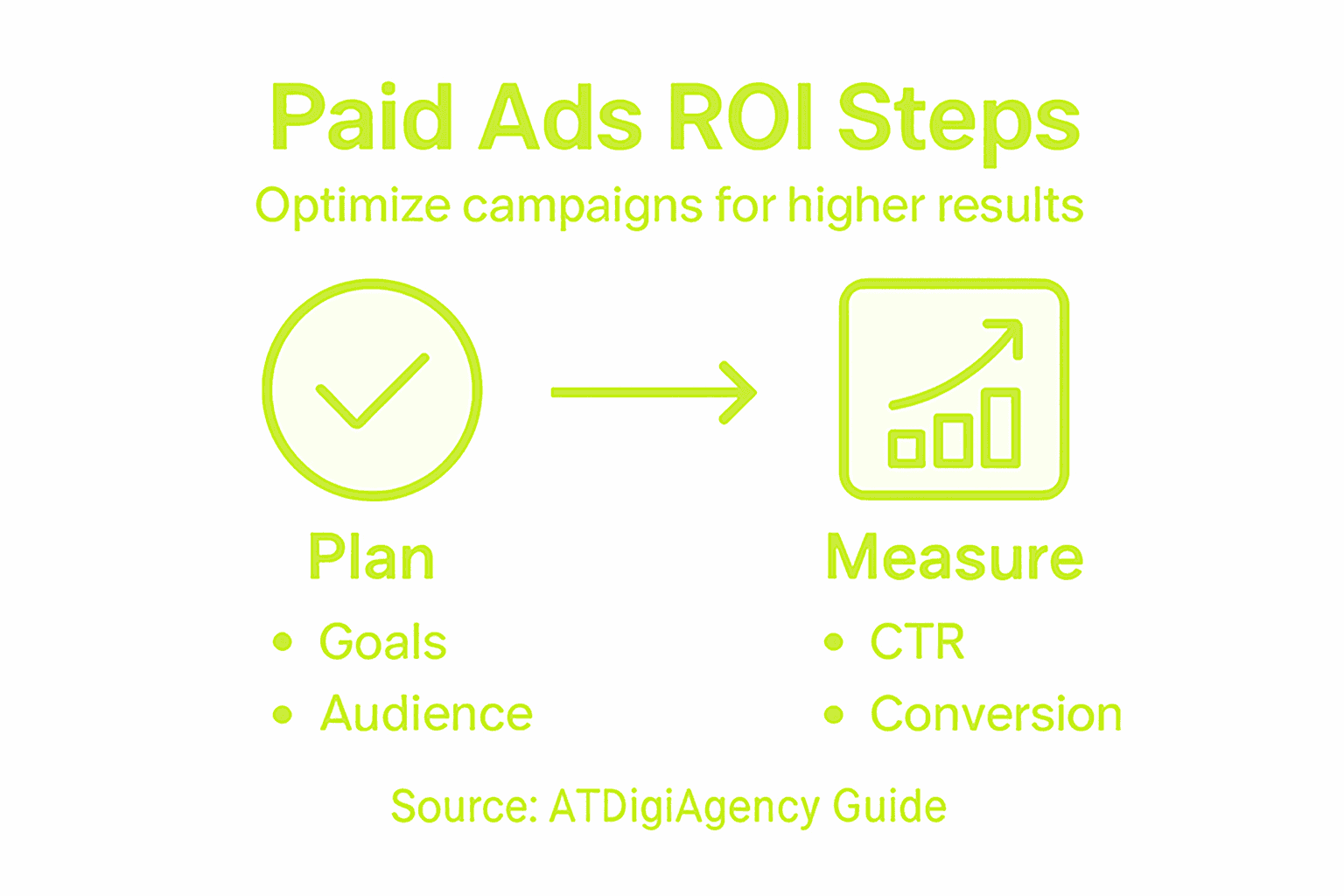
Establish a systematic monitoring approach by integrating multiple analytics platforms to ensure consistent and actionable insights. Set up real time dashboards that track performance across different campaign segments and audience groups. Pay special attention to metrics specific to each stage of the customer journey awareness, consideration, and conversion. This granular approach allows you to quickly identify which campaign elements are performing successfully and which require immediate optimization.
Implement a dynamic optimization strategy that responds to performance data. Create a feedback loop where campaign metrics directly inform creative adjustments, budget reallocation, and targeting refinements. Be prepared to make swift changes based on empirical evidence rather than assumptions. This might involve pausing underperforming ad sets, scaling successful creative variations, or adjusting audience targeting parameters to improve overall campaign efficiency.
Below is a summary of crucial paid ads performance metrics and their business impact:
Metric | What It Measures | Business Impact |
Click-Through Rate | Engagement with ads | Indicates ad appeal |
Conversion Rate | Actions taken after click | Shows sales effectiveness |
Cost Per Click | Expense per ad click | Reflects ad efficiency |
Cost Per Acquisition | Cost to gain a customer | Assesses campaign ROI |
Pro tip: Schedule weekly performance review sessions to systematically analyze campaign metrics and make data driven optimization decisions.
Step 5: Optimize performance using data-driven insights
Perfecting your paid advertising strategy requires a systematic approach to analyzing and leveraging performance data. Your objective is to transform raw metrics into actionable insights that continuously improve campaign effectiveness and return on investment.
Implement comprehensive paid ads analyticsthat go beyond surface level reporting. This means developing a nuanced understanding of how different campaign elements interact and impact overall performance. Track granular metrics such as click through rates, conversion rates, audience engagement, and cost per acquisition across various audience segments and creative variations.
Establish a robust A/B testing framework that allows you to make data driven decisions. Create controlled experiments where you test specific variables such as ad copy, visual elements, targeting parameters, and bidding strategies. Use statistical significance to determine which variations genuinely improve performance rather than relying on random fluctuations. Develop a systematic approach to scaling successful elements while quickly retiring underperforming campaign components.
Deploy advanced audience segmentation techniques that enable hyper targeted optimization. Break down your audience into micro segments based on behavioral patterns, demographic characteristics, and interaction history. Use these detailed audience insights to create personalized messaging and targeting strategies that resonate more deeply with specific customer groups. This approach allows for more precise budget allocation and dramatically improved campaign efficiency.
Pro tip: Create a standardized performance dashboard that visualizes key metrics and automatically highlights significant changes or optimization opportunities.
Boost Your ROI with Expert Paid Advertising Strategies
Struggling to build a paid advertising system that truly aligns with your business goals and audience insights The key challenges of defining clear objectives and designing targeted campaigns can feel overwhelming without expert guidance. This article highlights crucial steps like audience persona mapping and data-driven budget allocation that can make or break your ad performance. At A&T Digital we specialize in transforming these pain points into strengths by crafting highly targeted Google Ads and Meta campaigns that deliver measurable growth and conversions.
We combine strategic analysis, creative development, and continuous optimization to help small to medium-sized businesses scale effectively in competitive digital markets. Discover how our tailored approach to performance marketing takes the guesswork out of campaign management with personalized service that respects your time and investment.
Take action now to turn your paid advertising efforts into sustainable business growth. Explore our performance marketing solutions and learn how we can help you master ad strategy, launch, and optimization.
Ready to stop wasting ad spend and start generating real results Connect with A&T Digitaltoday and let us build your high-ROI campaign foundation.
Frequently Asked Questions
How can I align my business goals with my paid advertising strategy?
To align your business goals with your paid advertising strategy, start by defining clear and measurable objectives. Identify your revenue targets and market segments, then map these goals to specific audience insights to create targeted marketing campaigns.
What tools should I use for collecting audience data?
Utilize tools like Google Analytics and customer surveys to collect detailed audience data. Gather demographic information, behavioral patterns, and purchasing habits to create comprehensive audience personas that reflect your target market’s needs.
How do I determine the right budget for my advertising campaigns?
To determine the right budget, calculate your maximum cost per acquisition based on your customer lifetime value. Allocate your budget across campaign segments according to their potential return on investment and adjust regularly based on performance metrics.
What are the key performance metrics I should monitor for my paid advertising campaigns?
Focus on important metrics such as click-through rate, conversion rate, and cost per acquisition. Regularly tracking these metrics will provide insights into how well your campaigns are performing and where adjustments may be needed.
How can I optimize my advertising campaigns for better results?
Optimize your advertising campaigns by implementing A/B testing to analyze different aspects like ad copy and visuals. Use the data from these tests to scale successful elements and refine underperforming components within a few weeks.