Why Personalize Ad Campaigns for Higher ROI
Posted on
Marketing
Posted at

Every American marketing manager feels the pressure to make every advertising dollar count. Generic ads often miss the mark, leaving potential customers disengaged. Personalized ad campaigns turn scattered messaging into meaningful, data-driven connections that speak directly to each individual’s unique interests. This article provides practical insights for developing customized advertising strategies that will enable your e-commerce brand to enhance ROI and bolster customer relationships by leveraging sophisticated AI tools and smart segmentation.
Table of Contents
Key Takeaways
Point | Details |
Importance of Personalization | Personalization enhances ad relevance and engagement by tailoring messages to individual customer behaviors and preferences. |
Types of Personalization | Key strategies include individual-level targeting, contextual personalization, and predictive techniques to optimize ad effectiveness. |
Performance Improvement | Personalized campaigns significantly boost metrics such as conversion rates, customer acquisition, and retention, leading to better ROI. |
Privacy Considerations | Brands must balance data utilization with ethical standards to build trust, ensuring compliance with privacy regulations and protecting consumer data. |
What Personalization in Ad Campaigns Means
Personalization in ad campaigns represents a strategic approach to delivering targeted marketing messages that resonate directly with individual consumer preferences and behaviors. At its core, this technique transforms generic advertising into meaningful, individualized communication experiences.
Effective personalization goes far beyond simply inserting a customer’s first name into an email. Instead, it involves using sophisticated data analysis to understand and predict consumer needs, crafting messages that feel uniquely tailored to each recipient.
Key components of successful ad campaign personalization include:
Analyzing individual customer data patterns
Tracking behavioral insights across multiple touchpoints
Creating dynamic content that adapts to user interactions
Leveraging AI and machine learning for predictive targeting
Developing segment-specific messaging strategies
Modern personalization techniques allow marketers to move beyond broad demographic targeting toward hyper-specific audience segmentation. By understanding not just who customers are, but how they behave, brands can create more compelling and relevant advertising experiences that significantly improve engagement rates.
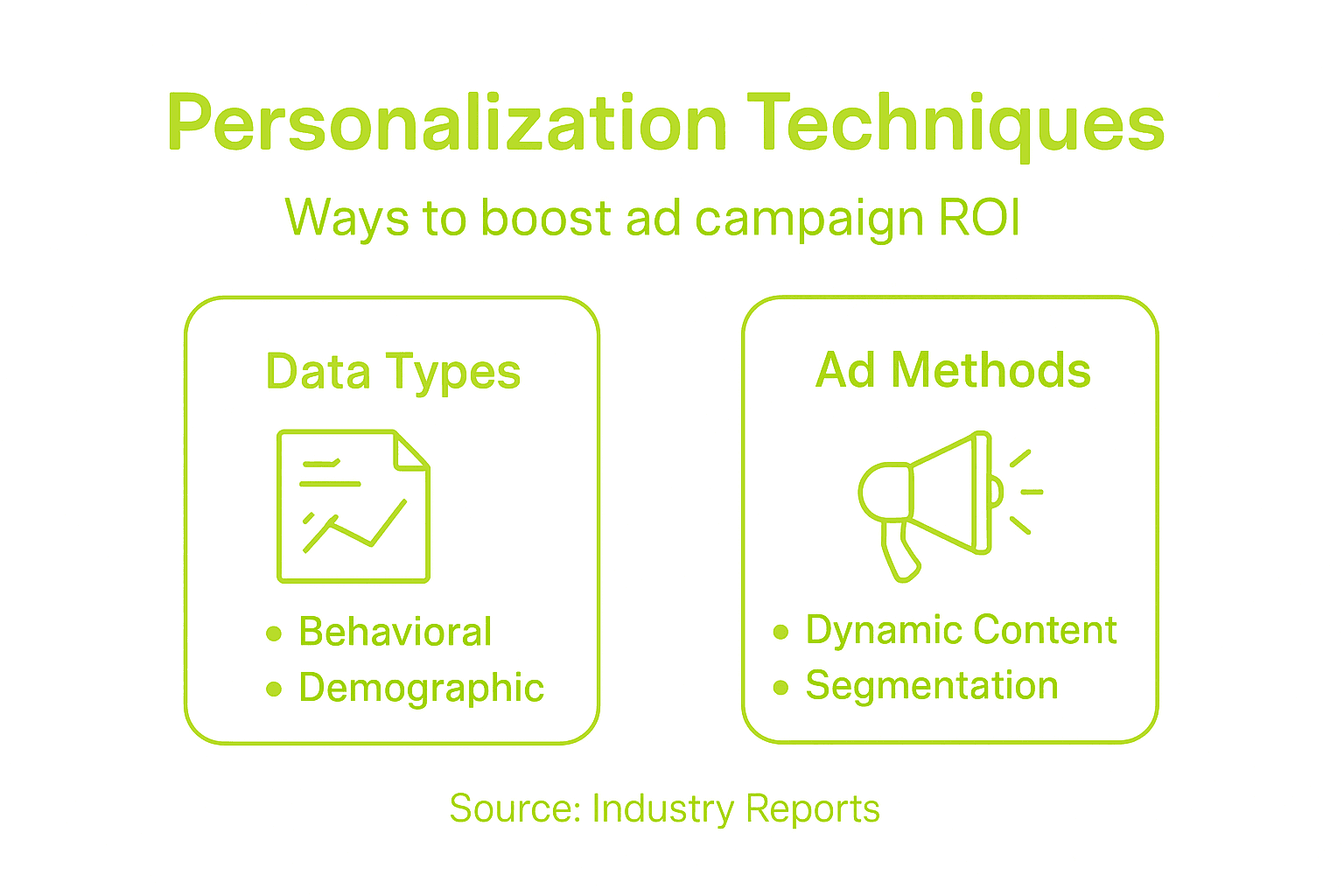
Pro tip: Start small by segmenting your audience based on 2-3 key behavioral indicators before attempting complex personalization strategies.
Types of Personalization for Digital Ads
Digital ad personalization has evolved from simple name insertion to sophisticated, data-driven targeting strategies that transform how brands communicate with potential customers. Advanced personalization techniques now enable marketers to create highly nuanced and contextually relevant advertising experiences.
The primary types of digital ad personalization can be categorized into several strategic approaches:
Individual-Level Personalization: Tailoring ads based on specific user characteristics, purchase history, and browsing behaviors
Contextual Personalization: Adapting ad content based on real-time user context like location, device, or current browsing environment
Behavioral Targeting: Creating ads that respond to specific user actions, search patterns, and engagement history
Demographic Segmentation: Customizing messaging according to age, gender, income level, and other demographic indicators
Predictive Personalization: Using AI and machine learning to anticipate user needs before they explicitly express them
Modern digital advertising platforms now support dynamic content adaptation, which means ads can change in real-time based on user interactions. This approach allows marketers to move beyond static, one-size-fits-all messaging toward more engaging, responsive communication strategies that feel individually crafted.
Personalization is no longer a luxury – it’s becoming an essential expectation for consumers navigating digital advertising landscapes.
Pro tip: Start implementing personalization by focusing on 2-3 core behavioral data points rather than attempting complex multi-variable targeting immediately.
How Personalization Drives Ad Performance
Personalization has transformed digital advertising from a scattershot approach to a precision-driven strategy that dramatically improves marketing outcomes. AI-driven real-time personalization enables marketers to create deeply targeted ad experiences that resonate with individual consumer needs and preferences.
The performance impact of personalization can be measured across several critical metrics:
Conversion Rate Optimization: Personalized ads increase the likelihood of user action
Customer Acquisition Cost Reduction: Targeted messaging reduces wasted ad spend
Engagement Metrics: More relevant ads generate higher click-through rates
Customer Retention: Personalized experiences build stronger brand connections
Return on Ad Spend (ROAS): Precise targeting improves overall campaign efficiency
Marketing teams implementing sophisticated personalization strategies can expect significant performance gains. Companies utilizing advanced personalization techniques typically see remarkable improvements, such as a 37% reduction in customer acquisition costs and a potential 43% increase in marketing return on investment.
Precision targeting is not just a strategy – it’s a competitive necessity in modern digital advertising.
The key to successful personalization lies in continuous data analysis, machine learning algorithms, and a deep understanding of audience segmentation. By leveraging advanced technologies, marketers can create ads that feel less like interruptions and more like valuable, tailored recommendations.

Pro tip: Implement a phased personalization approach, starting with basic behavioral segmentation before advancing to more complex predictive targeting strategies.
Real–World Examples of Personalized Campaigns
Successful personalization strategies demonstrate how targeted marketing can transform customer experiences and drive remarkable business growth. AI-powered personalization techniques have enabled companies across various industries to create deeply engaging and individualized marketing approaches.
Standout examples of personalized campaigns include:
Amazon: Leveraging predictive analytics for hyper-targeted product recommendations
Spotify: Creating personalized playlists based on individual listening habits
Netflix: Customizing content suggestions using viewing history and preferences
Starbucks: Delivering location-based offers through a mobile rewards program
Nike: Designing personalized workout recommendations through fitness apps
Take Spotify as a prime illustration of personalization done right. The music streaming platform has utilized machine learning to transform how users discover and consume music. By analyzing listening patterns, time of day, genre preferences, and even mood indicators, Spotify creates uniquely tailored playlists that feel almost magically curated for each user.
Personalization is not about selling – it’s about creating meaningful connections that make customers feel genuinely understood.
Successful personalization requires more than just collecting data. It demands sophisticated analysis, continuous learning, and a genuine commitment to understanding individual customer journeys. Brands that master this approach can expect significant improvements in engagement, loyalty, and ultimately, revenue.
Here’s how popular brands use personalization in real-world campaigns:
Brand | Personalization Strategy | Key Outcome |
Amazon | AI-driven product recommendations | Increased repeat purchases |
Spotify | Custom playlists based on behavior | Higher user engagement |
Netflix | Tailored viewing suggestions | Enhanced session duration |
Starbucks | Location-based mobile offers | Boosted in-store visits |
Nike | Personalized workout program advice | Strengthened brand loyalty |
Pro tip: Start your personalization journey by collecting 3-5 core behavioral data points before implementing complex targeting strategies.
Risks, Compliance, and Data Privacy Issues
Personalization strategies walk a razor-thin line between delivering targeted experiences and maintaining consumer trust. Modern marketing faces critical data privacy challenges that require sophisticated approaches to balancing consumer insights with ethical data practices.
Key privacy and compliance risks include:
Consumer Data Protection: Preventing unauthorized data access
Transparent Data Collection: Clearly communicating how user information is gathered
Consent Management: Ensuring explicit user permissions for data usage
Regulatory Compliance: Adhering to GDPR, CCPA, and other global privacy regulations
Algorithmic Bias Prevention: Mitigating discriminatory targeting practices
The Cambridge Analytica scandal serves as a critical warning about the potential catastrophic consequences of mishandling consumer data. Such incidents demonstrate how aggressive data collection can rapidly erode consumer confidence and lead to significant legal and reputational damage. Brands must now view data privacy not as a compliance checkbox, but as a fundamental aspect of building long-term customer relationships.
Privacy is no longer an option – it’s a fundamental consumer right that brands must respect and proactively protect.
Successful personalization requires a delicate balance between leveraging data insights and maintaining rigorous ethical standards. This means implementing robust consent mechanisms, providing clear opt-out options, and continuously auditing data collection and usage practices.
This table summarizes typical personalization risks and recommended safeguards:
Risk | Example Consequence | Best Practice |
Unclear data use | Consumer distrust rising | Clear privacy policies |
Collecting excessive personal info | Regulatory fines and penalties | Data minimization |
Not managing user consent | Loss of legal compliance status | Explicit opt-in system |
Algorithmic bias | Unfair exclusion of customers | Regular audits |
Weak data security | Data breach and exposure | Robust encryption |
Pro tip: Develop a comprehensive data governance framework that prioritizes transparency, user consent, and proactive privacy protections.
Mistakes to Avoid When Personalizing Ads
Personalization can quickly become counterproductive when marketers fail to implement strategic approaches. Common personalization mistakes can dramatically reduce campaign effectiveness and potentially alienate the very customers brands aim to engage.
Critical mistakes in ad personalization include:
Irrelevant Targeting: Sending ads that miss user interests completely
Invasive Messaging: Creating ads that feel uncomfortably intrusive
Data Overreach: Collecting more personal information than necessary
Inconsistent Messaging: Presenting conflicting information across channels
Ignoring User Context: Failing to understand nuanced customer behaviors
Two-thirds of consumers report experiencing poor personalization, which means brands must carefully navigate the fine line between helpful targeting and perceived manipulation. Overly mechanical approaches that rely solely on data points without understanding emotional context can backfire spectacularly, turning potential customers away instead of drawing them closer.
Personalization is an art of subtlety, not a science of pure data manipulation.
Successful personalization requires continuous refinement, a deep understanding of customer preferences, and a commitment to creating genuinely valuable experiences. Marketers must view personalization as a dialogue, not a monologue, constantly listening and adapting to evolving customer needs.
Pro tip: Implement a robust feedback mechanism that allows customers to easily adjust their personalization preferences and provide direct input.
Unlock Higher ROI with Expert Ad Personalization That Works
Personalizing ad campaigns is essential to cut through the noise and reach your customers with precise, relevant messaging that drives real results. If you struggle with creating targeted ads that connect or want to significantly improve conversion rates and reduce wasted spend, the key lies in leveraging data-driven strategies, behavioral targeting, and predictive personalization. At A&T Digital Agency, we specialize in building and scaling paid advertising systems tailored to your business needs, helping you convert insights into powerful, revenue-boosting campaigns.
Don’t settle for generic ads that miss the mark. Experience the power of personalized, performance-driven marketing crafted by a boutique team that values strategic insight and creative execution. Ready to transform your campaigns with targeted Google Ads and Meta strategies that deliver measurable growth? Visit A&T Digital Agency now to learn how we create high-ROI ad systems with clear analysis and purposeful execution. Discover our approach to performance marketing and get started on building campaigns that truly resonate and convert.
Frequently Asked Questions
What is the importance of personalization in ad campaigns?
Personalization in ad campaigns is crucial because it enables brands to deliver targeted marketing messages that resonate with individual consumer preferences, leading to higher engagement and improved conversion rates.
How does personalized advertising improve ROI?
Personalized advertising enhances return on investment (ROI) by optimizing conversion rates, reducing customer acquisition costs, and increasing overall campaign efficiency through tailored messaging that connects with the audience.
What are some effective strategies for personalizing ad campaigns?
Effective strategies for personalizing ad campaigns include analyzing customer data patterns, tracking behavioral insights, developing segment-specific messaging, and leveraging AI for predictive targeting to create dynamic and relevant content.
What mistakes should marketers avoid when personalizing ads?
Marketers should avoid mistakes such as irrelevant targeting, invasive messaging, data overreach, inconsistent messaging across channels, and ignoring user context, as these errors can lead to poor engagement and customer alienation.


