Role of Google Ads in Retail – Driving Sales Growth
Posted on
Marketing
Posted at

Every American retailer faces the challenge of standing out in a crowded digital marketplace. With Google Ads commanding a dominant share of digital advertising in the United States, mastering this platform is essential for those aiming to drive measurable sales growth and maximize return on investment. This guide unpacks how strategic targeting, data-driven campaign choices, and smart optimization techniques help retail businesses achieve reliable results in a competitive market.
Table of Contents
Key Takeaways
Point | Details |
Utilize Targeted Campaigns | Leverage Google Ads campaign types like Search, Display, and Shopping to effectively reach potential customers. |
Implement Advanced Targeting | Use demographic, interest-based, and remarketing strategies to personalize advertising for better engagement. |
Monitor Performance Metrics | Regularly analyze campaign analytics and conversion tracking to refine strategies and maximize ROI. |
Avoid Common Mistakes | Stay aware of pitfalls like broad keyword targeting and poor mobile optimization to protect advertising budgets. |
Defining Google Ads and Retail Impact
Google Ads represents a powerful digital advertising platform enabling retailers to strategically target potential customers across search, display, and video channels. With extensive digital advertising networks, Google provides businesses unprecedented opportunities to reach consumers precisely when they’re most likely to make purchasing decisions.
The platform’s core strength lies in its ability to connect retailers with highly targeted audience segments through sophisticated keyword targeting, demographic filtering, and intent-based advertising. Retailers can leverage multiple ad formats, including:
Search network ads appearing alongside relevant search results
Display ads showcasing products across websites and apps
Shopping ads featuring product images, prices, and merchant details
Video ads targeting consumers on YouTube and partner platforms
Research demonstrates Google’s dominant position in digital advertising, with comprehensive marketing success metrics highlighting its critical role in driving online sales. By enabling granular audience targeting and real-time performance tracking, Google Ads empowers retailers to optimize marketing spend and maximize return on investment.
The platform’s flexibility allows businesses of all sizes to compete effectively, from local boutiques to national retail chains. Retailers can set precise budgets, track conversion rates, and continuously refine their advertising strategies based on actionable insights generated through Google’s robust analytics tools.
Pro tip: Start with small, targeted campaigns and gradually expand your Google Ads strategy as you learn which audience segments and keywords deliver the most cost-effective results.
Main Google Ads Campaign Types Explained
Retail businesses can leverage several distinct Google Ads campaign types to drive targeted sales and engagement. These campaign formats offer unique approaches to reaching potential customers across different digital platforms. Campaign strategy optimization remains critical for maximizing advertising effectiveness and return on investment.
The primary Google Ads campaign types for retailers include:
Search Network Campaigns: Text-based ads appearing in Google search results
Display Network Campaigns: Visual ads shown across millions of websites and apps
Shopping Campaigns: Product-specific ads featuring images, prices, and merchant information
Video Campaigns: Promotional video content displayed on YouTube and partner platforms
Remarketing Campaigns: Targeted ads shown to users who previously interacted with your website or products
Each campaign type offers distinct advantages for retail marketing. Search network campaigns capture high-intent customers actively searching for products, while display network campaigns build brand awareness through visually engaging advertisements. Shopping campaigns provide direct product showcases, enabling potential buyers to see exact pricing and visual details before clicking.
Video and remarketing campaigns represent more advanced targeting strategies. Video campaigns allow retailers to create storytelling opportunities and demonstrate product features, while remarketing campaigns re-engage customers who have already shown interest in specific product categories or brand interactions.
Here’s a quick overview of the main Google Ads campaign types and how they support retail business goals:
Campaign Type | Key Purpose | Typical Retail Impact |
Search Network | Capture ready-to-buy intent | Immediate online sales boost |
Display Network | Build brand visibility | Expand reach to new customers |
Shopping | Show product catalogue | Drive direct product purchases |
Video | Engage via storytelling | Enhance brand and product recall |
Remarketing | Re-engage past visitors | Increase repeat conversion rate |
Pro tip: Experiment with multiple campaign types simultaneously and use Google’s analytics tools to track performance metrics, allowing you to quickly identify and double down on the most cost-effective advertising strategies.
Targeting and Personalization Strategies for Retail
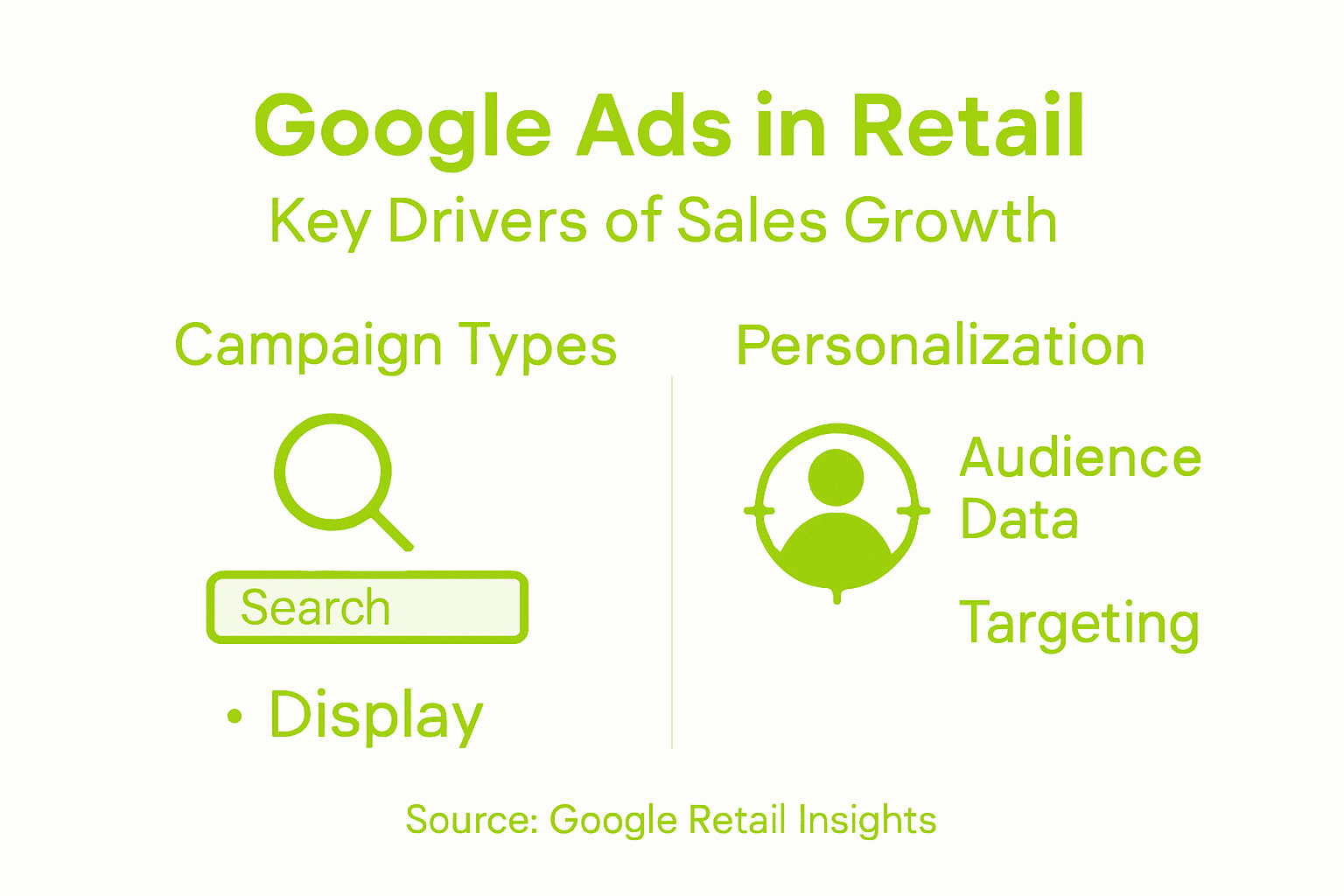
Modern retail advertising demands sophisticated targeting and personalization strategies that go beyond traditional demographic segmentation. Customer segmentation techniques have evolved to leverage complex data analysis, enabling retailers to create highly precise and individualized marketing approaches.
Key personalization strategies for Google Ads in retail include:
Demographic Targeting: Focusing on age, gender, income, and location
Interest-Based Targeting: Segmenting audiences by online behaviors and preferences
Remarketing: Reconnecting with previous website visitors
Custom Intent Audiences: Targeting users based on recent search history
Life Event Targeting: Reaching consumers during significant personal transitions
Advanced personalization requires a profound understanding of customer data and patterns of behavior. Retailers can leverage Google Ads’ sophisticated algorithms to create dynamic audience segments that respond to specific triggers, such as recent product searches, browsing history, or previous purchase interactions. This approach allows for creating micro-targeted advertising experiences that feel uniquely tailored to individual consumer needs.
By combining multiple targeting methods, retailers can develop complex audience profiles that dramatically improve advertising efficiency. Machine learning algorithms continuously refine these targeting parameters, enabling more precise ad delivery and higher conversion potential. The goal is to create a seamless, personalized advertising experience that feels relevant and timely to potential customers.
Pro tip: Regularly analyze your audience performance metrics and be prepared to adjust your targeting parameters, ensuring your personalization strategies remain dynamic and responsive to changing consumer behaviors.
How Google Ads Fuels Measurable Retail Growth
Retail businesses increasingly rely on Google Ads as a critical mechanism for driving measurable sales growth through precise digital marketing strategies. Targeted advertising strategies enable retailers to track and optimize their marketing performance with unprecedented accuracy and efficiency.
Key mechanisms through which Google Ads drives retail growth include:
Real-Time Performance Tracking: Instant insights into ad spend and conversion rates
Audience Segmentation: Precise targeting of potential customers
Conversion Optimization: Machine learning algorithms that continuously improve ad performance
Multi-Channel Campaign Integration: Connecting search, display, and shopping ads
Advanced Analytics: Comprehensive reporting on customer interactions and purchase behaviors
The platform’s sophisticated analytics provide retailers with granular visibility into campaign performance, allowing for rapid adjustments and strategic refinements. By leveraging data-driven insights, businesses can understand exactly how each advertising dollar contributes to overall sales objectives, transforming marketing from a cost center to a revenue-generating engine.

Advanced AI-powered tools within Google Ads enable retailers to create dynamic, responsive advertising experiences that adapt in real-time to changing consumer behaviors. These technologies allow for microtargeting, predictive performance modeling, and automated optimization, ensuring that advertising budgets are deployed with maximum efficiency and strategic precision.
Pro tip: Implement conversion tracking and regularly review your campaign analytics, focusing on metrics like cost per acquisition and return on ad spend to continuously refine your Google Ads strategy.
Common Retail Mistakes and Ad Spend Risks
Navigating Google Ads requires strategic awareness of potential pitfalls that can quickly drain marketing budgets and compromise advertising effectiveness. A paid advertising strategy demands careful planning to avoid common mistakes that undermine retail marketing performance.
Critical mistakes retailers frequently encounter include:
Broad Keyword Targeting: Selecting overly generic keywords that attract irrelevant traffic
Inadequate Conversion Tracking: Failing to set up precise conversion measurement tools
Neglecting Negative Keywords: Missing opportunities to filter out unproductive search queries
Inconsistent Landing Page Experiences: Misalignment between ad promises and website content
Overlooking Mobile User Experience: Ignoring performance optimization for mobile platforms
The financial risks associated with these mistakes can be substantial. Poorly constructed Google Ads campaigns can rapidly consume advertising budgets without generating meaningful returns. Retailers must implement rigorous monitoring and optimization strategies to ensure each advertising dollar contributes directly to sales growth.
Successful ad spend management requires continuous learning and adaptation. By understanding common pitfalls, retailers can develop more sophisticated targeting approaches, create more compelling ad content, and build more efficient conversion funnels that maximize return on investment.
The following table summarizes common Google Ads mistakes and the associated business risks for retailers:
Mistake | Business Impact | Risk Level |
Broad keyword targeting | Wasted budget, low relevance | High |
Poor conversion tracking | Unclear campaign value assessment | Medium |
Ignoring mobile users | Lost sales opportunities | High |
Weak landing pages | Reduced conversion rates | Medium |
No negative keywords | Higher cost per acquisition | Medium |
Pro tip: Establish a monthly audit process to review campaign performance, systematically eliminating underperforming keywords and reallocating budget toward high-conversion targeting strategies.
Maximizing ROI with Expert Optimization Techniques
Retail businesses can significantly enhance their Google Ads performance by implementing strategic optimization techniques that go beyond basic campaign management. Google Ads optimization strategies demand a comprehensive approach to continuously improve advertising efficiency and return on investment.
Key expert optimization techniques include:
Granular Keyword Segmentation: Breaking down keywords into highly specific, performance-driven clusters
Dynamic Bid Adjustment: Implementing automated bidding strategies based on real-time performance data
Precision Audience Targeting: Refining audience segments to maximize relevance and conversion potential
Continuous A/B Testing: Systematically testing ad creatives, landing pages, and messaging
Advanced Conversion Tracking: Implementing multitouch attribution models to understand complex customer journeys
Successful optimization requires a data-driven mindset that treats each campaign as a living, evolving system. Retailers must develop sophisticated tracking mechanisms that provide in-depth insights into customer behavior, allowing for rapid iterations and strategic refinements that progressively improve advertising performance.
Advanced retailers leverage machine learning and predictive analytics to move beyond traditional optimization approaches. By integrating sophisticated data analysis techniques, businesses can create highly responsive advertising systems that automatically adjust to changing market conditions and consumer preferences.
Pro tip: Develop a structured monthly optimization workflow that includes a comprehensive performance review, strategic hypothesis generation, and systematic test implementation to continuously enhance your Google Ads campaign effectiveness.
Unlock Your Retail Growth Potential with Expert Google Ads Management
The article highlights key challenges retailers face, such as navigating complex Google Ads campaign types, avoiding costly mistakes like broad keyword targeting, and mastering personalization strategies to connect with high-intent customers. If you are striving to boost your sales while managing risk and maximizing return on ad spend, then a precise, data-driven campaign strategy and optimization become critical.
At A&T Digital Agency, we specialize in delivering measurable retail growth through comprehensive Google Ads solutions. Our boutique team combines strategic insight with creative execution to build and scale high-ROI campaigns crafted specifically for your business needs. We focus on:
Developing granular keyword segmentation and dynamic bid adjustments that cut wasted spend
Implementing advanced audience targeting and remarketing strategies that increase conversion rates
Providing transparent analytics and continuous optimization so you can clearly see your advertising impact
Don’t let ineffective ad spend hold your retail business back. Take control of your Google Ads performance today with personalized, expert guidance. Visit A&T Digital Agency to get started with a tailored campaign strategy, launch, and optimization that drives real sales growth in a competitive digital marketplace.
Frequently Asked Questions
What are the main types of Google Ads campaigns for retail?
Google Ads offers several campaign types for retailers, including Search Network Campaigns (text ads in search results), Display Network Campaigns (visual ads on websites), Shopping Campaigns (product-specific ads with images and prices), Video Campaigns (ads on YouTube), and Remarketing Campaigns (targeting previous visitors to your site).
How can I effectively target my ads on Google Ads?
To effectively target your ads, utilize strategies like demographic targeting (age, gender, income), interest-based targeting, remarketing to reconnect with previous visitors, custom intent audiences based on search behavior, and life event targeting to reach consumers during significant changes.
What common mistakes should retailers avoid when using Google Ads?
Retailers should avoid common mistakes like broad keyword targeting (which can waste budget), inadequate conversion tracking (leading to unclear performance), neglecting negative keywords (resulting in irrelevant traffic), and overlooking mobile user experience, all of which can compromise advertising effectiveness and ROI.
How can I maximize my return on investment with Google Ads?
To maximize ROI, implement expert optimization techniques such as granular keyword segmentation, dynamic bid adjustments, precision audience targeting, continuous A/B testing, and advanced conversion tracking to refine your strategies and improve ad performance.


