Role of Google Ads: Driving Growth for U.S. SMBs
Posted on
Marketing
Posted at

Running an American e-commerce business often means juggling tight budgets while fighting for attention in a sea of competition. Standing out when every dollar counts can feel overwhelming, especially if Google Ads seems too complex or risky. Understanding the pay-per-click system, campaign types, and how quality score impacts ad rank is the first step toward building a smarter path to return on investment. Discover how to use this powerful platform to attract high-intent buyers and make every ad dollar work harder for your growth.
Table of Contents
Key Takeaways
Point | Details |
Understanding Google Ads | Google Ads is a pay-per-click platform that allows businesses to show ads to users actively searching for their products, ensuring budget efficiency. |
Ad Campaign Types | Different campaign types, such as Search, Shopping, and Display Ads, cater to various business goals, from immediate sales to brand awareness. |
Importance of Targeting | Effective use of audience targeting and keyword research is crucial for optimizing ad performance and achieving a positive return on investment. |
Automation and AI | Utilizing Google Ads’ automation features, like Performance Max, can enhance campaign management and improve overall advertising efficiency. |
Google Ads Explained for Small Businesses
Google Ads is fundamentally a pay-per-click (PPC) advertising platform that lets you display your products or services to customers actively searching for what you sell. Instead of paying upfront for ad space, you only pay when someone clicks your ad. Think of it like a storefront where you pay rent only when a customer walks through the door. The platform operates across multiple channels, including Google Search, YouTube, Google Display Network, and Google Shopping, giving your e-commerce business multiple ways to reach potential buyers at different stages of their purchasing journey.
The core mechanics work like this: you select relevant keywords that match what your customers are searching for, set a maximum bid amount you’re willing to pay per click, and Google ranks your ads based on both your bid and your ad’s quality score. Quality score measures how relevant and useful Google thinks your ad is to the searcher, based on factors like click-through rate, landing page experience, and ad relevance. Your ad rank (the position where your ad appears) is determined by combining these elements, not just your budget. This means a well-crafted ad with a lower bid can sometimes outrank a poorly constructed ad with a higher bid. When customers click your ad, you pay the cost per click (CPC), which varies depending on competition and quality.
For e-commerce business owners specifically, Google Ads offers several specialized formats that directly support your growth goals. Shopping Ads display product images, prices, and ratings directly in search results, which is invaluable for retailers selling physical products. Search Ads appear at the top of Google search results as text-based ads and work well for capturing high-intent customers. Display Ads reach people across thousands of websites, building awareness with your target audience. YouTube Ads let you tap into video traffic, which has become critical as video shopping behavior explodes. To get started, you’ll need to set clear campaign goals (whether that’s sales, leads, or website traffic), conduct keyword research to understand what your customers search for, and establish audience targeting to ensure your budget reaches the right people. Each of these elements works together to form a paid advertising system that compounds over time when optimized correctly.
Pro tip: Start with one campaign focused on your best-selling products with high search volume keywords, then let performance data guide expansion to other products or audiences rather than spreading your budget thin across everything from day one.
Core Campaign Types and Key Features
Google Ads isn’t a one-size-fits-all platform. Each campaign type serves a different purpose, and choosing the right one depends on what you’re trying to accomplish. If you’re running an e-commerce store, you likely need multiple campaign types working together. Search Ads capture customers actively hunting for products like yours in Google search results. These text-based ads appear at the top of search pages when someone types in relevant keywords, making them perfect for high-intent shoppers ready to buy. Display Ads take a different approach, using image-based creatives to reach people across thousands of websites as they browse content. This builds awareness with audiences who may not be actively searching yet but fit your target demographic. Then there’s Shopping Ads, which is arguably the most valuable for e-commerce because it displays product images, prices, and ratings directly in search results. Customers see exactly what you’re selling before clicking, which dramatically improves conversion rates. YouTube Ads let you tap into video traffic, whether through skippable ads before videos, non-skippable bumper ads, or in-stream placements. Finally, App Ads promote mobile app downloads and engagement, which is useful if you’ve developed a companion app for your business.

Each campaign type comes with unique targeting capabilities that let you reach the right people. You can narrow down by demographics (age, gender, household income), in-market audiences (people actively researching similar products), device types (mobile, desktop, tablet), and geographic location. Responsive search ads use machine learning to automatically test different combinations of your headlines and descriptions, optimizing performance over time. This means you provide multiple variations and Google’s algorithms find the winning combinations, saving you manual testing work. Quality score remains important across all campaign types, rewarding ads with high click-through rates, relevant landing pages, and strong ad relevance.
For your e-commerce business specifically, the combination matters more than individual campaigns. You might run Shopping Ads to capture immediate purchase intent, Display Ads to build long-term brand awareness with past visitors, and YouTube Ads to showcase product demonstrations or lifestyle content. Start by aligning campaign types to specific business goals: use Search for direct sales, Shopping for product visibility, Display for awareness building, and YouTube for storytelling. Understanding how campaign strategy drives ROI helps you allocate budget across the types that perform best for your specific products and audience.
Pro tip: Test one campaign type thoroughly before splitting your budget across multiple types, then use performance data to guide how much budget each campaign type deserves based on your cost-per-acquisition and return on ad spend.
Here’s a summary of Google Ads campaign types and their unique strengths for e-commerce businesses:
Campaign Type | Ideal Use Case | Key Strength | Typical Creative Format |
Search Ads | High-intent shoppers | Immediate sales | Text-based |
Shopping Ads | Product visibility | Detailed product info | Image & price listings |
Display Ads | Brand awareness | Broad audience reach | Banner and visual images |
YouTube Ads | Product demos | Video engagement | In-stream video ads |
App Ads | Mobile app installs | App-specific targeting | Responsive creatives |
Automation, AI, and Performance Max Evolution
Google Ads has undergone a dramatic transformation over the past few years, shifting from manual campaign management to AI-powered automation. This shift isn’t just a nice-to-have feature. It fundamentally changes how you can compete as a small to medium-sized e-commerce business. Where you once had to manually adjust bids, test ad variations, and optimize targeting throughout the day, intelligent systems now handle that heavy lifting continuously. Machine learning algorithms analyze performance patterns across millions of campaigns, identifying what works for your specific products and audience faster than any human could. The platform now learns from your historical data, recognizing which customer segments convert best and automatically adjusting your ad delivery to prioritize high-value audiences. This means less time spent in campaign management dashboards and more time focused on strategy.
Performance Max represents the evolution of this automation philosophy. This campaign type hands over the steering wheel almost entirely to Google’s AI, instructing the system to optimize across Google’s entire inventory (Search, Display, YouTube, Gmail, Google Maps, and more) to achieve your specified goal, whether that’s maximizing sales or leads. You provide your product feed, some creative assets like images and headlines, and your target cost per acquisition or return on ad spend. The algorithm then automatically tests different creative combinations, audience segments, and placements across the network, identifying the highest-performing combinations for your budget. Unlike traditional campaigns, where you manually allocate budget across channels, Performance Max treats Google’s entire ecosystem as one interconnected opportunity to find conversions. How organizations embed AI into strategies shows that the companies seeing measurable performance gains are those that trust their AI systems while maintaining strategic oversight.
For e-commerce businesses specifically, this automation evolution means you can scale more efficiently. You’re no longer choosing between Search, Display, and YouTube as separate buckets. Instead, Performance Max allows the system to allocate your budget where it finds the best results in real time. The tradeoff is transparency: you have less granular visibility into individual placements, which requires a shift in mindset from controlling every detail to setting goals and letting algorithms execute. The key is having clean conversion tracking and clear business objectives. If your system knows exactly when a customer makes a purchase and how much profit you make, the AI can optimize ruthlessly toward profitability rather than just clicks or impressions.
Pro tip: Start Performance Max with a modest daily budget while maintaining one traditional Search campaign, then gradually shift budget to Performance Max as you build confidence in the AI’s ability to hit your target metrics, rather than going all in immediately.
How SMBs Achieve ROI and Customer Growth
Achieving real ROI with Google Ads comes down to understanding what drives profitability, not just traffic. Many small business owners measure success by clicks or impressions, but that’s like counting foot traffic through your store without tracking what customers actually buy. True ROI means your ad spend generates more revenue than it costs. For an e-commerce business, this means tracking the entire journey from click to purchase and profit, accounting for your actual product margins. If you sell items with a 40% gross margin and your customer acquisition cost is 30% of that margin, you’re building a sustainable business. But if your acquisition costs exceed your profit per item, you’re essentially buying unprofitable sales. Google Ads excels when you have clear conversion tracking because the system can optimize toward actual business outcomes rather than vanity metrics.
The mechanics of achieving growth through Google Ads involve three interconnected elements. First, you need targeted customer acquisition that reaches people actively searching for or browsing products like yours. Your quality score, bid strategy, and audience targeting all influence who sees your ads and at what cost. Second, you need compelling ad creative that captures attention and communicates clear value. Creating ads with distinctiveness and clear benefits directly improves click-through rates and conversion likelihood. Third, you need conversion optimization on your landing pages and checkout process. The most effective ad in the world fails if your website doesn’t convert visitors into buyers. For e-commerce specifically, product page quality, checkout friction, shipping costs, and return policies all influence whether the customer completes the purchase. Many SMBs blame Google Ads when the real problem lies in their website or product offering. Your Google Ads strategy should include regular testing of these three elements: audience targeting, ad messaging, and landing page experience.
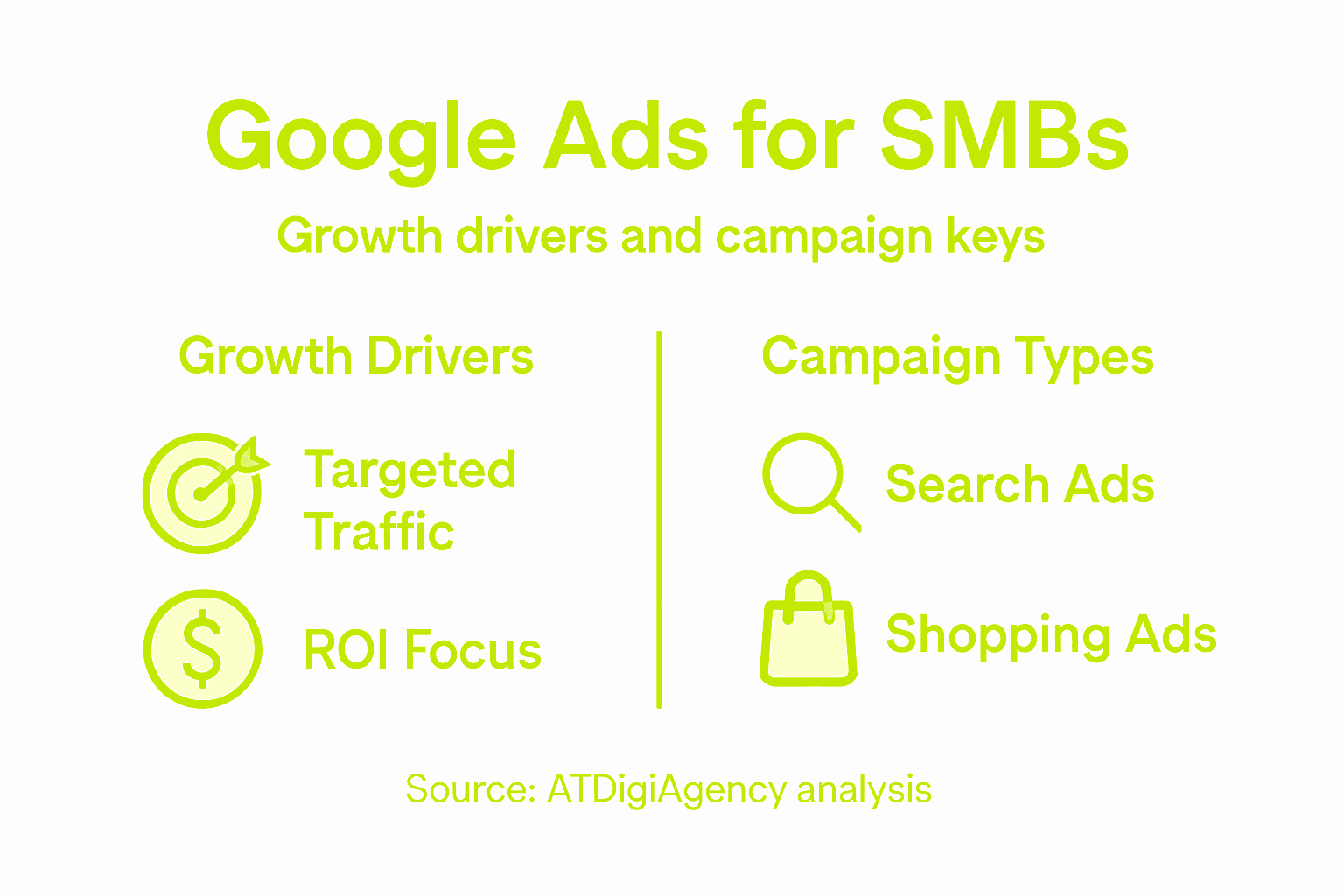
Measurable growth requires treating Google Ads as a system you continuously refine. Start by establishing baseline metrics: your current customer acquisition cost, average order value, and repeat purchase rate. Then test systematically. Change one variable at a time and measure the impact over at least two to four weeks to account for natural fluctuation. Maybe you test new audience segments, different bid strategies, or revised ad copy. The data reveals what actually works for your specific products and customers. As you accumulate this data, you can allocate more budget to high-performing campaigns and reduce spending on underperformers. This is how businesses scale from 10 sales per month to 100. The key is treating budget allocation as data-driven rather than as an even distribution. Effective scaling strategies emphasize measuring performance quantitatively and optimizing spending toward repeatable growth outcomes, which is accurately what Google Ads enables when you have proper tracking in place.
Pro tip: Calculate your true customer lifetime value (repeat purchases plus referrals) rather than just the first-purchase value, which allows you to bid more aggressively on customer acquisition since you’re optimizing for long-term profit, not just the first transaction.
Managing Costs, Common Pitfalls, and Alternatives
Google Ads can drain your budget faster than you realize if you don’t actively manage it. The platform doesn’t care about your profit margins. It optimizes toward the goal you set, whether that’s clicks, conversions, or impressions. If you set a goal to maximize conversions without a target cost per acquisition, Google will happily spend your entire monthly budget acquiring customers at a loss. This is why budget management and clear campaign goals are non-negotiable from day one. Set a daily budget that aligns with what you can afford to spend while still achieving profitability. More importantly, establish specific campaign objectives: are you optimizing for sales, leads, or brand awareness? Each objective changes how the algorithm behaves. Then use bid strategies like target cost per acquisition or return on ad spend targets to keep spending aligned with your actual business metrics. Many SMBs fail because they set a daily budget but forget to monitor whether the quality of conversions matches their profitability requirements. You might hit your conversion targets while going broke on customer acquisition costs.
Common pitfalls often stem from poor planning rather than platform limitations. Inadequate keyword research leads to bidding on irrelevant searches that generate clicks but no sales. Poorly targeted ads reach the wrong audience entirely, wasting impressions. Lack of conversion tracking means you’re flying blind, unable to see which campaigns actually drive sales versus which ones just look busy. Unrealistic expectations about the timeline and budget create frustration. Many business owners expect immediate results from a campaign that needs weeks of data to optimize properly. Another frequent mistake is treating Google Ads as a one-time setup rather than an ongoing system. You set it up, launch it, then ignore it for three months while costs climb and performance degrades. Effective budget management requires ongoing monitoring of performance metrics and regular optimization to prevent overspending and maintain ROI.
Before committing heavily to Google Ads, consider whether alternatives or complementary channels make sense for your business. Bing Ads often have lower competition and cheaper clicks, especially if your customer demographic skews older or more professional. Meta advertising (Facebook and Instagram) works better for lifestyle products and brand awareness than high-intent search. Email marketing has exceptional ROI if you already own your customer list. Organic search optimization takes months but eliminates per-click costs. The strongest approach combines Google Ads with other channels rather than betting everything on one platform. A typical e-commerce business might allocate 50% of paid budget to Google Ads for high-intent capture, 30% to Meta for awareness and retargeting, and 20% to test emerging channels. This diversification protects you from algorithm changes or cost increases on any single platform. Start with Google Ads since intent is clearest and ROI is measurable, but view it as the foundation of a multi-channel strategy, not the entire strategy.
This table compares major paid and organic channels often paired with Google Ads in e-commerce marketing:
Channel | Cost Structure | Best For | Strength Compared to Google Ads |
Google Ads | Pay-per-click | High buyer intent | Most conversion-focused |
Bing Ads | Usually lower CPC | Older, professional users | Lower competition, less reach |
Meta Ads | Impression-based spend | Lifestyle, brand building | Visual creativity, retargeting |
Email Marketing | Owned audience | Nurturing, repeat sales | Highest ROI, list required |
Organic Search | Free but slow results | Long-term traffic growth | No ongoing spend, takes time |
Pro tip: Set a monthly spending cap and test at low daily budgets first, then only increase budget to channels that hit your target cost per acquisition, rather than gradually increasing all campaigns equally regardless of performance.
Unlock Your SMBs Growth Potential with Expert Google Ads Support
Many U.S. small and medium-sized businesses struggle to translate Google Ads clicks into profitable sales due to challenges like managing budgets, optimizing campaigns, and measuring true ROI. The key to success lies in mastering terms like quality score, performance max campaigns, and customer acquisition cost while balancing creative messaging and precise audience targeting. At A&T Digital Agency, we understand these pain points and help you build and scale paid advertising systems that focus on driving revenue growth and sustainable customer acquisition.
Partner with a boutique team that delivers personalized, data-driven performance marketing customized for your e-commerce or service business. From strategic planning to creative development and continuous optimization, our approach ensures your Google Ads campaigns operate efficiently across Search, Shopping, Display, and YouTube platforms. Instead of spreading your budget thin or guessing what works, we test, analyze, and optimize your campaign types to maximize your return on ad spend. Explore how our proven methods can turn clicks into loyal customers at A&T Digital Agency.
Ready to move beyond wasted spend and uncertain results? Visit A&T Digital Agency to start crafting a powerful paid advertising strategy with experts who keep ROI front and center. Learn how to harness automation, refine your targeting, and unleash Google Ads’ full potential for your business with our performance marketing services. Don’t wait for your competitors to capture your ideal customers. Take the first step to scalable growth today by connecting with us at A&T Digital Agency.
Frequently Asked Questions
What is Google Ads, and how does it work for small businesses?
Google Ads is a pay-per-click advertising platform that allows small businesses to display their products or services to customers searching for what they offer. Businesses pay only when someone clicks their ad, using a bidding system that ranks ads based on bid amount and quality score.
How can small businesses utilize different types of Google Ads campaigns?
Small businesses can use various Google Ads campaign types, such as Search Ads for high-intent shoppers, Shopping Ads for product visibility, Display Ads for brand awareness, and YouTube Ads for video engagement. Combining these campaigns effectively can help achieve specific business goals like sales or leads.
What are some key features of Google Ads that can drive ROI for small businesses?
Key features include targeted customer acquisition through demographic and in-market audience targeting, compelling ad creatives, and conversion tracking, which ensures that the advertising budget is spent on effective ads that generate sales, rather than just clicks.
How can automation and AI improve the effectiveness of Google Ads campaigns?
Automation and AI in Google Ads streamline campaign management by continuously optimizing bids, ad placements, and audience targeting. This allows small businesses to focus on strategy while the platform adapts to find the best-performing combinations across channels, enhancing efficiency and outcomes.


