Campaign Strategy: Driving Growth and ROI Online
Posted on
Marketing
Posted at
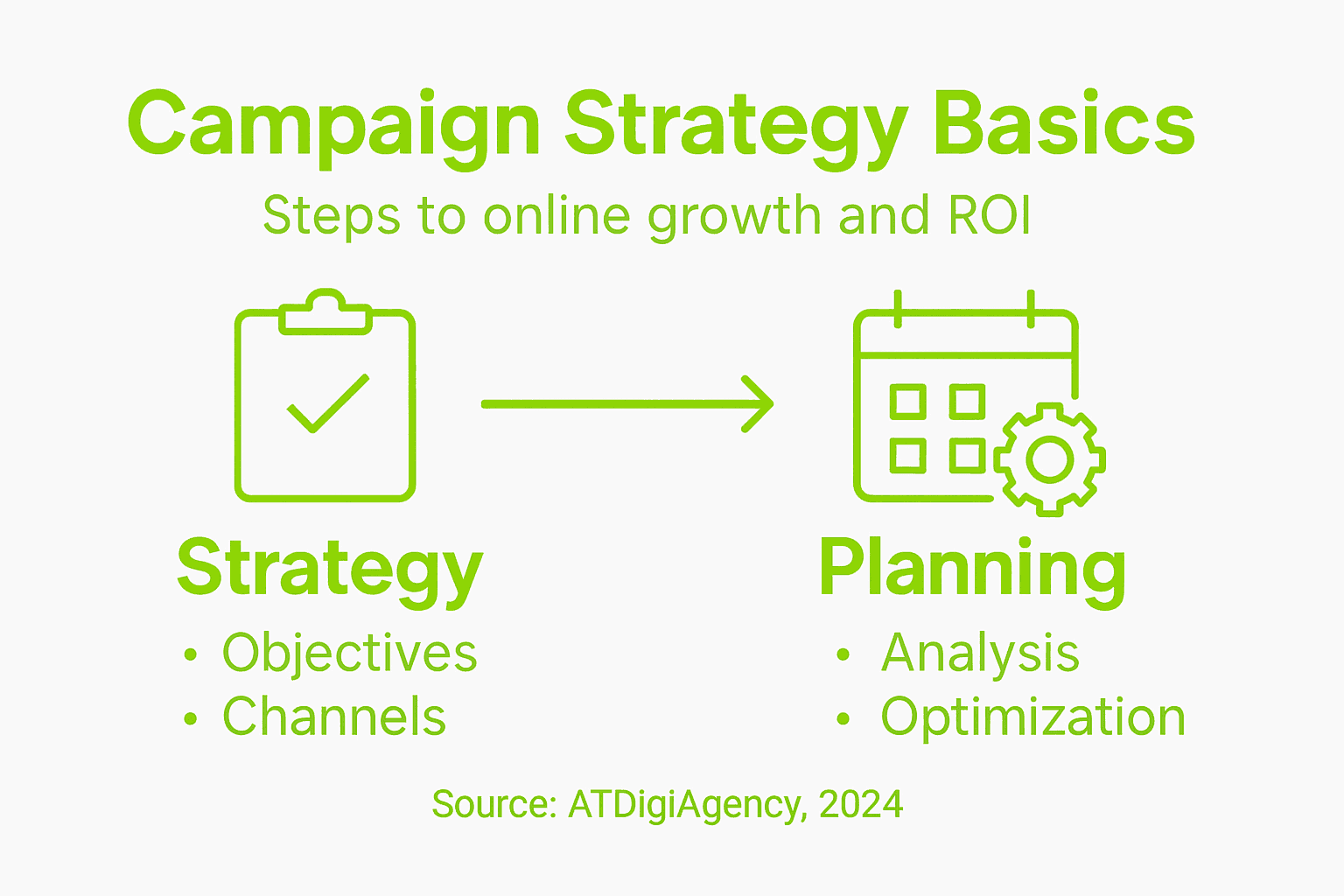
Most American businesses face rising pressure to demonstrate real marketing results, yet nearly 60 percent admit they lack a clear campaign strategy. For CEOs and marketing directors in e-commerce or healthcare, getting campaign planning right can be the difference between market growth and wasted budgets. This overview explains how a structured strategy guides resource allocation, improves measurement, and ensures digital advertising delivers measurable, sustainable impact for your organization.
Table of Contents
Key Takeaways
Point | Details |
Campaign Strategy Framework | A well-defined campaign strategy serves as a comprehensive guide for transforming marketing objectives into tangible results through structured planning. |
Critical Components | Effective campaigns integrate precise targeting, clear value propositions, and continuous performance tracking to achieve marketing goals. |
Digital Ad Strategies | Employ tailored digital ad strategies such as brand awareness and conversion optimization to meet distinct business objectives across online platforms. |
Performance Measurement | Use key performance metrics to assess marketing success and make data-driven adjustments for optimizing return on investment. |
Defining Campaign Strategy in Marketing
Campaign strategy represents the systematic blueprint businesses use to transform marketing objectives into actionable results. At its core, a campaign strategy is a comprehensive roadmap that guides organizations in planning organized marketing efforts to achieve specific business goals.
Successful campaign strategies integrate multiple critical components that work together seamlessly. These typically include precise customer targeting, clear value propositions, strategic resource allocation, and well-defined performance metrics. The strategy functions as a navigational tool that helps businesses identify their current market position and chart a path toward desired outcomes. By creating a structured approach, companies can effectively manage digital advertising initiatives, optimize spending, and maximize return on investment.
Key Elements of an Effective Campaign Strategy:
Detailed market research and audience segmentation
Defined campaign goals and key performance indicators
Tactical selection of marketing channels
Budget allocation and resource management
Continuous performance tracking and optimization
Understanding campaign strategy requires recognizing it as more than a singular tactical approach. Campaign strategists map pathways to change by aligning organizational vision with practical execution tactics. This means developing a holistic framework that considers not just immediate marketing objectives, but long-term business growth potential.
Pro tip: Always develop your campaign strategy with flexibility built-in, allowing for real-time adjustments based on performance data and emerging market trends.
Types of Campaign Strategies for Digital Ads
Digital advertising strategies represent sophisticated approaches designed to reach specific marketing objectives across multiple online platforms. Advertising campaigns leverage integrated marketing communications to engage consumers through targeted digital channels like social media, search platforms, and direct marketing tools.
Businesses typically employ several core digital ad campaign strategies, each tailored to achieve distinct marketing goals. These strategies include:
Targeted Engagement Strategies:
Brand Awareness Campaigns: Focused on increasing visibility and recognition
Conversion Optimization Campaigns: Designed to drive specific user actions
Lead Generation Campaigns: Aimed at capturing potential customer information
Retargeting Campaigns: Reconnecting with previous website visitors
Product Launch Campaigns: Introducing new offerings to market segments
The selection of a specific campaign strategy depends on multiple factors, including target audience characteristics, business objectives, and available resources. Campaign strategies can involve public mobilization and strategic communication approaches that adapt to the unique needs of different market segments and organizational goals.
Here’s how core digital ad campaign strategies differ in their primary objectives and business impact:
Campaign Strategy Type | Primary Goal | Typical Channels | Potential Business Impact |
Brand Awareness | Increase visibility | Social, Display Ads | Builds long-term market presence |
Conversion Optimization | Drive specific actions | Search, Email, Paid Media | Boosts sales or registration rate |
Lead Generation | Capture leads | Landing Pages, Emails | Expands customer pipeline for growth |
Retargeting | Re-engage site visitors | Social, Display Ads | Improves conversion rates and loyalty |
Product Launch | Introduce new offerings | Social, Influencer Ads | Accelerates adoption in target market |
Successful digital ad strategies require continuous monitoring and adaptive optimization. This means regularly analyzing performance metrics, understanding audience behavior, and making data-driven adjustments to maximize campaign effectiveness and return on investment.
Pro tip: Always develop a flexible digital ad strategy that allows for real-time pivoting based on performance data and emerging market trends.
Key Elements of Effective Campaign Planning
Effective campaign planning transforms strategic vision into actionable roadmaps that drive measurable business outcomes. Campaign planning requires systematic resource management that integrates strategic thinking with practical execution across multiple organizational dimensions.
Critical Components of Campaign Planning:
Goal Setting and Objective Definition
Comprehensive Stakeholder Mapping
Detailed Timeline and Action Planning
Budget and Resource Allocation
Performance Measurement and Tracking
Adaptive Strategy Mechanisms
Developing a comprehensive campaign strategyinvolves understanding complex contextual dynamics and creating flexible frameworks that can respond to changing market conditions. Successful planning means developing a nuanced approach that balances strategic intentions with tactical adaptability.

The planning process demands continuous evaluation and iterative refinement. This requires marketing teams to establish clear metrics, monitor performance indicators, and be prepared to pivot strategies based on real-time insights. By maintaining a dynamic and responsive planning approach, organizations can maximize their campaign effectiveness and optimize resource utilization.
Pro tip: Create a living campaign document that allows for real-time annotations and strategy adjustments, enabling your team to remain agile and responsive to emerging opportunities.
Performance Metrics and ROI Optimization
Marketing success hinges on precise measurement and strategic optimization of campaign performance. Performance metrics help businesses track critical marketing indicators that translate advertising efforts into tangible financial outcomes.
Key Performance Metrics for Digital Campaigns:
Conversion Rates
Customer Acquisition Cost (CAC)
Customer Lifetime Value (CLV)
Engagement Rates
Click-Through Rates (CTR)
Return on Ad Spend (ROAS)
Campaign research drives strategic resource deploymentby identifying the most effective communication channels and audience targeting approaches. Successful ROI optimization requires a systematic approach that goes beyond surface-level metrics, diving deep into data analytics to uncover meaningful insights that drive business growth.
The following table summarizes key digital campaign performance metrics and what each reveals about marketing effectiveness:
Metric | What It Measures | Why It Matters |
Conversion Rate | % of users taking desired action | Indicates campaign effectiveness |
CAC (Customer Acquisition Cost) | Expense to acquire one customer | Evaluates cost efficiency |
CLV (Customer Lifetime Value) | Total profit per customer | Guides long-term strategy |
Engagement Rate | User interaction with content | Assesses audience relevance |
CTR (Click-Through Rate) | % of users clicking ads | Signals ad appeal and targeting |
ROAS (Return on Ad Spend) | Revenue earned per $ spent | Measures overall campaign ROI |
Modern digital marketing demands continuous performance evaluation and adaptive strategy refinement. This means implementing robust tracking mechanisms, conducting regular data analysis, and being prepared to make swift, data-driven adjustments. By developing a dynamic optimization framework, businesses can progressively improve campaign efficiency, reduce wasted spending, and maximize their marketing investment returns.
Pro tip: Implement a monthly performance review process that systematically compares actual campaign results against predefined benchmarks, enabling rapid strategic pivots.
Common Pitfalls and Best Practices
Digital marketing campaigns frequently encounter predictable challenges that can dramatically undermine strategic objectives. Campaign strategies require careful navigation of complex organizational and tactical considerations to maintain effectiveness and drive meaningful results.
Critical Pitfalls to Avoid:
Undefined or Ambiguous Campaign Goals
Inadequate Stakeholder Alignment
Poor Resource Allocation
Lack of Adaptive Mechanisms
Insufficient Performance Tracking
Overlooking Audience Segmentation
Successful campaigns demand comprehensive strategic approachesthat balance broad vision with granular tactical execution. Understanding potential obstacles allows marketing teams to proactively design resilient campaign frameworks that can withstand unexpected challenges and market fluctuations.
Navigating campaign development requires a disciplined methodology that emphasizes continuous learning and strategic flexibility. This means creating robust monitoring systems, establishing clear communication channels, and maintaining an organizational culture that values data-driven decision making and rapid iterative improvement. By anticipating potential challenges and implementing preventative strategies, businesses can significantly enhance their marketing campaign performance and mitigate unnecessary risks.
Pro tip: Conduct quarterly comprehensive campaign audits that systematically review strategy, performance, and potential improvement areas to maintain strategic agility.
Unlock Your Campaign’s True Potential with Expert Strategy and Execution
Is your digital campaign strategy falling short of driving consistent growth and high ROI? Struggling with aligning precise targeting, budget management, and performance optimization as outlined in the article? At A&T Digital Agency, we understand the critical challenges of converting strategic plans into measurable business results. Our boutique team specializes in performance marketing through expertly crafted Google Ads and Meta campaigns tailored to your unique goals like lead generation, customer acquisition, and conversion optimization.
What sets us apart?
Strategic planning fused with creative development
Data-driven execution that adapts to emerging trends
Transparent management of paid ad spend to maximize return
Stop leaving your growth to chance. Partner with A&T Digital Agency to develop a flexible, result-driven campaign strategy that continuously evolves with your market. Discover how our personalized service and proven methodology can transform your advertising into sustained revenue growth.
Frequently Asked Questions
What is a campaign strategy in marketing?
A campaign strategy in marketing is a structured plan that outlines how businesses will achieve specific marketing objectives through organized efforts, including customer targeting, resource allocation, and performance tracking.
How can I measure the success of my digital marketing campaign?
Success can be measured using key performance metrics such as conversion rates, customer acquisition costs, customer lifetime value, engagement rates, click-through rates, and return on ad spend (ROAS).
What are some common pitfalls in developing a campaign strategy?
Common pitfalls include undefined campaign goals, poor stakeholder alignment, inadequate resource allocation, lack of adaptability, insufficient performance tracking, and failure to consider audience segmentation.
What are effective types of digital ad campaign strategies?
Effective types of digital ad campaign strategies include brand awareness campaigns, conversion optimization campaigns, lead generation campaigns, retargeting campaigns, and product launch campaigns.