What Is Ad Funnel Strategy and Why ROI Depends on It
Posted on
Marketing
Posted at

Seeing potential customers browse your site without making a purchase leaves many founders questioning what went wrong. For American e-commerce and healthcare businesses, missing sales can often be traced back to unclear or outdated ad funnel strategies. Mastering a modern, ad funnel strategy gives you the framework to guide prospects from first click to lasting loyalty, revealing practical approaches to reach your revenue goals in a non-linear digital world.
Table of Contents
Key Takeaways
Point | Details |
Understanding Modern Funnels | Modern ad funnel strategies are non-linear, recognizing that consumers have dynamic journeys influenced by multiple touchpoints. |
Adaptive Messaging | Successful campaigns require personalized and adaptive messaging tailored to different customer journey stages. |
Data-Driven Optimization | Continuous monitoring and optimization through data insights enhance the effectiveness of ad funnels. |
Avoiding Common Pitfalls | Businesses should avoid inconsistent messaging, neglecting audience segmentation, and overlooking drop-off points to improve campaign performance. |
Ad Funnel Strategy Defined and Debunked
Every successful digital marketing campaign starts with understanding how potential customers move from initial curiosity to final purchase. An ad funnel strategy represents the systematic approach businesses use to guide consumers through their purchasing journey, transforming casual browsers into committed buyers.
Traditionally, marketing funnel analysis visualizes consumer behavior as a progressive narrowing process. Just like a physical funnel, this model suggests that marketing efforts filter numerous prospects down to fewer, more qualified leads. However, modern marketing recognizes that consumer journeys are far more dynamic and non-linear than earlier models suggested.
The classic ad funnel typically includes several key stages:
Awareness: Where potential customers first discover your brand or product
Interest: Consumers begin researching and evaluating your offering
Consideration: Prospects actively compare your solution with alternatives
Conversion: The critical moment when a prospect becomes a paying customer
Loyalty: Post-purchase engagement that transforms one-time buyers into repeat customers
Funnel marketing strategieshelp businesses target customers at different stages, adapting messaging and tactics to move prospects progressively toward conversion. The goal isn’t just about making a single sale, but creating a comprehensive journey that builds long-term customer relationships.
Modern digital advertising platforms like Google Ads and Meta Campaigns have revolutionized how marketers implement these strategies. They provide granular targeting options that allow precise audience segmentation, enabling businesses to craft hyper-specific messages for each funnel stage.
The key distinction in contemporary ad funnel strategy is understanding that consumers don’t move through stages in a perfectly linear fashion. Digital consumers zigzag, research extensively, and make complex purchasing decisions influenced by multiple touchpoints. Successful marketers recognize this complexity and design flexible, adaptive funnel approaches.
Here’s a comparison of traditional vs. modern ad funnel strategies:
Aspect | Traditional Funnel | Modern Funnel |
Customer Journey | Linear and sequential | Non-linear and dynamic |
Messaging | Broad, generic | Personalized, adaptive |
Touchpoints | Limited, single channel | Multiple, cross-channel |
Measurement | Basic conversion tracking | Real-time, multi-stage analytics |
Pro tip: Create personalized content and ad sequences that align with different customer journey stages, using data-driven insights to refine your targeting and messaging.
Stages and Types of Ad Funnels Explained
Understanding the nuanced structure of ad funnels is critical for creating effective digital marketing strategies. Digital marketing funnels help businesses visualize and optimize the complex journey customers take from initial awareness to final purchase.
The traditional marketing funnel consists of several interconnected stages that map the customer’s progression:
Top of Funnel (Awareness Stage): Broad audience targeting through brand visibility campaigns
Middle of Funnel (Consideration Stage): Engaging potential customers with detailed product information
Bottom of Funnel (Conversion Stage): Targeting high-intent prospects with direct conversion tactics
Marketing funnel strategiesrecognize that each stage requires unique approaches. Top-of-funnel tactics might involve content marketing and broad social media advertising, while bottom-of-funnel strategies focus on retargeting and direct conversion techniques.
Modern ad funnels aren’t rigid linear paths but adaptive frameworks that accommodate complex consumer behaviors. Sophisticated marketers design multi-dimensional funnels that account for:
Non-linear customer journeys
Multiple touchpoints across different platforms
Personalized messaging based on user interactions
Dynamic retargeting strategies
Cross-channel engagement mechanisms
These advanced funnel models acknowledge that digital consumers research extensively, compare options, and make decisions through intricate, interconnected interactions. Success depends on creating flexible strategies that can dynamically adjust to individual customer behaviors and preferences.
Pro tip: Develop granular audience segmentation and create tailored content for each funnel stage, enabling more precise and effective targeting.
How Ad Funnels Drive Growth Across Sectors
Ad funnels have transformed from simple linear marketing models to sophisticated growth engines that drive business expansion across multiple sectors. Advertising effectiveness demonstrates how strategic funnel approaches can dramatically impact revenue generation for businesses of all sizes.
Different industries leverage ad funnels uniquely to accelerate growth:
Healthcare: Targeting potential patients through educational content and trust-building messaging
E-commerce: Creating personalized product recommendations and retargeting campaigns
Technology: Nurturing leads through detailed product demonstrations and technical content
Professional Services: Building credibility through thought leadership and testimonial-driven strategies
Retail: Combining online and offline marketing touchpoints
Media platform researchreveals that multi-channel advertising strategies enhance funnel performance by creating comprehensive customer engagement ecosystems. The most successful businesses design flexible funnel approaches that adapt to complex consumer decision-making processes.
Modern ad funnels go beyond traditional sales techniques by incorporating:
Advanced audience segmentation
Predictive behavioral targeting
Real-time personalization
Cross-platform tracking
Emotional intelligence in messaging
The key to driving growth lies in understanding that each sector requires a nuanced approach. Sophisticated marketers recognize that ad funnels are living, breathing strategies that must continuously evolve with changing consumer behaviors and technological capabilities.

This table summarizes how different industries implement ad funnels for business growth:
Sector | Main Funnel Goal | Unique Approach |
Healthcare | Build patient trust | Educational, credibility-focused content |
E-commerce | Drive personalized sales | Product recommendations, retargeting |
Technology | Nurture informed leads | Demos, technical resources |
Retail | Integrate online/offline | Unified brand experiences |
Professional Services | Establish authority | Thought leadership, client testimonials |
Pro tip: Implement cross-channel tracking and create adaptive content strategies that respond dynamically to user interactions across different platforms.
Optimizing and Measuring Funnel Effectiveness
Successful digital marketing demands a strategic approach to marketing funnel optimization. Understanding how to track, analyze, and improve each stage of the customer journey is crucial for driving meaningful business results and maximizing return on investment.
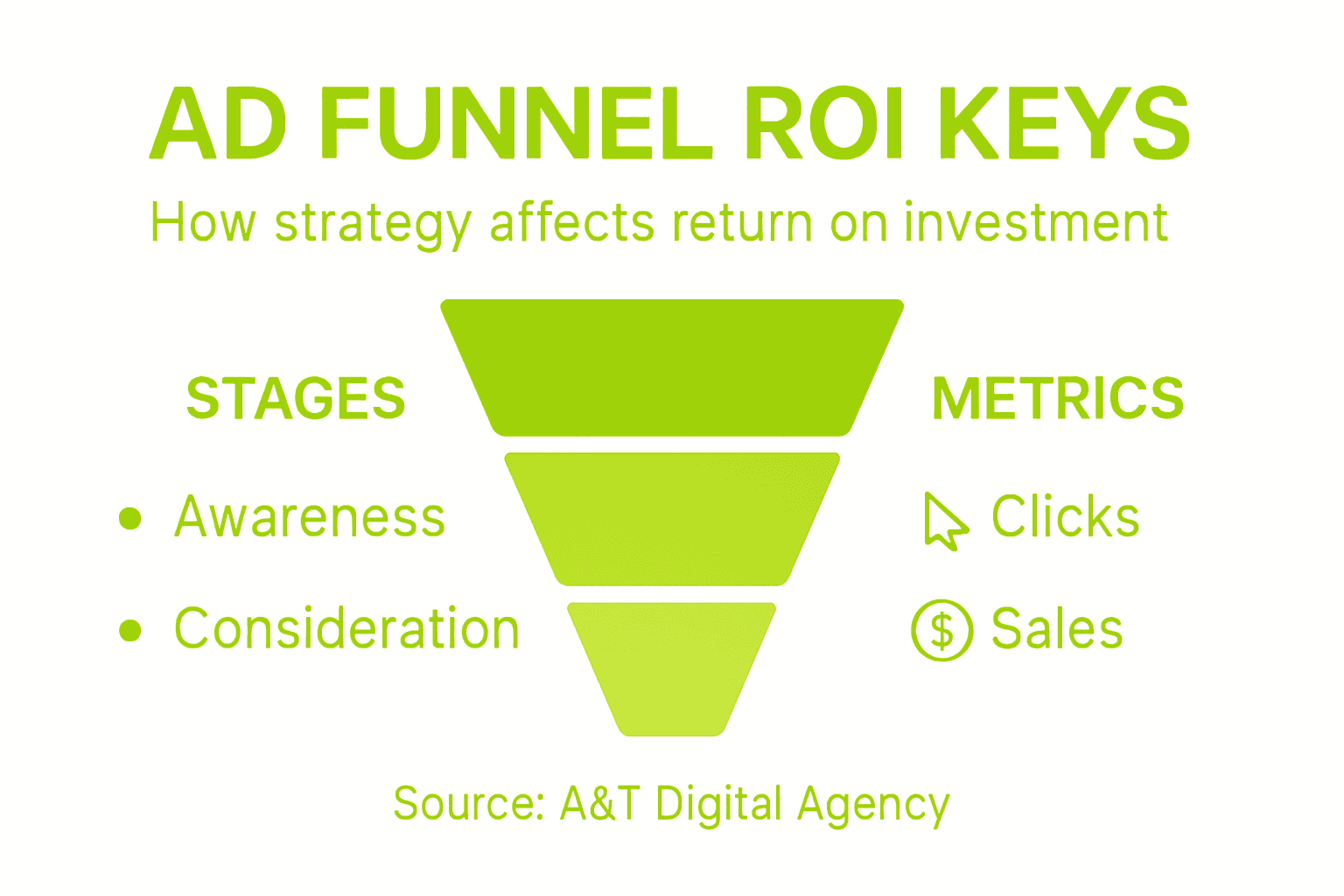
Key metrics for measuring funnel effectiveness include:
Conversion Rates: Percentage of prospects moving between funnel stages
Customer Acquisition Cost (CAC): Total expense of acquiring a new customer
Customer Lifetime Value (CLV): Total revenue generated per customer
Drop-off Points: Stages where potential customers exit the funnel
Engagement Rates: Level of interaction across different marketing touchpoints
Digital marketing funnel strategies emphasize continuous optimization through data-driven insights. Sophisticated marketers leverage advanced analytics tools to create dynamic, responsive marketing ecosystems that adapt in real-time to customer behaviors.
Optimization techniques involve:
Implementing sophisticated tracking mechanisms
Conducting A/B testing across funnel stages
Creating personalized content for specific audience segments
Reducing friction points in the customer journey
Developing predictive behavioral models
The most successful marketing strategies treat the funnel as a living, evolving system. By continuously monitoring performance metrics and being willing to experiment with new approaches, businesses can create increasingly efficient customer acquisition pathways.
Pro tip: Develop a comprehensive analytics dashboard that tracks key performance indicators across all funnel stages, enabling real-time insights and rapid strategic adjustments.
Common Ad Funnel Mistakes and What to Avoid
Navigating the complex landscape of digital marketing requires understanding the most critical pitfalls that can derail your advertising strategy. Marketing funnel strategies reveal numerous common mistakes that can significantly impact campaign performance and overall return on investment.
The most frequent ad funnel errors include:
Inconsistent Messaging: Failing to align communication across different funnel stages
Neglecting Audience Segmentation: Treating all potential customers as a monolithic group
Overlooking Drop-off Points: Not analyzing where and why prospects exit the funnel
Lack of Multi-Channel Integration: Creating disjointed experiences across platforms
Ignoring Customer Behavior Data: Relying on assumptions instead of actionable insights
Audience funnel disciplinedemands a sophisticated approach to understanding and addressing potential weaknesses. Successful marketers recognize that each stage of the funnel requires unique strategies and targeted interventions.
Most businesses struggle with fundamental misunderstandings about funnel effectiveness:
Assuming linear customer journeys
Using generic, non-personalized content
Failing to adapt strategies based on performance data
Undervaluing mid-funnel engagement
Neglecting post-conversion relationship building
The most critical insight is that ad funnels are dynamic, living systems that require constant monitoring, analysis, and refinement. Rigorous testing, granular audience understanding, and adaptive strategies separate successful campaigns from mediocre ones.
Pro tip: Implement a robust analytics framework that tracks customer interactions across all funnel stages, enabling real-time insights and rapid strategic adjustments.
Unlock the True Power of Your Ad Funnel Strategy with Marketing Agency
Navigating the complexities of a modern ad funnel strategy is no easy task. The article highlights challenges like managing non-linear customer journeys, creating personalized messaging, and optimizing multi-channel touchpoints to boost conversion rates and ROI. If aligning your campaigns with these evolving funnel stages feels overwhelming or if you struggle to turn data-driven insights into actionable growth, you are not alone. Achieving measurable results demands expert strategic planning, precise audience segmentation, and continuous optimization — all areas where many businesses falter.
A&T Digital Agency specializes in performance marketing that brings your ad funnel to life, delivering real revenue growth and lead generation across competitive industries like healthcare, retail, and tech. From strategic campaign planning to creative development and rigorous data analysis, our boutique team crafts adaptive, high-ROI Google Ads and Meta campaigns designed to meet each stage of your funnel challenges head-on. Discover how our tested approach harnesses the dynamic nature of digital consumer behavior and turns complexity into clarity.
Ready to transform your digital marketing funnel into a powerful engine for growth? Visit A&T Digital Agency now to explore how our performance marketing solutions can optimize your paid advertising spend and amplify conversions. Don’t let outdated funnel assumptions hold back your business. Take the first step toward smarter, personalized advertising that drives measurable results today.
Frequently Asked Questions
What is an ad funnel strategy?
An ad funnel strategy is a systematic approach used by businesses to guide potential customers through their purchasing journey, transforming them from initial awareness to final purchase and post-purchase loyalty.
How does the modern ad funnel differ from the traditional model?
Unlike the traditional linear model, modern ad funnels are dynamic and non-linear, recognizing that consumers move through various stages in a complex manner influenced by multiple touchpoints across different platforms.
Why is it important to have personalized messaging in ad funnels?
Personalized messaging is crucial because it aligns with the specific needs and behaviors of consumers at each funnel stage, enhancing engagement and increasing the likelihood of conversion.
What are common mistakes to avoid in ad funnel strategies?
Common mistakes include inconsistent messaging across stages, neglecting audience segmentation, overlooking drop-off points, and failing to incorporate customer behavior data into decision-making.


