Performance Marketing Guide 2026: Boost ROI with Proven Tactics
Posted on
Marketing
Posted at

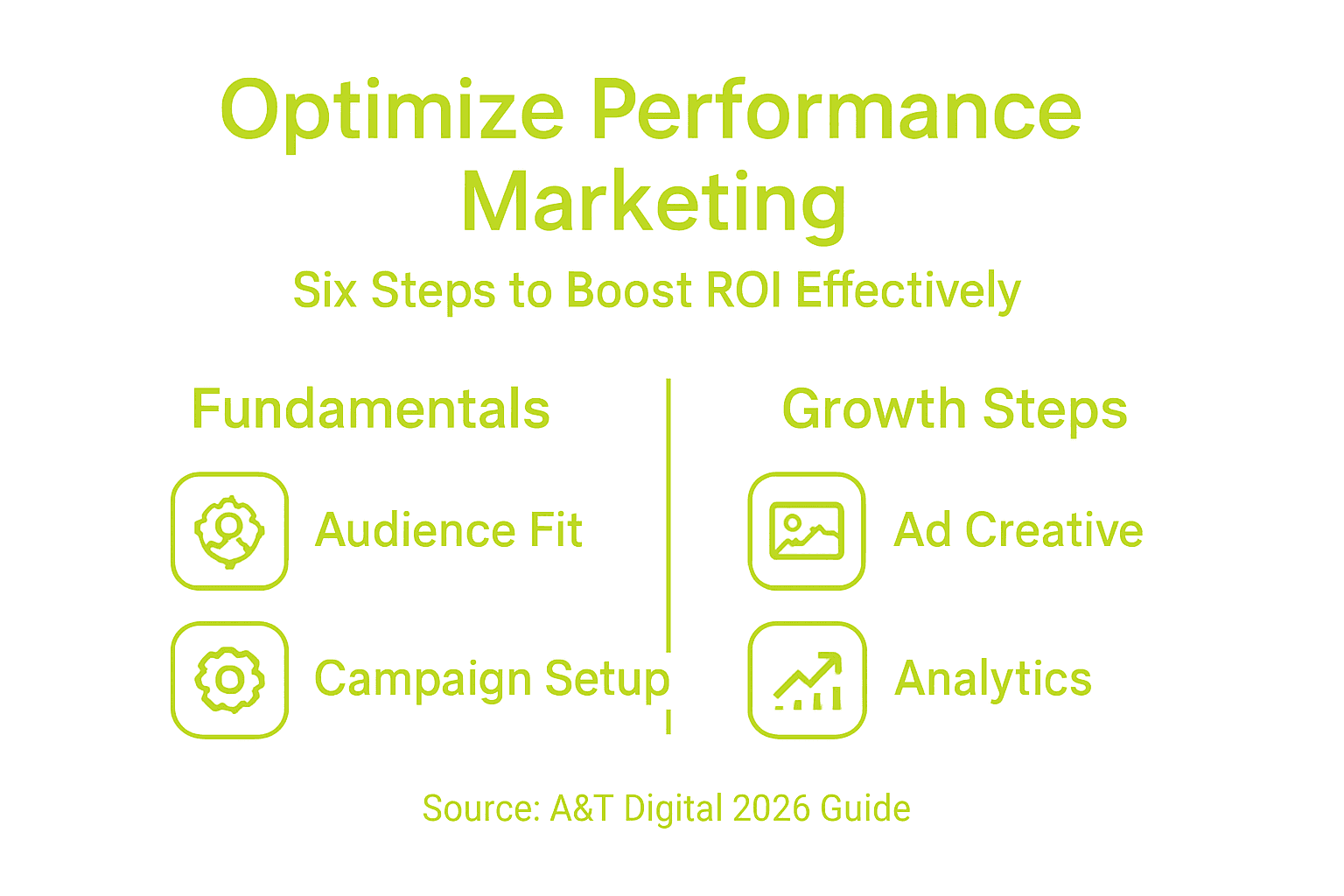
Every digital marketing manager knows the pressure to drive stronger revenue results year after year. With budgets under scrutiny, aligning your tactics with clear business goals and a precise audience fit is more crucial than ever. Performance marketing success comes from detailed segmentation and ongoing optimization rooted in actionable data. This guide breaks down proven steps for creating smarter, data-driven marketing strategies that help your e-commerce campaigns work harder and deliver measurable growth.
Table of Contents
Quick Summary
Key Insight | Explanation |
Focus on Audience Segmentation | Deeply segment your audience to tailor marketing efforts and improve engagement rates. Understanding behaviors increases effectiveness. |
Create Scalable Campaign Structures | Develop flexible campaign frameworks that adapt to growth and change, ensuring efficient resource use and quick pivots. |
Use Data-Driven Marketing | Implement precise targeting and advanced analytics from launch to maximize campaign performance and ROI effectively. |
Continuous Optimization is Key | Monitor and adjust campaigns in real-time using analytics to achieve incremental gains and improve marketing outcomes. |
Verify ROI for Future Strategies | Regularly assess campaign effectiveness and ROI to refine strategies and ensure sustainable business growth. |
Assess Business Goals and Audience Fit
Understanding your business goals and identifying the perfect audience requires strategic planning and precise targeting. Effective market research transforms your performance marketing approach from guesswork to precision.
To kickstart this process, break down your assessment into clear, actionable stages:
Define specific revenue targets
Analyze current customer demographics
Map out key performance indicators (KPIs)
Identify potential growth segments
The core of audience fit lies in detailed segmentation. Dive deep into behavioral data, understanding not just who your customers are, but how they think, interact, and make purchasing decisions. This means examining factors like:
Here’s how segmentation factors impact targeted marketing results:
Segmentation Factor | Targeting Benefit | Business Impact |
Age range | Tailored messaging | Higher engagement rates |
Income level | Relevant product offers | Improved conversion quality |
Online behavior | Personalized digital ads | Increased click-through rate |
Purchase history | Upsell/cross-sell strategy | Enhanced customer retention |
Pain points/motivations | Emotional connection | Boosted brand loyalty |
Precision targeting beats broad marketing every single time.
Utilize data-driven insights to align your marketing strategy with genuine audience needs. Digital marketing audits provide critical clarity, helping you optimize resource allocation and maximize campaign effectiveness.
Pro tip: Create multiple audience personas to test different messaging strategies and refine your approach incrementally.
Design Scalable Campaign Structures
Building a robust performance marketing strategy requires creating campaign structures that can grow and adapt with your business. Strategic marketing planning enables you to develop flexible frameworks that maximize your advertising potential.
To design scalable campaigns, focus on these critical elements:
Modular campaign architecture
Flexible budget allocation
Adaptive targeting mechanisms
Performance tracking systems
Start by establishing a baseline campaign framework that allows for easy expansion. This means creating templates and processes that can be quickly replicated and modified across different channels and audience segments.
Consider developing:
Standardized ad creation workflows
Reusable audience targeting parameters
Consistent performance measurement protocols
Integrated reporting dashboards
Scalability is not about size, but about intelligent design.
Each campaign structure should incorporate marketing program development principles that support incremental growth and optimization. This approach ensures you can quickly pivot and adjust your strategies based on real-time performance data.
Compare key performance marketing campaign elements for scalability:
Element | Supports Growth | Example Advantage |
Modular architecture | Easy channel expansion | Adapt to new platforms |
Flexible budgets | Responsive spending changes | Shift funds as needed |
Adaptive targeting | Rapid audience pivots | Refine segments instantly |
Reporting dashboards | Immediate insight sharing | Faster decision-making |
Pro tip: Develop a campaign template library that allows rapid deployment and easy customization across multiple marketing channels.
Craft Compelling Ad Creatives and Messaging
Successful performance marketing hinges on creating ad creatives that speak directly to your audience’s desires and pain points. Data-driven marketing strategies transform generic messaging into powerful communication that drives conversions.
To develop truly compelling ad content, focus on these key strategic elements:
Emotional resonance
Clear value proposition
Audience-specific targeting
Concise and impactful language
Start by understanding your target audience at a deep psychological level. This means going beyond demographic data and uncovering the core motivations and challenges your potential customers face.
Develop ad messaging that:
Addresses specific customer pain points
Highlights unique solution benefits
Creates an immediate emotional connection
Provides clear, tangible outcomes
Effective messaging turns viewers into believers.
Your creative approach should leverage marketing communication techniques that combine analytical insights with creative storytelling. This means crafting narratives that inform and inspire action.

Pro tip: Create multiple ad variations and conduct rapid A/B testing to quickly identify the most resonant messaging for each audience segment.
Launch Campaigns with Data–Driven Settings
Successful performance marketing demands precision and strategic data implementation from the moment you launch your campaigns. Performance data analysis transforms campaign execution from guesswork to a calculated strategy.
To ensure a robust data-driven campaign launch, focus on these critical configuration elements:
Precise audience targeting
Granular conversion tracking
Advanced analytics integration
Dynamic budget allocation
Implement strategic performance metrics that go beyond surface-level analytics. This means establishing a comprehensive measurement framework that captures nuanced insights about campaign performance.
Your launch should include:
Predefined key performance indicators (KPIs)
Automated tracking mechanisms
Real-time performance dashboards
Continuous optimization triggers
Data transforms marketing from an art into a precise science.
Leverage digital analytics insights to create campaigns that adapt in real time. By integrating advanced tracking and responsive settings, you can create campaigns that continually learn and optimize themselves.
Pro tip: Configure tracking pixels and conversion events before launching to capture maximum granular data about user interactions and campaign performance.
Optimize and Scale Based on Real–Time Analytics
Real-time analytics transforms performance marketing from static strategies to dynamic, responsive campaigns that continuously evolve. Web analytics insights enable precise, immediate adjustments that dramatically improve marketing effectiveness.
To optimize and scale your campaigns effectively, implement these strategic approaches:
Continuous performance monitoring
Automated optimization triggers
Rapid experimentation protocols
Adaptive budget reallocation
Develop a systematic optimization framework that turns data into actionable strategies.
Your scaling process should incorporate:
Hourly performance tracking
Segment-specific conversion analysis
Automated performance scoring
Machine learning optimization recommendations
Small, consistent improvements compound into massive gains.
Leverage performance management techniques to create a responsive marketing ecosystem. By treating each campaign as a living, breathing entity that learns and adapts, you can achieve exponential growth and efficiency.
Pro tip: Set up custom alerts for key performance indicators to enable immediate intervention when campaign metrics deviate from expected ranges.
Verify ROI and Refine Future Strategies
Successful performance marketing requires rigorous evaluation and strategic adaptation of your campaign outcomes. Performance measurement frameworks provide the critical tools to validate your marketing investments and chart future success paths.
To effectively verify ROI and refine strategies, focus on these key assessment elements:
Comprehensive financial analysis
Comparative performance benchmarking
Detailed conversion pathway examination
Strategic insight extraction
Develop a systematic ROI validation process that transforms raw data into actionable strategic insights. Your verification approach should include:
Precise revenue attribution modelling
Customer lifetime value calculations
Cost per acquisition analysis
Campaign effectiveness scoring
True marketing mastery lies in learning from every data point.
Utilize annual performance evaluation techniques to create a continuous improvement cycle. By treating each campaign as a learning opportunity, you can incrementally enhance your marketing approach and drive sustainable growth.
Pro tip: Create a standardized ROI dashboard that automatically highlights performance deviations and suggests potential strategic adjustments.
Elevate Your Performance Marketing with Strategic Expertise
The challenges of crafting scalable campaign structures, launching data-driven settings, and optimizing real-time analytics can overwhelm small to medium-sized businesses striving for high ROI. Your goals to precisely target audiences, implement modular campaign frameworks, and verify true marketing effectiveness are critical steps outlined in the Performance Marketing Guide 2026. These concepts demand more than just theory — they require hands-on, tested execution backed by creative development and continuous optimization.
At A&T Digital Agency, we specialize in transforming these proven tactics into measurable growth. Our boutique team expertly combines strategic planning with high-performing Google Ads and Meta campaigns tailored to your unique business challenges. From precise audience segmentation to dynamic budget management and rapid A/B testing, we help you scale paid advertising efficiently without wasting ad spend. See how our personalized approach has driven success for telehealth providers, entertainment venues, and retail brands by visiting A&T Digital Agency.
Ready to stop guessing and start growing? Discover how our data-driven strategies and creative execution deliver real results in competitive digital spaces.
Amplify your marketing impact today.
Please reach out to us at A&T Digital Agency now to build a tailored performance marketing system that scales with your business and maximizes ROI.
Frequently Asked Questions
What are the first steps to assess my business goals for performance marketing?
To assess your business goals, start by defining specific revenue targets and analyzing your current customer demographics. Create a clear list of key performance indicators (KPIs) to measure success, and identify potential growth segments to tailor your marketing efforts.
How can I design scalable campaign structures for my marketing efforts?
To design scalable campaigns, develop a modular campaign architecture that allows easy expansion. Implement flexible budget allocation and adaptive targeting mechanisms, enabling your campaigns to evolve as your business grows.
What key elements should I focus on when crafting ad creatives and messaging?
Focus on creating ad content that has emotional resonance and a clear value proposition tailored to your audience. Ensure that your messaging addresses specific pain points and highlights the unique benefits of your solutions.
How do I implement a data–driven campaign launch?
Start by setting precise audience targeting criteria and defining granular conversion tracking mechanisms. Use advanced analytics integration to monitor performance in real time, enabling you to make informed adjustments immediately after launch.
What strategies can I use to optimize and scale my campaigns based on analytics?
Implement continuous performance monitoring and set up automated optimization triggers to improve campaigns. Establish rapid experimentation protocols to test different strategies, helping you identify what works best to enhance your marketing effectiveness.
How can I verify the ROI of my performance marketing campaigns?
Develop a comprehensive financial analysis that includes revenue attribution modelling and cost per acquisition analysis. Regularly evaluate your campaign effectiveness and extract strategic insights to refine future marketing efforts.
Recommended
Performance Marketing Agency | Multi-Channel Paid Ads || A&T Agency
Performance Marketing Agency | Multi-Channel Paid Ads || A&T Agency
Performance Marketing Agency | Multi-Channel Paid Ads || A&T Agency
Performance Marketing Agency | Multi-Channel Paid Ads || A&T Agency
ROAS is Dead: Why Fortune 500s Track POAS Instead (And You Should Too)


