Why Test Paid Campaigns: Maximizing ROI and Growth
Posted on
Marketing
Posted at

More than 60 percent of e-commerce brands struggle to achieve consistent returns from paid advertising. Every marketing director knows that throwing budget at campaigns without a clear testing strategy can drain profits quickly. Understanding how to design and iterate paid campaigns - with data leading every decision - gives brands the power to increase revenue and outpace competitors. This overview breaks down practical, evidence-backed approaches that transform guesswork into measurable growth.
Table of Contents
Key Takeaways
Point | Details |
Establish Clear Objectives | Define what success looks like for each test to guide your strategy effectively. |
Embrace Continuous Testing | Approach campaign testing as an ongoing process, allocating 10-15% of your budget for experimentation. |
Utilize Multiple Test Types | Implement various testing methods, like A/B and multivariate testing, to refine your advertising strategies. |
Monitor Performance Metrics | Analyze key metrics such as click-through and conversion rates to inform data-driven decision-making. |
Defining Paid Campaign Testing Strategies
Successful paid advertising demands a strategic approach to testing that transforms potential guesswork into precise, measurable insights. Campaign testing allows marketers to systematically validate hypotheses about ad performance, audience targeting, and conversion optimization. By implementing structured campaign planning methods, businesses can minimize financial risks and maximize return on advertising investment.
A comprehensive paid campaign testing strategy involves multiple critical components. First, establish clear objectives that define what success looks like for each test. These might include improving click-through rates, reducing cost per acquisition, or increasing conversion percentages. Next, design controlled experiments that isolate specific variables like ad creative, audience targeting, or bidding strategies. Copy testing techniques provide a structured framework for evaluating advertisement effectiveness by measuring consumer responses before large-scale deployment.
Marketers should approach paid campaign testing as an ongoing process rather than a one-time event. This means creating a systematic methodology for collecting data, analyzing results, and implementing incremental improvements. Effective testing strategies typically involve:
Developing precise hypotheses about potential performance improvements
Creating statistically meaningful test variations
Tracking granular performance metrics
Establishing clear success benchmarks
Implementing rapid iteration cycles
Pro tip: Allocate 10-15% of your advertising budget specifically for testing new strategies and never stop experimenting with your campaigns.
Essential Types of Paid Campaign Tests
Paid campaign testing is a nuanced discipline that requires marketers to deploy strategic experimental approaches to validate advertising hypotheses. Ad variation testing represents a fundamental method where marketers systematically evaluate different creative elements, messaging, and design components to understand what resonates most effectively with target audiences. Political campaign experiments have shown how randomized control trials can provide precise insights into ad persuasiveness across different audience segments.

Key types of paid campaign tests include audience targeting tests, creative variation tests, and conversion optimization tests. Audience targeting tests help marketers refine their understanding of demographic and psychographic characteristics most likely to respond to specific advertisements. Creative variation tests involve experimenting with different visual elements, copywriting styles, and emotional triggers to determine which combinations generate maximum engagement. Conversion optimization tests focus on analyzing how slight modifications in call-to-action placement, button colors, or landing page design can significantly impact overall campaign performance.
The most sophisticated paid campaign testing strategies incorporate multiple test types simultaneously, creating a comprehensive approach to understanding advertising effectiveness. Marketers should consider implementing:
A/B split testing for direct comparison of campaign variations
Multivariate testing to evaluate multiple variables simultaneously
Audience segmentation tests to identify most responsive customer groups
Conversion funnel tests to optimize entire customer journey
Budget allocation tests to maximize return on advertising spend
Pro tip: Create a systematic testing calendar that schedules regular experiment cycles and allocates specific budget percentages for continuous campaign optimization.
Here is a quick comparison of common paid campaign test types and their primary business benefits:
Test Type | Main Objective | Example Business Impact |
A/B Split Testing | Compare two variations directly | Improved conversion rates |
Multivariate Testing | Test multiple variables at once | Optimized creative elements |
Audience Segmentation | Identify responsive user segments | Higher ROI from targeting |
Conversion Funnel Test | Analyze full customer journey | Reduced drop-off, higher sales |
How Testing Drives Performance Metrics
Performance metrics represent the critical diagnostic tools that transform raw advertising data into actionable strategic insights. Campaign testing serves as the primary mechanism for understanding how different marketing approaches directly influence key performance indicators. Campaign monitoring and evaluation enable marketers to distinguish between tactical outputs and meaningful business outcomes, creating a sophisticated framework for continuous improvement.
The most impactful performance metrics emerge through systematic testing of multiple campaign variables. Digital marketers typically focus on metrics like click-through rates, conversion rates, cost per acquisition, and return on ad spend. By implementing rigorous marketing analytics tools, businesses can transform seemingly abstract data points into concrete strategic decisions. Each test provides granular insights that help refine targeting, messaging, and overall campaign architecture.
Successful performance metric optimization requires a structured approach that encompasses several critical elements:
Establishing clear, measurable objectives before launching tests
Identifying specific key performance indicators (KPIs)
Creating controlled experimental environments
Collecting comprehensive performance data
Analyzing results with statistical significance
Implementing learnings across broader marketing strategies
Pro tip: Develop a standardized performance metric dashboard that tracks test results in real-time, allowing for immediate strategic adjustments and continuous campaign optimization.
The following table outlines key marketing metrics, what they measure, and their strategic value:
Metric | What It Measures | Strategic Value |
Click-Through Rate | User engagement with ads | Identifies compelling creatives |
Conversion Rate | Percent of users who take action | Measures campaign effectiveness |
Cost Per Acquisition | Spend per new customer | Assesses cost efficiency |
Return on Ad Spend | Revenue from each ad dollar | Guides budget allocation decisions |
Key Risks of Skipping Campaign Testing
Skipping systematic campaign testing creates significant strategic vulnerabilities that can devastate marketing performance and waste valuable advertising budgets. Campaign evaluation is not optional but essential for sustainable digital marketing success. Campaign monitoring risks demonstrate how unchecked advertising strategies can lead to substantial financial and strategic missteps that undermine organizational objectives.
Without rigorous testing, marketers expose themselves to multiple critical risks that can dramatically reduce campaign effectiveness. These risks include misallocating marketing budgets, targeting incorrect audience segments, using ineffective messaging, and failing to understand nuanced customer responses. Public communication campaign strategies reveal that untested campaigns frequently miss critical audience engagement opportunities, resulting in reduced persuasion and potential negative brand perception.
The most significant risks of skipping campaign testing encompass:
Wasting financial resources on unproductive marketing channels
Developing messaging that fails to resonate with target audiences
Misunderstanding customer behavior and preferences
Creating campaigns with unclear or ineffective calls to action
Reducing overall marketing return on investment (ROI)
Potentially damaging brand reputation through poorly conceived messaging
Pro tip: Allocate at least 10% of your marketing budget specifically for testing and experimentation to prevent costly strategic mistakes and continuously refine your approach.
Cost Efficiency and Real Data ROI Insights
Maximizing return on investment requires a nuanced understanding of how strategic testing directly translates into financial performance. Campaign ROI is not simply about spending less, but about intelligently allocating resources to generate maximum impact. Cost-effectiveness analyses demonstrate that precise measurement allows marketers to prioritize interventions that deliver meaningful results within financial constraints.
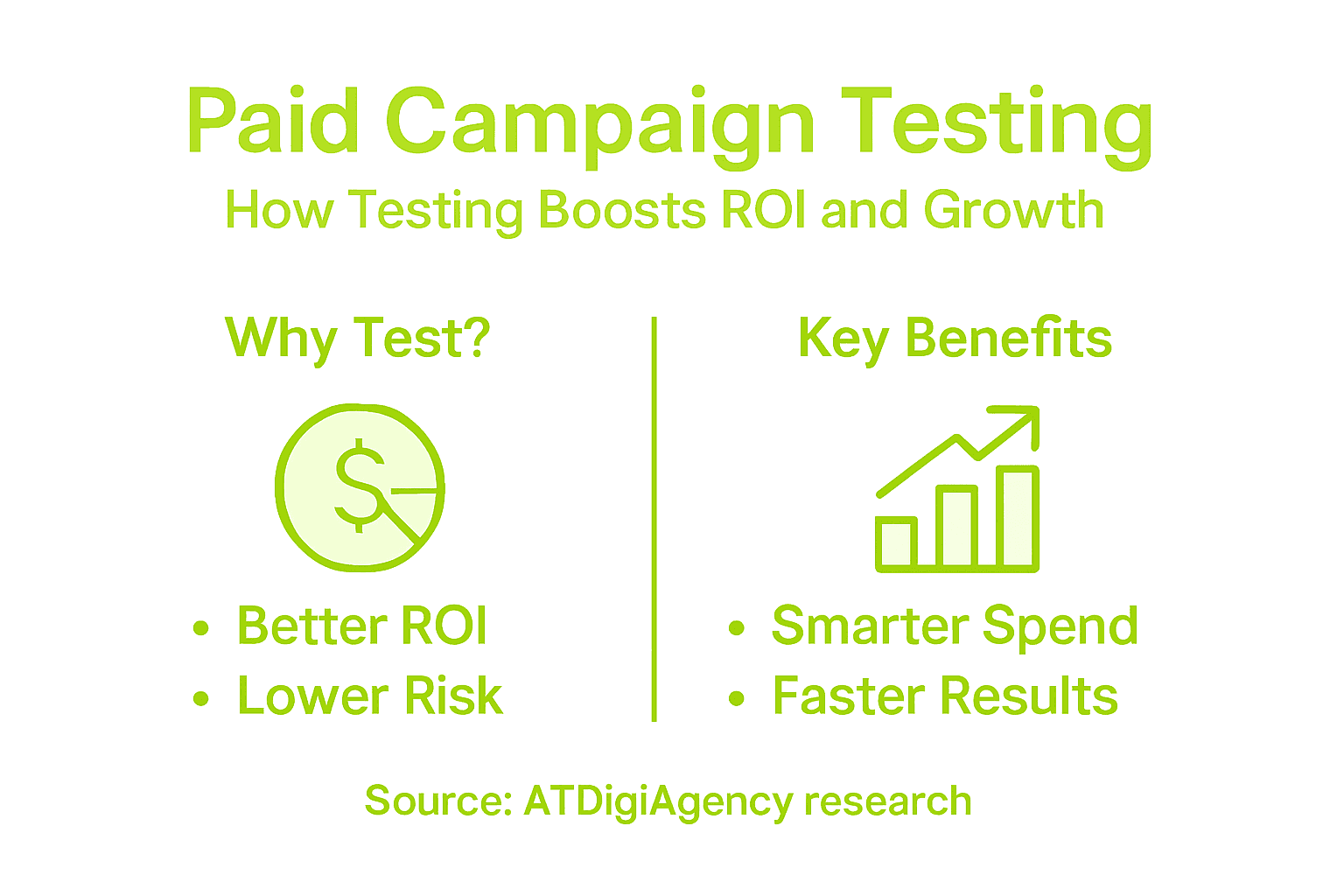
Real-world ROI insights reveal that successful paid campaigns depend on sophisticated testing methodologies that go beyond surface-level metrics. Digital marketers must develop a comprehensive approach that considers both immediate financial returns and long-term strategic value. Empirical campaign research consistently shows that data-driven testing enables more precise budget allocation, ultimately improving overall campaign efficiency and performance.
Key strategies for achieving superior cost efficiency include:
Implementing rigorous A/B testing across campaign variables
Developing granular performance tracking mechanisms
Creating detailed cost-per-acquisition benchmarks
Continuously refining targeting strategies
Optimizing ad spend based on real-time performance data
Scaling successful campaign elements systematically
Pro tip: Develop a dynamic ROI dashboard that tracks performance metrics in real-time, allowing for immediate budget reallocation and optimization.
Comparing Testing vs Universal Approach
The traditional one-size-fits-all marketing approach represents a fundamentally flawed strategy in an era of increasingly sophisticated digital advertising. Audience segmentation demands precision and nuance that generic campaigns cannot deliver. Psychological research on marketing approaches suggests that uniform messaging fails to account for critical variations in consumer behavior, preferences, and response patterns.
Comprehensive testing reveals the stark limitations of blanket marketing strategies. While one-size-fits-all approaches promise simplicity, they ultimately sacrifice performance and efficiency. Marketing effectiveness research indicates that different consumer segments respond dramatically differently to identical messaging, making precise targeting essential for maximizing campaign performance.
Key differences between testing and one-size-fits-all approaches include:
Customized messaging versus generic communication
Data-driven strategy versus intuition-based decisions
Precise audience targeting versus broad, unfocused approaches
Measurable performance metrics versus subjective outcomes
Dynamic campaign optimization versus static marketing efforts
Higher conversion rates versus diminishing returns
Pro tip: Develop audience personas with granular characteristics and design specific test variations for each segment to unlock true campaign potential.
Unlock Your Paid Campaign Potential with Expert Testing and Optimization
The article shows that skipping systematic paid campaign testing can lead to wasted budget, poor audience targeting, and missed growth opportunities. If you want to avoid these costly pitfalls and maximize your digital advertising ROI through data-driven strategies like A/B split testing and audience segmentation, it is crucial to partner with experts who specialize in turning insights into action. At ATDigiAgency, we understand the challenge of transforming complex campaign data into measurable revenue growth and lead generation without overwhelming you with unnecessary meetings or jargon.
Our boutique team delivers personalized performance marketing services focused on strategic planning, creative development, and ongoing optimization across platforms like Google Ads and Meta. By applying rigorous testing methodologies and continuous campaign refinement, we help small and medium-sized businesses scale efficiently and confidently in competitive markets.
Take control of your paid campaigns today with tailored, tested strategies proven to improve conversion rates and reduce wasted ad spend. Discover how our proven approach can create significant impact for your business by visiting ATDigiAgency. Learn more about how we build and optimize high ROI ad systems at our homepage and explore how performance marketing solutions drive growth in real-world case studies.
Ready to stop guessing and start growing with paid campaigns that deliver measurable results? Connect with ATDigiAgency now and turn your ad spend into profitable growth through expert testing and data-driven performance marketing.
Frequently Asked Questions
What are the main benefits of testing paid campaigns?
Testing paid campaigns helps marketers identify what works best for their target audience, improve key performance metrics such as click-through rates and conversion rates, and ultimately maximize return on investment (ROI).
How should I approach setting up a paid campaign test?
Begin by establishing clear objectives that define your success metrics, design controlled experiments to isolate specific variables, and track performance metrics to analyze results accurately.
What types of tests should I consider for my paid campaigns?
Consider implementing A/B split testing, multivariate testing, audience segmentation tests, and conversion funnel tests to gain insights into different aspects of your campaigns and refine your strategies accordingly.
Why is continuous testing important in paid campaigns?
Continuous testing allows you to systematically validate hypotheses, make data-driven decisions, and adapt to changes in audience behavior, ensuring your campaigns remain effective over time.