Why Optimize Ad Campaigns for Higher ROI
Posted on
Marketing
Posted at

Launching a Google Ads campaign without a strategy can feel like throwing money into the wind. For American marketing directors aiming for higher ROI and more leads, every dollar counts. Ad campaign optimization is a dynamic, data-driven process that transforms digital advertising from guesswork into measurable growth. Explore how systematic tracking, mathematical analysis, and smarter budget allocation improve real results and help your e-commerce business thrive in a competitive market.
Table of Contents
Key Takeaways
Point | Details |
Ad Campaign Optimization | Optimize campaigns systematically for better ROI through performance tracking, budget refinement, and strategic targeting. |
Types of Optimization | Focus on audience targeting, keyword optimization, and creative asset testing to improve overall advertising effectiveness. |
Impact on ROI | Implementing optimization techniques leads to increased efficiency and performance, directly contributing to measurable business growth. |
Common Pitfalls | Avoid strategic misalignment and performance tracking failures by maintaining clear communication and real-time monitoring across teams. |
Defining Ad Campaign Optimization
Ad campaign optimization represents a strategic, data-driven approach to systematically improving digital advertising performance. At its core, refining advertising strategies to maximize return on investment (ROI) across multiple digital platforms.
This systematic process involves several critical components that transform traditional advertising into a precise, measurable science:
Detailed performance tracking across digital channels
Mathematical analysis of campaign metrics
Continuous budget allocation refinement
Real-time performance adjustments
Strategic targeting improvement
The fundamental goal of ad campaign optimization is to transform raw advertising spend into measurable business growth. Marketing directors must view optimization not as a one-time task but as an ongoing, dynamic process of strategic refinement.

Campaign optimization requires leveraging advanced analytics to understand precise customer interactions, and identifying which advertising elements generate the most meaningful engagement and conversions. This means moving beyond surface-level metrics like impressions to deeply analyze click-through rates, conversion paths, and actual revenue generated.
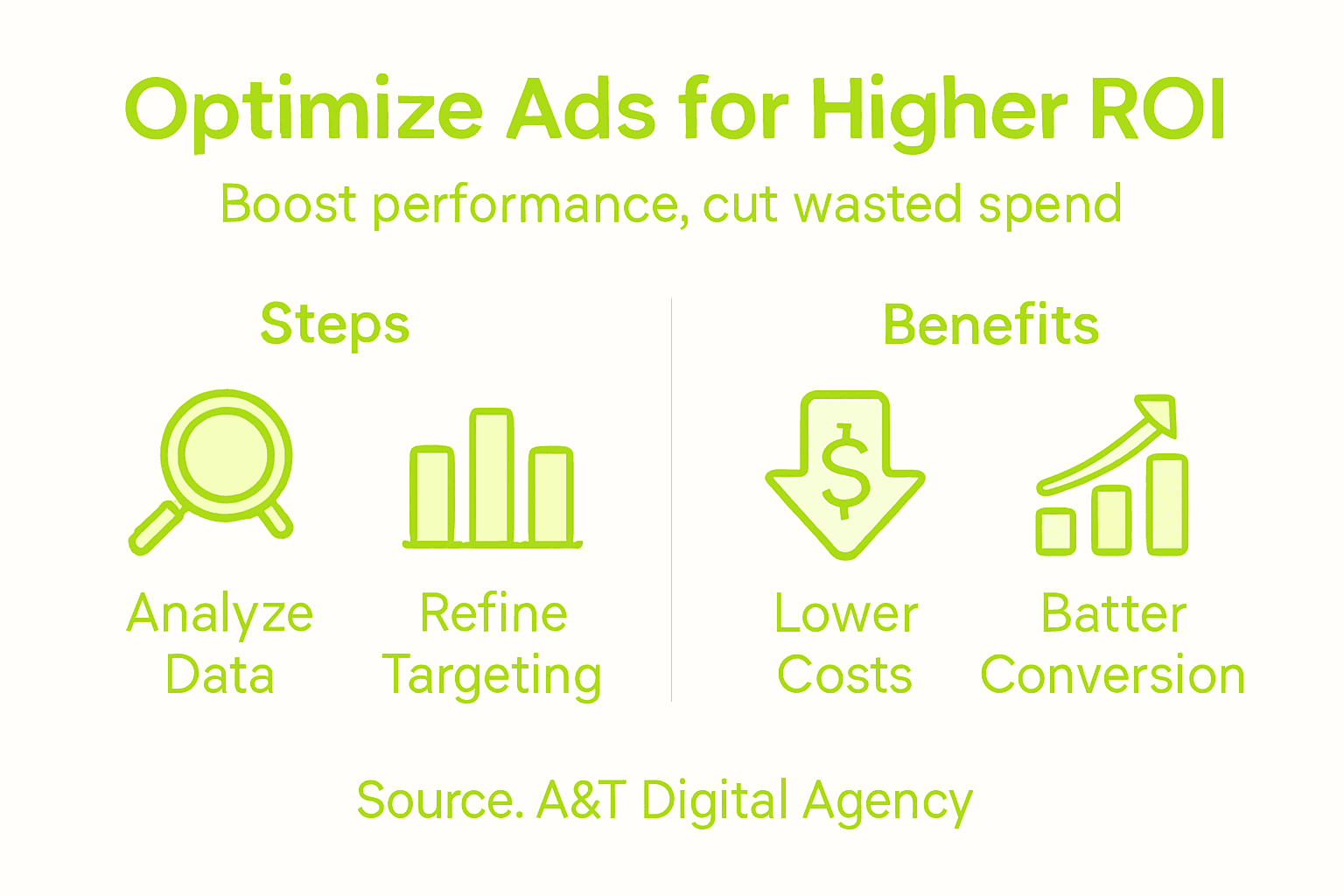
Here’s how core optimization components impact campaign success:
Component | Function in Optimization | Business Impact |
Performance Tracking | Monitors all channel outcomes | Enables informed, agile adjustments |
Mathematical Analysis | Dissects detailed metrics data | Reveals actionable growth levers |
Budget Refinement | Revises spending distribution | Increases marketing efficiency |
Real-Time Adjustments | Tweaks campaigns instantly | Capitalizes on live opportunities |
Advanced Targeting | Narrows the audience focus | Drives higher-quality conversions |
Effective ad campaign optimization turns digital advertising from a cost center into a strategic revenue generation mechanism.
Pro tip: Track your conversion rates meticulously and be prepared to reallocate budgets quickly based on real performance data.
Types of Optimization for Paid Ads
Paid advertising optimization encompasses multiple strategic approaches designed to enhance campaign performance and maximize marketing investments. Paid advertising strategies require systematic refinement across different dimensions to achieve optimal results.
The primary types of paid ad optimization include:
Audience Targeting Optimization
Refining demographic parameters
Implementing precise interest-based segmentation
Developing lookalike audience models
Keyword Optimization
Identifying high-performing search terms
Eliminating low-converting keywords
Expanding semantic keyword variations
Creative Asset Optimization
A/B testing ad copy variations
Rotating and refreshing visual elements
Aligning messaging with audience preferences
Each optimization type serves a distinct purpose in improving campaign efficiency. Audience targeting focuses on reaching the most relevant potential customers, while keyword optimization ensures ads appear for the most appropriate search queries. Creative asset optimization concentrates on crafting compelling messaging that drives engagement and conversions.
Budget allocation represents another critical optimization strategy. Marketing directors must dynamically redistribute advertising spend based on real-time performance metrics, shifting resources toward channels and campaigns demonstrating the highest return on investment.
Successful paid ad optimization transforms digital advertising from a cost center into a precision revenue generation mechanism.
Pro tip: Implement a monthly review process to systematically assess and recalibrate your paid advertising optimization strategies.
How Optimization Impacts ROI
Optimization is the critical bridge between advertising expenditure and measurable business growth. Strategic resource allocation transforms digital advertising from a cost center into a precision revenue generation mechanism.
The direct impact of optimization on ROI manifests through several key mechanisms:
Precision Targeting
Reduces wasted ad spend
Increases conversion probability
Improves audience engagement rates
Performance Analytics
Identifies high-performing channels
Tracks granular campaign metrics
Enables data-driven decision-making
Cost Efficiency
Minimizes unnecessary advertising expenses
Redirects budget to top-performing strategies
Maximizes return per marketing dollar
Marketing directors can leverage optimization techniques to directly improve financial outcomes. By continuously refining audience segments, creative assets, and bidding strategies, businesses can achieve exponentially better results compared to static, unchanging advertising approaches.
Budget reallocation becomes a powerful optimization tool. Sophisticated marketers dynamically shift resources based on real-time performance data, ensuring that every advertising dollar is strategically deployed for maximum impact.
Effective optimization transforms advertising from a guessing game into a precision science, where each campaign iteration improves overall marketing performance.
Pro tip: Implement weekly performance reviews to quickly identify and scale your most effective advertising strategies.
Compare the outcomes of static versus optimized paid ad campaigns:
Approach | Budget Efficiency | Conversion Quality | Revenue Potential |
Static Campaigns | High spending inefficiency | Lower, unfocused leads | Limited business growth |
Optimized Campaigns | Maximized spend value | Targeted, qualified | Significant ROI increase |
Strategies for Efficient Ad Spend
Marketing directors seeking maximum impact must approach ad spending with strategic precision. Campaign strategy optimization transforms advertising from a guesswork expense into a calculated investment mechanism.
Key strategies for efficient ad spend include:
Precision Budget Allocation
Set clear spending limits per channel
Create flexible budget frameworks
Monitor real-time performance metrics
Data-Driven Decision Making
Utilize advanced analytics tools
Track cost per acquisition (CPA)
Compare performance across platforms
Continuous Performance Monitoring
Implement weekly campaign audits
Identify underperforming ad sets
Quickly reallocate resources
Segmentation plays a crucial role in maximizing advertising efficiency. By breaking down audiences into granular segments, marketers can create hyper-targeted campaigns that reduce wasted spending and increase conversion potential. This approach allows for more intelligent resource distribution, ensuring each advertising dollar works harder and smarter.
Modern advertising requires a dynamic approach. Sophisticated marketers continuously test, measure, and adjust their strategies, treating ad spend as a precision instrument rather than a blunt financial tool.
Efficient ad spend is not about spending less, but about spending smarter and more strategically.
Pro tip: Develop a monthly performance dashboard that tracks key metrics and automatically highlights areas requiring budget reallocation.
Common Pitfalls in Campaign Management
Marketing campaign management involves navigating complex challenges that can derail performance and waste valuable resources. Campaign management challenges often emerge from systemic communication and coordination breakdowns that prevent strategic execution.
Common pitfalls in campaign management include:
Strategic Misalignment
Unclear campaign objectives
Inconsistent messaging across channels
Misaligned team expectations
Performance Tracking Failures
Inadequate analytics infrastructure
Lack of real-time monitoring
Missing critical performance indicators
Resource Allocation Mistakes
Random budget distribution
Ignoring channel-specific performance
Delayed response to underperforming campaigns
Communication breakdowns represent a significant risk to campaign success. When marketing teams operate in silos, critical information gets lost, leading to fragmented strategies that reduce overall campaign effectiveness. This disconnect prevents rapid adaptation and strategic pivoting.
Sophisticated marketing teams recognize that campaign management is an interconnected process requiring constant vigilance, communication, and data-driven decision-making. Successful organizations implement robust tracking systems and maintain transparent communication channels to mitigate these common pitfalls.
Effective campaign management transforms potential obstacles into strategic opportunities for optimization.
Pro tip: Establish weekly cross-functional meetings to ensure all team members understand campaign objectives and can quickly address emerging challenges.
Unlock Higher ROI with Expert Ad Campaign Optimization
Struggling to transform your ad spend into measurable business growth is a common challenge for many marketers. The article highlights key pain points such as inefficient budget allocation, lack of real-time performance adjustments, and the need for advanced targeting strategies to maximize conversions. If you want to break free from high spending inefficiencies and low-quality leads, embracing a systematic optimization process is essential.
At A&T Digital Agency, we specialize in performance marketing using platforms like Google Ads and Meta campaigns. Our boutique team combines strategic insight with creative execution to deliver deeply personalized service focused on high ROI. Whether you need help with precise budget allocation, dynamic real-time campaign management, or creative asset testing, we build and scale paid advertising systems designed to amplify revenue and lead generation.
Take control of your digital advertising now with a proven partner who turns complex data into actionable growth. Visit A&T Digital Agency to learn how our end-to-end campaign strategy, planning, launch, analysis, and optimization can elevate your ad performance. Don’t wait to optimize. Scale your growth efficiently and experience measurable results today. Discover more about our specialized performance marketing solutions and start converting your ad spend into business success.
Frequently Asked Questions
What is ad campaign optimization?
Ad campaign optimization is a strategic, data-driven approach aimed at improving digital advertising performance by refining advertising strategies to maximize return on investment (ROI).
How does optimization impact ROI for businesses?
Optimization enhances ROI by ensuring precise targeting, improving audience engagement, reducing wasted ad spend, and enabling data-driven decision-making across various advertising channels.
What are the main components of ad campaign optimization?
The main components include performance tracking, mathematical analysis of metrics, budget allocation refinement, real-time adjustments, and strategic targeting improvements.
Why is continuous monitoring important in ad campaign optimization?
Continuous monitoring allows marketers to quickly identify underperforming campaigns and reallocate resources dynamically, ensuring that every advertising dollar is used effectively for maximum impact.
Recommended
Performance Marketing Agency | Multi-Channel Paid Ads || A&T Agency
Performance Marketing Agency | Multi-Channel Paid Ads || A&T Agency
Performance Marketing Agency | Multi-Channel Paid Ads || A&T Agency
Performance Marketing Agency | Multi-Channel Paid Ads || A&T Agency
Insights & Strategies: Conversion Rate Optimization Blog | Conversion Design


