Role of Google Ads in E-commerce Growth
Posted on
Marketing
Posted at

Every e-commerce founder and marketing manager knows that spending money on ads without clear results is frustrating and costly. Understanding how Google Ads works is not just smart, it is necessary for brands aiming to connect with buyers who are actively searching for their products. Mastering the pay-per-click model and effective keyword strategies can transform Google Ads from a simple tool into a powerful engine for measurable growth and customer acquisition.
Table of Contents
Key Takeaways
Point | Details |
Pay-Per-Click Model | Google Ads uses a pay-per-click model, ensuring spending aligns with user interest and boosts customer acquisition efficiency for e-commerce. |
Campaign Integration | Successful e-commerce growth requires integrating Google Ads with a broader marketing strategy, leveraging analytics to optimize the entire customer journey. |
Strategic Optimization | Ongoing optimization is critical; brands must analyze performance data regularly to enhance campaigns and cost-effectiveness continuously. |
Diversified Marketing Approach | Relying solely on Google Ads for customer acquisition can be risky; employing a diversified strategy with multiple channels enhances resilience and growth potential. |
Core Principles of Google Ads in Electronic Commerce
Google Ads operates on a fundamentally different principle than traditional advertising. Instead of paying a fixed rate to display your message, you pay only when someone actually clicks your ad. This pay-per-click model aligns your spending directly with user interest, making it one of the most efficient ways to acquire customers for e-commerce businesses. When a potential buyer searches for a product you sell or visits a website related to your industry, your ad has the chance to appear in front of them at exactly the right moment. That’s the power of keyword targeting and placement strategy in capturing high-intent customers.
The foundation of any successful Google Ads campaign rests on three interconnected elements. First, keyword relevance determines when your ads show up. You bid on specific terms your customers actually use when searching, ensuring your ads reach people actively looking for what you offer. Second, ad quality and landing page experience influence how often Google shows your ads and at what cost. Google rewards ads that deliver genuine value and lead to quality user experiences. Third, conversion tracking closes the loop by letting you measure which clicks actually turned into sales, returns, or other valuable actions. Without understanding how these three elements work together, you’re essentially throwing money at the problem without the data needed to fix it.
Beyond individual campaigns, successful e-commerce growth with Google Ads requires integrating paid advertising into your broader marketing strategy. Rather than treating Google Ads as an isolated channel, top performers use it to work alongside organic search optimization, email marketing, and social advertising. The most effective approach combines digital marketing and e-commerce strategies that measure performance through analytics and optimize the entire customer journey. Your first Google Ads campaign might drive awareness among cold audiences, while subsequent campaigns retarget visitors who browsed your products but didn’t purchase. Some campaigns focus on capturing bottom-funnel searches from people ready to buy today, while others build brand recognition among people still researching solutions. Understanding which campaigns serve which purpose in your funnel determines where to allocate your budget for maximum return.
One critical misconception holds many e-commerce brands back: thinking that launching a campaign is enough. Google Ads requires ongoing optimization. Your initial keyword list won’t be perfect. Your ad copy won’t resonate equally with all audiences. Your landing pages might have friction points that prevent conversions. The businesses seeing consistent growth don’t set campaigns and forget them. They analyze performance data weekly, identify which keywords and ad variations drive the lowest cost per acquisition, and continuously reallocate budget toward winners. They test different approaches to find what resonates with their specific customers.
Pro tip: Start by identifying your top 10 products and the exact search terms your customers use to find them, then build your initial keyword list around those terms rather than guessing what people might search for.
Key Campaign Types and Formats for Online Stores
Not every Google Ads campaign works the same way, and choosing the wrong format for your goal wastes money fast. Google Ads offers several distinct campaign types, each designed to accomplish different objectives at different points in your customer’s journey. Search Campaigns show text ads at the exact moment someone types keywords related to your products into Google. When someone searches “buy organic coffee online”, your search ad appears alongside the search results. This format is ideal for capturing high-intent customers ready to make a purchase decision right now. Display Campaigns, by contrast, show visual banner ads across thousands of websites your potential customers visit. You might target people interested in coffee equipment, fitness, or health topics, displaying your organic coffee ad to them while they read blogs or news articles. Display reaches people earlier in their research phase, building awareness before they start searching. Then there’s the variety of campaign types supporting ecommerce goals, including Shopping Ads, Video Ads, and Responsive Search Ads, each serving specific purposes in your overall strategy.

Shopping Ads function differently from everything else on Google Ads. Instead of writing ad copy about your products, you upload your product catalog directly to Google. When someone searches for “blue running shoes size 10,” Shopping Ads display actual product images, prices, and your store name. This format connects customers directly to the specific product they want, cutting out the guessing game. For e-commerce brands selling physical products, Shopping Ads often deliver the lowest cost per acquisition because they match people to exact items. YouTube Video Ads place your brand in front of people consuming video content. You can show skippable ads that viewers can skip after five seconds, or longer-form ads for people genuinely interested in your message. Video works exceptionally well for demonstrating product benefits, telling your brand story, or building emotional connections with your audience.
Responsive Search Ads represent a shift in how modern e-commerce advertisers think about ad creation. Instead of writing a single ad and hoping it resonates with everyone, you provide multiple headlines and descriptions. Google’s machine learning tests different combinations automatically, learning which headlines and descriptions perform best with different audiences. One customer might respond to “Free Shipping on Orders Over 50 Dollars,” while another converts better with “Join 100,000 Satisfied Customers.” Responsive Search Ads find these preferences without requiring you to manually split-test dozens of variations. When implementing bidding strategies and audience targeting across formats, the most successful ecommerce brands don’t pick just one campaign type. They layer multiple formats to hit customers at different stages. Someone brand new to your company might first encounter a Display Ad. That sparks curiosity. Days later, when they search for your product category, your Search Ad appears. If they visit your website but leave without buying, Remarketing Ads follow them around the internet, reminding them about the specific product they viewed. Finally, when they are ready to purchase, your Shopping Ad shows the exact item with current pricing.
The choice of campaign type depends entirely on what you need right now. Are you launching a new product and need awareness? Display and Video campaigns build that foundation. Do you have inventory you need to move immediately? Search and Shopping campaigns capture people actively buying. Are you trying to recover sales from people who visited your website? Remarketing campaigns excel at this. Most successful ecommerce operations use a mix of all these formats, with budget allocated based on which campaigns deliver the lowest cost per customer acquisition.
Pro tip: Start with Search Campaigns and Shopping Ads to capture bottom-funnel buyers ready to purchase, then add Display Campaigns once you have data proving which products drive the most conversions.
Here’s a quick comparison of the main Google Ads campaign types used in e-commerce:
Campaign Type | Ad Format | Primary Goal | Ideal Customer Stage |
Search | Text ads | Capture purchase intent | Ready to buy |
Display | Banner/image ads | Build brand awareness | Early research |
Shopping | Product listings | Promote specific products | Active product seekers |
Video (YouTube) | Video ads | Showcase brand/product story | Inspire or educate buyers |
Responsive Search Ads | Adaptive text ads | Test/adapt messaging | All funnel stages |
AI, Automation, and Optimization Based on Data
Google Ads has fundamentally changed how machines handle advertising decisions. What used to require a marketing manager spending hours analyzing spreadsheets and manually adjusting bids now happens automatically through artificial intelligence. When you enable automation features in Google Ads, you’re letting machine learning algorithms analyze millions of data points in real-time to make decisions faster and more accurately than any human could. Consider bid management. A decade ago, setting bids meant guessing what you could afford to pay per click and hoping for the best. Today, Google’s AI evaluates the likelihood that a specific user will convert, the competitive landscape for that keyword at that exact moment, your daily budget constraints, and your target return on ad spend. It adjusts your bid automatically, sometimes hundreds of times per day. The result is dramatically lower cost per acquisition and higher profit margins. AI-driven analytics and bid optimization represent one of the most significant shifts in how e-commerce brands can compete effectively without needing massive marketing teams to manage every campaign detail.
The power of automation extends beyond just adjusting bids. Smart Bidding Strategies like Target Return on Ad Spend (ROAS) and Target Cost Per Acquisition (CPA) let you set a goal and let Google’s AI figure out how to achieve it. You tell Google, “I want to pay no more than 25 dollars per customer acquired,” and the system works backward from that constraint, adjusting bids across thousands of keywords and audience segments to stay within your target. This is genuinely hands-off optimization. Responsive Search Ads, which we discussed earlier, use machine learning to test headline and description combinations and automatically serve the best-performing variants to each audience segment. Dynamic Remarketing learns which products specific users viewed and automatically shows them ads for those exact items, often with personalized pricing or special offers. The automation isn’t replacing strategy, though. It’s replacing the tedious manual work. You still decide your budget, your target profit margin, and your overall business objectives. The AI handles the execution.
Data-driven optimization requires clean conversion tracking and clear business metrics. Without proper setup, automation becomes guesswork for the AI. If Google doesn’t know which clicks actually turned into profitable sales, it can’t optimize toward profitability. This is why behavioral data analysis and automated decision-making depend so heavily on accurate tracking implementation. Many e-commerce brands leave money on the table because they haven’t connected their Google Ads account to their CRM system or e-commerce platform. They track that an ad drove a click and maybe a landing page visit, but not whether that visitor actually purchased, returned the item, or became a repeat customer. Google’s algorithms can only work with the information you give them. A clothing retailer might see one traffic source driving cheap clicks but high returns, while another source drives expensive clicks that result in satisfied customers. Manual bid adjustments might favor the cheap traffic. An AI system with access to returns data knows which source is actually profitable and allocates budget accordingly.
The most successful ecommerce brands use automation as a baseline, not a replacement for strategy. They set up Smart Bidding with realistic targets, enable responsive ads and dynamic formats, implement comprehensive conversion tracking across their entire funnel, and then monitor performance weekly. They look for patterns in the data that the automation might miss. Are certain products generating sales but at a loss? Are certain customer segments profitable while others drain the budget? Are seasonality patterns shifting? They use these insights to adjust their overall strategy, then let automation handle the execution of that refined strategy. Quarterly, they review their conversion tracking setup to ensure the AI is making decisions based on accurate data. This combination of strategic oversight and operational automation is what creates consistent growth.
Pro tip: Set up conversion tracking for your three most valuable customer actions (purchase, high-value purchase, repeat purchase) before enabling automated bidding, so Google’s AI optimizes toward actual business outcomes rather than just clicks.
To clarify the impact of Smart Bidding strategies, here is how different automation types in Google Ads support e-commerce profitability:
Automation Feature | How It Works | Business Impact |
Target ROAS | Sets bids to maximize return on ad spend | Prioritizes highest-value conversions |
Target CPA | Finds conversions at set cost per action | Controls acquisition cost, manages risk |
Responsive Search Ads | Rotates headlines/descriptions automatically | Improves ad relevance and engagement |
Dynamic Remarketing | Shows product ads based on user behavior | Recovers abandoned carts, boosts sales |
Budget Planning and ROI Measurement Essentials
You cannot grow what you cannot measure. This fundamental truth separates ecommerce brands that scale profitably from those that simply spend more money. Budget planning and ROI measurement are not accounting tasks. They are strategic decisions that determine whether your Google Ads investment makes your business stronger or just burns cash. Start with a clear understanding of Return on Investment as a profitability metric, which measures the ratio of net profit to your advertising investment. If you spend 1000 dollars on Google Ads and generate 5000 dollars in revenue, that sounds good until you factor in your cost of goods sold. Maybe that 5000 dollars in revenue only yielded 1200 dollars in actual profit after product costs and fulfillment. Your real ROI is 20 percent, meaning you made 20 cents profit for every dollar spent on ads. That’s barely breaking even. Without this calculation, you might happily continue spending, unaware that you are actually losing money. The goal is not maximum revenue. It is maximum profit at a sustainable growth rate.
Effective budget planning starts with knowing your numbers before you launch a single campaign. Ask yourself three critical questions. First, what is your profit per customer after all expenses? This includes product cost, shipping, returns, customer service, and every other cost associated with that sale. If you sell a product for 50 dollars with a 40 dollar cost of goods sold and average a return rate of 15 percent, your real profit per sale is closer to 6 dollars, not 10 dollars. Second, what is your customer lifetime value? A first-time buyer generating 6 dollars profit is worth far less than a repeat customer who buys four times per year. Understanding whether your customers buy once or ten times completely changes your budget math. Third, what marketing spend can you afford? If your average profit per customer is 6 dollars, you cannot spend 10 dollars acquiring them on Google Ads. You need headroom for platform fees, other marketing channels, and business operations. Many new e-commerce brands start with a maximum cost per acquisition target, like 3 dollars per customer, leaving enough margin for profitability and scaling. This target becomes your North Star for campaign optimization. When implementing budget allocation and performance goal-setting strategies, successful brands establish monthly budgets based on these numbers, not arbitrary amounts. If you can profitably acquire customers at 3 dollars each and your monthly profit target is 2000 dollars, you need approximately 667 customer acquisitions. At a 3 percent conversion rate, that requires roughly 22,000 clicks, which costs about 6600 dollars at a 30-cent cost per click. That becomes your monthly budget.
Measuring ROI requires connecting Google Ads data to your actual business results. Google’s reporting dashboard shows you clicks and conversions within the platform, but “conversions” as Google defines them might just be purchases. You need to know profitability. Set up conversion values in Google Ads that reflect your actual profit per sale, not just the transaction amount. If you sell a 50-dollar product with a 6-dollar profit, mark that conversion as 6 dollars in value. Now when Google reports “1000 dollars in conversion value,” you know that represents actual profit, not gross revenue. Layer on additional analysis by exporting Google Ads data into Google Analytics or your business intelligence platform. Look for patterns. Which keywords drive the most profitable customers? Which audience segments have the best lifetime value? Which geographic regions or devices convert at the highest profit margins? A campaign driving 1000 conversions at a 50-dollar average order value looks great until you realize 80 percent of those are returns or come from unprofitable customer segments. Weekly analysis is minimum. Daily analysis is better. You are looking for drift. Is your cost per acquisition creeping up? Are certain products becoming less profitable? Are seasonal patterns emerging?
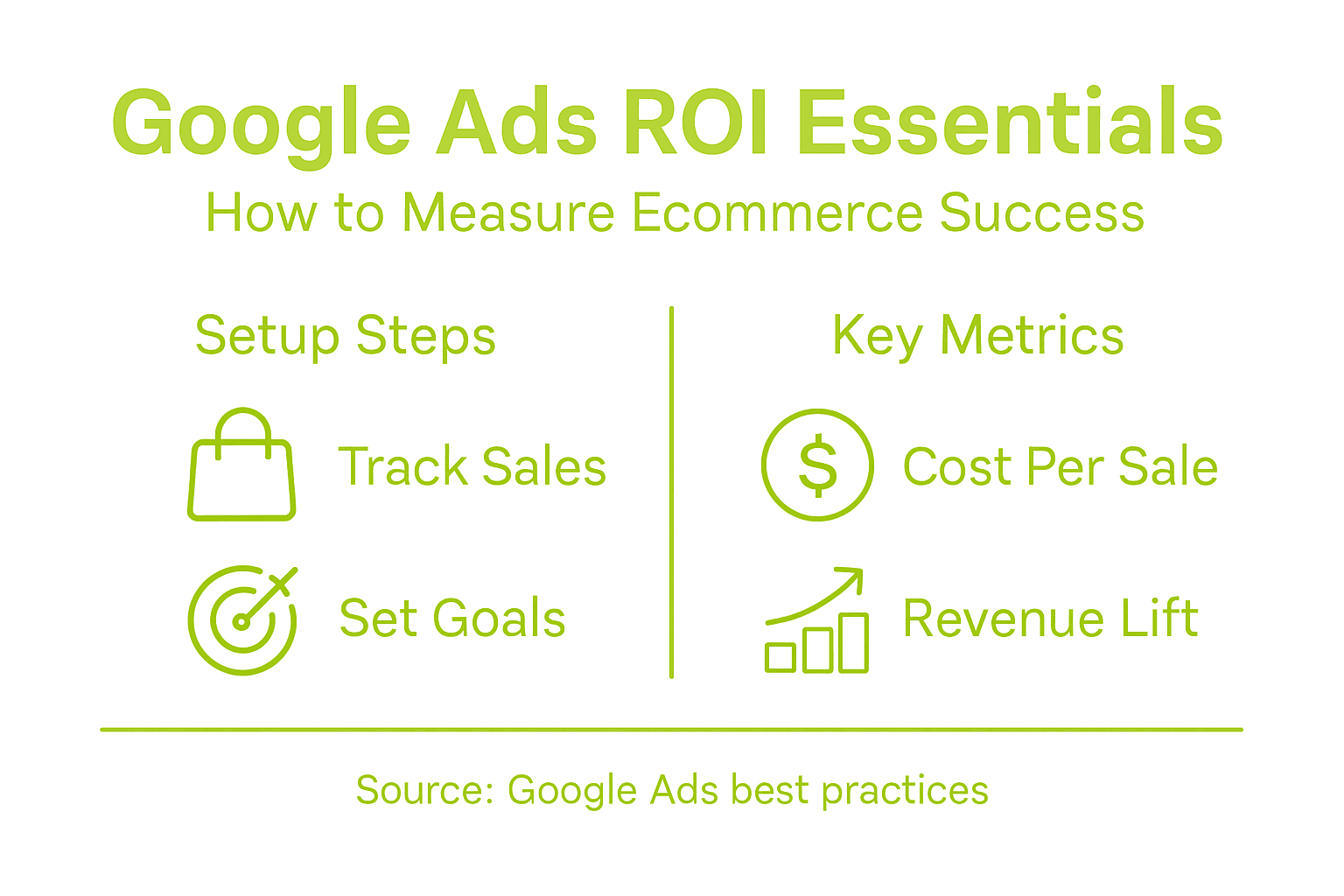
Budget reallocation based on performance data is where strategy meets execution. If Search Campaigns consistently deliver customers at a 2.50 dollars while Display Campaigns average 4.50 dollars, shifting budget from Display to Search improves profitability. If Video Ads drive high-value repeat customers while Search Ads drive one-time buyers, you might accept, higher short-term cost per acquisition on Video because lifetime value justifies it. The most successful ecommerce brands review campaign performance weekly and reallocate budgets monthly based on what the data reveals. They also forecast. If you are growing at 10 percent month over month and profit per customer remains constant, you can predict when you will hit profitability targets and adjust campaigns accordingly. If you notice cost per acquisition rising while customer quality declines, you reduce spend before problems escalate. This combination of clear metrics, regular analysis, and decisive budget reallocation turns Google Ads from a marketing expense into a profit engine.
Pro tip: Calculate your maximum cost per acquisition as 30 percent of your profit per customer, then set this as your bidding target in Google Ads campaigns to ensure every customer acquired contributes meaningfully to overall profitability.
Common Pitfalls and How to Avoid Them
Google Ads makes it deceptively easy to spend money. Click a few buttons, set a budget, and campaigns launch within hours. What takes months to notice is that most of that spending produces nothing. The difference between brands that scale profitably and those that crash comes down to avoiding predictable mistakes that plague e-commerce marketers. One of the most dangerous pitfalls is confusing correlation with causation. You spend 5000 dollars on Google Ads one month, and revenue jumps 15 percent. That looks like a win. But here is the problem. You cannot know how much of that revenue growth came from your ads versus other sources like organic search, direct traffic, word of mouth, or seasonal patterns. Many e-commerce brands make the mistake of attributing sales to ads without proper measurement models. They assume every conversion that happens after an ad click was caused by that ad. In reality, some customers would have found you anyway through search or direct navigation. You end up paying for conversions that would have happened organically. This overestimation of ad impact leads to overspending on low-performing campaigns while underinvesting in channels that actually drive growth.
The solution is implementing proper attribution modeling. Last-click attribution, where all credit goes to the final touchpoint before a conversion, vastly overestimates Google Ads impact. First-click attribution does the opposite, crediting your awareness campaigns for sales that actually resulted from a competitor’s retargeting campaign. Multi-touch attribution, where credit is distributed across multiple touchpoints in the customer journey, provides a more accurate picture. A customer might first discover you through a Display Ad, then search your brand name and click a Search Ad, then visit your website directly and purchase. Multi-touch attribution recognizes that all three touchpoints contributed to the sale. Google Analytics 4 offers built-in attribution modeling, but many brands never configure it properly. They default to last-click and never dig deeper. Another critical mistake is targeting too broadly. New ecommerce brands often launch campaigns with vague targeting, hoping to reach “anyone who might buy.” They target keywords like “gift ideas” or “online shopping” instead of the specific products they sell. They target audiences interested in “shopping” instead of audiences interested in their specific product category. This broad targeting dilutes their budget across low-intent users. Someone searching “for gift ideas” might buy from anyone. Someone searching “best organic coffee grinder under 100 dollars” is far more likely to buy from you if you sell coffee grinders. Tight audience targeting combined with specific keyword selection produces higher-quality conversions at lower cost. Start narrow, measure performance, and only expand to broader audiences once you have proven higher intent variations are working.
Poor mobile optimization represents another silent killer. Many e-commerce brands optimize their desktop experience obsessively while neglecting mobile. Your ads might drive high-intent traffic, but if those visitors land on a mobile site that loads slowly, requires annoying account creation before browsing, or has confusing checkout flows, they bounce. Conversion rates plummet while cost per acquisition rises. Mobile-first user experience optimization across platforms is essential for turning ad traffic into actual sales. Test your website on mobile devices. Load times matter enormously. Checkout should require a minimum number of steps. Product images should load quickly. Many brands discover only after wasting months on Google Ads that their mobile conversion rate is 40 percent of their desktop rate. A fourth pitfall is neglecting negative keywords. As your campaigns run, you accumulate clicks from search terms that are not relevant to your business. Someone searching “free coffee recipes” might match your keyword “coffee,” click your ad, and leave immediately. That wasted click costs money and inflates your cost per acquisition. Adding “free” as a negative keyword tells Google not to show your ad for searches containing that term. Successful brands spend 15 minutes weekly reviewing search terms triggering their ads, and adding irrelevant variations as negative keywords. This simple maintenance keeps your budget focused on genuinely interested people.
Perhaps the biggest pitfall is treating Google Ads as your only marketing channel. Brands that rely entirely on Google Ads for customer acquisition become vulnerable to algorithm changes, increasing competition, and shifting user behavior. If Google changes its policies or you get suspended, your entire customer acquisition pipeline vanishes. Successful ecommerce brands use Google Ads as one component of a diversified strategy that includes email marketing, social advertising, organic search optimization, and content marketing. Google Ads excels at capturing high-intent buyers ready to purchase today. Email and social media at building relationships and encouraging repeat purchases. Organic search builds long-term traffic independence. Together, they create resilience. One channel declining does not destroy your business because other channels continue performing. Additionally, many brands fail to test and iterate. They launch campaigns, check results once, and either kill them or let them run indefinitely. The brands winning conduct continuous experiments. They test different ad copy variations, landing pages, audience segments, and bidding strategies. They measure results weekly. They reallocate the budget toward winners. Likewise, they kill losers ruthlessly. This constant testing creates compounding improvements in performance.
Pro tip: Implement Google Analytics 4 conversion tracking with multi-touch attribution before scaling Google Ads spend, so you measure which campaigns truly drive new customer acquisition versus claiming credit for organic traffic.
Unlock Your Electronic Сommerce Growth with Expert Google Ads Management
Navigating Google Ads can feel overwhelming when faced with challenges like optimizing bids, setting up accurate conversion tracking, and choosing the right campaign types. This article highlights key pain points such as the need for continuous campaign optimization, data-driven strategies, and precise budget planning to maximize ROI. If you struggle with turning clicks into profitable customers or integrating AI-driven automation effectively, you are not alone. Understanding how to leverage Smart Bidding and multi-touch attribution while avoiding common pitfalls is critical for scaling your business online.
At ATDigitalAgency, we specialize in performance marketing focused on expert Google Ads campaigns that deliver measurable revenue growth and optimized ad spend. Our boutique team provides personalized service that combines strategic planning, creative development, and ongoing data-driven optimization so you don’t waste your budget on guesswork. We help ecommerce brands implement precise conversion tracking, develop winning keyword strategies, and choose the right mix of Search, Shopping, Display, and Video ads tailored to your goals.
Ready to move beyond trial and error with Google Ads and turn your ad spend into sustainable profit? Contact us at ATDigitalAgency today to start building a high-ROI paid advertising system designed for e-commerce success. Don’t let common pitfalls limit your growth when expert guidance is just one click away.
Frequently Asked Questions
What is the payment per click model in Google Ads?
The pay-per-click model means you only pay when someone clicks on your ad, aligning your spending directly with user interest, making it an efficient way to acquire customers in e-commerce.
How can I optimize my Google Ads campaigns for electronic commerce?
To optimize your campaigns, focus on keyword relevance, create high-quality ads, ensure a positive landing page experience, and implement conversion tracking to measure performance.
What are the main types of Google Ads campaigns for electronic commerce?
The main types include Search Campaigns for capturing purchase intent, Display Campaigns for building awareness, Shopping Ads for promoting specific products, Video Ads for storytelling, and Responsive Search Ads for testing different messaging.
How does automation in Google Ads improve electronic commerce campaign performance?
Automation uses AI to analyze data and adjust bids in real-time, optimizing your campaigns for lower cost per acquisition and higher profit margins without requiring constant manual intervention.


