Strategic Planning in Marketing: Driving High ROI
Posted on
Marketing
Posted at

Throwing budget at Google Ads or Meta without a clear plan often leaves small e-commerce brands frustrated and outpaced by competitors. The difference between wasted spending and predictable revenue comes down to strong strategic planning, which means making deliberate choices based on market analysis and customer insights. This guide explains actionable steps for defining objectives, targeting the right audiences, and maximizing ROI—so your campaigns actually drive sales instead of guesswork.
Table of Contents
Key Takeaways
Point | Details |
Strategic Planning is Essential | A clear marketing strategy is crucial for maximizing ROI, preventing wasteful spending, and ensuring campaigns are aligned with business objectives. |
Understand Your Market and Audience | Analyzing market conditions, internal capabilities, and customer insights can reveal valuable opportunities to differentiate from competitors. |
Focus on Measurable Metrics | Establishing clear success metrics allows businesses to evaluate performance accurately and make informed resource allocation decisions. |
Avoid Common Mistakes | Targeting the wrong audience and neglecting performance data can lead to significant budget waste; disciplined testing is key to improving campaign effectiveness. |
Strategic Planning in Marketing Explained
Strategic marketing planning is the foundation that separates campaigns that waste money from those that generate predictable revenue. Without a clear plan, you’re essentially guessing—throwing budget at channels and hoping something sticks. Your competitors who plan strategically will outpace you every time.
At its core, strategic planning involves defining your goals, understanding your market position, and mapping out exactly how you’ll reach your target customers. Think of it like plotting a route before a road trip. You know where you’re starting, where you’re going, and which roads actually lead there. In marketing, most businesses skip this step and wonder why their paid ads underperform.
Strategic planning requires analyzing three critical areas:
Market conditions: Who are your competitors? What are they doing? What gaps exist in the market?
Internal capabilities: What are your team’s strengths? What budget can you realistically allocate?
Customer insights: Who actually buys from you? What problems do they have? Where do they spend time online?
When you analyze your market position and competitors properly, you uncover opportunities that others miss. A small e-commerce brand selling specialty products can dominate a niche by targeting specific customer pain points that larger competitors ignore.
Here’s what separates strategic planning from random execution: strategy means making deliberate choices about which channels, audiences, and messages will work best for your business. For Google Ads and Meta campaigns, this means identifying which products, seasonal moments, and customer types generate the highest return on ad spend before you even create an ad.
Strategic planning forces you to answer hard questions before spending money, not after burning through your budget and wondering what went wrong.
Your planning process should include these stages:
Define clear objectives with measurable targets (e.g., “Generate 50 qualified leads at $15 cost per lead”)
Identify your target audience using data from past customers and market research
Choose the right channels based on where your audience actually spends time
Set a realistic budget aligned with your revenue goals, not arbitrary amounts
Establish success metrics so you know what you’re measuring and why it matters
Most small to medium e-commerce brands skip ahead to creative and launch because it feels more exciting. That’s exactly why their campaigns underperform. The planning phase is where you make or break your ROI before a single ad runs.
Pro tip: Document your strategic plan in a simple one-page format before creating any ads. Include your target customer description, primary and secondary channels, monthly budget, and the specific metric you’re optimizing (revenue, profit, or lead quality). This becomes your decision-making filter for every campaign adjustment going forward.
Types and Stages in Digital Marketing
Digital marketing isn’t one-size-fits-all. Different businesses operate at different maturity levels, and what works for an established brand won’t work for a startup. Understanding where you are in the digital marketing journey helps you invest resources wisely and avoid costly mistakes.
Digital marketing exists across a spectrum of development stages. Your business might be just starting to run ads, or you might already have a sophisticated multi-channel operation. The key is knowing what stage you’re in and what comes next.
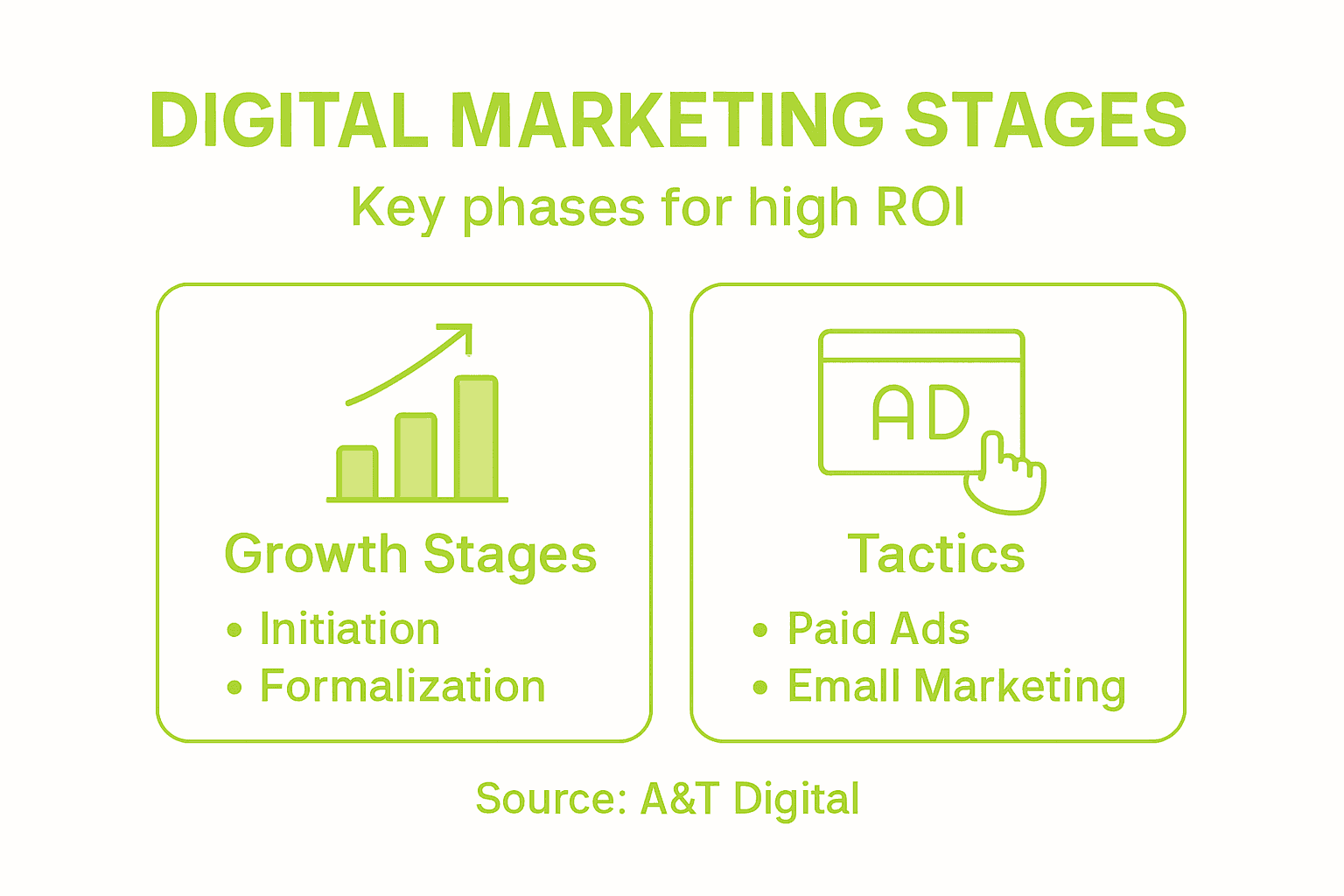
Research on digital marketing maturity models identifies five distinct progression levels that most businesses move through:
Initiation: You’re running basic campaigns, often reactively rather than strategically. Testing begins here.
Expansion: You’re adding new channels and audiences based on early wins. Growth accelerates, but complexity increases.
Formalization: You establish clear processes, measurement standards, and cross-team coordination for consistency.
Integration: All marketing channels work together seamlessly, sharing data and insights across platforms.
Maturity: Your organization operates with sophisticated automation, AI-powered optimization, and predictive analytics.
Most small to medium e-commerce brands operate somewhere between initiation and formalization. You have Google Ads and Meta running, but they may not be fully integrated or using shared performance data to inform decisions across channels.
Here’s a comparison of digital marketing maturity stages and the typical characteristics at each level:
Stage | Team Coordination | Measurement Focus | Technology Used |
Initiation | Minimal collaboration | Basic campaign stats | Manual campaign setup |
Expansion | Growing coordination | Early ROI tracking | Channel-specific tools |
Formalization | Cross-team collaboration | Standardized metrics | Shared dashboards |
Integration | Unified strategy | Data-driven insights | Automated workflows |
Maturity | Fully aligned organization | Predictive analytics | AI-powered optimization |
Beyond maturity stages, digital marketing breaks down into distinct types based on channel and approach:
Paid advertising: Google Ads, Meta ads, display networks—you pay per click or impression
Search engine optimization: Organic visibility through content and technical improvements
Content marketing: Blogs, videos, guides that attract and educate your audience
Email marketing: Direct communication with customers and prospects
Social media marketing: Organic community building and engagement
Your goal isn’t to be excellent at every type—it’s to master the 2-3 types that directly drive revenue for your specific business.
For e-commerce brands focused on measurable ROI, paid advertising and email marketing typically deliver the fastest, most predictable returns. You can see exactly which ads generated sales and optimize accordingly. This direct attribution is why performance-driven digital marketing strategies matter so much for your bottom line.
Where you currently operate dictates your next moves. If you’re at initiation, your focus should be on establishing reliable tracking and basic optimization. If you’re in expansion, you need formalized processes before adding more channels.
Pro tip: Audit where your business actually sits in the maturity model by listing your current channels, how you measure success, and whether teams share data. Then map one specific upgrade for the next quarter—whether that’s better tracking, process documentation, or channel integration. One deliberate improvement beats unfocused expansion every time.
How Strategic Planning Guides Campaigns
Without a strategic planning, your campaigns become random experiments. With it, every ad placement, audience segment, and message serves a clear business objective. This is the difference between burning budget and building predictable revenue.

Strategic planning acts as the blueprint for every decision your campaigns will make. Before you create ad copy, choose audiences, or set bids, your strategy answers foundational questions: What are we trying to achieve? Who are we reaching? How will we know we’re winning?
The planning process breaks down into clear stages that guide execution:
Define objectives: What specific business outcome do you want? Revenue, leads, customer acquisition, or repeat purchases?
Analyze your market: Who are your competitors? What messages work? Where is your audience spending time?
Set resource priorities: How much budget goes to each channel or audience segment based on expected return?
Establish measurement: Which metrics prove success? Cost per acquisition, return on ad spend, or customer lifetime value?
Create alignment: Ensure Google Ads, Meta, email, and any other channels all work toward the same goal.
When you complete strategic planning that prioritizes resources correctly, your team stops making conflicting decisions. One person isn’t trying to maximize clicks while another optimizes for profit. Everyone moves in the same direction.
Here’s the practical impact: A strategy prevents your team from pausing winning campaigns because one underperforming segment pulled down overall numbers. It clarifies that different audiences need different approaches. One segment might drive high-volume sales at lower margins; another drives premium customers at higher value.
Strategy transforms your campaigns from scattered attempts into a coordinated system where every piece reinforces the others.
Without a strategy, you see only surface-level metrics. With it, you understand why certain audiences convert better and how to allocate budget accordingly. This is why optimizing campaigns through strategic oversight matters more than any individual tactic.
Your strategy also guides testing decisions. Instead of running random experiments, you test hypotheses aligned with your goals. Does a new audience segment perform better? Your strategy predicts what to measure and when to expand or cut.
The biggest mistake small brands make: they skip planning and jump to execution. They launch campaigns based on what competitors are doing or what feels right intuitively. Then they’re shocked when results don’t match expectations.
Pro tip: Before launching any campaign, write down three things: your exact business goal, the customer segment you’re targeting, and one specific metric proving success. These three answers are your strategic guardrails. Every decision—from keyword selection to creative messaging—should tie back to at least one of these three elements.
Common Mistakes in Paid Ad Strategy
Most paid ad campaigns fail not because the channels are broken, but because the strategy behind them is flawed. You can have an unlimited budget and still lose money if you’re making fundamental strategic mistakes. Here are the errors that cost small e-commerce brands the most.
Mistake 1: Targeting the wrong audience entirely. You set up Google Ads or Meta, pick a broad audience, and hope conversions happen. But if you’re reaching people who don’t actually need your product, no amount of optimization fixes that. A specialty skincare brand targeting “all women ages 25-45” wastes half its budget on people with different skin types who’ll never buy.
Mistake 2: Ignoring budget allocation and spending pacing. You set a daily budget but don’t track how it’s actually being spent across campaigns. One underperforming channel consumes 60% of your budget while your best-performing channel gets 20%. Without deliberate allocation, you subsidize losers with winners.
Mistake 3: Skipping performance data review. Overlooking metrics and performance tracking is where most small brands derail. You launch campaigns, let them run for weeks, then check results only when money runs out. By then, you’ve lost thousands on ineffective variations.
These three errors create a cascade of damage:
Wrong audience + poor spending = wasted budget
Wasted budget + no data review = repeated mistakes
Repeated mistakes + no strategy = eventual shutdown of paid advertising
Mistake 4: Running too many experiments at once. You change audiences, creative, and bidding strategy simultaneously. When results improve, you don’t know which change caused it. When results drop, you panic and change everything again. You need disciplined testing approaches that isolate one variable at a time.
The deadliest mistake is treating paid ads like a set-and-forget channel. Paid advertising demands weekly attention, constant measurement, and aggressive optimization.
Mistake 5: Confusing ad quality with campaign performance. You create beautiful ads that get high click-through rates but low conversions. Or you obsess over creative when the real problem is your landing page, offer, or audience definition. Strategy always beats creatives in importance.
Here’s what separates winners from budget-burners: winners track specific metrics from day one, allocate budget intentionally, and adjust weekly based on data. They don’t guess. They measure.
Start auditing your current paid ad campaigns with these questions:
Are you reaching the exact customer profile most likely to buy?
Is your budget distributed based on past performance or arbitrary splits?
When did you last review actual conversion data and cost per acquisition?
Are you testing one variable at a time or changing multiple things weekly?
Does your landing page match the promise made in your ads?
Pro tip: Set a weekly review habit: every Monday, spend 30 minutes checking conversion data, cost per acquisition trends, and audience performance. Pause or reduce spending on underperformers immediately. This single habit—more than any tactic—determines whether your campaigns improve or deteriorate over time.
Maximizing ROI Through Strategic Analysis
ROI isn’t just a number to track—it’s the lens through which every strategic decision should be evaluated. Without rigorous analysis, you’re flying blind. Strategic analysis forces you to connect spending to outcomes and prove which investments actually work.
True ROI analysis goes beyond surface metrics. You need to understand not just what happened, but why it happened and what it predicts about future performance. A campaign with 200 conversions means nothing if each conversion costs more than your profit margin.
Strategic analysis requires measuring the right metrics. Focus on these core indicators:
Cost per acquisition: How much does it cost to acquire one customer? This must be lower than your profit per customer, or the campaign loses money.
Return on ad spend: For every dollar spent on ads, how many dollars return? Aim for 3:1 or better for sustainable growth.
Customer lifetime value: How much will this customer spend with you over time? This determines how much you can spend to acquire them.
Conversion rate by audience: Which customer segments convert best? Where should a budget flow?
When you combine customer insights with financial metrics, you uncover opportunities hidden in surface-level data. A high-traffic audience might have terrible conversion rates, wasting your budget on tire-kickers. A smaller audience might convert at five times the rate, making them far more profitable.
To help maximize ROI, here’s a summary table of key analysis metrics and their business value:
Metric | What It Measures | Business Impact |
Cost per Acquisition | Spend per new customer | Determines campaign profitability |
Return on Ad Spend | Revenue per ad dollar | Guides budget allocation |
Customer Lifetime Value | Total spend per customer | Sets max acquisition cost |
Conversion Rate by Audience | Success for each segment | Reveals high-value targets |
Here’s the strategic shift: Stop optimizing for clicks or impressions. Optimize for profit. These are fundamentally different goals. Clicks are cheap when you target broadly. Profit requires precision.
Strategic analysis transforms marketing from a cost center into a profit generator—but only when you measure what actually matters.
The analysis process follows these steps:
Define your baseline metrics: What’s your current cost per acquisition? Return on ad spend? Customer lifetime value?
Segment performance data: Break results by audience, campaign, channel, and creative to find patterns.
Identify your winners: Which segments deliver ROI consistently? Allocate more budget there.
Cut underperformers: Pause campaigns below your profit threshold immediately, not after six weeks.
Test and iterate: Once you understand what works, test variations to improve efficiency further.
Most small e-commerce brands skip steps 3 and 4. They let underperforming campaigns run because “they might improve.” That’s how small budgets disappear. Winners get rewarded with scale. Losers get cut ruthlessly.
You also need integrated measurement systems and CRM data connecting your ad platforms to your sales data. Without this integration, you’re making decisions on incomplete information. Google Ads shows you clicks and conversions, but it doesn’t show whether those customers actually became profitable repeat buyers.
Pro tip: Build a simple spreadsheet tracking cost per acquisition, return on ad spend, and profit per customer by channel and audience segment weekly. Update it every Monday morning. This single spreadsheet becomes your strategic decision filter—cut anything below your baseline, scale anything above it, and test variations on winners.
Unlock High ROI with Expert Strategic Planning Today
Struggling to turn your marketing budget into predictable revenue? This article highlights how missing a clear strategic plan leads to wasted spend and poor campaign results. You deserve a marketing approach that aligns your goals, target audience, and budget for maximum impact. If you want to stop guessing and start winning, incorporating proven planning, data-driven optimization, and disciplined campaign management is critical.
Partner with a boutique team that specializes in performance marketing focused on Google Ads and Meta campaigns. A&T Digital Agency builds scalable paid advertising systems that align with your precise business objectives. We combine strategic insight with creative execution to deliver measurable growth in revenue, leads, and conversions for small to medium businesses. Ready to get your paid campaigns firing on all cylinders? Visit A&T Digital Agency and explore how our campaign strategy and planning can transform your marketing results starting now.
Frequently Asked Questions
What is strategic planning in marketing?
Strategic planning in marketing is the process of defining your business goals, understanding your market position, and creating a detailed plan to reach your target customers effectively. It involves analyzing market conditions, internal capabilities, and customer insights to design campaigns that drive revenue.
Why is strategic planning important for marketing campaigns?
Strategic planning is crucial because it helps you avoid wasting budget on ineffective campaigns. Without a clear strategy, marketing efforts become random experiments, leading to unpredictable results. Strategic planning helps you make informed decisions about target audiences, budget allocation, and channel selection to maximize ROI.
How can I identify my target audience for marketing campaigns?
To identify your target audience, analyze data from past customers, conduct market research, and evaluate your competitors. Look for patterns in customer demographics, behaviors, and preferences to establish a clear profile of who is most likely to buy your products.
What common mistakes should I avoid in my marketing campaigns?
Common mistakes include targeting the wrong audience, failing to track budget allocation, overlooking performance data, running too many simultaneous experiments, and confusing ad quality with campaign performance. Being aware of these pitfalls can help you design more effective campaigns that yield better results.


