Digital Ad Campaign Guide for Maximizing ROI Results
Posted on
Marketing
Posted at

Launching Google or Meta ads without clear goals or audience insights can drain your budget faster than you think. Marketing directors at American e-commerce brands know that guesswork rarely delivers consistent results. By focusing on measurable campaign objectives and precise audience definition, you lay the groundwork for campaigns that track every dollar spent and attract quality leads who are more likely to convert. This step-by-step approach will help you maximize return and make smarter ad decisions from the start.
Table of Contents
Quick Summary
Key Insight | Explanation |
Define SMART Objectives | Set Specific, Measurable, Achievable, Realistic, Time-bound goals to clarify campaign success. |
Understand Your Audience | Identify detailed demographics, behaviors, and motivations to create messaging that resonates. |
Create Compelling Ad Assets | Develop creative assets that reflect audience pain points and include a strong call-to-action. |
Optimize with Data | Continuously analyze campaign metrics and adjust budget allocation to focus on high-performing segments. |
Validate Before Scaling | Ensure campaign results are consistent over time before increasing budgets and expanding reach. |
Define measurable campaign objectives and audiences
You’re about to build the foundation of every successful ad campaign. Without clear objectives and a defined audience, you’re essentially throwing budget at the wall and hoping something sticks. That doesn’t work here.
Start by asking yourself what you actually want this campaign to accomplish. Are you driving sales? Capturing leads? Building email lists? Each goal requires different targeting, messaging, and measurement tactics.
Set SMART objectives first. Your goals should be Specific, Measurable, Achievable, Realistic, and Time-bound. Instead of “increase sales,” aim for “generate $50,000 in revenue within 60 days” or “capture 200 qualified leads by the end of Q2.” This clarity transforms vague intentions into trackable benchmarks.
Clear, time-bound objectives give your entire campaign direction and make success measurable from day one.
Now move to audience definition. This is where most marketers stumble. Your audience isn’t “people who might buy.” It’s much more specific. You need to understand:
Demographics: Age, location, income level, job title
Behavioral patterns: Purchase history, website visits, email engagement
Motivations: Why they buy, what problems they solve for
Understanding your audience’s behavioral patternshelps you craft messaging that actually resonates. If you’re an e-commerce brand selling subscription boxes, your audience isn’t “people aged 25-45.” It’s “busy professionals who’ve purchased similar subscriptions in the past and engage with lifestyle content on Instagram.”
For Google and Meta campaigns, you’ll layer these insights into audience segments. Create separate audience profiles if you have fundamentally different customer types. A telehealth clinic, for example, might target “existing patients needing refills” differently than “new patients seeking first-time consultation.”
Once you’ve defined objectives and audiences, you’ll know exactly where to spend your budget and how to measure success. That’s the power of this step.
Pro tip: Use your existing customer data first—analyze who actually converts for you before building lookalike audiences, since your best data comes from customers who’ve already proven their value.
Build strategic ad assets and set targeted budgets
You have your objectives and audience defined. Now comes the work that actually shows up in front of people—your ad creative and your budget allocation strategy.
This step splits into two moving parts: creating compelling ad assets and deciding how much to spend where. Both decisions influence each other, so approach them together.
Start with your creative assets. These are your headlines, ad copy, images, and videos. Your assets need to speak directly to the audience you defined in Step 1. A financial services firm targeting high-net-worth individuals needs entirely different messaging than one targeting first-time investors. Your creative should reflect the specific pain points and motivations of your target segment.

For Google Ads, you’ll typically create multiple ad variations—different headlines, descriptions, and extensions. For Meta campaigns, you’re developing image or video ads paired with targeted copy. The best-performing assets usually solve a specific problem or create urgency.
Here’s what strong ad assets include:
Clear value proposition in the headline (not generic benefits)
Specific language that mirrors how your audience thinks
Visual consistency with your brand (colors, fonts, tone)
Strong call-to-action that matches your objective
Your ad assets are only as effective as how well they match your audience’s specific needs and language.
Now for budgeting. Strategic budget allocation requires aligning spending with your campaign goals and expected performance across channels. Don’t split your budget equally across Google and Meta just because they’re both important.
Instead, allocate budget based on where your audience spends time and what your data suggests. If you’re targeting B2B professionals, Google Ads might deserve 70 percent of the budget. If you’re selling to younger e-commerce audiences, Meta might get the majority.
Start with a test allocation, then scale winners. Begin with daily budgets that allow room to gather data—typically 10 to 14 days minimum before making major adjustments. Calculate your budget based on your cost-per-acquisition goal and desired monthly conversions.
If you need 50 leads monthly and your target CPA is 25 dollars, you need roughly 1,250 dollars in monthly ad spend. Build flexibility into your budget plan—performance data will tell you whether to increase, decrease, or reallocate as campaigns run.
Pro tip: Front-load your budget in the first week to gather conversion data quickly, then use that performance to inform budget increases on your strongest-performing creatives and audiences.
Launch campaigns on Google and Meta platforms
Your objectives are set, your creative is ready, and your budget is allocated. Now you actually activate your campaigns and put them in front of your audience.
Google Ads and Meta operate differently, so the launch process varies slightly between them. You’ll need accounts set up on both platforms if you’re running dual-channel campaigns, plus conversion tracking connected to your website or CRM.
Start with Google Ads. Log into your Google Ads account and create a new campaign. Choose your campaign type based on your goal: Search for keyword-driven intent, Shopping for e-commerce products, or Display for brand awareness. Then set your daily budget and select your geographic and demographic targeting.
Create your ad groups with relevant keywords that match your audience’s search behavior. Write your ads with the creative assets you prepared in Step 2. Google will show variations to find what resonates. Set your bid strategy—usually starting with automated bidding to let Google optimize for conversions.
For Meta campaigns, the process flows through Ads Manager. Start by selecting your campaign objective (conversions, leads, traffic, or engagement depending on your Step 1 goals). Meta’s Ads Manager platform lets you structure budgets, audiences, and placements across Facebook and Instagram simultaneously.
Here’s what you’ll configure on Meta:
Campaign objective matching your business goal
Budget and schedule for your daily spend
Target audience using demographics, interests, and behaviors
Ad placement (automatic or manual across Facebook, Instagram, Audience Network)
Ad creative with your prepared images or videos
Successful campaign launches require careful setup once, then patience to gather performance data before major adjustments.
Once both campaigns are live, verify tracking is working. Check that conversions are recording properly. Give campaigns at least 48 to 72 hours to accumulate data before making changes. The algorithms on both platforms need time to optimize delivery.
Here’s how Google Ads and Meta Ads campaign setups compare:
Step | Google Ads | Meta Ads |
Account Setup | Requires Google Ads | Requires Ads Manager |
Goal Selection | Search, Shopping, Display | Conversions, Leads, Traffic |
Budget Control | Daily and campaign-level | Daily and ad set level |
Targeting | Keywords, demographics | Interests, demographics |
Creative Format | Text, headlines, extensions | Images, videos, text |
Tracking | Linked website, conversion tracking | Pixel, custom conversions |
Don’t panic if initial results feel slow. The first week is often data collection. Your real insights come in week two and beyond, when you have enough conversions to identify patterns.
Pro tip: Launch both campaigns simultaneously on the same day so performance data aligns temporally—comparing week-one data across platforms becomes much easier when they started at the same time.
Optimize performance through data–driven adjustments
Your campaigns are live and data is flowing in. This is where most marketing directors either scale their winners or keep throwing money at underperformers. The difference between mediocre ROI and exceptional ROI lives in your optimization decisions.
Optimization isn’t a one-time event. It’s a continuous cycle of measuring, analyzing, and adjusting. You’re looking for patterns in what works and doubling down on them while cutting what doesn’t.
Start by establishing your baseline metrics. Data analytics helps evaluate campaign performance across channels so you know what normal looks like. In Google Ads, track your cost-per-acquisition, click-through rate, and conversion rate. On Meta, monitor your cost-per-result, relevance score, and frequency.
After the first week, you’ll have initial data. Look for clear patterns. Which ad creative generated the most conversions? Which audience segment had the lowest cost-per-acquisition? Which keywords or interests drove sales? These answers guide your next moves.
Optimization priorities typically follow this sequence:
Pause underperformers (ads or audiences burning budget with no conversions)
Increase budget on winners (proven audience segments and creative performing well)
Test variations (new copy or audience twists based on what’s working)
Refine targeting (narrow audiences if cost-per-acquisition is rising)
Successful optimization means being willing to cut what doesn’t work fast, then scaling winners aggressively.
Measuring effectiveness requires analyzing performance bottlenecksand reallocating resources to proven segments. Conduct a quick audit every 10 to 14 days. Ask yourself which segments are hitting your target CPA and which are missing it by a mile.
If you set a $25 CPA goal and one audience segment is delivering at $18, increase spend there. If another is sitting at $45, either narrow the targeting or pause it entirely. This reallocation forces your budget toward your best performers.
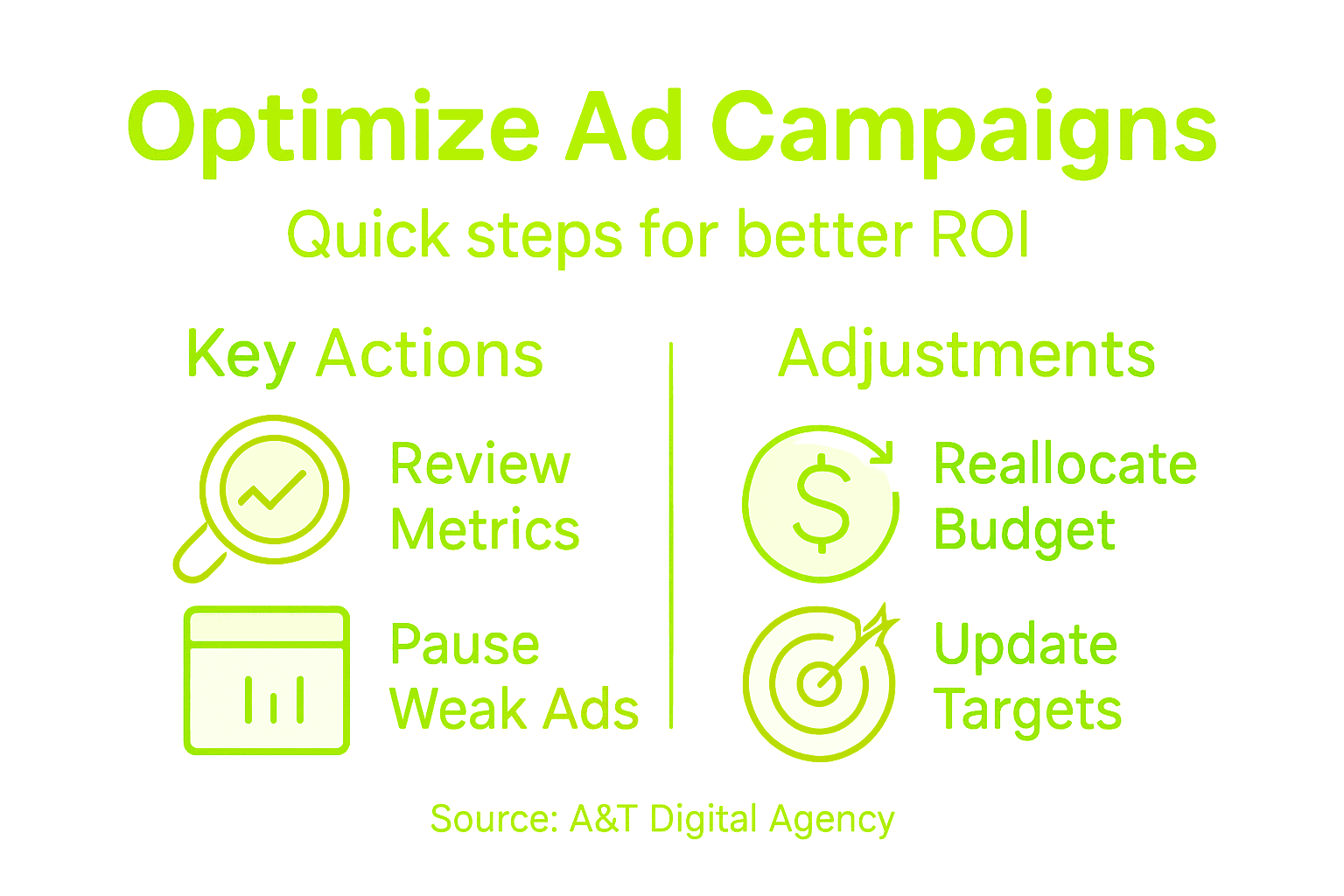
Give adjustments time to settle before making the next round of changes. Jump too quickly and you won’t know what actually worked. Wait too long and you’re wasting budget on dead weight.
Key optimization metrics and their business impact:
Metric | Platform | Business Impact |
Cost-per-acquisition | Google & Meta | Measures efficiency of spend |
Click-through rate | Gauges audience engagement | |
Conversion rate | Google & Meta | Indicates campaign effectiveness |
Relevance score | Meta | Evaluates ad quality |
ROAS (Return on Ad Spend) | Google & Meta | Tracks campaign profitability |
Document what you change and why. This creates a record of what works for your business, which becomes invaluable when launching future campaigns.
Pro tip: Set up automated rules in Google Ads and Meta that pause underperforming ads when they hit specific thresholds (like 10 conversions below your target CPA), so optimization happens even when you’re not watching.
Validate results and identify scaling opportunities
You’ve been running campaigns for several weeks now and optimizing along the way. Before you aggressively scale your budget, you need to validate that your results are actually sustainable and identify which parts of your campaign are ready to grow.
Validation isn’t just about hitting your numbers once. It’s about proving those numbers can repeat consistently across larger audiences and budgets.
Look at your core metrics over time. Validating marketing results requires establishing metrics to track campaign impact so you understand true performance. Pull 30 days of data and calculate your average cost-per-acquisition, return on ad spend, and customer lifetime value.
If your target CPA was $25 and you’re consistently hitting $22 to $24 across multiple weeks, that’s validated. If you’re bouncing between $18 and $35 every other week, you haven’t validated anything yet—keep optimizing before scaling.
Validation checklist:
Consistent CPA over at least 30 days across multiple audience segments
Sustainable conversion volume (enough leads or sales weekly to prove consistency)
Profitable ROAS (return on ad spend above your target)
Strong creative performance across multiple ad variations
Validated results prove your campaign works at current scale—not just once, but repeatedly.
Once validation is confirmed, identify which segments are your strongest scaling candidates. Successful scaling requires building evidence-based cases for extending proven tactics to broader audiences and budgets.
Your best scaling opportunities typically fall into these categories: audience segments performing 15 to 20 percent better than your average CPA, geographic regions showing strong conversion rates, and ad creative consistently outperforming benchmarks. These are your golden opportunities.
Create a scaling plan for your top three performers. Instead of doubling budget overnight, increase spend by 25 to 30 percent. Monitor closely for the next two weeks. If performance holds steady or improves, increase again. If it deteriorates, pull back immediately.
Scaling should feel methodical, not aggressive. Rush it and you’ll blow your budget chasing vanishing ROI. Go too slow and you leave money on the table.
Document your validated insights. Which audiences converted best? Which creative resonated? Which keywords or interests drove sales? This becomes your playbook for future campaigns and saves weeks of testing time.
Pro tip: Before scaling, increase your daily budget cap by only 20 to 30 percent and monitor the next 200 conversions—if CPA remains stable or improves, you’ve found a reliable scaling lever worth aggressive investment.
Unlock High–Impact Digital Advertising That Maximizes Your ROI
Many businesses struggle with setting clear objectives, defining precise audiences, and efficiently allocating budgets for Google and Meta ad campaigns. If you have experienced the frustration of unclear campaign goals, wasted ad spend, or slow performance optimization, you are not alone. This guide highlights the importance of data-driven strategies, ongoing optimization, and validated scaling to overcome these hurdles and generate sustainable growth.
At A&T Digital Agency, we specialize in turning these exact challenges into measurable success. Our boutique team crafts personalized campaign strategies tailored to your unique audience and business goals. We focus on performance marketing through expert campaign planning, creative development, launch management, and continuous optimization designed for maximum return on investment. Explore how we transform strategic insights into revenue growth by visiting our performance marketing solutions.
Experience the difference of a results-focused partner who cuts through guesswork and puts your ad spend to work.
Ready to elevate your digital advertising campaigns with proven tactics and expert execution now?
Discover the power of performance-driven Google and Meta campaigns crafted for your success by contacting us today at A&T Digital Agency. Take the first step toward consistent revenue growth and lead generation by partnering with a team that delivers measurable results without unnecessary meetings or wasted budgets.
Frequently Asked Questions
What are SMART objectives in a digital ad campaign?
SMART objectives are Specific, Measurable, Achievable, Realistic, and Time-bound goals that provide clarity for your campaign. For example, instead of aiming to “increase sales,” set a goal to “generate $50,000 in revenue within 60 days” to track your success effectively.
How do I define my target audience for a digital ad campaign?
Defining your target audience involves analyzing their demographics, behavioral patterns, and motivations. To start, gather data on who currently converts for your business, focusing on age, location, and purchase history to create specific audience segments.
What types of ad assets should I create for my campaign?
Create compelling ad assets that include clear headlines, targeted ad copy, engaging images or videos, and strong calls-to-action. Ensure these assets resonate with your defined audience to encourage engagement and drive conversions.
How can I allocate my budget effectively for a digital ad campaign?
Allocate your budget based on where your target audience spends their time and what channels yield the best performance. Start with a test budget for each channel, such as spending 70 percent on one with higher relevance, then adjust based on performance data over the first couple of weeks.
What steps should I take to optimize my ad campaign performance?
To optimize performance, regularly review your metrics to identify underperforming ads and audience segments. Pause ads that aren’t converting, increase budgets on successful campaigns, and continuously test variations to determine the best-performing strategies.
How do I validate the results of my digital ad campaign before scaling?
Validate your campaign results by assessing core metrics over a minimum of 30 days to ensure consistent performance. If your cost-per-acquisition remains stable, such as consistently hitting your target CPA, consider this evidence to support a strategic scaling plan.


