Why Track Campaign Performance for Healthcare ROI
Posted on
Marketing
Posted at

Running a digital ad campaign without the right tracking is like flying blind in a crowded sky. For healthcare providers, every marketing dollar counts, and small data misses can easily hide valuable growth opportunities. By focusing on campaign performance tracking, you can connect the dots between impressions, engagement, and conversions, turning raw results into actionable steps for measurable success.
Table of Contents
Key Takeaways
Point | Details |
Comprehensive Metrics | Healthcare marketing success requires tracking nuanced performance metrics across awareness, engagement, and conversion stages. |
Data-Driven Insights | Transforming raw data into actionable insights is essential for optimizing campaigns and maximizing ROI. |
Holistic Tracking Approach | Employ multi-dimensional dashboards that integrate quantitative metrics with qualitative patient feedback for better understanding of performance. |
ROI Optimization Strategies | Focus on resource allocation based on performance analysis to ensure marketing investments drive meaningful growth and engagement. |
Defining Campaign Performance Tracking Metrics
Healthcare marketing campaigns require precise measurement to understand their effectiveness and return on investment (ROI). Campaign performance tracking involves systematically evaluating key metrics that reveal how well digital advertising efforts are meeting organizational goals. These metrics go far beyond simple visibility, providing deep insights into campaign impact and strategic opportunities.
Marketing performance metrics can be categorized across multiple strategic levels:
Awareness Metrics
Total campaign impressions
Reach within target demographic
Website traffic generated
Engagement Metrics
Click-through rates
Time spent on landing pages
Social media interactions
Conversion Metrics
Lead generation volume
Appointment booking rates
Cost per qualified lead
Tracking these marketing performance indicators enables healthcare marketing teams to understand campaign effectiveness systematically. Each metric provides a specific lens into campaign performance, helping teams optimize future strategies and resource allocation.
For healthcare providers, performance tracking is particularly critical. Unlike traditional product marketing, healthcare campaigns involve complex decision journeys with multiple stakeholder touchpoints. This means tracking metrics must be comprehensive and nuanced, capturing both quantitative and qualitative campaign impacts.
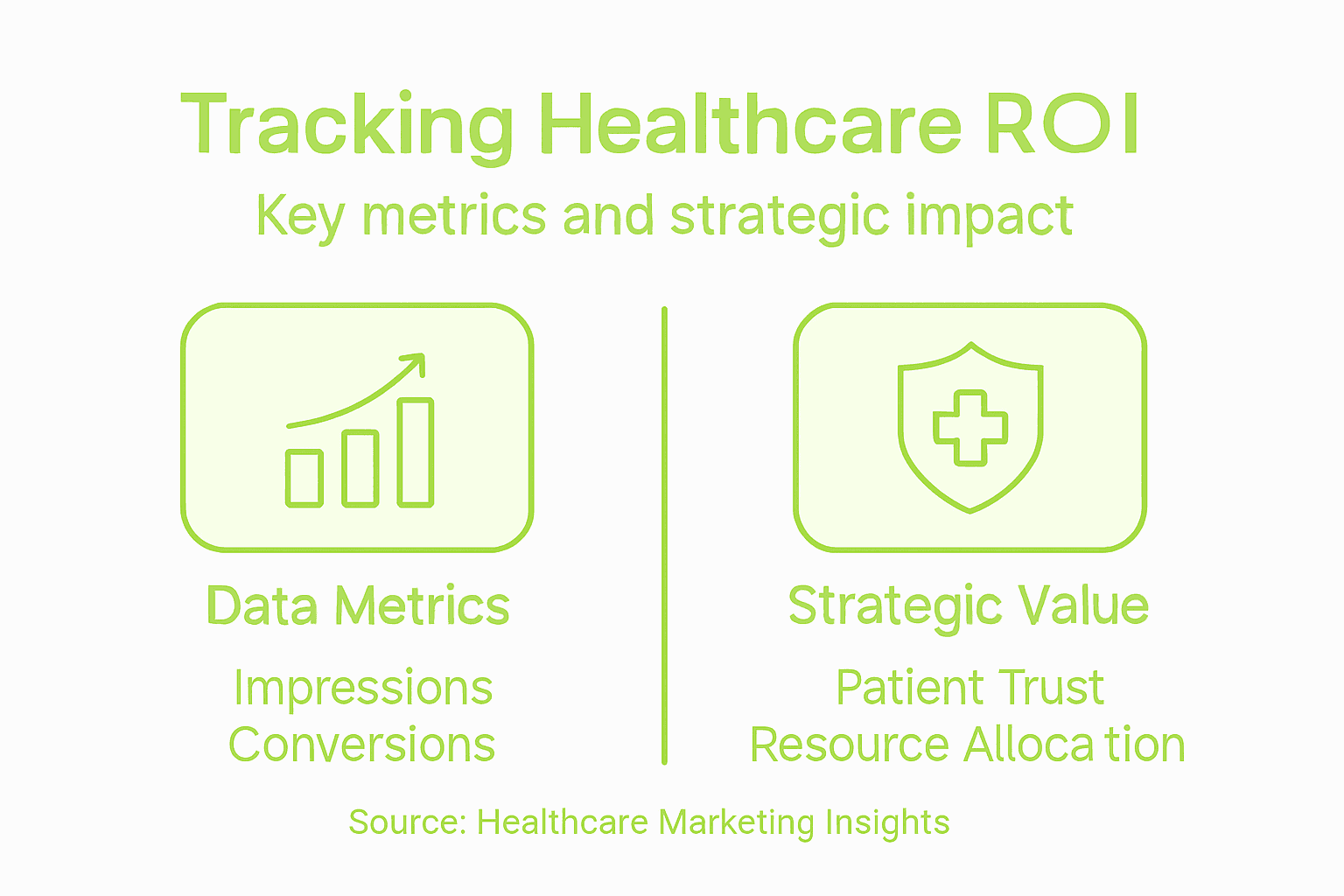
Performance tracking transforms raw data into actionable strategic insights. By understanding which channels, messages, and targeting approaches generate the most meaningful results, marketing teams can continuously refine their approach and maximize ROI.
Pro tip: Start by establishing baseline performance metrics before launching new campaigns, which will help you accurately measure incremental improvements and campaign effectiveness.
Different Metrics for Healthcare Marketing Success
Healthcare marketing requires sophisticated measurement strategies that go beyond traditional performance indicators. Marketing metrics in healthcare are nuanced, reflecting the complex patient journey and specialized communication needs of medical providers. Understanding these metrics helps organizations optimize their digital strategies and improve patient engagement.
Key performance metrics can be categorized into three critical stages:
Awareness Stage Metrics
Total campaign impressions
Website visitor demographics
Brand recognition surveys
Consideration Stage Metrics
Content engagement rates
Video content view duration
Landing page interaction time
Conversion Stage Metrics
Patient inquiry volume
Appointment booking rates
Patient acquisition cost
Healthcare marketing success metricsreveal compelling insights into digital strategy effectiveness. For instance, personalized content can increase patient engagement by up to 63%, while targeted video content improves information retention by 72%.

Here’s a summary of how healthcare marketing metrics align with stages of the patient journey:
Stage | Common Metrics | Strategic Value |
Awareness | Impressions, demographics | Gauge broad reach and recognition |
Consideration | Engagement, content views | Measure patient interest and intent |
Conversion | Bookings, acquisition cost | Assess campaign ROI and growth |
Digital marketing for healthcare requires a strategic approach that balances quantitative measurement with qualitative understanding. Unlike traditional industries, healthcare marketing must navigate complex regulatory environments, patient privacy concerns, and deeply personal decision-making processes.
Digital marketing performance is about more than numbers. It’s about understanding patient needs, building trust, and creating meaningful connections that support health outcomes and organizational growth.
Pro tip: Develop a comprehensive tracking dashboard that integrates both quantitative metrics and qualitative patient feedback to gain a holistic view of marketing performance.
How Tracking Works: Tools and Strategies
Healthcare marketing performance tracking involves sophisticated digital tools and strategic methodologies that transform raw data into actionable insights. Campaign tracking is not just about collecting numbers, but about creating a comprehensive understanding of patient engagement, marketing effectiveness, and organizational growth potential.
Key tracking tools and strategies include:
Analytics Platforms
Google Analytics
Healthcare-specific tracking dashboards
Custom conversion tracking systems
Data Collection Methods
Patient survey integrations
Website interaction monitoring
Digital ad platform reporting
Performance Evaluation Frameworks
Goal-setting protocols
Comparative benchmark analysis
Continuous improvement models
Performance management strategiesemphasize continuous measurement and stakeholder engagement. These approaches help healthcare marketers develop data-driven insights that go beyond surface-level metrics, enabling more nuanced and effective campaign optimization.
Compare common tracking tools used in healthcare marketing performance measurement:
Tool Type | Example | Main Benefit |
Analytics Platform | Google Analytics | Understand website behavior |
Survey Integration | Post-visit surveys | Gather patient feedback |
Custom Dashboards | Healthcare tools | Visualize multi-source metrics |
Successful tracking requires a holistic approach that balances quantitative data with qualitative understanding. Healthcare marketing teams must develop robust systems that capture patient interactions across multiple digital touchpoints, from initial awareness to final conversion.
Effective tracking transforms raw data into strategic intelligence. By implementing comprehensive monitoring tools, healthcare organizations can create more targeted, empathetic, and successful marketing campaigns that genuinely connect with patient needs.
Pro tip: Implement a multi-dimensional tracking dashboard that integrates patient feedback, digital interaction data, and conversion metrics to gain a 360-degree view of marketing performance.
ROI and Resource Optimization in Healthcare
Healthcare marketing demands a strategic approach to resource allocation that goes beyond traditional spending models. Measuring return on investment (ROI) requires sophisticated tracking mechanisms that transform marketing expenditures into tangible organizational value. The goal is not just spending money, but investing it with precision and purpose.
Key ROI optimization strategies include:
Financial Performance Metrics
Cost per patient acquisition
Patient lifetime value
Revenue generated per marketing campaign
Efficiency Optimization Techniques
Budget reallocation based on performance
Targeted campaign refinement
Elimination of underperforming channels
Strategic Investment Approaches
Data-driven budget planning
Continuous performance monitoring
Predictive spending models
Marketing performance measurement systemsemphasize tracking metrics that directly link marketing efforts to revenue generation. By developing comprehensive visualization tools, healthcare organizations can make more informed decisions about resource allocation and campaign strategy.
Successful ROI optimization requires a holistic view that balances short-term results with long-term strategic objectives. Healthcare marketing teams must develop adaptive frameworks that can quickly identify and respond to changing patient engagement patterns and market dynamics.
Resource optimization is a continuous journey of strategic refinement. By implementing data-driven approaches, healthcare organizations can transform marketing from a cost center into a strategic investment engine that drives meaningful growth and patient engagement.
Pro tip: Create a quarterly ROI dashboard that tracks both financial metrics and patient engagement indicators to ensure a comprehensive view of marketing performance.
Common Pitfalls in Performance Measurement
Healthcare marketing performance tracking is fraught with complex challenges that can undermine the effectiveness of strategic insights. Performance measurement requires a nuanced approach that goes far beyond simple numerical reporting, demanding a sophisticated understanding of data interpretation and contextual analysis.
Common measurement pitfalls include:
Data Collection Errors
Inconsistent metric definitions
Incomplete data sets
Unreliable tracking mechanisms
Interpretative Mistakes
Over-relying on single metrics
Ignoring contextual nuances
Misinterpreting correlation as causation
Strategic Limitations
Narrow performance perspectives
Lack of comparative benchmarking
Failure to adapt measurement approaches
Healthcare performance measurement challengesreveal significant systemic issues, including fragmented data sources and inconsistent evaluation frameworks. These complexities make it difficult to generate meaningful, actionable insights from marketing performance data.
Successful performance measurement requires a holistic approach that balances quantitative metrics with qualitative understanding. Healthcare marketing teams must develop adaptive frameworks that can capture the multidimensional nature of patient engagement and campaign effectiveness.
Measurement is an art as much as a science. By recognizing potential pitfalls and developing robust, flexible tracking strategies, organizations can transform data into genuine strategic intelligence.
Pro tip: Implement a cross-functional review process that regularly audits performance measurement methodologies to identify and mitigate potential measurement blind spots.
Unlock the True ROI of Your Healthcare Campaigns with Expert Performance Tracking
The article highlights the complexity of healthcare marketing and the critical need for precise campaign performance tracking to achieve measurable ROI. If you struggle with identifying which marketing channels drive real patient engagement or want to avoid common pitfalls like incomplete data and misinterpretation, you are not alone. Key goals include gaining deep insights into patient acquisition cost, optimizing ad spend, and transforming raw metrics into actionable strategies that truly grow your practice.
At A&T Digital Agency, we specialize in building and scaling tailored paid advertising systems via Google Ads and Meta platforms, designed to deliver the exact measurable outcomes healthcare providers seek. Our boutique team combines strategic planning with creative execution to ensure your campaigns are not just visible but convert effectively — lowering costs while increasing patient bookings and revenue. Learn more about our performance marketing services that bring clarity to your data and empower smarter decisions.
Drive your healthcare marketing forward with proven expertise and data-driven optimization.
Ready to see how targeted campaign strategies and real-time tracking can elevate your ROI?
Discover the power of transparent performance tracking and start optimizing your ad spend today. Visit A&T Digital Agency to connect with specialists who understand healthcare marketing challenges and deliver results that matter.
Frequently Asked Questions
Why is it important to track campaign performance in healthcare marketing?
Tracking campaign performance in healthcare marketing is crucial to understand the effectiveness of your strategies, optimize resource allocation, and ensure a strong return on investment (ROI). It allows healthcare organizations to analyze key metrics that inform decision-making and improve patient engagement.
What key metrics should be monitored for healthcare marketing campaigns?
Important metrics to track include awareness metrics (total impressions, website traffic), engagement metrics (click-through rates, social media interactions), and conversion metrics (lead generation volume, appointment booking rates). These help gauge the overall success of a campaign.
How can healthcare organizations optimize their marketing ROI?
Organizations can optimize marketing ROI by using data-driven budget planning, reallocating resources based on performance, and continuously monitoring campaign effectiveness. Developing a quarterly ROI dashboard can also provide insights into financial and engagement metrics.
What are common pitfalls in measuring healthcare marketing performance?
Common pitfalls include data collection errors, such as inconsistent metric definitions, and interpretative mistakes like over-relying on single metrics. Organizations should avoid these by implementing robust tracking strategies and regular audits of measurement methodologies.


