Performance Marketing: Driving Measurable Growth Online
Posted on
Marketing
Posted at

Every marketing manager knows the pressure of proving that ad spends really drives results. Competing for customers in crowded markets means every dollar matters, especially for American retail and healthcare businesses with tight budgets. Performance marketing focuses on paying only for measurable actions like clicks, sales, or leads, giving you the clarity and accountability traditional advertising often lacks. This article sheds light on key misconceptions and guides you toward strategies that turn digital campaigns into trackable revenue growth.
Table of Contents
Key Takeaways
Point | Details |
Understand Performance Marketing | Focus on paying for measurable results like sales or leads, differing from traditional advertising, which relies on impressions. |
Choose the Right Metrics | Identify 3-5 key metrics directly linked to revenue goals to avoid over-measuring irrelevant data. |
Leverage Effective Channels | Start with a single channel for your target audience, utilizing CPC or CPA models, before expanding to additional platforms. |
Blend Approaches | Combine performance marketing with content or brand marketing for immediate revenue alongside long-term customer relationships. |
Defining Performance Marketing and Misconceptions
Performance marketing is fundamentally about paying for measurable results. When you run a performance marketing campaign, you’re paying for specific actions: a sale, a lead form submission, a phone call, and a qualified click. This is different from traditional brand advertising, where you pay for impressions and hope people remember your name.
Your retail or healthcare business likely has a limited budget. That’s precisely why performance marketing appeals to you. You want proof that your advertising dollars are working. You want to see which campaign drove that customer through your door or which ad got that appointment scheduled.
The confusion starts here. Many business owners mistake performance marketing for paid advertising in general. Paid advertising encompasses both performance tactics and brand-building efforts, but they serve different purposes. You can run a Google Ads campaign focused on immediate sales (performance) or build awareness for your clinic’s new services (brand). Most high-performing campaigns actually blend both approaches.
Another major misconception is that you should measure everything. You’ve probably heard the phrase “what gets measured gets managed.” But here’s what actually happens: teams end up drowning in vanity metrics. Clicks look good in a report. So do impressions. These numbers feel productive but don’t necessarily connect to revenue or actual business growth. Organizations often over-measure irrelevant data that obscures meaningful performance assessment, which leads to wasted time and misguided decisions.
The right approach focuses on metrics tied directly to your business objectives. For a retail business, that might be revenue or customer acquisition cost. For healthcare, it could be qualified patient intakes or appointment bookings. Not every metric deserves your attention.
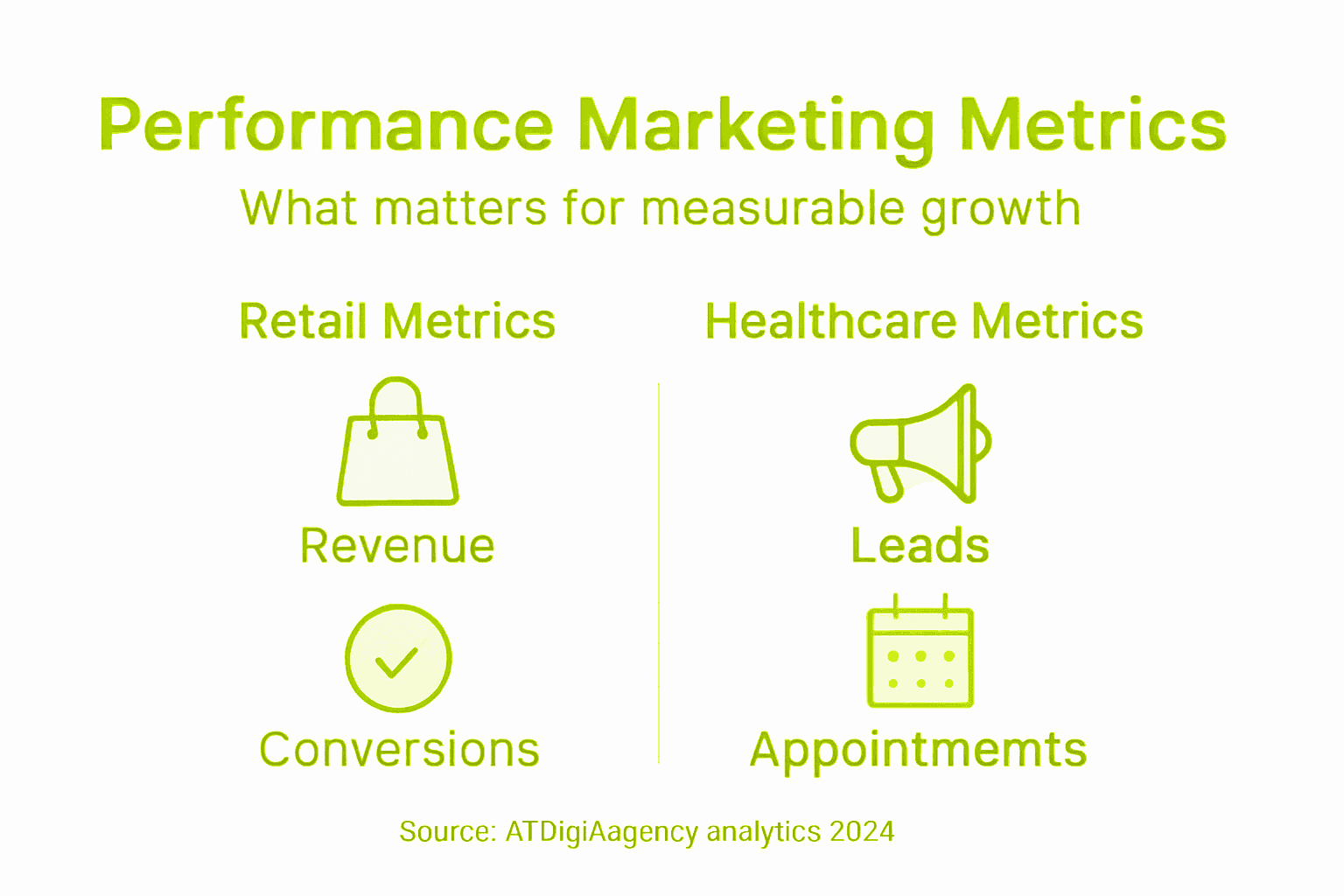
Pro tip: Before launching any campaign, identify 3-5 key metrics that directly link to your revenue goals, then ignore everything else that doesn’t serve those metrics.
Based on the results Ad Models and Channels
Performance marketing operates on several distinct pricing models, each determining how you pay for advertising. Understanding these models helps you choose the right strategy for your business goals.
Cost Per Click (CPC) means you pay only when someone clicks your ad. Search engine advertising typically uses CPC. A dental clinic running Google Ads for “emergency dentist near me” pays when someone actually clicks that ad link. Cost Per Acquisition (CPA) is more performance-oriented: you pay only when that click converts to a sale or lead. A retail store selling supplements might pay CPA to ensure they only pay when someone completes a purchase.

Cost Per Mille (CPM) charges per thousand impressions, useful for building awareness. Cost Per Lead (CPL) charges when someone submits a form or provides contact information. Common pricing models include CPM, CPC, CPL, and CPA structures, each serving different campaign objectives and business needs.
Here’s how popular performance marketing pricing models compare:
Pricing Model | Payment Trigger | Main Business Benefit |
CPC (Cost Per Click) | User clicks ad | Drives measurable website traffic |
CPA (Cost Per Acquisition) | Sale or lead is completed | Pays only for actual conversions |
CPM (Cost Per Mille) | 1,000 ad impressions served | Efficient for large-scale awareness |
CPL (Cost Per Lead) | Lead form submission | Grows prospect database directly |
Where you advertise matters as much as how you pay. The major channels for performance marketing include Google Search, Google Display Network, Facebook and Instagram, LinkedIn, and email marketing. Google Search captures high-intent traffic from people actively searching for your services. Someone typing “physical therapy” is ready to learn about your clinic.
Facebook and Instagram let you target by interest, behavior, and demographics with visual creative. Healthcare providers use these for appointment scheduling and patient education. Email marketing offers remarkable ROI when you’re reaching existing customers or warm leads.
Digital channels such as social media and search engines enable targeted audience reach and measurable results. The channel you choose depends on where your customers spend time and what action you want them to take.
Pro tip: Start with one channel where your target audience is most active, master the CPC or CPA model for that channel, then expand to additional channels once you have consistent data proving ROI.
How Performance Marketing Operates Day By Day
Performance marketing isn’t a set-it-and-forget-it system. Your campaigns require active management, constant monitoring, and regular adjustments to stay profitable. Here’s what happens behind the scenes.
Every morning, your performance marketing team reviews overnight results. They check conversion rates, cost per lead, return on ad spend, and traffic volume. A healthcare provider running appointment-booking ads looks at how many qualified leads came in and what they cost. A retail store checks sales attributed to each campaign. This daily review reveals what’s working and what isn’t.
Campaign management involves testing creative content and adjusting bidding strategies to optimize performance. A retail business running Facebook ads might test three different product images to see which gets the best click-through rate. They’ll pause the underperforming versions and increase the budget on the winner. This happens constantly, sometimes multiple times per week.
Budget allocation shifts based on performance data. If Google Search is delivering customers at a $45 cost per acquisition and Facebook is delivering them at $65, you reallocate more budget to Google. This is where precision matters. You’re not guessing which channel works better; the numbers tell you.
Performance marketing involves data analysis to optimize ads and refine targetingfor maximum measurable returns. A healthcare provider might discover their appointment ads convert better for people aged 35-54 than for younger audiences, so they adjust targeting parameters. They notice certain keywords trigger higher-quality leads and increase bids on those terms.
Creative testing runs continuously. Your team designs multiple ad variations, measures performance, and scales what works. This cycle repeats weekly or even daily, depending on campaign volume. The goal is always incremental improvement, compound growth from small optimizations that add up over time.
Pro tip: Establish a daily review routine with 3-5 key metrics you check without fail, then dedicate Friday to strategic decisions about budget shifts and creative tests based on the week’s data.
Google Ads and Meta Campaign Strategies
Google Ads and Meta (Facebook and Instagram) represent the two dominant platforms for performance marketing. They work differently but serve complementary purposes in your overall strategy.
Google Ads operates on intent. When someone searches for “urgent care near me” or “buy orthopaedic shoe inserts,” they’re actively looking for what you offer. Google Ads uses a pay-per-click model where advertisers bid on keywords to display text, shopping, and video ads across search results. A healthcare provider bidding on “pediatric dentist” appears right when parents need that service. This is high-intent traffic. You pay only when someone clicks.
Your Google Ads strategy centres on three core elements: keyword research, bid management, and conversion optimization. Start by identifying keywords your customers actually search for. A vitamin retailer targets “best B12 supplement” or “where to buy collagen powder.” Use bid adjustments to pay more for high-converting keywords and less for underperformers. Ad extensions like phone numbers and location information give searchers quick reasons to click.
Meta Ads work differently. Meta targets people based on interests, behaviours, and demographics rather than active search. Meta Ads Manager allows marketers to structure campaigns by selecting specific objectives and target audiences across Facebook and Instagram. A health clinic creates ads for “appointment bookings” and targets people interested in wellness. A retail store targets people similar to existing customers.
Meta excels at visual storytelling and testing. Build multiple ad variations with different images, headlines, and copy. Run A/B tests to discover which resonates with your audience. Budget automatically distributes to better-performing ads. A supplement retailer might test before and after images, lifestyle photos, and product close-ups simultaneously.
The two platforms complement each other. Google Ads captures immediate demand. Meta builds awareness and reaches people earlier in their buying journey. Together, they create multiple touchpoints that move customers from awareness to purchase.
Pro tip: Start with Google Ads to capture high-intent customers, then layer in Meta campaigns targeting interests and lookalike audiences to expand reach without sacrificing immediate ROI.
Risks, Costs, and Mistakes to Avoid
Performance marketing isn’t risk-free. Understanding the pitfalls helps you avoid expensive mistakes that drain budgets without delivering results.
The most common trap is obsessing over short-term metrics while ignoring brand health. You chase immediate sales through aggressive discounting or intrusive ads, but you damage long-term customer perception. A healthcare provider running aggressive appointment ads might get quick bookings but annoy potential patients with excessive frequency. Overemphasis on short-term sales at the expense of brand building creates a false sense of success that collapses when ad spending stops.
Budgets escalate quickly without discipline. Competitive bidding on popular keywords drives up costs. A retail business bidding on “best supplement for joint health” might pay fifty percent more per click than six months ago simply because competitors increased their bids. Poor targeting wastes money on irrelevant clicks. Setting audience parameters too broadly means paying for clicks from people who’ll never buy.
Ad fatigue kills performance. Your audience sees the same creative repeatedly, response rates drop, and costs rise. A healthcare clinic running the same appointment ad for three months watches click-through rates decline as people tune it out. You must refresh creativity constantly.
Privacy concerns and over-reliance on data that may not capture long-term valuerepresent growing risks. Third-party cookie deprecation means you lose tracking capabilities. Attribution becomes murky. You might credit a conversion to the wrong touchpoint, overinvesting in underperforming channels.
Failing to align campaigns with the overall brand strategy creates a disconnect. Your ads promise one thing, your website delivers another. This frustrates customers and wastes spending. A supplement retailer emphasizing “all natural ingredients” in ads but displaying synthetic components on the website loses credibility and conversions.
Pro tip: Set a monthly budget cap per channel and review performance against both immediate conversions and longer-term metrics like customer lifetime value at least quarterly to catch budget leaks early.
Comparing Performance Marketing Alternatives
Performance marketing isn’t your only option. Understanding alternatives helps you decide if it fits your business or if you should blend it with other approaches.
Content Marketing focuses on building trust through valuable information. A healthcare provider publishes articles about joint health, recovery exercises, and preventive care. Patients read these, trust the clinic’s expertise, and eventually book appointments. No direct payment per result. The return comes months later through loyalty and referrals. This takes longer but builds more in-depth customer relationships.
Brand Marketing emphasizes awareness and emotional connection rather than immediate conversions. A supplement retailer runs ads showcasing their company story, manufacturing process, or athlete endorsements. People might not buy immediately, but they remember the brand when they’re ready. Traditional brand marketing emphasizes awareness and long-term customer loyalty without direct payment for results, contributing heavily to brand equity over time.
Social Media Marketing (organic) involves building communities through engagement without paid promotion. A healthcare provider shares patient success stories, health tips, and responds to comments. Growth is slow but creates genuine connection. Cost is staff time, not ad spend.
Email Marketing (organic list) nurtures existing customers without per-result payment. A retail store sends newsletters about new products, health research, or seasonal offers. Existing customers open emails they’ve subscribed to willingly.
Here’s the reality for most small to medium-sized businesses: you need a mix. Marketing alternatives range from content marketing and brand approaches to experiential marketing, each suited to different business goals. Performance marketing delivers immediate, measurable revenue. Content and brand approaches build long-term assets. A healthcare clinic running Google Ads for quick appointment bookings while publishing helpful blog content creates two engines: one for today’s revenue one for next year’s organic growth.
See the key differences between common marketing approaches:
Approach | Time to Results | Best For |
Performance Marketing | Immediate to short-term | Quick sales and lead generation |
Content Marketing | Medium to long-term | Trust-building and education |
Brand Marketing | Long-term | Loyalty and recognition |
Organic Social/Email | Ongoing | Community engagement |
Performance marketing works best for businesses with limited brand recognition or immediate revenue needs. Brand approaches work better for established companies, building loyalty. Most successful businesses use both simultaneously.
Pro tip: Allocate 70 % of the budget to performance marketing for immediate revenue, 30% to content and brand building, then track both short-term conversions and long-term customer lifetime value to justify the investment.
Drive Real Growth with Expert Performance Marketing Support
Performance marketing demands sharp focus on measurable results like conversions and revenue growth—not just vanity metrics. If you feel overwhelmed by complex campaign management or unsure how to optimize your ad spend across Google Ads and Meta platforms, you are not alone. Many businesses struggle to balance creative testing with data-driven decisions while avoiding wasted budgets on underperforming channels. This article highlights the critical need for strategic daily oversight and targeted budgeting to maximize ROI and scale efficiently.
A&T Digital Agencyspecializes in building and scaling high-impact paid advertising systems tailored to your unique goals. Our boutique team deploys proven strategies to optimize campaigns that deliver lead generation and revenue growth through laser-focused keyword bidding and demographic targeting. Learn how our performance marketing service includes everything from strategic planning through to continuous analysis and hands-on optimization for Google Ads and Meta campaigns.
Take control of your advertising spend now to see measurable business growth and avoid costly common pitfalls.
Discover how our performance marketing solutions can transform your digital advertising today.
Explore strategic campaign planning and execution designed for your business growth.
Get started with data-driven optimization to maximize your ad spend.
Frequently Asked Questions
What is performance marketing?
Performance marketing is an online advertising strategy where businesses pay for measurable results, such as sales, leads, or clicks, rather than for ad impressions. This approach allows businesses to track the effectiveness of their advertising spend.
How do performance marketing models work?
Performance marketing operates on various pricing models, including Cost Per Click (CPC), Cost Per Acquisition (CPA), Cost Per Mille (CPM), and Cost Per Lead (CPL). Each model has a different payment trigger that aligns with specific business goals.
What are the benefits of using performance marketing?
The primary benefits of performance marketing include measurable results, better budget control, and the ability to make data-driven decisions. It allows businesses to see which campaigns drive revenue and optimize their ad spend accordingly.
How can I avoid common mistakes in performance marketing?
To avoid mistakes in performance marketing, focus on long-term brand health rather than just short-term metrics, refresh ad creative to prevent ad fatigue, and ensure proper targeting. Additionally, set budget limits and regularly review performance against both immediate and long-term goals.
Recommended
Performance Marketing Agency | Multi-Channel Paid Ads || A&T Agency
Performance Marketing Agency | Multi-Channel Paid Ads || A&T Agency
Performance Marketing Agency | Multi-Channel Paid Ads || A&T Agency
Performance Marketing Agency | Multi-Channel Paid Ads || A&T Agency
Mastering SEM Techniques to Drive Digital Growth - Bamsh Digital Marketing
50,000 Organic Visitors in 2 Weeks - #1 Ranking in the U.S. Sports Niche - 1on1 SEO
Conversion Rate Optimization 101: Transform Visitors into Customers


