Role of Google Ads in Healthcare – Driving Patient Growth
Posted on
Marketing
Posted at

Google Ads campaigns often feel like a game of strategy for small and medium-sized American telehealth providers trying to attract new patients while protecting patient privacy. Every ad dollar spent needs to deliver real value, especially when competing in high-cost healthcare markets. This guide breaks down targeting strategies and compliance essentials so you can capture leads, optimize budget, and avoid costly mistakes while navigating strict regulations like HIPAA.
Table of Contents
Key Takeaways
Point | Details |
Ad Format Effectiveness | Utilize Search Ads for high-intent patients and Display Ads for brand awareness to optimize patient acquisition. |
Precise Targeting | Implement demographic and keyword targeting to reach audiences at critical moments in their healthcare journey. |
Compliance Focus | Prioritize HIPAA compliance and truthful advertising to maintain patient trust and avoid legal penalties. |
ROI Optimization | Track conversion metrics closely to ensure effective lead generation and refine campaigns for better return on investment. |
Key Ad Types and Targeting Strategies
Google Ads offers multiple ad formats designed specifically for healthcare providers. Search ads appear when potential patients actively look for medical services, making them invaluable for capturing high-intent traffic. Display ads reach broader audiences across websites and apps, building awareness among those exploring health-related content. Video ads on YouTube can showcase your telehealth services or patient testimonials, creating emotional connections that drive engagement. Shopping ads work well for healthcare providers offering products like medical supplies or wellness items. Each format serves a distinct purpose, and the right mix depends on your specific patient acquisition goals.

Here’s a comparison of major Google Ads formats for healthcare providers:
Ad Format | Best Use Case | Typical Audience | Sample ROI Metric |
Search Ads | High-intent patient searches | Actively seeking care | Cost per acquired patient |
Display Ads | Brand awareness | Browsing health sites | Impressions per dollar spent |
Video Ads | Education or trust building | Visual, engaged users | Engagement rate |
Shopping Ads | Healthcare products | Buyers of supplies | Product sales per ad dollar |
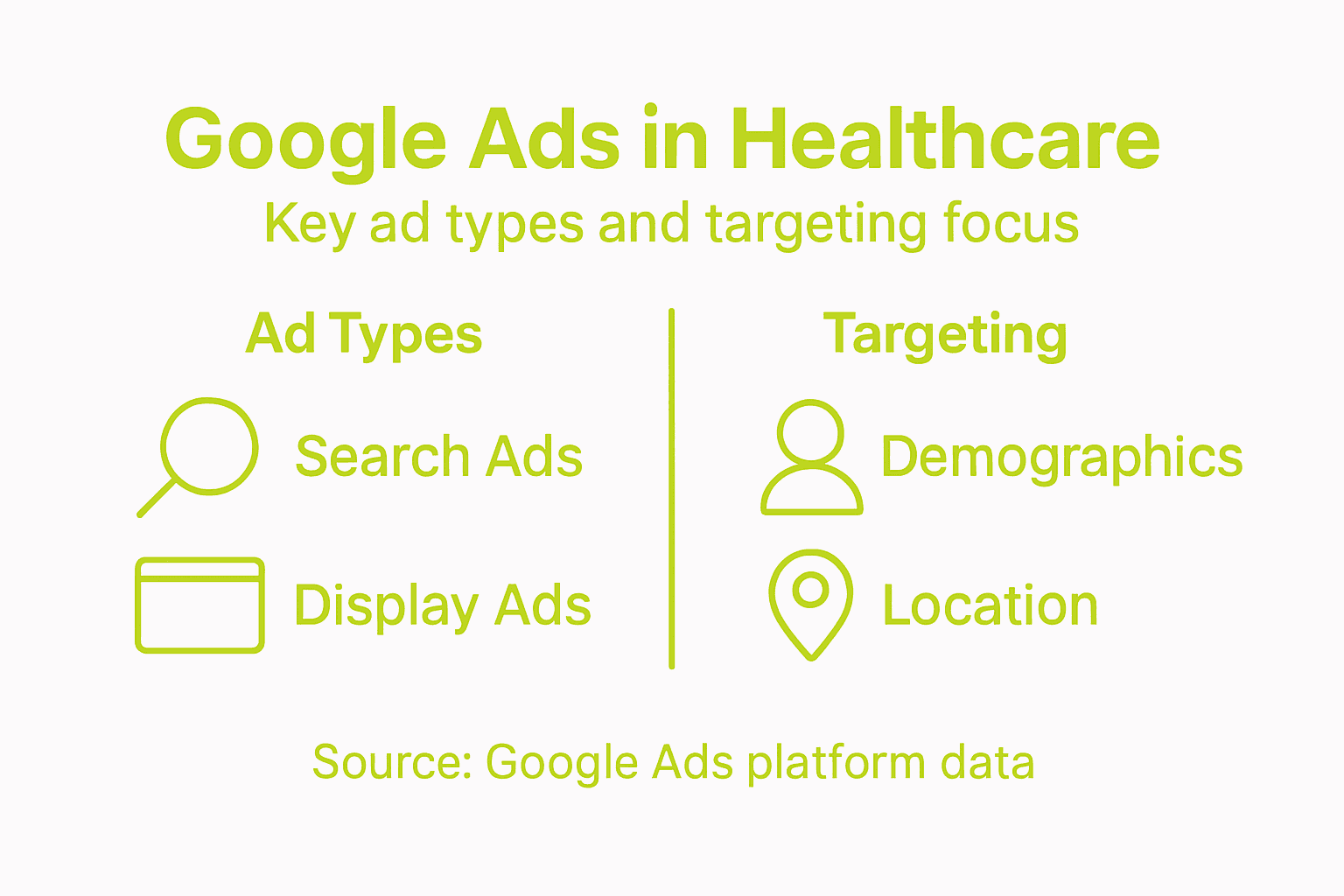
Targeting in healthcare demands precision because you are reaching people at vulnerable moments. Using demographic, behavioral, and psychographic data, you can segment audiences by age, health conditions, location, and even device type. A telehealth provider treating chronic conditions benefits from targeting adults aged 45 plus in specific geographic areas, while a pediatric practice focuses on parents searching for children’s health services. Keyword targeting ensures your ads appear when someone searches for specific treatments or symptoms your practice addresses. Geographic targeting restricts spending to service areas, preventing wasted budgets on unreachable patients.
The STP model (segmentation, targeting, positioning) provides a structured approach to healthcare ad strategy. Start by segmenting your market into distinct patient groups: new patient seekers, existing patients needing additional services, or those researching specific conditions. Next, target the segments offering the highest value for your practice. Finally, position your messaging to resonate with each segment’s unique needs and concerns. A segment researching “telehealth options for anxiety” needs different messaging than one searching “psychiatry near me.” This alignment between audience and message dramatically improves conversion rates and reduces cost per acquisition.
Remarketing campaigns deserve special attention in healthcare marketing. After someone visits your website but doesn’t book an appointment, remarketing ads follow them across the internet, reminding them of your services. For telehealth providers, this is particularly effective because the decision journey often spans multiple days or weeks. Someone might research virtual therapy on Monday, browse your website on Tuesday, then see your ad on Wednesday while checking email. That ad reminder can be the nudge that converts them into a patient.
Pro tip: Start with keyword targeting based on high-intent search terms your ideal patients actually use, then layer demographic restrictions to your service area and relevant age groups, allowing you to maximize your initial budget before expanding to broader display and remarketing campaigns.
Legal Requirements and Policy Compliance
Healthcare advertising exists in a heavily regulated space. Unlike most industries, you cannot simply run ads promoting your services without strict oversight. HIPAA and the 21st Century Cures Act govern how patient information flows through your marketing channels, and violations carry serious penalties. Your Google Ads campaigns must protect patient privacy at every stage, from keyword selection to landing page design. When someone searches for a specific condition and clicks your ad, you need safeguards to ensure their health information remains confidential. This is not optional compliance theater. It is foundational to operating legally and maintaining patient trust.
Truth in advertising carries particular weight in healthcare. You cannot exaggerate treatment outcomes, claim unproven benefits, or make medical claims that lack scientific support. A telehealth provider advertising anxiety treatment cannot promise a cure. A dental practice cannot claim that teeth whitening prevents cancer. These might seem obvious, but the line between persuasive marketing and misleading claims gets blurry quickly. Google Ads has built-in policies that flag healthcare ads for additional review, and your campaigns may face disapproval if messaging crosses into false or deceptive territory. Beyond Google’s policies, the Federal Trade Commission (FTC) and state medical boards actively monitor healthcare advertising for violations.
Healthcare compliance programs require staff training, monitoring, and clear promotional guidelines to maintain legal standing. Your marketing team needs to understand anti-kickback statutes, which prevent offering incentives that influence patient referrals or treatment decisions. For example, you cannot offer a free initial consultation as a giveaway prize in an ad campaign if the intent is to steer patients toward your practice rather than allow genuine choice. Patient testimonials in ads must be genuine, and any results claimed must be typical and verifiable. Documentation matters. Keep records of medical claims substantiation, approval processes for ad copy, and compliance review workflows.
The practical reality for small to medium-sized telehealth providers is that you need a compliance-first mindset before launching campaigns. Review your ad copy with someone who understands healthcare law, not just marketing. Audit your landing pages to ensure no HIPAA violations occur when patients submit contact forms. Work with Google’s healthcare advertiser verification process. These steps take time upfront but prevent costly mistakes down the road.
To help keep your healthcare ads compliant, use this quick legal compliance reference:
Legal Area | Why It Matters | Example Compliance Step |
Patient Privacy (HIPAA) | Prevents data breaches | Do not capture health info in ad URLs |
Truthful Claims | Avoids legal penalties | Substantiate treatment outcome claims |
Anti-Kickback Statutes | Prevents unethical bias | Prohibit incentivized patient referrals |
Documentation & Training | Ensures ongoing safety | Conduct monthly compliance audits |
Pro tip: Create an internal checklist reviewing every Google Ads campaign for three things: patient data protection in forms and tracking, truthfulness of medical claims with documentation, and alignment with anti-kickback statutes before launching any healthcare campaign.
Lead Generation and ROI Optimization
Lead generation in healthcare operates differently from other industries because the stakes are higher and the decision-making journey is longer. When someone clicks your Google Ads, they are not buying a product on impulse. They are exploring a healthcare decision that affects their well-being or their family’s health. Your job is to capture that interest, qualify them as a genuine lead, and move them toward booking an appointment. This requires a thoughtful campaign structure. Search ads targeting high-intent keywords like “telehealth for depression” or “virtual therapy near me” attract people actively seeking solutions. Display ads build awareness among those researching health topics. Video ads create trust through provider testimonials. Each channel feeds into a lead generation funnel designed to convert exploratory clicks into actual patient bookings.
Optimizing ROI means understanding what a new patient is truly worth to your practice. Continuous campaign monitoring, A/B testing, and conversion tracking allow you to measure performance at every stage and refine your approach. If your video ads generate clicks but no calls, you know the problem exists between the ad and the landing page. If your search ads drive traffic but conversions are low, your landing page messaging may not align with what the ad promised. By testing different headlines, landing page layouts, and call-to-action buttons, you identify what actually moves patients to action. Cost per lead matters, but cost per acquired patient matters more. A campaign generating 100 leads at $5 each that converts 5 patients is more valuable than one generating 200 leads at $2 each that converts 3 patients.
Calculating ROI requires knowing your numbers. ROI optimization involves measuring investment costs against new patient acquisitions and health outcomes. Start with your actual patient acquisition cost. If you spent $5,000 on Google Ads last month and acquired 10 new patients, your cost per acquisition is $500. Next, calculate patient lifetime value. If each new patient generates $3,000 in revenue over their relationship with your practice, your ROI is 500 percent (profit divided by investment). This maths justifies continued investment and shows where budget increases make sense. For a telehealth provider with high patient lifetime value, spending $1,000 to acquire one patient makes business sense. For providers with lower lifetime value, that same $1,000 may not pencil out.
The real optimization happens when you stop treating Google Ads as a single campaign and start treating it as a system. Week one focuses on data collection and learning which audiences respond. Weeks two through four involve testing and refinement. By week five, you should have clear winners. Double down on what works. Pause what does not. Adjust bids on high-performing keywords. Expand targeting to similar audiences. This systematic approach compounds over time, and what started as a breakeven campaign becomes highly profitable.
Pro tip: Track not just leads generated but specifically how many leads convert to booked appointments, then calculate the revenue each appointment generates; this single metric reveals your true ROI better than lead volume alone.
Risks, Costs, and Common Mistakes
Google Ads in healthcare is expensive. Period. You are competing against established providers with massive budgets, and healthcare keywords consistently rank among the most costly on the platform. A single click on “psychiatry near me” or “telehealth for anxiety” can cost $8 to $15, depending on your market. Multiply that across hundreds of clicks, and your monthly budget disappears fast. The real danger is not just the cost itself but wasting that cost on poorly targeted campaigns. Many healthcare providers launch ads without a clear understanding of their patient acquisition economics. They spend $10,000 monthly, generate 50 leads, convert 2 patients, and declare the campaign a failure without realizing that those 2 patients might generate $6,000 in revenue each. The mistake was not the spending but the lack of proper analysis to guide it.
Another critical risk involves inadequate staff training and misunderstanding patient needs. Your marketing team needs baseline knowledge of healthcare compliance, but they also need to understand your actual patient population. A campaign targeting “affordable mental health services” might attract price-sensitive patients who are less likely to complete treatment and more likely to request refunds. Understanding patient psychographics prevents this mismatch. A therapist seeking to build a high-value practice targets patients with insurance and stable income, not bargain hunters. Staff also need ongoing education as regulations evolve. The person managing your ads today must understand current HIPAA requirements, Google policy changes, and platform updates. One outdated assumption about consent requirements or patient data can trigger a compliance violation.
High costs from competitive bidding, ineffective targeting, and regulatory non-compliance often stem from foundational mistakes. Neglecting audience segmentation is common. A dermatology practice runs broad search ads for “skin care” and attracts people looking for moisturizer reviews instead of dermatology patients. Poor ad copy compounds the problem. Your headline and description must immediately signal that you treat actual patients, not sell retail products. Failure to monitor performance means you keep funding underperforming campaigns indefinitely. You set a monthly budget, launch ads, and assume everything is working because you see impressions and clicks. Without conversion tracking, you have no idea what is actually happening.
The path forward requires systematic preparation. Document your patient acquisition cost before launching. Understand what compliance rules apply to your specific services. Train your team on both marketing best practices and healthcare regulations. Set up conversion tracking before spending a single dollar. Start with a small daily budget and scale only after proving the model works. This approach costs time upfront but prevents expensive mistakes that undermine your entire campaign.
Pro tip: Audit any existing Google Ads campaign for conversion tracking setup before spending more money; if you cannot measure what happened to patients who clicked your ads, you are flying blind and likely wasting significant budget.
Maximize Patient Growth with Expert Google Ads Management
Navigating the complex world of healthcare advertising demands precision, compliance, and a profound understanding of patient behavior. This article highlights key challenges such as high competition, costly keywords, rigorous legal requirements, and the need for targeted messaging to optimize your patient acquisition cost and ROI. If your healthcare practice struggles with these pain points or wants to boost lead generation while staying fully compliant, you need a strategic partner who knows how to craft winning Google Ads campaigns tailored specifically for the healthcare sector.
At A&T Digital Agency, we specialize in building and scaling performance-driven Google Ads systems that deliver measurable results for healthcare providers. Our boutique approach blends strategic planning, creative development, and data-driven optimization to help you:
Target high-intent patient segments using the STP model with precision demographic and keyword strategies
Maintain strict adherence to HIPAA and advertising regulations to protect your practice from risk
Optimize your campaigns for true ROI by tracking booked appointments and patient lifetime value
Avoid costly mistakes using proven performance marketing frameworks designed for the healthcare space
Ready to transform your healthcare advertising and start gaining more patients without wasting budget? Discover how our personalized Google Ads expertise can help you grow confidently in a competitive market. Visit A&T Digital Agency today to learn more about our performance marketing services and schedule a consultation that aligns your goals with proven digital solutions.
Frequently Asked Questions
What are the different ad formats available in Google Ads for healthcare providers?
Google Ads offers various ad formats tailored for healthcare providers, including search ads for high-intent patient searches, display ads for broad brand awareness, video ads for education and trust building, and shopping ads for healthcare products.
How can targeting strategies improve the effectiveness of Google Ads in healthcare?
Targeting strategies utilize demographic, behavioral, and psychographic data to reach specific audiences based on age, health conditions, and geographic location. This helps healthcare providers engage potential patients at critical decision-making moments.
Why is compliance important when running Google Ads for healthcare?
Compliance is crucial in healthcare advertising due to regulations such as HIPAA and the 21st Century Cures Act, which protect patient privacy and ensure truthful claims. Violating these regulations can lead to severe penalties and loss of patient trust.
What are some key metrics to measure the success of Google Ads campaigns in healthcare?
Key metrics include cost per acquisition, conversion rates, and patient lifetime value. Understanding these metrics helps optimize campaigns for better ROI and ensures that marketing budgets are spent effectively.
Recommended
Performance Marketing Agency | Multi-Channel Paid Ads || A&T Agency
Performance Marketing Agency | Multi-Channel Paid Ads || A&T Agency
Performance Marketing Agency | Multi-Channel Paid Ads || A&T Agency
The History and Evolution of Google Ads - playablemaker.com The History and Evolution of Google Ads


