What Is Competitive Ad Analysis? A 2026 Guide
Posted on
Marketing
Posted at

What competitive ad analysis actually means
Competitive ad analysis is the systematic process of monitoring, documenting, and reverse-engineering your competitors' advertising strategies across platforms like Google Ads, Meta, YouTube, and LinkedIn. You study what messaging converts, which creative formats hold attention, and where budget opportunities exist in your market. The goal is to identify patterns that accelerate your own ad performance while skipping the costly tests your competitors already ran.
This practice goes well beyond scrolling through a rival's Facebook page. It involves tracking ad frequency, creative rotation, audience targeting signals, landing page structure, and seasonal campaign shifts. Done right, it produces three concrete outputs: a creative inventory, a message map, and an action brief your team can execute immediately.
The core components of a complete competitive ad analysis:
Competitor selection: Identify several brands genuinely competing for your audience's attention and budget
Cross-platform creative collection: Pull ads from Meta Ad Library, Google Ads Transparency Center, YouTube, LinkedIn, and TikTok
Creative dissection: Break each ad into its hook, structure, copy, visual style, and call-to-action
Message mapping: Cluster ads by claim theme to reveal what competitors are betting on and what they are ignoring
Budget and cadence inference: Use ad longevity, variant count, and platform breadth to estimate competitor investment levels
Brief generation: Translate findings into specific creative directions for your next campaign sprint
Why analyzing competitor ads changes your campaign results
The most direct benefit of competitor ad analysis is avoiding wasted spend. When you launch campaigns without competitive intelligence, you pay to repeat experiments others already completed and failed. Businesses that conduct regular competitor analysis see 23% higher click-through rates and 18% lower cost-per-acquisition compared to those that skip it.

Speed is the second major benefit. Regular competitor ad tracking can reduce time-to-profitability significantly by starting with proven messaging frameworks and creative formats. That compression matters enormously when you are managing a fixed quarterly budget.
Key outcomes marketers gain from structured competitor ad research:
Reduced creative waste: Skip concepts competitors already tested and lost
Faster campaign optimization: Start with validated messaging angles instead of blank-slate hypotheses
Budget allocation clarity: Understand where rivals concentrate spend and where gaps exist
Creative fatigue prediction: Spot when competitors are about to refresh, then time your own launches to capture market share
Format intelligence: Identify which ad formats (video, carousel, static) dominate your category and where you are underrepresented
Stat worth noting: Businesses applying competitive intelligence see up to 18% higher marketing ROI than those who only gather data.
8 frameworks for executing competitor ad analysis effectively
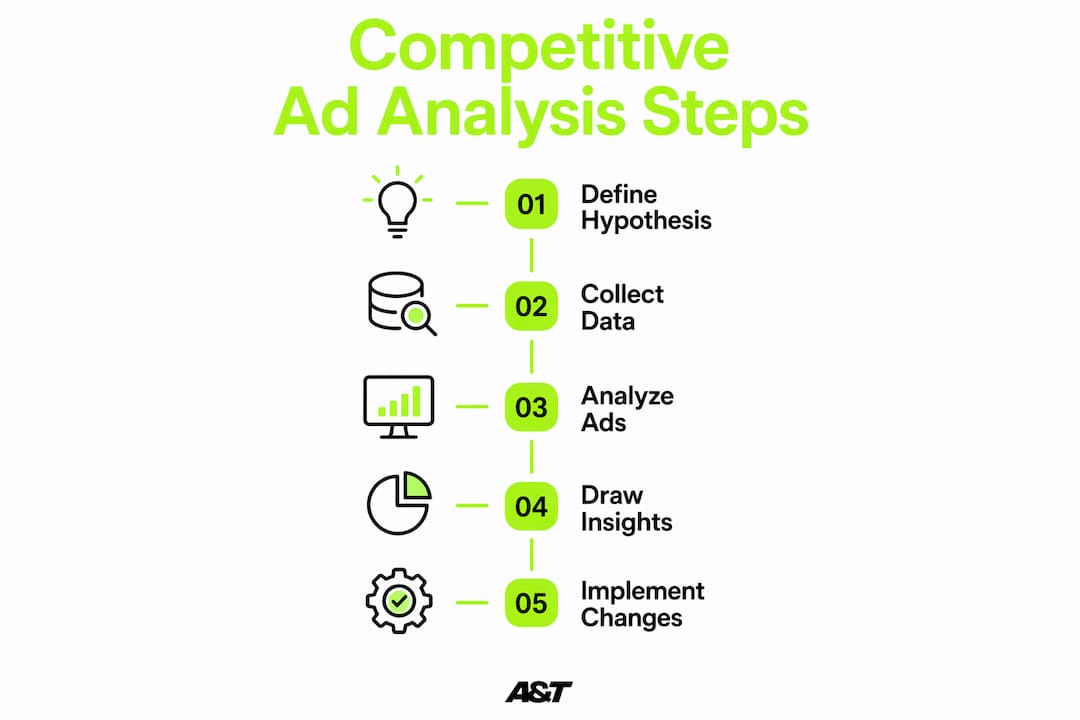
Professional competitive ad analysis follows a structured process. The six-phase approach most practitioners use covers competitor selection, cross-platform collection, creative dissection, message mapping, budget inference, and brief generation. Most teams skip phases four and five. That is exactly where the real edge lives.

Here is how each stage works in practice.
The competitive ad analysis framework at a glance
Phase | What you do | Key output |
|---|---|---|
Competitor selection | Choose 5–10 brands competing for your audience | Prioritized competitor list |
Creative collection | Pull ads from all active platforms, no filtering yet | Raw creative inventory |
Ad DNA dissection | Break each ad into hook, structure, copy, visual, CTA | Annotated ad database |
4. Map messages | Cluster by claim theme; count frequency | Message map with whitespace |
5. Infer budget and cadence | Read longevity, variant count, platform breadth | Spend and timing signals |
Brief generation | Identify messages to counter, gaps to fill, formats to test | Action brief for creative team |
Framework stages and execution tips:
Competitor selection: Focus on direct competitors first, then aspirational ones. Tracking more than 15 brands creates data overload that reduces your ability to act on anything.
Creative collection: Do not filter at collection time. Filtering before you have seen the full picture introduces bias into your analysis.
Ad DNA dissection: Every ad has five analyzable components. The hook is what stops the scroll in the first three seconds. The structure is how the ad flows from hook to call-to-action. Copy covers tone, messaging angle, and value proposition. Visual style distinguishes polished production from user-generated content. The CTA covers placement, wording, and visual treatment.
Longevity as performance proxy: An ad running 30 or more days without a major refresh is almost certainly profitable. Algorithms reduce spend on underperforming ads within two to three weeks, so longevity is the clearest signal you have without access to their internal data.
Message mapping: Strip out format and visual. Ask what each ad is actually claiming. Group claims into themes. The themes no competitor is using are your whitespace.
Budget inference: Tracking ad frequency, platform presence, and active creative variants lets you estimate competitor investment levels. A brand running simultaneous campaigns across Meta, YouTube, LinkedIn, and TikTok is committing serious monthly budget to paid media.
Brief generation: A good brief has three sections: messages to counter, gaps to fill, and formats to test. Without the brief, the analysis stays research. The brief is what converts intelligence into creative strategy.
Applying findings: When you spot a winning competitor approach, do not copy it directly. Identify the underlying principle and adapt it to your brand voice. The goal is to learn what structures and angles resonate with your shared audience, not to replicate someone else's execution.
Pro Tip: Frame every analysis session around a specific hypothesis before you start. "Does our competitor's guarantee offer outperform our free-trial angle?" is a question you can answer. "What are competitors doing?" is a question that produces a folder of screenshots and no decisions.
Which tools make competitor ad research faster and more accurate
The two free starting points are Meta Ad Library and Google Ads Transparency Center. Both offer access to competitor ads at no cost, but with real limitations: no historical data, no performance metrics, and no alerting when competitors launch new creative. They work well for occasional checks and initial research. For systematic tracking, you need more.
Google Ads Auction Insights, available inside your own account, is the most reliable first-party competitive data available for search campaigns. It shows the actual domains sharing your auctions, along with their impression share, overlap rate, and outranking share. This is measured data from your live auctions, not modeled estimates from third-party sampling.
Automated competitive intelligence tools fill the gaps that free libraries leave open. They provide historical creative archives, automated alerts when competitors launch new ads, cross-platform dashboards, and pattern detection that would take hours to replicate manually. For teams spending more than $5,000 per month on paid media, the time savings alone typically justify the cost.
Tools worth knowing:
Meta Ad Library: Free access to all active Facebook and Instagram ads; no performance data or history
Google Ads Transparency Center: Free visibility into Google Search and Display ads across advertisers
Google Ads Auction Insights: First-party impression share and competitive overlap data for your live campaigns
Third-party spend estimation tools: Directional keyword and spend intelligence; treat as themes, not precise figures
Automated ad intelligence platforms: Historical archives, multi-platform monitoring, creative alerting, and pattern dashboards
Configuring your tools correctly determines whether you get signal or noise. Set alerts for significant creative changes, not every minor variation. Build a simple competitor ad database tracking: competitor name, ad start date, format, hook type, messaging angle, platform, and active status. That database becomes more valuable every week as it reveals seasonal patterns and long-term strategy shifts. For a broader look at top ad management platforms that support competitive data collection, A&T Digital has a dedicated 2026 breakdown worth reviewing.
Common mistakes that undermine competitor ad analysis
The most damaging mistake is reacting emotionally to isolated competitor moves. A competitor launches a flashy promotion, and your team scrambles to match it. That reaction wastes budget on a single data point that may be a test, a seasonal push, or a desperate move. Consistent patterns across multiple data points should drive decisions, not one screenshot from last Tuesday.
Data overload is the second major trap. Tracking 20 competitors across six platforms produces more information than any team can act on. The discipline is in the selection: choose the competitors who genuinely compete for your audience's attention and budget, then track them consistently.
Common pitfalls and how to avoid them:
Emotional reactions to minor moves: Wait for patterns across multiple observations before changing course
Copying without understanding: Extracting the underlying principle matters more than replicating the execution
Ignoring longevity signals: An ad running for weeks is a signal. An ad that appeared yesterday is just data.
Skipping message mapping: Creative dissection without message mapping produces observations, not strategy
Inconsistent tracking: Occasional checks miss the trends that only emerge over time; weekly reviews build the pattern recognition you need
Treating third-party spend estimates as facts: Third-party tools model spend from SERP sampling. Use them for directional themes, not precise budget numbers.
Pro Tip: Build a simple weekly review habit: 30 minutes, same competitors, same platforms, same database. Consistency beats intensity. One hour per week for three months reveals patterns that a single all-day research session never will.
How A&T agency approaches competitive ad analysis for clients
At A&T Digital, we treat competitive ad analysis as the foundation of every campaign we build, not an optional pre-launch step. Before we write a single line of ad copy or allocate a dollar of budget, we know what the market is saying, what it is ignoring, and where the real creative whitespace sits.
Our approach combines three things most teams separate: strategic planning, creative development, and data-driven execution. Competitive intelligence feeds all three simultaneously. The message map informs the creative brief. The budget inference shapes the media plan. The longevity signals tell us which formats to prioritize and which to test.
What this looks like in practice for our clients:
Creative briefs built on gaps: We identify the claims no competitor is making that our client can legitimately own, then build campaigns around those unopposed angles
Cross-platform data collection: We pull from Meta, Google, YouTube, and LinkedIn before forming any creative hypothesis
Ongoing optimization: Competitive analysis does not stop at launch; we track competitor creative rotation throughout the campaign and adjust accordingly
Hypothesis-driven testing: Every creative test connects to a specific competitive question, which reduces blind experiments and focuses budget on decisions that matter
Performance benchmarking: We use ad longevity, engagement patterns, and Auction Insights data to set realistic performance expectations before a campaign goes live
Understanding why competitor campaign analysis mattersis one thing. Building a system that turns those insights into better creative briefs is another. For teams ready to go deeper ontesting ad creativesbased on competitive findings, A&T Digital's process covers exactly that translation from intelligence to execution.
Pro Tip: When building your creative brief from competitive research, always include a "defend or counter" column alongside your gap opportunities. Knowing which competitor claims you need to address is just as valuable as knowing which angles are wide open. Effective calls-to-action informed by competitor CTA patterns consistently outperform CTAs written in isolation.
Real–world examples of competitive ad analysis driving results
The clearest example of competitive ad analysis working in practice comes from the telehealth sector, where A&T Digital ran campaigns for a client entering a crowded market. Before writing a single ad, we audited the active creative across the top competitors in the space. Three patterns emerged immediately: every major player led with symptom-focused hooks, all of them used the same "fast and convenient" positioning, and none of them addressed the trust barrier that new patients consistently face.
That gap became the campaign's foundation. Instead of competing on convenience, we built creative around verified provider credentials and transparent pricing. The messaging was unopposed. Competitors had left it completely unaddressed, which meant our client's ads did not fight for the same mental shelf space. The result was a cost-per-acquisition that came in well below the category average within the first four weeks.
A second example comes from a retail client selling health and wellness products. Competitor analysis revealed that the dominant brands in the category were running heavy video with polished production, but almost no user-generated content. The audience, however, was engaging heavily with UGC-style organic content from micro-influencers in the same space. We built a creative test around that format gap, and the UGC-style ads outperformed the polished video variants in both click-through rate and conversion rate. The insight came directly from reading what competitors were not doing, not from copying what they were.
These cases reflect a consistent principle: the most valuable output of competitive ad analysis is not a list of what competitors are doing. It is a clear picture of what they are leaving uncontested.
Key Takeaways
Competitive ad analysis gives you a measurable edge: businesses that apply it consistently see 23% higher click-through rates and 18% lower cost-per-acquisition compared to those that skip it.
Point | Details |
|---|---|
Start with a clear hypothesis | Frame analysis around a specific decision before collecting data to avoid paralysis. |
Longevity signals profitability | Ads running 30 or more days without refresh are almost certainly profitable and worth deep study. |
Message gaps are the real prize | The claims no competitor makes are your best creative bets; unopposed angles convert better. |
Free tools have real limits | Meta Ad Library and Google Ads Transparency Center show what is running, not what is working. |
Apply insights, not just observations | Businesses applying competitive intelligence see up to 18% higher marketing ROI than those who only gather data. |