Why Tailor Ads for Venues: The ROI Case for SMBs
Posted on
Marketing
Posted at

Tailored venue ads that match location, timing, and audience signals produce faster bookings and higher revenue compared to generic campaigns.
Using geo-targeting, audience segmentation, and event-specific creative maximizes ROI and reduces wasted ad spend significantly.
Tailoring ads for venues increases booking conversion and cuts wasted spend by matching your message to the right place, time, and buyer stage. Generic ads broadcast to everyone and convert almost no one. When you align geo-targeting, event timing, audience signals, and creative to a specific venue and date, you give buyers a reason to act now. The three platforms that make this work at scale for SMBs are Google Ads, Meta (Facebook & Instagram) Ads, and TikTok Ads, and the critical elements to tailor are:
Geo: 3–15 mile radii, tightened for urban venues, broadened for regional draws
Timing: day-of-week, event type, and seasonal cadence
Audience: first-party CRM data, repeat attendees, lookalikes built from actual bookers
Creative: event-specific copy, real venue imagery, and offers tied to a specific date or package
The payoff is faster booking velocity, higher in-venue spend, and measurable lift over generic campaigns.
Table of Contents
Why venue-tailored ads deliver stronger business returns
The tactical levers that actually move venue bookings
How to set up venue-tailored paid campaigns step by step
How to measure success: the KPIs and benchmarks venues should use
Common pitfalls, ad fatigue, and U.S. privacy considerations
What success looks like: a venue campaign case study
Quick implementation checklist for SMB venues
Key Takeaways
The case for venue-specific ad strategy
How A&T Digital builds venue-tailored campaigns that convert
Sources and further reading
Why venue–tailored ads deliver stronger business returns
The business case is direct. Meta venue campaigns structured with the right funnel and creative can generate significant revenue multiples for every dollar spent. That multiple collapses when you run one generic ad to a broad audience. Venue-specific targeting reduces wasted impressions by narrowing delivery to the DMA, radius, and lookalike audiences built from people who actually booked, not just clicked.
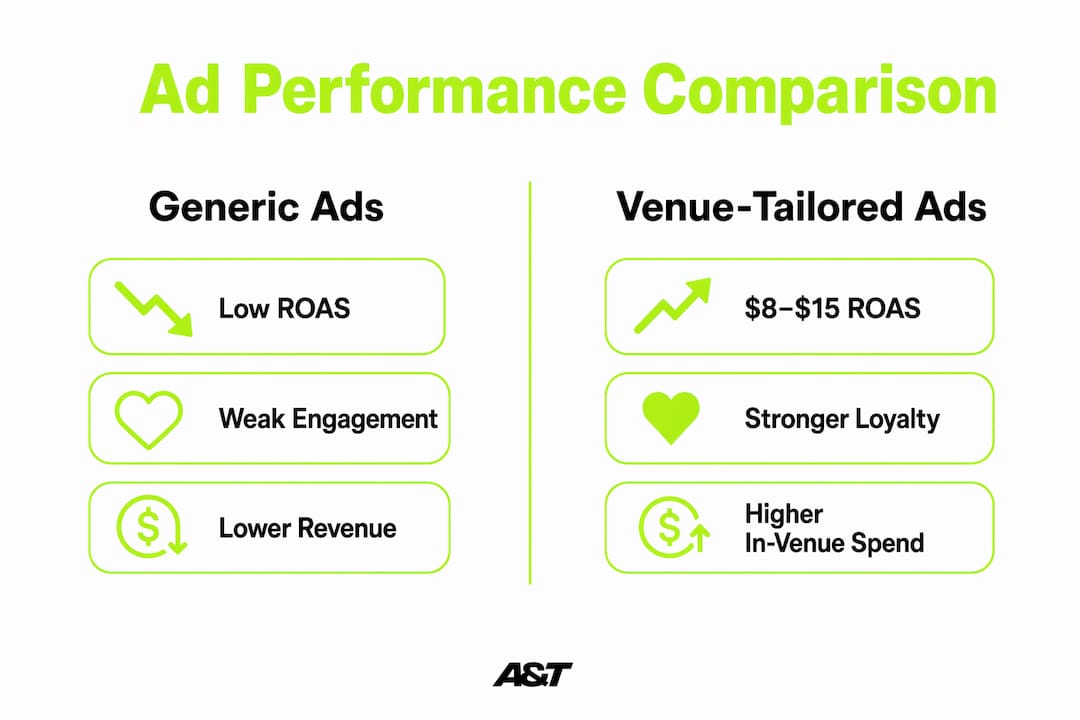
Outcome | Generic Ads | Venue-Tailored Ads |
|---|---|---|
Revenue per $1 on Meta | Below benchmark | $8–$15 (well-structured campaigns) |
Landing-page conversion rate | Baseline (homepage) | 3x–5x higher (dedicated page) |
Cost per booking | Higher | Reduced significantly when using Meta and Google Ads combined |
Repeat attendance | Low | Higher with first-party data personalization |
Beyond the booking itself, personalizing the venue experience using first-party data increases loyalty, in-venue spend, and repeat attendance. Live Nation's personalized loyalty video program delivered a high return on investment, a figure that reflects what happens when data and creative work together at scale.
Running Meta for demand generation alongside Google Ads for demand capture typically reduces cost per booking significantly versus running one channel alone. That cross-channel efficiency is one of the clearest arguments for a structured, venue-specific approach.
The tactical levers that actually move venue bookings
Knowing which controls to adjust, and when, separates campaigns that scale from ones that stall.

Geo-targeting is the first lever. Geo-fencing radii of 3–15 miles are standard, but the right radius depends on context. Urban venues with dense competition benefit from a tighter 3–5 mile pull. Regional event centers drawing from a wider area can push to 10–15 miles without losing relevance.
Audience segmentation is where most SMB venues leave money on the table:
New attendees vs. repeat bookers require different messages and offers
Event-intent audiences (newly engaged couples for wedding venues, corporate planners for conference spaces) respond to category-specific creative
Lookalike audiences built from your actual booker list outperform interest-based targeting
CRM retargeting to past attendees drives repeat visits at a fraction of new-acquisition cost
Creative and offers must match the segment. An event-specific CTA ("Book your holiday party before October 31") outperforms a generic "Learn more." Real venue photography, not stock images, builds trust faster. Dynamic creative that swaps assets by audience segment scales this without multiplying production costs.
Timing and frequency matter more than most operators realize. Structure campaigns by funnel stage: awareness video early, consideration carousel mid-funnel, conversion retargeting close to the event date. Frequency caps prevent ad fatigue, which shows up as rising cost-per-click with flat conversions.
Pro Tip: Set frequency caps at 3–5 impressions per user per week for awareness campaigns and tighten to 7–10 for retargeting. Beyond those thresholds, you're paying to annoy people who already know you.
How to set up venue–tailored paid campaigns step by step
A clean setup prevents the measurement gaps that make optimization impossible. Here is the ordered build:
Install pixels and server-side events. Web pixels alone miss a significant share of conversions due to browser restrictions. Server-side tagging closes that gap and feeds cleaner data to Google Ads and Meta.
Define conversion events tied to CRM booking stages. Map "form submit," "tour booked," and "deposit paid" as distinct events so you can optimize toward revenue, not just clicks.
Build dedicated landing pages per event or offer. Pages must load in under 3 seconds on mobile, carry a single CTA, and show the booking calendar or inquiry form above the fold. Dedicated landing pages convert at a substantially higher rate than generic homepages.
Structure three campaigns: awareness video, consideration carousel or lead-gen, and conversion retargeting. Split budget roughly 20/30/50 as audiences build.
Sync your CRM. Connect your CRM to both platforms for lead scoring and rapid follow-up. Venues that respond within five minutes convert at 3–4x the rate of those that respond within an hour.
Import offline conversions. Phone bookings and in-person deposits must flow back into Google Ads and Meta so the algorithms optimize toward real revenue. See the Google Ads setup guide for the technical steps.
Schedule a 30–60 day learning window. Algorithmic platforms need volume to exit the learning phase. Resist the urge to restructure campaigns before that window closes.
Pro Tip: Use a marketing automation checklist to verify your CRM and ad platforms are exchanging data before you spend a dollar on media. A broken sync means you're flying blind.
How to measure success: the KPIs and benchmarks venues should use
Primary KPIs for venue campaigns are bookings and tours (volume and CPA), ROAS, revenue per attendee, and qualified lead volume. Supporting metrics include CTR, landing-page conversion rate, view-through conversions for video awareness, and lead response time.
KPI | Benchmark / Target |
|---|---|
Landing-page load time | Under 3 seconds (mobile) |
Meta campaign ROAS | $15 revenue per $1 spent |
Dedicated landing page vs. homepage | 3x–5x higher conversion rate |
Lead response time | Under 5 minutes for 3–4x booking rate |
Multi-channel cost per booking | lower vs. single channel |
Attribution is where venue campaigns most often break down. Importing CRM bookings and phone-call conversions back into Google Ads and Meta closes the loop between ad spend and actual revenue. Without offline conversion import, your platforms optimize toward form fills, not deposits, which skews budget toward low-intent leads.
Common pitfalls, ad fatigue, and U.S. privacy considerations
The most expensive mistake is sending paid traffic to a generic homepage. The second most expensive is running one creative for every audience. Both problems are fixable, but they compound quickly when left unaddressed.
Funnel staging ignored: Pushing conversion ads to cold audiences burns budget. Build awareness first, then retarget.
No offline conversion import: Platforms optimize toward the signal you give them. If you only import form fills, you get form fills, not bookings.
Ad fatigue: Rising CPC with flat conversions is the signal. Refresh creative every 3–4 weeks for active retargeting audiences, expand lookalike audiences, and adjust frequency caps.
U.S. privacy: Respect opt-outs under applicable state privacy laws (California's CCPA is the most common framework for SMBs). Document your first-party data governance, avoid targeting sensitive categories, and include clear data-collection disclosures on landing pages and lead forms.
Pro Tip: If server-side tagging, CRM integration, or compliance workflows feel out of scope for your team, that is a clear signal to bring in an agency. The cost of bad data compounds every month.
What success looks like: a venue campaign case study
A technology-led sports and entertainment complex with nearly 100 U.S. locations used dynamic, time-based ad delivery to promote food and beverage offerings tied to the guest journey. By serving different messages based on how long a guest had been checked in, the team surfaced drink offers early and food offers later in the session.
The core tactics: real-time dynamic creative, dedicated offer pages, and 100% measurable attribution tied to in-venue screens. The results were direct:
3x increase in sales for a featured drink that had previously gone unadvertised
Approximately $2 million in revenue from an off-menu item promoted exclusively on in-venue screens
Full attribution to specific campaigns and placements
The same logic applies to paid digital campaigns. When you match the message to the moment, the buyer's stage, and the specific offer, you get measurable lift. When you don't, you get impressions.
The client's role in any comparable campaign: provide an updated availability calendar, real venue photography, CRM access, and a point of contact for rapid lead response. Expected time to measurable results: 30–90 days from launch.
Quick implementation checklist for SMB venues
Ordered setup:
Audit existing pixels, conversion events, and CRM connections (one week)
Build or brief creative asset pack: venue photos, event-specific copy, offer variants (one to two weeks)
Build dedicated landing pages per event type, verify mobile load under 3 seconds (one to two weeks)
Sync CRM and configure offline conversion import (one week)
Launch three-campaign structure with test budgets (week four)
Set reporting cadence: weekly performance review for first 60 days
Enter 30–60 day learning window before major restructuring
Cost drivers to plan for:
Creative production: photography, copy, and dynamic templates
Platform media budgets: $1,500–$3,000/month per location is a typical SMB starting point for Meta and Google Ads combined
Management fees: agency or in-house time for optimization, reporting, and CRM workflows
Hire an agency when: your team lacks conversion tracking expertise, you cannot guarantee sub-five-minute lead response, or you need cross-platform optimization and reporting without adding headcount. The venue campaign workflow guide covers the full decision criteria.
Key Takeaways
Venue-tailored ads outperform generic campaigns because they match geo, timing, creative, and data signals to the specific moment a buyer is ready to book.
Point | Details |
|---|---|
Geo and audience first | Use 3–15 mile radii and CRM-built lookalikes to cut wasted impressions from the start. |
Fix landing pages before scaling spend | Dedicated pages convert at 3x–5x the rate of a homepage; load time must be under 3 seconds. |
Run a three-campaign funnel | Awareness video, consideration carousel, and conversion retargeting with a 30–60 day learning window. |
Import offline conversions | Bookings and phone calls must flow back into Google Ads and Meta for accurate optimization. |
A&T Digital for execution | Hire A&T Digital when tracking setup, CRM integration, or cross-platform optimization exceeds internal capacity. |
The case for venue–specific ad strategy
Most venue operators we work with have tried paid ads before and walked away frustrated. The campaigns weren't wrong in concept. They were wrong in structure. A broad audience, a homepage destination, and a single creative running for three months will always underperform, not because the platform failed, but because the system wasn't built to convert.
What we've seen work, consistently, is treating venue marketing as a system where every element earns its place. Geo narrows the audience to people who can actually show up. Event-specific creative gives them a reason to act this week, not someday. A fast, focused landing page removes friction at the moment of decision. CRM follow-up within minutes closes the gap between interest and deposit.
The venues that win aren't spending more. They're spending smarter, on the right people, at the right moment, with a message that matches where those people are in the decision. That's the whole case for personalizing ad campaigns for venues, and it's why we build every campaign around it.
How A&T agency builds venue–tailored campaigns that convert
A&T Digital runs the full paid advertising system for SMB venues: Google Ads management, Meta Ads management (Facebook & Instagram), TikTok Ads, conversion tracking setup, CRM integration, landing-page optimization, and ongoing reporting. You get a prioritized audit in the first week, a structured setup plan with a proposed test budget and timeline, and a team that responds fast when campaigns need adjustment. No unnecessary meetings. No generic strategies. Book a discovery call and we'll show you exactly where your current setup is losing bookings and what it would take to fix it.
Sources and further reading
Facebook Ads for Venues: What Actually Works — Venyrs AI
The Complete Guide to Marketing Your Event Venue in 2026 — Venyrs AI
Google Ads for Event Center: A Step-by-Step Setup Guide — Sona
Personalizing the Venue Experience in 2026 — TicketFairy
How Live Nation Hit 12.3x ROI With Personalized Fan Loyalty Video — Blings
Geo-Fencing for Entertainment Venues — Clinch Case Study
Entertainment Venue Generated Over $2M in Revenue — Vistar Media