First–Party Data Benefits for Ecommerce: 2026 Guide
Posted on
Marketing
Posted at

First-party data is the single most reliable growth lever ecommerce teams can control. You own it, it doesn't expire when a browser policy changes, and it gets more accurate the longer you use it. The benefits of first-party data for ecommerce are concrete: better personalization, lower wasted ad spend, cleaner attribution, and higher customer lifetime value. A Google and Boston Consulting Group study found that brands activating first-party data for key marketing functions achieved significant revenue uplift and cost savings compared to those relying on third-party signals.
Here's what that means in practice for your store:
Better personalization: Product recommendations and email flows built on real purchase and browse history convert at higher rates than generic campaigns.
Lower CPA: Suppression lists and high-LTV lookalike seeds cut wasted spend on audiences who already bought or will never convert.
Cleaner attribution: Server-side event collection gives ad platforms complete, accurate conversion signals, so optimization actually works.
Higher retention and AOV: Lifecycle segmentation built on purchase history keeps customers coming back and spending more per order.
Privacy resilience: Data you collected with consent on your own channels isn't subject to third-party deprecation.
The 2026 ad-platform reality makes this urgent. Meta Conversions API, Google Enhanced Conversions, and TikTok Events API all run on server-side, first-party inputs. Without them, platforms default to probabilistic modeling and your optimization degrades. This guide covers every layer: what qualifies as first-party data, how to collect it, how to activate it across channels, and how to measure the lift.
Key Takeaways
First-party data is the most cost-effective growth asset ecommerce brands control, and activating it through server-side tracking and clean audience segmentation is what separates brands seeing real efficiency gains from those paying more for worse results.
Point | Details |
|---|---|
Revenue uplift potential | Brands activating first-party data for key marketing functions achieved up to 2.9x revenue uplift per Google and BCG research. |
Server-side tracking is required | Meta CAPI, Google Enhanced Conversions, and TikTok Events API all require server-side, first-party inputs; target 85%+ purchase event match rate. |
Suppression and seeding cut CPA | Uploading high-LTV customer segments as lookalike seeds and suppressing recent purchasers consistently improves paid acquisition efficiency. |
Owned channel revenue share | Best-in-class ecommerce brands generate a significant share of revenue from email and SMS, reducing dependence on paid acquisition. |
A&T Digital activates your data | A&T Digital audits your data connections and builds the audience architecture that turns first-party signals into measurable paid media results. |
Table of Contents
What exactly is first-party data, and how does it differ from other types?
The core business benefits of first-party data for ecommerce
How to collect first-party data at scale for your online store
How to use first-party data across your marketing channels
What tech stack do you actually need to unify first-party data?
Measuring the ROI of your first-party data program
Privacy, consent, and US compliance for ecommerce teams
Common pitfalls and a 90-day implementation checklist
How A&T Digital approaches first-party data for ecommerce clients
Why first-party data deserves your budget and attention right now
A&T Digital helps ecommerce brands activate first-party data through paid media
Sources
What exactly is first–party data, and how does it differ from other types?
First-party data is any information your brand collects directly from customers through channels you own and operate: your website, your app, your email list, your checkout flow, your loyalty program. You control the collection, you control the storage, and you own the relationship.
The distinctions between data types matter because they determine accuracy, cost, and legal exposure:
Data Type | Who Collects It | How You Get It | Ecommerce Example |
|---|---|---|---|
Zero-party | The customer, voluntarily | Quizzes, preference centers, surveys | "I prefer running shoes in size 10" |
You, on your own channels | Purchase events, site behavior, email clicks | A customer's 90-day order history | |
A trusted partner | Data-sharing agreements | A retailer sharing purchase data with a brand | |
A data broker | Purchased audience segments | Demographic lists from an ad network |
Zero-party data deserves special attention. It's what customers tell you explicitly, which makes it the most defensible signal as privacy regulations tighten. A quiz asking "What's your skin type?" or a post-purchase survey asking "What almost stopped you from buying?" produces signals no algorithm can infer reliably.
For ecommerce, the practical scope of first-party data includes: transaction history (items, frequency, AOV), on-site behavior (pages viewed, search queries, cart events), email and SMS engagement (opens, clicks, unsubscribes), loyalty program activity, customer service interactions, and survey or quiz responses. Each of these lives in a system you control, which is the defining characteristic.
The core business benefits of first–party data for ecommerce
The advantages of first-party data aren't theoretical. They show up in specific KPIs. Here's where the impact lands.
Personalization that actually moves revenue
Generic product recommendations convert at a fraction of the rate of behavior-driven ones. When you know a customer bought a French press last month, you can surface coffee subscriptions, grinders, and filters at the right moment. That's not a nice feature — it's a revenue mechanism. Personalization built on real purchase and browse signals increases AOV because it's relevant, not random.

Lower acquisition cost and less wasted spend
Suppression is one of the most underused tactics in paid media. Uploading your recent purchasers as a suppression list on Meta and Google can reduce paying to re-acquire customers you already have. Seeding your highest-value customers into lookalike audiences helps platforms find people similar to your best customers. Brands that activate high-LTV cohorts and maintain suppression hygiene consistently see better CPAs than those running cold audiences alone.
Improved attribution and ad optimization
Browser pixels miss a significant share of conversions due to ad blockers, iOS privacy changes, and cookie restrictions. Server-side event collection closes that gap. The result is better delivery, potentially lower CPMs on high-intent audiences, and measurement that is generally more reliable.
Higher retention and lifetime value
Lifecycle segmentation built on purchase history lets you identify customers approaching churn before they leave. A customer who bought twice in six months and then went quiet for 90 days is a win-back candidate. A customer who just placed their third order is a loyalty program candidate. Neither of those moves is possible without clean, unified first-party data. Practitioners report that brands treating first-party data as a revenue asset are seeing notably better paid acquisition efficiency compared to those still relying on modeled signals.
Smarter inventory and merchandising decisions
Purchase frequency data and category affinity signals tell you what to stock, when to reorder, and which products to bundle. This isn't a marketing function — it's an operations function. But it runs on the same first-party data your email team uses. That's the compounding advantage: one clean data asset serves multiple business functions simultaneously.
Pro Tip: Build a simple cohort report in your analytics tool that tracks 90-day repeat purchase rate by acquisition source. The sources that produce customers with the highest repeat rate deserve more budget, not just the ones with the lowest initial CPA.
How to collect first–party data at scale for your online store
Collection is where most ecommerce teams underinvest. The data exists — it just isn't being captured cleanly or connected to anything useful.
High-impact capture tactics:
Email and SMS opt-ins at checkout: The highest-intent moment in the customer journey. Offer a clear value exchange (early access, order updates, exclusive discounts) and collect at the point of purchase.
Post-purchase surveys: A two-question survey immediately after checkout captures attribution data ("How did you hear about us?") and preference signals that improve segmentation.
Interactive quizzes: Quizzes and short post-purchase surveys produce higher-quality zero/first-party signals than generic pop-ups when executed as a genuine value exchange. A skincare brand asking "What's your biggest skin concern?" gets explicit preference data it can use for years.
Loyalty program enrollment: Every loyalty interaction is a structured first-party event. Enrollment captures identity; activity captures behavior.
On-site behavioral events: Page views, search queries, add-to-cart, and product detail views are first-party behavioral signals. Capture them server-side, not just via browser tags.
Support logs: Customer service interactions reveal friction points, product confusion, and unmet needs. That's qualitative first-party data most brands ignore.
Technical capture priorities:
Server-side event collection is no longer optional. Tag-based third-party collection is incomplete for the AI and real-time commerce systems that now require structured, complete behavioral data. Infrastructure-layer collection, capturing events upstream of the browser, produces the complete signals that ad platforms and personalization engines need. Set up Meta CAPI, Google Enhanced Conversions, and TikTok Events API with server-side inputs before anything else.
For customer list uploads, hash emails and phone numbers using SHA-256 before sending to any ad platform. Formatting consistency matters: lowercase, trimmed, no extra spaces.
US consent basics (CCPA/CPRA): California residents have the right to know what data you collect, opt out of its sale or sharing, and request deletion. At minimum, your privacy policy must disclose data categories collected, your checkout opt-in must be explicit (not pre-checked), and you need a "Do Not Sell or Share My Personal Information" link in your footer. For detailed compliance steps, digital marketing compliance for SMBs covers the practical notice and opt-out requirements.
30-day quick-start checklist:
Audit your checkout flow: confirm email/SMS opt-in is explicit and collecting to your ESP.
Install server-side event collection for purchase and add-to-cart events.
Add a two-question post-purchase survey (attribution + preference).
Set up a loyalty program or waitlist capture if you don't have one.
Review your privacy policy for CCPA/CPRA disclosure completeness.
Hash and upload your customer list to Meta and Google for match-rate baseline.
Pro Tip: Don't ask for data without giving something back. "Join our list" converts at a fraction of the rate of "Get early access to new drops." The value exchange is the mechanism — make it explicit in every opt-in prompt.
How to use first–party data across your marketing channels
Capture without activation is just storage. Here's where the advantages of first-party data compound into real revenue.
Site personalization and product recommendations:
Use cart and browse signals to surface relevant products in real time. A customer who viewed three running shoes and added one to cart should see running accessories on their next visit, not your homepage hero. Real-time personalization requires infrastructure-layer event collection — browser-only signals are too slow and too incomplete for this use case.
Email and SMS automation:
Segment by purchase frequency, category affinity, and recency to send messages that match where each customer is in their lifecycle.
Build suppression logic into every flow: don't send a win-back email to someone who purchased yesterday.
Use preference center data (zero-party signals) to let customers choose their cadence and content type. This reduces unsubscribes and improves deliverability.
Lifecycle flows (welcome, post-purchase, win-back, VIP) built on first-party triggers outperform broadcast campaigns on every metric that matters: open rate, click rate, and revenue per send.
Paid media activation:
This is where first-party data delivers its clearest ROI. Upload hashed customer lists to Meta Custom Audiences and Google Customer Match. Seed your top-LTV segment as a lookalike source. Suppress recent purchasers from prospecting campaigns. Feed server-side purchase events to both platforms so their algorithms optimize on real conversions, not modeled ones. For a deeper look at how these tactics play out in live campaigns, retail ad campaigns driving results shows the mechanics in practice. Pair these tactics with the ecommerce competitive ad strategies that are working in 2026 for a full paid-media picture.
Customer service and post-purchase retention:
Purchase history in your support tool lets agents personalize every interaction. A customer contacting support about a delayed order who has placed five orders in the past year deserves a different response than a first-time buyer. That context reduces churn. Post-purchase data also identifies which products generate the most returns, which is a merchandising signal as much as a service one.
What tech stack do you actually need to unify first–party data?
Merchants often have the raw data but fail at activationbecause it's scattered across systems that don't talk to each other. Unifying it into a single system of record is the highest-leverage infrastructure investment most ecommerce brands can make.
Core stack roles:
Layer | Role | Examples |
|---|---|---|
System of record | Stores unified customer profiles | CDP (Segment, Klaviyo CDP), CRM |
Event collection | Captures behavioral signals server-side | Meta CAPI, Google Enhanced Conversions, Shopify webhooks |
Activation | Exports audiences and triggers to channels | ESP (Klaviyo, Attentive), ad platform connectors |
Analytics/BI | Measures cohort performance and attribution | Google Analytics 4, Looker, Triple Whale |
Identity resolution:
The goal is a single customer profile that stitches together anonymous sessions, email clicks, purchase events, and loyalty activity. The mechanism is a persistent identifier, typically a hashed email or phone number, that ties events across touchpoints. When a customer clicks an email and then purchases on mobile, both events should land on the same profile. Without that stitching, your segmentation is based on fragments, not full pictures.
Integration priority order:
Connect checkout purchase events first. That's your highest-signal event. Then connect email activity (opens, clicks, unsubscribes). Then loyalty events. Then browse behavior. Each layer adds resolution to the customer profile. Don't try to connect everything at once — start with purchase and email, get those clean, then expand.
Data flow in plain terms:
Customer action on storefront → server-side event layer captures the event → event sent to CDP → CDP updates customer profile → CDP exports updated segment to ESP and ad platforms → campaigns run against fresh, accurate audiences.
Pro Tip: Before evaluating CDP vendors, map your current data flow on a whiteboard. A simple integration often beats a full platform replacement.
For a broader view of how unified data supports consistent messaging across every channel, omnichannel marketing and customer experience covers the strategic layer well.
Measuring the ROI of your first–party data program
Attribution in a privacy-first world is harder than it was in 2019. But it's not impossible. The key is using multiple measurement methods together rather than relying on any single source of truth.
Primary KPIs for a healthy first-party program:
These benchmarks come from current industry guidance on first-party program health.
Attribution approaches that work:
Blended ROAS (actual revenue divided by total ad spend) is the most honest top-line metric because it doesn't depend on platform-reported attribution windows. Post-purchase surveys capture self-reported attribution that no pixel can match. Marketing mix modeling (MMM) works for brands spending above roughly $50K per month and gives channel-level incrementality estimates.
Activating first-party data properly is what separates brands that see that kind of lift from those that collect data and do nothing with it. For more on how analytics investment translates to measurable returns, analytics in marketing and ROI provides useful context on measurement frameworks.
Server-side event recovery matters more than most teams realize. Recovering accurate conversion events via server-side tracking materially improves ad platform optimization compared to pixel-only setups.
Privacy, consent, and US compliance for ecommerce teams
First-party data is only defensible if it's collected with proper consent. The good news: a well-run consent program also improves data quality, because opted-in customers engage more.
US compliance checklist (CCPA/CPRA focus):
Notice: Your privacy policy must disclose what categories of personal information you collect, the purposes for collection, and whether you share or sell data to third parties.
Opt-out mechanism: A "Do Not Sell or Share My Personal Information" link must be present in your site footer and honored within 15 business days of a request.
Data access and deletion: California residents can request to know what data you hold and ask for deletion. Have a process to respond within 45 days.
Retention policy: Don't hold data indefinitely. Define retention periods for each data category and document them.
Sensitive data: CPRA adds protections for sensitive personal information (precise geolocation, health data, financial data). If you collect any of these, additional consent requirements apply.
Permissioned marketing in practice:
The best consent prompts are honest and specific. "Get order updates and early access to new products via SMS" outperforms "Sign up for texts" because it tells the customer exactly what they're agreeing to. Preference centers let customers control their cadence and content type, which reduces unsubscribes and keeps your list healthy. A clean, opted-in list of 50,000 contacts outperforms a scraped list of 500,000 on every deliverability and engagement metric.
Pro Tip: When a data use case involves sensitive data categories, cross-channel data sharing with partners, or automated decision-making that affects customers, involve legal before product. For everything else, a well-documented internal policy and a clear privacy notice are usually sufficient.
When to involve legal: Any time you're sharing customer data with a third party, using data for automated profiling, or expanding into a new state with its own privacy law (Virginia, Colorado, Connecticut, and Texas all have active frameworks). For routine first-party collection on your own channels, documented consent and a clear privacy policy are the baseline.
This section provides general information, not legal advice. Consult qualified legal counsel for questions specific to your business and jurisdiction.
Common pitfalls and a 90–day implementation checklist
Most first-party data programs fail not because the data isn't there, but because of execution gaps. Here's what goes wrong and how to avoid it.
Common pitfalls:
Fragmented profiles: Customer data split across your ESP, Shopify, your loyalty platform, and your support tool with no shared identifier. You're looking at four partial pictures of the same person.
Poor hashing and formatting: Inconsistent email formatting (uppercase, extra spaces, different domains for the same customer) tanks match rates. A match rate below 55% on a customer list is a data quality problem, not a platform problem.
Over-collection without activation: Collecting quiz responses, survey data, and loyalty events but never using them in segmentation or personalization. Data that isn't activated is a liability, not an asset.
Ignoring suppression hygiene: Running prospecting campaigns against audiences that include recent purchasers wastes budget and annoys customers. Suppression lists need to be updated at least weekly.
Relying on modeled signals alone: Platform-reported attribution is increasingly modeled, not measured. If you're making budget decisions based solely on Meta or Google's reported ROAS, you're working with an estimate. Blended ROAS and post-purchase surveys give you a ground-truth check.
Red-flag indicators to watch:
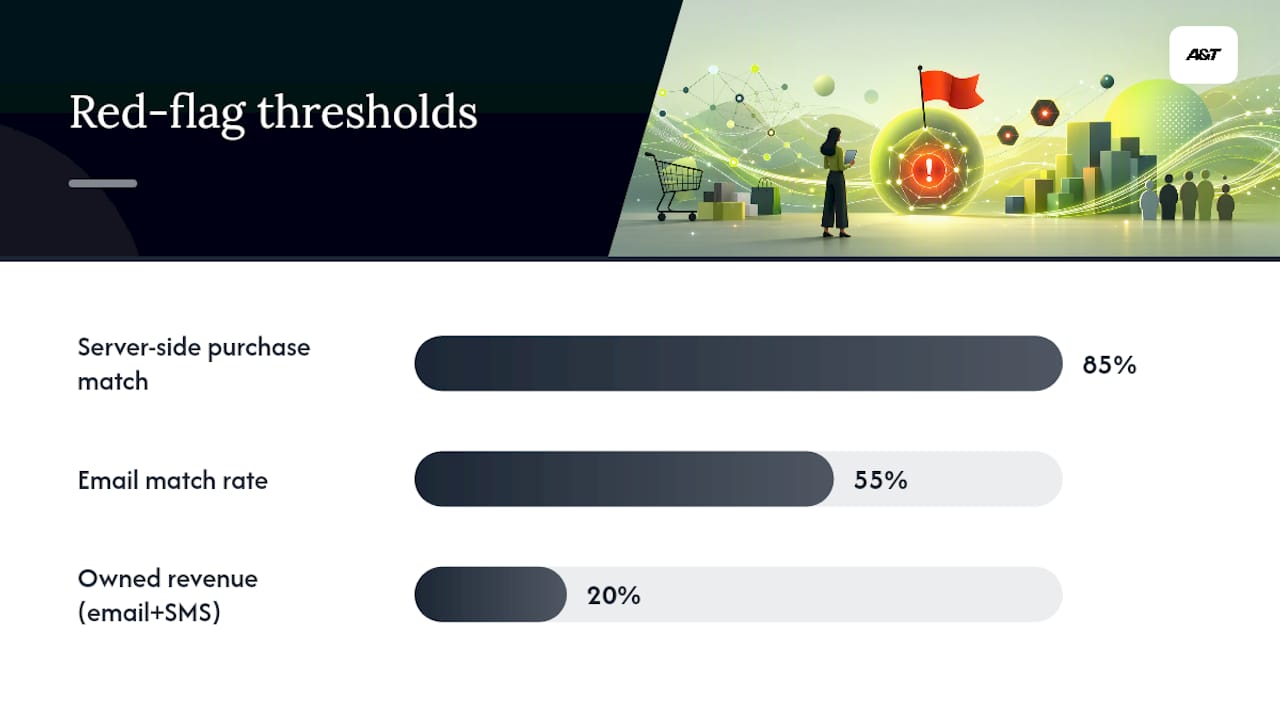
Email/custom audience match rate below 55%: data quality or formatting issue.
Server-side purchase event match rate below 85%: incomplete server-side setup.
Owned channel revenue share (email + SMS) below 20%: over-dependence on paid acquisition.
90-day implementation plan:
Phase 1: Audit (Days 1–30)
Map every system holding customer data (ESP, CRM, loyalty, support, analytics).
Identify your primary customer identifier and check consistency across systems.
Baseline your current match rates (email list to Meta Custom Audience, server-side event match rate in Meta Events Manager or Google Tag Manager).
Review your privacy policy and opt-in flows for CCPA/CPRA compliance.
Document what first-party data you're collecting but not activating.
Phase 2: Capture and connect (Days 31–60)
Implement server-side event collection for purchase and add-to-cart events.
Add post-purchase survey (two questions: attribution + preference).
Connect your ESP and loyalty platform to a shared customer identifier.
Upload a cleaned, hashed customer list to Meta and Google; record baseline match rates.
Launch one quiz or preference center if you don't have one.
Phase 3: Activate and measure (Days 61–90)
Build three audience segments: recent purchasers (suppress from prospecting), high-LTV customers (seed for lookalikes), and lapsed customers (win-back flow).
Launch a suppression-enabled prospecting campaign and compare CPA to your previous baseline.
Set up a 90-day cohort report tracking repeat purchase rate by acquisition source.
Run a simple audience holdout test on one campaign to measure incremental lift.
Review blended ROAS and owned channel revenue share at day 90.
How A&T agency approaches first–party data for ecommerce clients
The pattern we see most often: an ecommerce brand has solid traffic, a decent email list, and a Shopify store generating real purchase data. But the email list isn't connected to the ad platforms, the server-side events aren't set up, and the customer segments are "everyone" and "everyone else." The data exists. The activation doesn't.
In one recent engagement with a mid-market health and wellness retailer, the core problem was exactly that. Purchase events were tracked only via browser pixel, and the customer list hadn't been uploaded to Meta in over a year. Suppression lists were applied to prospecting campaigns. High-LTV customers were seeded into a lookalike audience. Within 60 days, the brand's cost per purchase dropped materially and owned channel revenue share increased.
Recommended next steps for SMB ecommerce brands:
Audit your current data connections (ESP, ad platforms, loyalty, analytics) before buying any new tools.
Prioritize server-side event collection for purchase events above all other technical work.
Build your first three audience segments (recent buyers, high-LTV, lapsed) before expanding to more complex personalization.
Set a 90-day measurement cadence: blended ROAS, match rates, and owned channel revenue share reviewed together.
Explore how performance marketing for ecommerce brands connects first-party data activation to paid media results.
Why first–party data deserves your budget and attention right now
The conventional wisdom says first-party data is a privacy play. That framing undersells it. Privacy compliance is the floor, not the ceiling. The real case for prioritizing first-party data now is offensive, not defensive.
Ad platforms are optimizing on server-side, first-party inputs. Brands that feed them clean, complete signals get better delivery, lower CPMs, and more accurate measurement. Brands that don't are paying the same rates for worse results. That gap will widen as platforms lean further into AI-driven optimization, because AI requires structured, complete data to function well.
The build-vs.-hire question comes down to one thing: do you have someone who can own the data layer end to end? Server-side implementation, identity resolution, audience segmentation, and measurement all require different skills. Most ecommerce teams have one or two of those covered. When the gaps are in the technical layer (server-side setup, CDP integration), hiring an agency with that infrastructure experience is faster and cheaper than building it internally. When the gaps are in strategy and activation, the same logic applies.
First-party data is both a defensive moat (you're not dependent on third-party signals that can disappear) and an offensive weapon (you can personalize, suppress, and seed in ways your competitors can't if their data is fragmented). The brands building this capability now are compounding an advantage that gets harder to close every quarter.
A&T agency helps ecommerce brands activate first–party data through paid media
Most ecommerce brands have the data. What they need is someone to connect it to the campaigns. A&T Digital's performance marketing team handles Google Ads management and Meta Ads management with first-party data activation built into the process: server-side event setup, hashed customer list uploads, suppression hygiene, and high-LTV lookalike seeding. We start every engagement with a data audit — what you're collecting, what's connected, and what's being wasted. From there, we build the audience architecture and campaign structure that turns your existing customer data into lower CPAs and higher blended ROAS. If you're ready to stop leaving data on the table, reach out for a discovery call and we'll show you exactly where your program stands.
Sources
The sources below represent the strongest available benchmarks, technical how-tos, and strategic playbooks on first-party data for ecommerce. They cover everything from platform-specific implementation to measurement frameworks and capture tactics.
How to Build a First-Party Data Strategy That Survives the 2026 Cookie Collapse – Ecommerce Times
The First-Party Data Playbook for E‑Commerce Brands — InsightIQ
First‑Party Data in Ecommerce: Beyond Third‑Party Tags — Webscale
How to Build a First‑Party Data Strategy That Fuels Every Marketing Channel — Online Store News