Omnichannel advertising: A complete guide for 2026
Posted on
Marketing
Posted at

Most businesses mistakenly believe they are doing omnichannel advertising when they are only engaging in disconnected multichannel efforts. True omnichannel marketing connects every customer touchpoint with shared data and context, enabling seamless, personalized experiences across devices and channels. Building an effective omnichannel system requires a cultural shift towards collaboration, shared metrics, and integrated technology, rather than relying solely on advanced tools.
Most businesses think they're doing omnichannel advertising. They're running Google Ads, posting on social media, sending email campaigns, and maybe retargeting on Meta. Multiple channels. Must be omnichannel, right? Not even close. What most businesses are actually doing is multichannel advertising with disconnected touchpoints that reset every time a customer switches devices or platforms. The result is wasted ad spend, inconsistent messaging, and customers who feel like strangers every time they interact with your brand. This guide breaks down what omnichannel advertising actually means, how to spot the difference, and exactly how to build it the right way.
Table of Contents
Defining omnichannel advertising: More than just being everywhere
How to get started: Practical steps for small and medium businesses
The uncomfortable truth: Omnichannel is about culture, not just technology
Key Takeaways
Point | Details |
|---|---|
Integration is key | Omnichannel advertising succeeds only when channels share data and context for seamless messaging. |
Distinct from multichannel | Unlike multichannel, omnichannel ensures conversations continue smoothly across platforms. |
Avoid siloed efforts | Real results depend on unified teams, systems, and measurement, not just presence on multiple channels. |
Start small, scale up | Begin integrating the most important channels, measure results, and expand your efforts strategically. |
Culture drives success | Achieving true omnichannel effectiveness requires a culture of collaboration, not just advanced technology. |
Defining omnichannel advertising: More than just being everywhere
True omnichannel advertising is not about volume of channels. It's about connection between them. The defining feature of a real omnichannel system is that every channel shares information with every other channel. When a customer browses your site on a laptop, adds something to their cart, and later opens Instagram on their phone, your ad system already knows what they looked at. The experience picks up where it left off. That's omnichannel.
Omnichannel relies on shared contextand data between channels so messaging can carry over when customers switch devices or touchpoints. This is the core principle. Without it, you're just running parallel campaigns that happen to share a logo.
Three elements define a genuine omnichannel advertising approach:
Integrated data systems: Customer behavior from every platform feeds into one centralized place, whether that's a CRM, a customer data platform, or a unified analytics layer.
Messaging continuity: A customer who saw your video ad on YouTube doesn't get a generic intro email. They get a follow-up that references where they are in the journey.
Cross-device personalization: Your ads recognize the same customer across mobile, desktop, and even physical touchpoints like in-store visits or SMS opt-ins.
Think about a concrete example. A customer visits your website, checks out a product page for 45 seconds, and leaves without buying. A basic multichannel setup would show them a generic retargeting ad. A true omnichannel setup would show them a specific ad featuring that exact product, adjust the message based on how far into the funnel they were, and if they've previously interacted with your email list, sync that context so the next email reflects their browsing behavior. That level of precision is what drives real multi channel advertising growth for businesses that commit to integration.
"Omnichannel is not a technology choice. It's a strategic choice to treat the customer as the center of every interaction, not the channel."
The shift from multichannel to omnichannel requires rethinking the customer journey entirely. Instead of asking "what do we say on each platform," you start asking "what does this specific customer need to hear next, and where are they most likely to receive it."
Omnichannel vs. multichannel: Whatʼs the difference?
This is where most businesses get confused. Multichannel and omnichannel sound almost identical but they produce very different customer experiences and very different results.
Multichannel advertising means you are present on multiple platforms. Each platform operates with its own strategy, its own data, and its own goals. A customer might see your Facebook ad on Monday, visit your website on Tuesday, and receive a generic email on Wednesday. Those three touchpoints don't know about each other. The conversation restarts every time.
Omnichannel flips that. The conversation continues across channels rather than restarting with each touchpoint. Every interaction builds on the previous one. The experience feels less like advertising and more like a helpful, well-timed nudge from a brand that pays attention.

Here's a direct comparison:
Factor | Multichannel | Omnichannel |
|---|---|---|
Data sharing | Each channel stores data separately | All channels share a unified data layer |
Customer experience | Starts fresh with each interaction | Picks up where the last touchpoint left off |
Messaging | Platform-specific, often inconsistent | Consistent, contextual, and sequential |
Measurement | Each channel measured in isolation | Cross-channel attribution and unified KPIs |
Typical result | Awareness and traffic | Engagement, conversion, and retention |
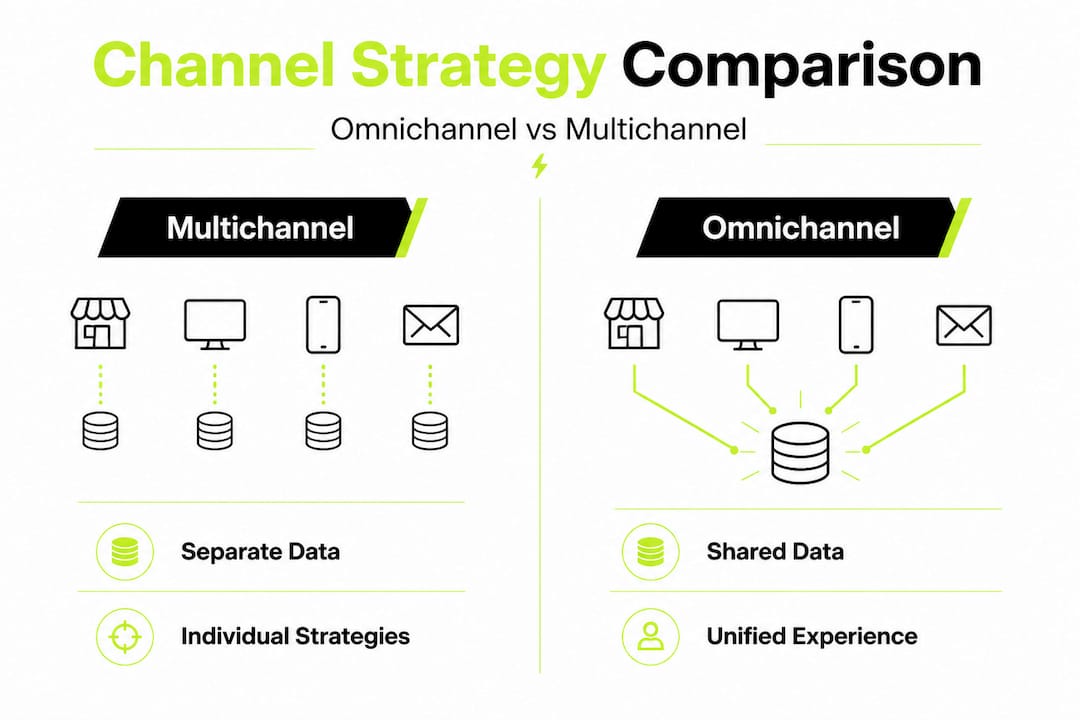
The difference in results is significant. Businesses that coordinate their retail ad campaigns across integrated channels consistently see higher return on ad spend than those running siloed efforts, because every dollar works harder when channels reinforce each other.
Three key shifts when moving from multichannel to omnichannel:
Data ownership moves to the customer level, not the channel level. You stop thinking about "Facebook audiences" and "email lists" as separate things. They're all the same customers viewed through different lenses.
Creative strategy becomes sequential. You plan ad creative in stages, knowing that a customer who saw the awareness video will receive a different message than one who already visited your checkout page.
Measurement unifies. Instead of celebrating a 4x ROAS on Google while ignoring that the same customers converted because of a Meta retargeting sequence, you measure the entire journey together.
Pro Tip: Test your own experience. Visit your website, add a product to your cart, switch to your phone, and see whether your own ads recognize you. If they don't, you're likely running multichannel, not omnichannel.
Building blocks of an effective omnichannel strategy
Knowing what omnichannel means is one thing. Building it is another. The good news is that you don't need to overhaul everything at once. The bad news is that disconnected experiences caused by siloed systems and lack of integration are more common than most businesses realize, even among brands that invest heavily in advertising.
These are the foundational building blocks you need in place:
Centralized customer data: A CRM or customer data platform that consolidates behavior from your website, email, ads, and any offline channels. Without this, integration is impossible.
Unified tagging and tracking: Consistent UTM parameters, pixel coverage, and event tracking across every platform so you can map the full customer journey accurately.
Cross-channel creative alignment: Ad creative that's designed to work in sequence, not in isolation. Each stage of the funnel should have a visual and messaging thread that connects them.
Shared KPIs across teams: Marketing, sales, and customer service all need to be working toward the same customer journey metrics, not just their own channel performance numbers.
Automation with human oversight: Automated sequences handle timing and personalization at scale, but human review ensures the logic stays accurate and the creative stays relevant.
Here's how these building blocks connect to business outcomes:
Building block | What it enables | Impact on engagement |
|---|---|---|
Centralized data | Cross-channel personalization | Higher relevance per touchpoint |
Unified tracking | Accurate attribution | Smarter budget allocation |
Sequential creative | Narrative-driven journeys | Stronger conversion rates |
Shared KPIs | Aligned team decisions | Fewer wasted touchpoints |
Automation | Scalable personalization | Consistent experience at volume |
The right paid campaign management tools make this infrastructure manageable. And when you're ready to evaluate platforms at scale, reviewing the top ad management platforms for 2026 gives you a clear picture of where to invest.
Pro Tip: Start with your highest impact channel pairing, typically paid search and email, or paid social and website retargeting. Integrate those two first, measure the lift, and then expand to additional channels one step at a time. Trying to integrate everything simultaneously usually produces nothing.
Common pitfalls: Why most «omnichannel» programs fall short
Here's the hard truth. Most businesses that describe their advertising as omnichannel are actually running sophisticated multichannel programs at best. The label gets applied loosely, and the gap between appearance and reality costs real money.
Omnichannel programs can run into situations where they appear omnichannel while actually operating in silos. This is one of the most expensive mistakes in digital advertising because it gives teams false confidence. Budgets keep flowing, campaigns keep running, and nobody notices that the customer experience is still fragmented.
The most common pitfalls include:
Surface-level integration: You've connected your tools on paper, but data isn't flowing accurately. Your email platform shows a customer opened a campaign, but your ad platform still serves them a top-of-funnel awareness ad three days later.
Siloed teams with individual goals: Your paid media team is optimizing for CPC, your email team is optimizing for open rates, and nobody is optimizing for the customer journey as a whole. Each team wins their metric while the overall conversion rate stays flat.
No unified measurement framework: When you can't attribute a conversion to the full sequence of touchpoints that led to it, you end up rewarding the last click and cutting the channels that actually started the conversation.
Over-investing in tech before process: Some businesses buy enterprise-level platforms expecting integration to happen automatically. It doesn't. Tools only work when the processes and people behind them are aligned first.
Ignoring context continuity: A customer who just purchased should not receive an ad asking them to buy the same product they already own. This happens constantly in programs that lack real-time data sync between channels.
"Appearing integrated without being integrated is arguably worse than being openly multichannel. It creates confidence without accuracy."
The path to measurable growth strategies requires honest auditing of where your program actually stands, not where you assume it stands. Pull a customer journey report. Map what a real customer actually experiences. You'll often find the gaps quickly.
How to get started: Practical steps for small and medium businesses
Avoiding pitfalls gets you halfway there. Let's put it all together with a clear action plan that works for resource-conscious SMBs. You don't need a massive budget or a team of 20 to begin integrating your channels. You need the right sequence and the right priorities.
Omnichannel relies on shared context and data between channels at its core, and that principle scales down to even the smallest advertising programs. Here's how to start:
Audit your current channels. List every active touchpoint, your website, email, paid search, paid social, SMS, and any others. For each one, ask: does this channel share data with any other? If the answer is mostly no, you have confirmed silos.
Pick two channels to integrate first. The highest value starting point is usually your website and either your email platform or your paid social retargeting. Set up pixel tracking, import your CRM data into your ad platform, and create audience segments based on actual on-site behavior.
Set a baseline and define shared metrics. Before integration, document your current conversion rate, cost per acquisition, and customer engagement by touchpoint. After integration, measure change at the journey level, not just per channel.
Implement automated touchpoint syncing. Use tools that allow your email platform to update your ad audiences in near real time. When someone converts via email, they should exit your paid retargeting audience within hours, not weeks.
Review and expand one channel at a time. Once your first integration is working, add a third channel. Map the new touchpoints, update your audience logic, and track the incremental lift. Repeat this cycle.
Regularly QA the customer experience. Assign someone on your team to walk through the customer journey monthly. Create test profiles, simulate buying behavior, and verify that messaging is actually coordinated the way your system says it is.
Using the right campaign optimization solutions will speed up this process significantly, especially when it comes to audience syncing and automated messaging logic.
Pro Tip: Many SaaS platforms offer free trials or entry-level tiers specifically designed for SMBs. Use these to run integration pilots before committing to annual contracts. Test whether the data actually flows the way the vendor claims before scaling.
The uncomfortable truth: Omnichannel is about culture, not just technology
After years of working with businesses across retail, health and wellness, telehealth, and entertainment, we've seen a consistent pattern. The businesses that achieve real omnichannel results share one thing that has nothing to do with their tech stack. They have a culture where every team member feels responsible for the customer journey.
The businesses that struggle with omnichannel buy the right tools, connect the right platforms, and still end up with a fragmented experience. Why? Because their internal teams are still operating in silos. The paid media team doesn't talk to the email team. Customer service doesn't share data with marketing. And leadership measures each department by its own metrics without asking how those metrics combine to serve the customer.
We've seen real campaign success come from clients who made organizational changes before they made technology changes. They held a single weekly meeting where paid, email, and content teams reviewed customer journey data together. They created shared dashboards. They stopped rewarding channel-level wins and started rewarding customer-level wins.
Tools are accelerators. But they accelerate the direction you're already moving. If your organization is siloed, better tools just make siloed work happen faster.
Our advice: before you invest another dollar in integration technology, spend one afternoon mapping how your internal teams currently share customer information. If the answer is "they email each other sometimes," your biggest barrier is communication, not software. Fix the process first, then add the platform.
Omnichannel is not a project you complete. It's a standard you maintain. The brands that treat every customer touchpoint as one chapter in an ongoing conversation, not a standalone transaction, are the ones that build genuine loyalty, higher retention, and lower cost per acquisition over time.
Turn insight into action with omnichannel experts
Building a true omnichannel advertising system takes the right strategy, the right tools, and the right execution. Most SMBs have the ambition but not always the bandwidth to get it done while running their core business. That's where we come in. At A&T Digital Agency, we specialize in performance marketing built around integrated Google Ads and Meta campaigns that work together, not independently. We help businesses move from scattered paid efforts to coordinated, data-driven systems that drive real revenue. Whether you're starting from scratch or trying to fix a fragmented setup, our team brings the strategic clarity and hands-on execution to make omnichannel work for your specific business and budget. Let's build something that converts.
Frequently asked questions
What makes an advertising program truly omnichannel?
A program is truly omnichannel when it shares context and data across all channels, creating a seamless and coordinated experience where each interaction builds on the previous one.
How is omnichannel different from multichannel marketing?
Omnichannel connects channels with shared data and carries customer context forward, while multichannel operates independently without integration, causing each touchpoint to restart the conversation from zero.
What are the most common mistakes with omnichannel advertising?
The most common mistakes are working in isolated teams, failing to integrate data tools, and measuring each channel separately, which is exactly how programs can appear integrated while actually operating in silos.
Is omnichannel advertising expensive to implement?
Not necessarily. Small businesses can start by connecting just two channels, such as their website and email platform, using affordable or free-tier tools, then expand integration gradually as results build confidence and budget.
How do I measure the impact of omnichannel advertising?
Measure by tracking coordinated engagement and conversion metrics across the full customer journey, rather than evaluating individual platform results in isolation, which masks the true contribution of each touchpoint.