Multi channel advertising for measurable business growth
Posted on
Marketing
Posted at

Multi-channel advertising spreads risk and broadens audience reach effectively.
Key components include segmentation, channel synergy, consistent messaging, and unified attribution.
Focus on 2-3 high-impact channels, measure KPIs, and optimize based on clear data insights.
Most e-commerce businesses spend more acquiring a customer than they realize. The median CAC hits $156 for e-commerce, and a significant portion of that cost comes from over-relying on a single ad channel. When one platform underperforms, your entire pipeline stalls. Multi-channel advertising changes that equation. Instead of betting everything on Google Ads or Meta alone, you coordinate campaigns across platforms so each channel does what it does best. In this article, we break down what multi-channel advertising is, why it matters for SMBs, the core components that make it work, how to build your own strategy, and how to measure results that actually move the needle.
Table of Contents
Key Takeaways
Point | Details |
|---|---|
Multi-channel defined | Multi-channel advertising means promoting your business across several platforms to reach more potential customers. |
Start with intent | Begin with channels where your audience actively searches or engages, then expand based on results. |
Measure and optimize | Track KPIs like ROAS and CAC closely to continuously improve your campaigns. |
Avoid common pitfalls | Focusing on too many channels at once can spread your budget thin and diminish results. |
What is multi channel advertising and why does it matter?
With the stakes for online growth and ad efficiency higher than ever, it's essential to know exactly what multi-channel advertising is and why it should be your focus.
Multi-channel advertising means running coordinated paid campaigns across more than one platform, such as Google Search, Meta, YouTube, or email, with a unified strategy behind them. It's not just about being everywhere. It's about being in the right places with the right message at the right moment in the buyer's journey.
Single-channel advertising puts all your budget into one platform. That might work early on, but it creates a fragile system. Algorithm changes, rising CPCs, or audience fatigue on one platform can wipe out your results overnight. Multi-channel spreads that risk and compounds your reach.
Approach | Risk level | Audience reach | Data visibility |
|---|---|---|---|
Single-channel | High | Limited | Narrow |
Multi-channel | Lower | Broader | Holistic |
The benefits are concrete:
Broader audience reach: Different platforms attract different segments of your market.
Reduced wasted spend: You stop over-investing in one channel that may not convert as well for every audience segment.
Diversified risk: A dip in one platform doesn't kill your pipeline.
Channel synergy: Social builds awareness; search captures intent. Together, they lower your overall CAC.
According to Shopify's multi-channel strategy research, effective multi-channel execution involves audience segmentation, consistent core messaging adapted per channel, and unified attribution through tools like GA4, with KPIs including ROAS, CAC, and CTR. The $156 median CAC for e-commerce shows just how expensive single-channel reliance can get when one platform stops delivering.
Staying current on advertising trends in 2026 helps you identify which channels are gaining traction and where your competitors are moving budget. Pair that awareness with a solid strategy guide for higher ROI and you have a real competitive edge.
The core concepts to internalize are segmented messaging, coordinated campaigns, and integrated reporting. Each one plays a specific role in making your advertising system more resilient and more effective.
Core components of effective multi channel campaigns
Now that you know the basics, it's time to see what makes a multi-channel strategy truly effective.
Every successful multi-channel campaign is built on five core components. Each one serves a distinct purpose, and skipping any of them weakens the whole system.
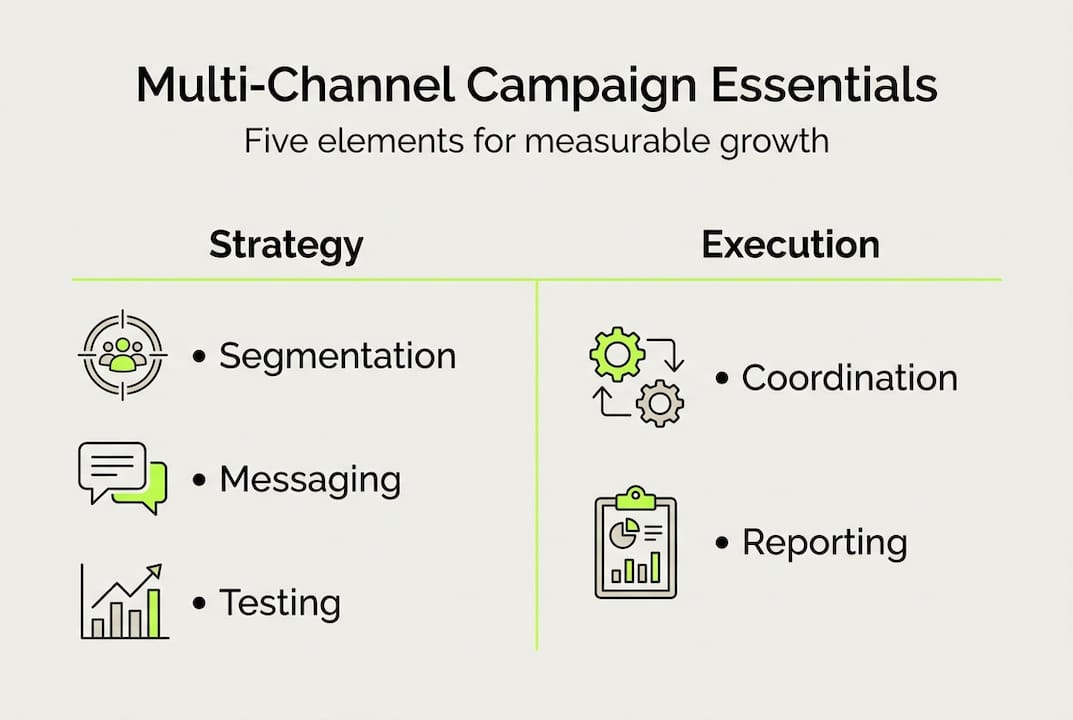
Component | Purpose | Value delivered |
|---|---|---|
Audience segmentation | Divide your market by behavior, intent, and demographics | Right message to the right person |
Channel synergy | Assign roles to each platform | Awareness, consideration, and conversion aligned |
Consistent messaging | Adapt tone per channel, keep core offer unified | Builds trust and recognition |
Unified attribution | Track the full customer journey across platforms | Accurate data for smarter decisions |
KPI framework | Measure ROAS, CAC, CTR, and CPA across channels | Clear view of what's working |
The KPIs that matter most in a multi-channel context are:
ROAS (return on ad spend): Are your campaigns generating revenue above their cost?
CAC (customer acquisition cost): What does it actually cost to win a new customer across all channels combined?
CTR (click-through rate): Are your creatives compelling enough to drive action?
CPA (cost per acquisition): How efficient is each channel at converting leads or sales?
For tracking, the tools that deliver the clearest picture include:
Google Analytics 4 (GA4) for unified attribution across channels
Meta Ads Manager for campaign-level performance
Google Ads dashboard for search and display data
Third-party tools like Triple Whale or Northbeam for e-commerce-specific attribution
You can see how these components play out in real campaign results across retail and service verticals. And if you want a deeper look at the mechanics, our guide on tracking ad performance walks through the full setup.
Pro Tip: Start with the channels that already show the strongest conversion signals for your audience. High-intent, low-complexity platforms like Google Search are often the best first move before layering in awareness channels like Meta or YouTube.
How to build a multi channel advertising strategy
Having explored campaign components, here's how you can put a multi-channel strategy into action.
Building a multi-channel strategy doesn't require a massive budget or a large team. It requires a clear process and the discipline to follow it.
Set clear campaign objectives. Are you driving e-commerce sales, generating leads, or building brand awareness? Your goal shapes every other decision.
Segment your audience. Break your market into groups by intent, behavior, or demographics. Cold audiences need different messaging than warm retargeting pools.
Match channels to goals. Use search for high-intent buyers ready to convert. Use social for awareness and retargeting. Use email for nurturing existing contacts.
Tailor your messaging per channel. The core offer stays consistent, but the format and tone adapt. A Meta ad needs a strong visual hook. A Google Search ad needs tight, intent-matched copy.
Set up unified attribution before you launch. GA4 or a similar tool should be configured to track the full customer journey from first touch to conversion.
Launch, track, and iterate. Run your campaigns, monitor ROAS, CAC, and CTR, and make data-driven adjustments weekly.
Here's a quick real-world example. A health and wellness brand starts with Google Search to capture buyers already searching for their product. They layer in Meta retargeting to re-engage visitors who didn't convert. Within 60 days, their CAC drops because Meta reinforces the Google touchpoint instead of working in isolation. That's channel synergy in practice.
When working across channels, the biggest mistake is launching everything simultaneously without a testing phase. Start with two channels, learn fast, then expand. Our breakdown of strategies for high ROI covers how to sequence that expansion effectively.
Pro Tip: Use a unified dashboard that pulls data from all active channels into one view. Faster visibility means faster decisions, and in paid advertising, speed matters.
Measuring and optimizing multi channel advertising performance
Once your campaigns are in motion, the next step is keeping a close eye on performance to maximize impact.
Running campaigns without rigorous measurement is like driving without a dashboard. You might be moving, but you won't know if you're heading in the right direction.

Unified attribution is the foundation. Tools like GA4 map the full customer journey, showing you which channels contributed to a conversion and in what sequence. Without this, you risk over-crediting the last click and under-investing in the channels that actually build demand.
Metrics every SMB should monitor:
ROAS by channel: Identifies which platforms deliver the strongest revenue return.
CAC overall and per channel: Reveals where you're acquiring customers most efficiently.
CTR by ad creative: Shows which messages resonate with your audience.
Conversion rate by channel: Highlights where the funnel is leaking.
Frequency (for social): Prevents ad fatigue by flagging when audiences see your ads too often.
"The median customer acquisition cost for e-commerce is $156. Businesses that track CAC across channels can identify where they're overpaying and reallocate budget to higher-performing platforms."
Once you have clean data, use it to reallocate. If Google Search is delivering a ROAS of 4x and Meta is at 1.8x, shift budget toward search while testing new Meta creatives. Don't kill underperforming channels immediately. Diagnose first.
For a deeper look at how performance marketing ROI is tracked and improved, we've covered the frameworks in detail. Our guides on marketing workflow for high ROI and campaign strategy for ROI walk through the optimization process step by step.
The businesses that win at multi-channel advertising are not the ones with the biggest budgets. They're the ones who read their data clearly and act on it quickly.
Why most SMBs get multi channel wrong
and how to fix it
But even with a solid plan, pitfalls abound. Here's what businesses commonly do wrong and how you can avoid it.
We've seen this pattern repeatedly. A business decides to go multi-channel, launches on five platforms in the first month, and burns through budget with nothing to show for it. The problem isn't the strategy. It's the execution.
The most common mistake is spreading too thin too fast. Running on five channels with a limited budget means none of them get enough data to optimize. You end up with inconclusive results everywhere.
The second mistake is duplicating creatives across channels. Copying a Google Search ad directly into a Meta campaign ignores how differently those audiences behave. Each channel has its own context, and your creative needs to match it.
The third mistake is ignoring holistic data. Teams look at each channel in isolation and miss the cross-channel story. A customer might click a Meta ad, search Google three days later, and convert on the second visit. If you only measure last-click, Meta looks like it didn't work.
Our perspective: quality and integration beat channel count every time. Two well-coordinated channels with tailored messaging and clean attribution will outperform five disconnected ones. When thinking about effective channel selection, start narrow, learn fast, and scale what works.
Pro Tip: Focus on 2 to 3 high-impact channels first. Master the coordination between them before adding more. Expanding too early dilutes your learning and your budget.
Ready to amplify your results? Expert help is one step away
Once you know where most strategies go off track, the next step is getting expert guidance tailored to your business.
Building a multi-channel advertising system that actually delivers takes more than a checklist. It takes tested execution, creative that converts, and data-driven decisions made consistently. That's exactly what we do at A&T Digital Agency.
We specialize in Google Ads management and Meta ads management, building coordinated paid ad systems that drive real revenue growth for SMBs. Our clients don't need more meetings. They need campaigns that convert. If you're ready to stop guessing and start scaling, reach out for a no-obligation consultation. We'll assess your current setup and show you exactly where the opportunity is.
Frequently asked questions
What is the advantage of multi channel advertising for small businesses?
Multi-channel advertising helps small businesses reach more customers, reduce wasted spend, and improve results by combining the strengths of different platforms. Channel synergy means each platform reinforces the others, lowering your overall cost to acquire a customer.
How do I know which advertising channels are best for my business?
Start with the channels where your target audience is most active, then test for the highest ROAS and lowest CAC. Prioritize high-intent, lower-competition platforms before expanding to broader awareness channels.
Which metrics should I track to measure multi channel campaign success?
Monitor ROAS, CAC, CTR, and CPA across all active channels, and use unified attribution tools like Google Analytics 4 to see the full customer journey rather than just last-click data.
Do I need a big budget to benefit from multi channel advertising?
No. Starting small with 2 to 3 high-impact channels and a focused budget can deliver strong results. Expand only after you have real data showing what works for your specific audience.


