Understanding Ad Auction: How It Shapes Your Ad Spend
Posted on
Marketing
Posted at

Ad auctions occur thousands of times per second using real-time bidding processes to determine ad placement and cost. Factors like Quality Score, context, and auction type influence outcomes, requiring strategic bid calibration and transparency. Implementing data-driven techniques, including bid shading and quality optimization, enhances ad efficiency and reduces unnecessary expenditure.
Most advertisers assume that winning an ad auction is simple: bid the most, win the spot, pay your bid. That belief costs real money every day. Understanding ad auction mechanics reveals a far more complex system where quality, context, and timing shape every outcome as much as your budget does. Whether you run Google Ads, Meta campaigns, or programmatic display, the auction determines your placement, your cost, and ultimately your return. This guide breaks down exactly how it works, and what you can do about it.
Table of Contents
Key Takeaways
Understanding ad auction mechanics
First-price vs. second-price auctions
Quality Score, Ad Rank, and what actually determines placement
Transparency standards changing the industry
Practical strategies to win more auctions at lower cost
My take on where ad auction strategy is actually failing
How A&T Digital approaches ad auction performance
FAQ
Key Takeaways
Point | Details |
|---|---|
Auctions run in milliseconds | Every ad impression triggers a real-time auction involving multiple platforms and signals simultaneously. |
Highest bid does not always win | Ad Rank, Quality Score, and contextual signals all determine final placement and cost. |
Auction type changes your strategy | First-price and second-price models require fundamentally different bid calibration approaches. |
Quality Score reduces your CPC | Higher relevance scores can lower your actual cost per click even when competitors outbid you. |
Transparency standards are shifting | Industry rules now push platforms toward disclosing floor prices and auction parameters to advertisers. |
Understanding ad auction mechanics
Every time a user loads a webpage, opens an app, or triggers a search, an auction fires. Not once. Thousands of times per second, across millions of placements. This is the world of real-time bidding (RTB), and the infrastructure behind it moves faster than any human decision could.
Here is how a standard programmatic auction unfolds:
A user triggers an event. A page loads, a search query is entered, or an app launches. This creates an available ad impression.
The publisher sends a bid request. The publisher's Supply-Side Platform (SSP) packages data about the user, the context, and the placement into a structured bid request using the OpenRTB protocol.
DSPs receive and evaluate the request. Demand-Side Platforms (DSPs) representing advertisers receive the bid request, analyze it against campaign targeting parameters, and calculate a bid in real time.
Bids are submitted and resolved. The ad exchange collects all responses, applies auction rules, determines the winner, and serves the winning ad. The entire process completes in under 100 milliseconds.
The winner is notified and the ad is served. The winning DSP delivers the creative, and the user sees the ad without ever knowing a competitive auction just happened.
The bid request itself carries rich data: user geography, device type, browser, estimated audience segment, the page URL, and more. This data is what makes targeting possible and what makes contextual relevance so consequential to your win rate.
Pro Tip: Pay attention to the data your DSP receives. Richer audience signals mean smarter bidding decisions from automated systems. If you are running campaigns with thin targeting data, you are bidding with less precision than your competitors.
First–price vs. second–price auctions
This is where many advertisers lose money without realizing it. The pricing model of an auction determines how much you actually pay when you win, and that changes everything about how you should bid.
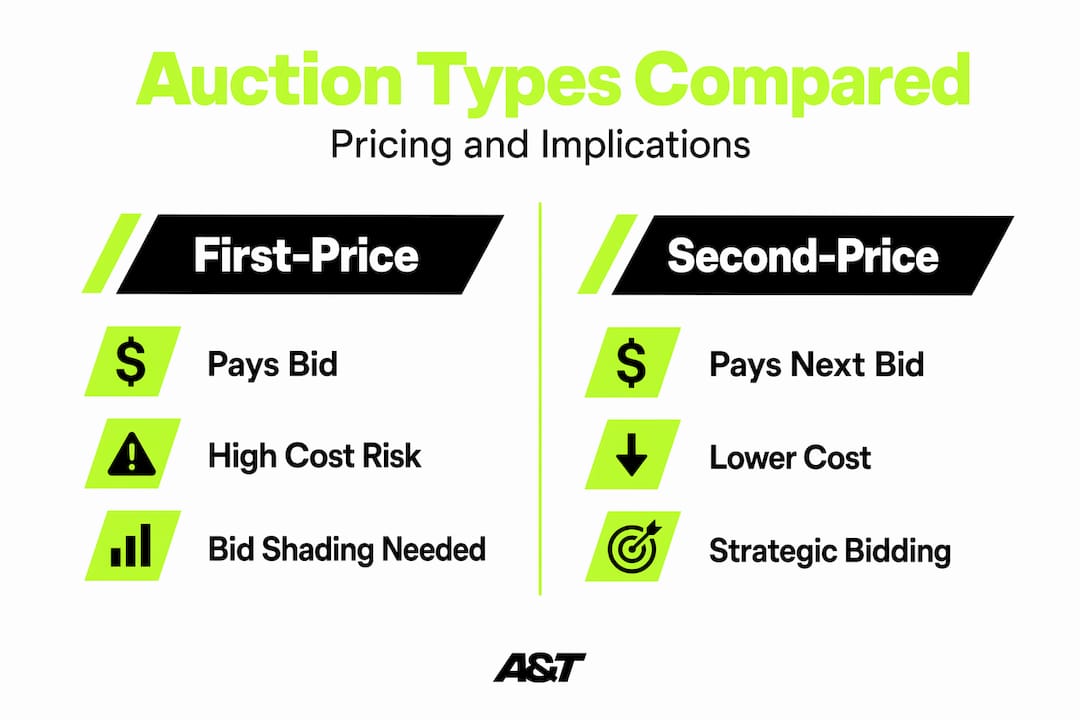
Auction Type | How pricing works | Bidding implication |
|---|---|---|
First-price | Winner pays their exact bid | You must bid carefully; no safety net on overpayment |
Second-price | Winner pays second-highest bid + $0.01 | Encourages truthful maximum bidding |
Modified second-price | Winner pays based on competitor Ad Rank and Quality Score | Rewards relevance, not just spend |
First-price auctions are now the dominant model in programmatic display and video. Google completed this transition for its display and video inventory back in 2019. When you win, you pay exactly what you bid. That means overbidding directly inflates your costs with no buffer. Bid calibration is critical in first-price environments because advertisers no longer have the safety margin a second-price model provided.
Second-price auctions historically dominated search. The winner pays just above the second-highest bid, which encourages advertisers to bid their true maximum value. The logic is sound: you have nothing to lose by bidding what the impression is genuinely worth to you.
Google Ads' modified second-price model adds a layer that most advertisers still underestimate. Your actual CPC is calculated as the next competitor's Ad Rank divided by your Quality Score, plus one cent. That formula means a higher Quality Score directly lowers what you pay for the same position. Two advertisers can bid the same amount and end up paying very different prices.
Better Quality Scores mean lower costs for identical positions
Ad extensions can raise your Ad Rank without raising your bid
Your actual CPC is always lower than or equal to your max bid
Pro Tip: In first-price auction environments, use bid shading. Bid shading algorithms analyze historical clearing prices and submit bids closer to the true market rate, reducing overpayment while maintaining a competitive win rate. Most major DSPs offer this natively.
Quality Score, Ad Rank, and what actually determines placement

Bid price is an input. Placement is an output. Between those two sits a system that weighs multiple factors simultaneously.
Ad Rank is Google's core auction scoring mechanism, and it accounts for far more than your maximum bid. The components include:
Your maximum bid per click
Quality Score (expected CTR, ad relevance, and landing page experience)
Expected impact of ad extensions and formats
Auction-time context including device, location, time of day, and search query specifics
Quality Score is computed live per auction, incorporating variables like the exact search query, the user's device, and the time of day. Signals exist that are not visible to advertisers at all. Your account-level Quality Score is an estimate. What Google uses in the actual auction is more nuanced and changes with every impression.
Contextual signal | How it affects your auction |
|---|---|
Device type | Adjusts expected CTR and bid modifiers |
Geographic location | Affects competition density and floor prices |
Time of day | Changes user intent signals and competing bid volumes |
Audience segment | Modifies relevance scoring and ad rank calculation |
Ad Rank thresholds are equally important to understand. Google will not show a low-quality ad even if the bid is high. These thresholds depend on the competitiveness of the query, the position being contested, and the advertiser's historical performance. A high bid with a weak Quality Score can still lose to a lower bid paired with a strong one.
The practical implication is clear: investing in ad relevance and landing page quality is not just a best-practice recommendation. It directly changes how much you pay and whether your ads show at all. You can learn more about improving ad relevance through responsive search ads and how they affect auction position.
Transparency standards changing the industry
The auction system has historically operated as a black box. Publishers set floor prices inconsistently, auction rules varied by buyer, and advertisers often had no visibility into why they won or lost. That is starting to change.
The Media Rating Council has introduced transparency standards for RTB that require platforms to disclose auction rules, reserve prices, and the key variables that determine outcomes. One critical component is uniform floor pricing. Uniform floor prices prevent publishers from applying different minimum bids to different buyers, which was a documented form of buyer discrimination in programmatic markets.
"Bidding without blindfolds" is not just an aspiration. It is becoming a measurable marketing advantage as platforms adopt voluntary compliance with MRC standards and certification programs that validate honest auction practices.
For advertisers, this matters in a direct and practical way. When you know the floor price, you can set bids that are competitive without unnecessary padding. When auction rules are disclosed, you can identify why performance fluctuates and adjust with precision rather than guesswork.
Pro Tip: Ask your DSP or managed service partner to document the floor prices and auction types for each inventory source you buy. Ad spend transparency at the deal level should be a non-negotiable requirement in any media partnership.
Practical strategies to win more auctions at lower cost
Knowing how ad auctions work is only useful if you apply it. Here are the strategies that translate auction knowledge into better campaign performance.
Monitor your win rate consistently. Healthy win rates fall between 15% and 40%. Below 10% signals underbidding. Above 60% suggests you are paying far more than necessary. Win rate is your real-time feedback on bid calibration.
Use bid shading in first-price environments. In first-price auctions, your DSP's bid shading tools analyze historical clearing prices to estimate the minimum bid needed to win. This protects margin without sacrificing impression share.
Invest in Quality Score as a cost-reduction strategy. The actual CPC formula rewards quality directly. A jump from Quality Score 5 to 8 can meaningfully reduce your cost per click for the same position, without changing your bid at all. Review Google Ads tips for advanced approaches to quality optimization.
Leverage auction insights reports. Google Ads provides auction insights data showing who else is bidding on your keywords and how often they appear alongside you. Use this to identify over-competitive segments where you should reconsider volume versus margin trade-offs.
Additional bid optimization practices worth building into your workflow:
Set bid adjustments by device, location, and audience segment based on actual conversion data
Use CPC bidding strategies that align with your auction environment (manual for control, smart for scale)
Review Quality Score components at the keyword level monthly, not quarterly
Segment campaigns by match type to control auction entry points and average bid accuracy
My take on where ad auction strategy is actually failing
I have seen advertisers spend months optimizing creative and targeting while completely ignoring the auction environment they are operating in. That is a real and common gap.
The shift to first-price auctions changed the rules fundamentally. In my experience, most advertisers who moved from search to programmatic display carried second-price instincts into a first-price world. They bid their true maximum, every time, and simply overpaid. The margin they lost was invisible in the reports because their campaigns were still "performing." Win rate was not something anyone checked.
The real-time nature of Quality Score is also underestimated. I have watched campaigns lose competitiveness overnight because a landing page load time increased after a site update. No bid changed. No targeting changed. But the auction score changed, and impressions dropped. That kind of invisible causal chain is exactly why you cannot manage these accounts on a weekly review cadence.
Transparency standards are, in my view, one of the most underappreciated developments in paid media right now. When you can see floor prices and auction rules, you negotiate differently. You allocate budget differently. The advertisers building that clarity into their campaign strategy will have a structural advantage over those still guessing.
— Ann
How A&T Agency approaches ad auction performance
At A&T Digital, we manage Google Ads and Meta campaigns with the auction mechanics built into every decision we make. We do not set bids and walk away. We track win rates, monitor Quality Score components, and map bid adjustments to real conversion data by device, location, and time of day.
Our clients get campaigns built around what actually wins auctions: tight relevance, smart budget allocation, and transparent reporting on what the data shows. If you are ready to stop guessing and start bidding with clarity, explore our Google Ads management service or our Meta Ads management program. We build paid ad systems that perform, not just spend.
FAQ
What is an ad auction?
An ad auction is an automated, real-time process that determines which ads are shown to a user and at what price. Every ad impression triggers an auction where advertisers compete based on bid amount, quality signals, and contextual relevance.
Does the highest bid always win the ad auction?
No. In Google Ads, Ad Rank determines the winner, factoring in Quality Score, ad extensions, and contextual signals alongside the maximum bid. A lower bid with a higher Quality Score can outrank a higher bid with poor relevance.
What is the difference between first–price and second–price auctions?
In a first-price auction, the winner pays their exact bid. In a second-price auction, the winner pays just above the next-highest bid. Google completed its transition to first-price auctions for display and video in 2019, which changed how advertisers should calibrate their bids.
How does Quality Score affect what I pay per click?
Your actual CPC in Google Ads equals the next competitor's Ad Rank divided by your Quality Score, plus one cent. A higher Quality Score directly lowers your cost for the same position, making it one of the highest-return areas to optimize.
What is a healthy win rate in programmatic advertising?
A win rate between 15% and 40% generally indicates well-calibrated bidding. Rates below 10% signal underbidding, while rates above 60% suggest you are overbidding and paying more than necessary to secure impressions.