What is CPC bidding? Guide to smarter paid ad strategies
Posted on
Marketing
Posted at

Understanding CPC bidding involves setting a maximum bid, but actual costs depend on ad relevance and quality signals, allowing lower payments. High CPCs may reflect increased competition or poor ad quality, but do not automatically indicate inefficiency if conversions are strong. Starting with manual bids, collecting data, and transitioning to automation ensures efficient budget use aligned with business goals.
Most business owners running Google Ads assume the advertiser with the biggest budget wins the top spot. That assumption costs real money. CPC bidding (cost-per-click bidding) is far more nuanced, and understanding how it actually works gives you a genuine edge over competitors who are simply throwing money at the auction. This guide walks you through the mechanics, the math, the strategy, and the common mistakes so you can make every click count and every dollar work harder.
Table of Contents
What is CPC bidding and how does it really work?
Manual vs automated CPC bidding: Which should you choose?
How actual CPC is calculated, and why it matters
Diagnosing high CPC: When high costs are a warning sign, and when they're not
CPC bidding strategies for SMBs: Choosing the right path
Our perspective: Why mastering CPC bidding means mastering your own goals
Want expert help with CPC bidding and paid ad success?
Frequently asked questions
Key Takeaways
Point | Details |
|---|---|
CPC bidding basics | You set the highest price for each click and pay only what’s required to win the auction. |
Manual vs automated | Manual bidding offers control, while automated bidding uses data to maximize efficiency and results. |
Actual CPC is dynamic | Your actual cost per click often ends up lower than your highest bid, depending on the competition and ad quality. |
High CPC signals | Expensive clicks can mean high competition or targeting, but should be interpreted alongside returns, not in isolation. |
Align bidding with goals | The best CPC strategy matches your business objectives, whether that’s more traffic, leads, or sales. |
What is CPC bidding and how does it really work?
CPC stands for cost-per-click. When you run ads using CPC bidding, you're telling the ad platform the maximum amount you're willing to pay each time someone clicks on your ad. But here's what most people miss: that maximum bid is not what you pay. And it doesn't automatically determine who wins the auction.
As Google Ads explains, CPC bidding means you set a bid representing the most you'll pay per click, and the ad auction uses those bids along with relevance, quality signals, and targeting to decide whether and where your ad appears. Three factors, not one.
That changes everything about how you should approach your bidding strategy. Here's what the auction actually evaluates:
Your maximum CPC bid: The ceiling you've set for what you'll pay per click
Ad quality and relevance: How closely your ad matches what the user is searching for
Expected click-through rate: How likely users are to click your ad based on its history and content
Landing page experience: Whether your destination page delivers on what the ad promises
"Higher bid doesn't always win if relevance or ad quality is low." This is the most important thing to understand before you set a single dollar amount in your campaign.
Consider two competing advertisers. One bids $5 per click with a highly relevant ad and a strong quality score. The other bids $8 but has a generic ad that doesn't match the search intent well. The $5 bidder can absolutely win the better position. This is how Google keeps the ecosystem useful for searchers and sustainable for advertisers. Relevance is currency.
For SMBs, this is actually great news. You don't need a massive budget to compete. You need smart, targeted ad copy and a landing page that delivers real value to the right audience.
Manual vs automated CPC bidding: Which should you choose?
With a basic grasp of CPC bidding, the next step is understanding the main methods for setting your bids: manual and automated approaches. Both have a place in a well-run paid ads strategy, but choosing the wrong one at the wrong time wastes budget and opportunity.
Manual CPC bidding means you set the maximum bid for each keyword or ad group yourself. You control every input. This approach works well when you're in a learning phase, testing new keywords, or managing a small, tightly focused campaign. The tradeoff is time. You have to monitor performance regularly and adjust bids as conditions change.

Automated CPC bidding (including options like Target CPA, Maximize Clicks, and Target ROAS) lets Google Ads use auction-time signals to set bids automatically based on a goal you define, such as hitting an average CPC target. The system considers hundreds of real-time contextual signals, including device type, time of day, location, and search query intent, far more than any human can process manually.
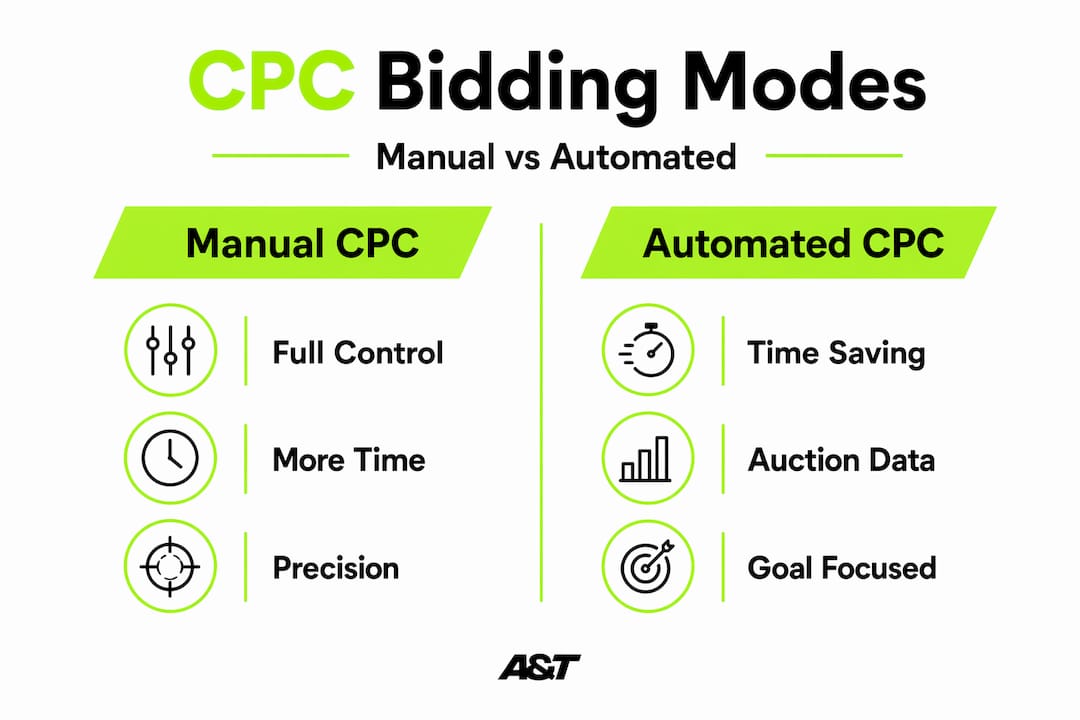
Here's a direct comparison to help you decide:
Feature | Manual CPC | Automated CPC |
|---|---|---|
Control | Full, granular control | System-driven, goal-oriented |
Flexibility | High | Moderate |
Time required | High | Low |
Recommended for | New campaigns, testing | Established campaigns with data |
Risk | Manual errors, slower optimization | Requires sufficient conversion data |
Best for SMBs when | Learning and budget is limited | Scaling with proven results |
We've seen SMBs jump straight to automation before they have enough data, and the results are usually underwhelming. Google's algorithms need at least 30 to 50 conversions per month to optimize effectively. Without that data, automated bidding is essentially guessing. Using automation for PPC efficiency becomes truly powerful only once your campaign foundation is solid.
Pro Tip: Start with manual CPC bidding for the first 60 to 90 days of any new campaign. Use that time to gather real performance data. Once you understand which keywords convert and at what cost, transition to automated bidding with confidence. This approach prevents the system from optimizing toward the wrong signals too early.
The ad optimization checklist we use with clients includes this exact transition framework. Moving to automation with strong data behind you is the difference between scaling efficiently and burning budget.
How actual CPC is calculated, and why it matters
Choosing the right bidding style is crucial, but understanding what you actually pay matters just as much. Let's break down how the ad auction determines your cost per click.
Your actual CPC is almost always lower than your maximum bid. Here's why: you pay only the minimum required to beat the ad rank of the next advertiser below you, not your full ceiling bid. Think of it like an auction where you win at $1 above the second-highest bid, not at whatever maximum you were willing to pay.
The formula, simplified:
Google calculates your Ad Rank: Max CPC Bid multiplied by Quality Score (plus additional factors like expected impact of ad extensions)
Google calculates the same for every competing advertiser
Ads are ranked by Ad Rank, highest to lowest
Your actual CPC is determined by what it takes to maintain your position over the next advertiser's Ad Rank
Here's a numerical example to make this concrete:
Advertiser | Max CPC Bid | Quality Score | Ad Rank | Actual CPC Paid |
|---|---|---|---|---|
You | $4.00 | 8 | 32 | ~$2.60 |
Competitor A | $6.00 | 5 | 30 | ~$4.10 |
Competitor B | $3.00 | 7 | 21 | ~$1.80 |
You bid less than Competitor A but still win the top spot. And you pay less than your max bid because Competitor A's lower quality score means their effective Ad Rank is lower than yours.
Auction competitiveness and quality signals influence CPC and winning behavior, so bid alone doesn't determine cost or results. This is the core mechanic that makes quality score optimization one of the highest-leverage activities in any campaign.
What does this mean for predicting your spend? It means your actual average CPC will typically run below your max bid, which gives you room to set slightly higher max bids on your most valuable keywords without blowing your budget. It also means improving your quality score, which is driven by ad relevance and landing page experience, can reduce your actual CPC without changing your bid at all.
For practical help setting this up, our ad campaign setup guide walks through how to structure your campaigns and ad groups to maximize quality score from day one. And once campaigns are running, analyzing campaign data regularly is what keeps your actual CPCs in check.
Diagnosing high CPC: When high costs are a warning sign, and when theyʼre not
With an understanding of why actual CPCs vary, let's tackle a big concern for ad managers: what should you do when costs spike?
First, the key insight: a high CPC is not automatically a problem. CPC rises when auctions are more competitive or when you're targeting higher-value opportunities, which can be entirely appropriate depending on your business model. A law firm paying $40 per click for a personal injury keyword might be making an excellent investment if each client is worth thousands of dollars.
That said, here are the most common reasons CPCs climb in ways that should concern you:
Increased competition: More advertisers entering your space drives up auction prices
Keyword targeting that's too broad: Generic keywords attract more bidders and higher costs
Low quality score: Poor ad relevance or landing page experience forces you to pay more to compete
Aggressive bid adjustments: Layering multiple bid adjustments without monitoring can inflate costs
Seasonal demand spikes: Certain periods naturally drive up CPCs across entire categories
When high CPC is a red flag: If your CPC is rising but your conversion volume is flat or declining, that's a signal to investigate. The cost is going up, but the outcome isn't improving. That imbalance needs attention.
When high CPC is expected and acceptable: Premium keywords in competitive industries, such as finance, legal, and healthcare, routinely carry high CPCs. If those clicks are converting into high-value customers, the cost is justified. The metric that matters is cost per acquisition, not cost per click in isolation.
Pro Tip: Always track ROI alongside CPC. A $15 click that converts at 10% and yields a $300 customer is far better than a $2 click that converts at 1%. Run the math relative to your business outcomes, not just your ad spend dashboard.
Your response to rising CPCs should follow this sequence: review your targeting to remove underperforming keywords, audit your ad copy and landing pages for relevance, check your quality scores, and then revisit your bids. Lowering bids is often the last step, not the first. Our campaign data analysis framework covers exactly this diagnostic process.
CPC bidding strategies for SMBs: Choosing the right path
To wrap up, here's how to put it all together and select the right CPC approach for your unique campaign goals.
Your starting point is always your objective. Not your budget. Not your competitor's ad position. Your goal.
Matching your CPC strategy to your business objectiveis the difference between ad spend that performs and ad spend that disappears. If you need more traffic to build awareness or test a new product, Maximize Clicks gives you volume within a daily budget. If you have conversion data and want to control average cost per click automatically, Target CPA handles the bidding for you.
Here are the steps we recommend for SMBs building a CPC strategy from scratch:
Define your goal clearly. Traffic, leads, or sales? Each maps to a different bidding strategy.
Start with manual CPC. Set conservative bids on a focused keyword list and gather real data.
Monitor quality scores weekly. A quality score below 5 is a signal to improve your ad copy or landing page before increasing bids.
Identify your top 20% of keywords. These are your best performers. Consider raising bids here specifically.
Pause or lower bids on poor performers. Don't let underperforming keywords drain your budget.
Transition to automation with data. Once you have 30 or more conversions per month, test Target CPA or Maximize Conversions.
Review and adapt every 30 days. Goals evolve, competition shifts, and your bidding strategy should reflect both.
Creative ad strategyplays an equally important role here. Even the best bidding strategy will underperform if your ad creative isn't compelling or your landing page doesn't convert. The mostefficient paid ad optimizationcombines smart bidding with strong creative and airtight targeting.
Pro Tip: Re-evaluate your bids any time your business goals shift, not just when performance dips. Launching a new product, entering a new geographic market, or adjusting pricing all affect what a click is worth to your business.
Our perspective: Why mastering CPC bidding means mastering your own goals
Here's the honest truth we share with every client: chasing the lowest CPC is a trap. We've seen businesses obsess over reducing their cost per click by $0.50 while leaving thousands of dollars in potential revenue on the table because their targeting was off or their creative was weak.
The lowest CPC does not mean the best campaign. It often means the least competitive placement, the broadest audience, or the least relevant keyword. Those aren't wins.
What we've learned from running paid ad systems across industries, from telehealth to retail to entertainment, is that the SMBs who grow fastest are the ones who start with clear goals and use data as a compass rather than a report card. They're not reacting to metrics. They're reading them and making intentional moves.
Automation for PPC is genuinely powerful. We use it regularly. But automation amplifies whatever foundation you've built. If your campaign structure is solid, your creative is sharp, and your targeting is precise, automation accelerates results. If the foundation is weak, automation just spends your budget faster on the wrong things.
Our candid advice: invest time upfront in understanding your goals, your audience, and your real conversion economics. Then use CPC bidding as a tool in service of those goals, not as the goal itself. In marketing, like in chess, those who calculate their moves ahead win.
Want expert help with CPC bidding and paid ad success?
CPC bidding is not a one-time setup. It requires continuous monitoring, data analysis, creative testing, and strategic adjustment as your goals and market conditions change. That's a significant ongoing commitment for any business owner or marketing manager already wearing multiple hats.
If you'd like a partner to handle the complexity and turn these bidding insights into measurable growth, we're ready. Our team at A&T Digital Agency manages Google Ads campaigns and Meta ads campaigns built around real business outcomes, not vanity metrics. No unnecessary meetings. Just campaigns that perform. Let's build something that works.
Frequently asked questions
What does CPC bidding mean in Google Ads?
CPC bidding means you set the highest amount you're willing to pay for each ad click, and Google runs an auction using your bid, ad quality, and targeting to determine whether and where your ad appears in search or display results.
Why is my actual CPC lower than my max bid?
In most auctions, you pay only the minimum required to beat the ad rank of the competitor below you, not your full maximum bid, which is why actual CPCs are regularly well below your ceiling.
Should I use manual or automated CPC bidding?
Manual bidding gives you precise control and is ideal for new campaigns or limited budgets, while automated CPC adjusts bids in real time using machine learning signals and performs best once you've accumulated solid conversion data.
What causes high CPCs in my account?
Auction competitiveness and quality signals are the primary drivers, meaning high CPCs can result from increased advertiser competition, broad keyword targeting, low quality scores, or naturally premium keyword categories in your industry.
Can I control how much I pay per click exactly?
You set the maximum you'll pay, but your actual cost is determined by auction conditions, competitor bids, and quality signals, so the final amount is always at or below your max bid ceiling, never above it.