What is paid acquisition? A guide to smarter ROI growth
Posted on
Marketing
Posted at

Paid acquisition is a systematic process that rewards discipline, preparation, and continuous learning to drive predictable business growth. It involves targeted advertising across channels like search and social, measuring results through profitability metrics such as CPA, CAC, and ROAS to optimize spend effectively. Successful strategies require confirming product-market fit, reliable conversion infrastructure, and ongoing optimization before scaling to avoid wasted budget and accelerate growth.
Many business owners pour budget into paid ads expecting quick wins, only to watch their spend evaporate with little to show for it. The problem isn't paid acquisition itself. It's the gap between what people assume it does and how it actually works. Paid acquisition is a system. It rewards discipline, preparation, and continuous learning. Get those right, and it becomes one of the most predictable growth levers available to a business. Miss them, and you're just funding someone else's platform.
Table of Contents
What is paid acquisition? Core concepts explained
Core mechanics: How paid acquisition works for SMBs
Success factors: When (and why) paid acquisition delivers ROI
Experimentation, optimization, and avoiding common mistakes
A smarter way to view paid acquisition: Our perspective
Get expert help to maximize your paid acquisition results
Frequently asked questions
Key Takeaways
Point | Details |
|---|---|
Paid vs organic | Paid acquisition means buying targeted ad traffic, while organic relies on building audience and search presence naturally. |
Success essentials | Effective paid campaigns require proper infrastructure, real-time measurement, and a clear fit with your audience. |
Experiment and optimize | Continual testing and campaign optimization are crucial for sustainable ROI with paid acquisition. |
Avoid costly pitfalls | Scaling spend before proving funnel readiness often leads to wasted budget and poor unit economics. |
Expert help matters | Partnering with specialists streamlines setup, ongoing optimization, and predictable paid acquisition growth. |
What is paid acquisition? Core concepts explained
Let's start with a clear definition. Paid acquisition is a customer acquisition strategy that uses paid advertising channels to attract prospects and drive conversions, whether that's leads, purchases, or sign-ups, by paying for visibility or traffic. It stands in direct contrast to organic acquisition methods like SEO and content marketing, where traffic grows over time without direct payment per click or impression.
Understanding where paid acquisition sits in your funnel matters. At the top of the funnel, paid ads generate awareness. In the middle, they capture intent and move prospects toward a decision. At the bottom, they close conversions. Most SMBs focus too narrowly on bottom-of-funnel spend without building the stages above it. That's a setup for expensive, inconsistent results.
Here's a clear comparison of paid versus organic acquisition:
Factor | Paid acquisition | Organic acquisition |
|---|---|---|
Speed to results | Fast (days to weeks) | Slow (months to years) |
Cost structure | Pay per click/impression | Time and content investment |
Scalability | Scales with budget | Limited by algorithm and output |
Control | High (targeting, timing) | Low (dependent on search rankings) |
Sustainability | Stops when budget stops | Compounding over time |
Intent targeting | Precise | Moderate |
The key insight in that table: paid and SEO vs paid media are not competitors for your attention. They serve different jobs at different speeds. Smart businesses use both, but they understand what each one is built to do.
"Intent and targeting matter far more than impressions and clicks. A thousand impressions from the wrong audience are worth less than ten clicks from buyers ready to act."
What separates effective paid acquisition from wasted spend? It comes down to three things: reaching the right person, with the right message, at the right moment in their buying process. Clicks are not customers. Impressions are not interest. Relevance and intent are everything.
Core mechanics: How paid acquisition works for SMBs
Choosing the right paid traffic sourcesfor your business means matching channel selection to audience intent and funnel fit, building campaigns around conversion architecture, and measuring results with metrics tied directly to revenue. That's the professional framework. Here's how it breaks down in practice.
Building a paid acquisition campaign: the core steps
Define your objective. Are you generating leads, driving purchases, or building an email list? Your goal shapes every downstream decision.
Choose your channel. Search, social, display, and video all serve different purposes. Match channel to audience behavior.
Build your audience segments. Segment by demographics, intent signals, and prior behavior. Never run a single monolithic campaign to everyone.
Create your ad creative and copy. Each segment needs messaging that speaks directly to its specific pain or desire.
Set up conversion tracking. Before a single dollar goes live, tracking must be airtight. No tracking means no learning.
Launch and monitor. Run initial budgets small. Collect data before scaling.
Analyze and optimize. Review performance weekly. Kill what doesn't work. Scale what does.
Channel comparison for SMBs
Channel | Best for | Avg. intent level | Typical use case |
|---|---|---|---|
Google Search Ads | Capturing high-intent buyers | Very high | Lead gen, e-commerce, service bookings |
Meta (Facebook/Instagram) | Awareness and interest targeting | Medium | Brand building, retargeting, direct response |
Google Display | Remarketing and awareness | Low to medium | Re-engaging past visitors |
YouTube Ads | Brand storytelling and education | Medium | Top-of-funnel awareness |
LinkedIn Ads | B2B decision-makers | High (for B2B) | Lead gen, recruitment, SaaS |
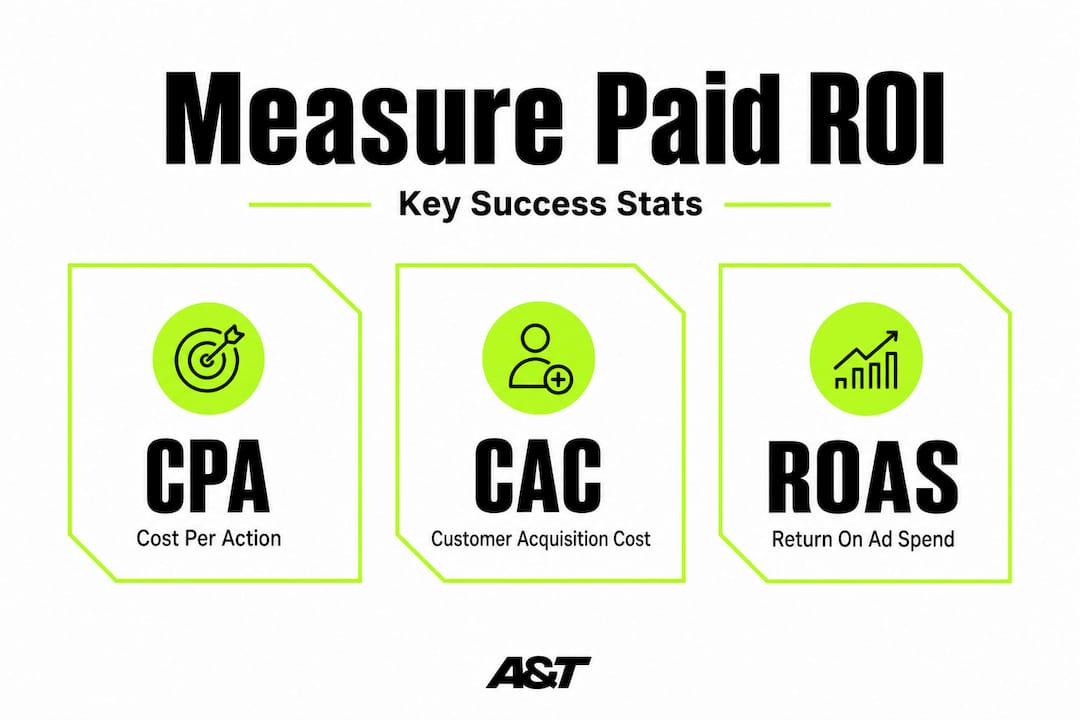
The metrics that actually tell you if a paid advertising strategy is working are not impressions, reach, or raw click counts. These are vanity metrics. The numbers that drive real decisions are:
CPA (cost per acquisition): What you pay to acquire one customer or lead
CAC (customer acquisition cost): Total sales and marketing cost divided by new customers acquired
ROAS (return on ad spend): Revenue generated per dollar spent on ads
LTV:CAC ratio: Lifetime value of a customer compared to what you spent to get them
Pro Tip: Before launching any multi-channel advertising campaign, establish your break-even ROAS first. If your margins require a 3x return to stay profitable, build that number into every campaign decision from day one. This single step eliminates most of the confusion around whether a campaign is "working."
Most SMBs make the mistake of optimizing for the cheapest clicks rather than the most profitable conversions. A $0.50 click that never converts costs more than a $5.00 click that closes a $500 sale every time. The math is that simple. The discipline to follow through on it is where most teams fall short.
Success factors: When (and why) paid acquisition delivers ROI
Paid acquisition works at scalewhen unit economics and funnel infrastructure support it. When they don't, paid advertising doesn't just fail to grow your business. It accelerates your burn rate.

This is the uncomfortable truth most paid acquisition guides skip over. You can have a technically perfect Google Ads campaign and still lose money. If your landing page converts at 1% when it should convert at 5%, you're paying five times more per lead than necessary. If your sales process can't close inbound leads, every dollar you spend on acquisition is funding a leaky bucket.
Here's what needs to be in place before you scale paid acquisition spend:
Product-market fit confirmed. People want what you're selling. You have proof: repeat customers, strong referral rates, or consistent organic demand.
Conversion infrastructure ready. Landing pages are built and tested. Forms work. Checkout flows are clean and fast. Mobile experience is strong.
Lead nurture in place. Email sequences or sales follow-up processes exist to convert leads over time, not just the ones ready to buy today.
Tracking installed correctly. Google Tag Manager, conversion pixels, and CRM integration are all live and verified before spending begins.
Clear unit economics. You know your average order value, customer lifetime value, and acceptable CAC before you set a budget.
"Paid acquisition accelerates whatever is already happening in your business. If conversions are broken, paid ads will just help you fail faster."
Signs your business may not be ready for paid acquisition yet include: no consistent organic traffic or referrals, unclear value proposition, untested landing pages, or no defined follow-up process for leads. These aren't permanent blockers, but they are things to fix before investing in paid traffic. Understand your marketing funnel deeply before you invest in filling the top of it.
The most common pitfall we see is businesses scaling spend before confirming fit. They see a campaign get a few leads at a reasonable cost and immediately double the budget. But the early leads were their warmest audience. As reach expands, costs climb and conversion rates drop. The campaign that looked profitable at $2,000 per month collapses at $10,000 per month. Scaling too fast without monitoring unit economics is one of the most reliable ways to waste a significant budget.
The businesses that win with paid acquisition treat it as a precision tool, not a volume play. They test assumptions small, confirm the unit economics hold, and then scale with confidence.
Experimentation, optimization, and avoiding common mistakes
Paid acquisition is best understood as an experiment-driven, measurement-heavy system. You're buying demand or capturing intent, and then you must convert and retain customers profitably. Without that loop, paid becomes a fast way to spend without durable ROI.
The businesses that consistently outperform their competition in paid acquisition share one habit: they run structured experiments constantly. They don't guess. They test.
Optimization checklist for ongoing campaigns:
A/B test ad creative regularly. Test one variable at a time: headline, image, call-to-action, or offer. Never test multiple changes at once or you won't know what moved the needle.
Segment your audiences tightly. Separate cold audiences from warm audiences. Separate new visitors from past converters. Different people need different messages.
Review search term reports weekly (for search campaigns). Negative keywords are as important as positive ones. Irrelevant traffic costs real money.
Test landing page variations. Even a headline change can move conversion rates by 20% or more. Always be testing something.
Monitor frequency on social campaigns. High frequency with declining CTR signals audience fatigue. Refresh creative before performance falls off a cliff.
Align your offer with audience intent. A cold audience doesn't want a "Buy Now" CTA. They want education or a low-friction next step.
Pro Tip: Run small paid campaign tests with no more than 10% of your total monthly budget before committing to scale. Two to three weeks of clean data from a small test is worth more than three months of guessing at scale.
The most common paid acquisition mistakes we see:
Set-and-forget campaigns. Running the same creative and targeting for months without updates destroys performance.
Chasing vanity metrics. Optimizing for impressions and click-through rates while ignoring CPA and ROAS.
No attribution clarity. Not knowing which campaigns or channels actually drove conversions leads to misallocated budget.
Scaling before the data justifies it. Seeing a few good days and doubling spend, only to find those results were noise rather than signal.
Ignoring the post-click experience. Great ads that send traffic to poor landing pages are a direct path to wasted spend.
Learning from real paid campaign examples shows that the winners aren't always the ones with the biggest budgets. They're the ones with the tightest feedback loops. And disciplined ad budget planning keeps those loops honest.
A smarter way to view paid acquisition: Our perspective
Most guides treat paid acquisition like a light switch. Flip it on, money comes in. But that framing sets businesses up for disappointment.
The teams we've seen succeed with paid acquisition don't think about it as a spending activity. They think about it as a learning system. Every dollar spent is buying information about what works and what doesn't. The faster you can run that loop, the faster you compound results.
In practice, this means being ruthlessly honest about your data. If a campaign isn't working after a statistically valid test period, kill it without emotion. If one ad angle outperforms others by a wide margin, understand why and build on it. The signal is always in the data. Most businesses miss it because they're not watching for it.
We've also noticed that the businesses most prone to wasted paid spend are those chasing channel hacks. They hear "Meta ads are working great for someone in my industry" and immediately dump budget there without verifying the fit for their specific audience and offer. The channel matters far less than the combination of audience, message, offer, and landing experience. Get those four elements aligned and almost any major channel will generate results.
Smart digital ad spend management means building processes before scaling spend, measuring what matters, and being willing to be wrong fast rather than wrong slowly. The businesses that win aren't the ones with the biggest budgets. They're the ones who learn the fastest and act on what they learn.
Get expert help to maximize your paid acquisition results
Implementing paid acquisition the right way takes structure, experience, and honest measurement. If you're navigating channel selection, building your first campaigns, or trying to fix a strategy that isn't delivering the ROI it should, working with specialists means avoiding the most expensive mistakes before they happen.
At A&T Digital Agency, we build and scale paid advertising systems designed to generate measurable results. Whether you need Google Ads management for high-intent search traffic, Meta ads management for social campaigns that convert, or a full multi-channel strategy, we bring the frameworks, creative execution, and data discipline that turn ad spend into real growth. No unnecessary meetings. Just campaigns that work.
Frequently asked questions
How is paid acquisition different from organic marketing?
Paid acquisition buys visibility and drives conversions quickly through paid channels, while organic marketing builds traffic over time through unpaid methods like SEO, content, and social engagement.
What channels work best for paid acquisition?
The best channel depends on your audience and product fit. Matching channels to audience intent is more important than following trends. Paid search captures buyers ready to act, while paid social builds awareness and demand.
How do I measure if paid acquisition is working?
Skip vanity metrics and track CPA, CAC, and ROAS instead. These figures tell you whether your campaigns are generating profitable returns, not just traffic.
When should I invest in paid acquisition?
Invest once you have confirmed product-market fit and a working conversion infrastructure, including tested landing pages, lead nurture sequences, and reliable tracking. Scaling paid spend before those foundations exist accelerates waste, not growth.