Ad rotation strategy: Boost your digital ad ROI
Posted on
Marketing
Posted at

Ad rotation strategy controls how multiple ads in a campaign compete for impressions, influencing testing accuracy and budget efficiency.
Choosing the right rotation mode aligned with campaign goals is crucial, as platforms often override manual settings through auction dynamics and Smart Bidding.
Most marketers assume ad platforms automatically give each ad a fair shot. They set up three or four creatives, hit publish, and trust the algorithm to sort it out. That assumption costs real money. Ad rotation strategy controls how your ads compete for impressions, and getting it wrong means you're either wasting budget on underperformers or crowning a winner before you have enough data to trust the result. We're going to break down how rotation works, why it matters more than most managers realize, and exactly how to use it to sharpen your testing and scale what works.
Table of Contents
What is ad rotation strategy?
Core ad rotation options: How platforms serve your ads
Even rotation isn't always equal: The hidden dynamics
Choosing the right rotation strategy: Performance vs. fairness
Practical steps to exploit ad rotation in your campaigns
Why most marketers miss the real power of ad rotation
Partner with experts for smarter ad rotation
Frequently asked questions
Key Takeaways
Point | Details |
|---|---|
Ad rotation controls ad delivery | Selecting the right rotation strategy shapes which ads get seen and how often they appear. |
Options impact testing and ROI | Optimized and even rotation modes have distinct effects on creative testing and performance gains. |
Even rotation isn’t always equal | Auction dynamics and algorithms can override manual rotation and lead to uneven impressions. |
Choose strategy by campaign goal | For fair testing, use even rotation; for performance, use optimization—your goal should drive your choice. |
Collect enough data before switching | Don't change rotation settings prematurely; wait for statistically significant results for accuracy. |
What is ad rotation strategy?
Ad rotation strategy is the setting that decides which ad gets served when your campaign has more than one creative in an ad group or ad set. It sounds simple. In practice, it shapes everything from your testing accuracy to your cost per acquisition.
Ad rotation strategyis a setting in platforms like Google Ads and Meta that controls how multiple ads in an ad group or ad set are served to users. Most platforms offer at least two modes: let the algorithm decide, or distribute more evenly across your creatives.
Here's what most managers miss. Rotation isn't just a delivery preference. It's a testing framework. If you don't control it deliberately, you're letting the platform decide which ad "wins" without your input, sometimes before you've collected enough data to know if that decision is actually correct.
Ad rotation is one of the most underused levers in paid advertising. When used with intention, it turns guesswork into structured insight.
Why does this matter for testing ad creatives? Because the rotation setting directly determines how much exposure each creative gets before a winner is declared. Too little exposure and you're making decisions on noise, not signal.
Key reasons to take rotation seriously:
It affects which ads collect enough data to be statistically meaningful
It determines how quickly the platform shifts budget toward a perceived winner
It controls whether you're running a real test or just letting the algorithm optimize prematurely
It interacts with Smart Bidding in ways that can completely override your manual settings
Core ad rotation options: How platforms serve your ads
Now that we understand what rotation does, let's look at the actual options available and what each one means for your campaigns.
In Google Ads, primary rotation methodologies are "Optimize," which prioritizes ads expected to perform best using machine learning signals like keywords, device, and location, and "Do not optimize," which delivers ads more evenly indefinitely. Those are your two core choices in standard Google Ads campaigns.
Google Ad Manager adds more granular control. Advanced rotation modes include Evenly (random equal distribution), Optimized (sends 75% of impressions to the highest CTR ad), Weighted (you set custom frequency percentages), and Sequential (ads run in a defined order). Each serves a different purpose depending on what you're trying to learn or achieve.
Here's a direct comparison of the main rotation strategies:
Rotation mode | Best for | Main risk | Platform |
|---|---|---|---|
Optimize | Scaling known winners | Premature bias | Google Ads |
Do not optimize | True creative testing | Short-term inefficiency | Google Ads |
Evenly | Baseline exposure testing | Still not truly equal | Ad Manager |
Optimized (Ad Mgr) | CTR-focused campaigns | Ignores conversion depth | Ad Manager |
Weighted | Custom frequency tests | Complex to manage | Ad Manager |
Sequential | Brand storytelling | Limited performance data | Ad Manager |
How to apply this in practice:
Define your goal first. Are you testing a new headline, or are you scaling a proven campaign? The answer determines your rotation mode before you even open the platform.
Choose rotation before launching. Changing rotation mid-campaign pollutes your data. Set it intentionally from the start.
Match rotation to campaign stage. Early-stage campaigns benefit from even rotation for learning. Mature campaigns performing well can shift to Optimize.
Audit your defaults. Google Ads defaults to Optimize. If you've never changed it, you may have been letting the algorithm decide before you had real data.
Align rotation with your Google Ads ROI optimization strategy. Rotation is one piece of the larger optimization picture.
Pro Tip: Don't default to "Optimize" just because it's the platform default. If you're running any kind of creative test, start with "Do not optimize" to gather clean, unbiased data. Switch to Optimize only after one creative has proven itself at a statistically significant threshold.
Understanding testing ad copy becomes far more reliable when your rotation setting gives every variant a real chance to perform.
Even rotation isnʼt always equal: The hidden dynamics
This is where things get genuinely surprising. Many managers choose "Do not optimize" or "Evenly" and assume every ad gets an equal slice of impressions. That's not what actually happens.
Even rotation doesn't guarantee equal impressionsdue to auction dynamics, ad quality, and bids. Uneven serving is possible even with "Do not optimize" selected. With Smart Bidding, manual rotation may be overridden by algorithm predictions entirely.

Here's why this matters. Each ad impression is won or lost through an auction. Your ad's quality score, relevance, bid, and predicted click-through rate all influence whether your ad wins that specific auction. Even if the rotation setting says "serve evenly," Ad A might naturally win more auctions than Ad B simply because it has a better quality score. The setting tells the platform to try to distribute evenly, but auction mechanics don't always cooperate.
Factor | Effect on actual impressions | Within marketer's control? |
|---|---|---|
Quality score | High quality = more auctions won | Partially (via ad copy, landing page) |
Bid amount | Higher bids win more auctions | Yes |
Ad relevance | More relevant ads show more often | Yes (via targeting and creative) |
Smart Bidding | Algorithm can override rotation | Limited |
Auction competition | Fluctuates by day, time, device | No |
The Smart Bidding complication is significant. If you're running Target CPA or Target ROAS bidding strategies, the algorithm is actively predicting which creative will drive the best result for each individual auction. It will quietly deprioritize ads it predicts will underperform, regardless of your rotation setting. You can see how this creates a conflict. You've told the platform to rotate evenly, but the bidding strategy is pulling in a different direction.
The practical fix is straightforward. Monitor actual impression share at the individual ad level, not just overall campaign impressions. If one ad is receiving dramatically more impressions than others under an "even" rotation setting, investigate. Check quality scores, ad relevance, and whether your bidding strategy might be overriding your rotation preference.
This connects directly to your ad campaign optimization process. Knowing that rotation settings don't always reflect reality means you need to verify, not assume.
Pro Tip: Export your ad-level impression data weekly when running a creative test under even rotation. If the distribution is more than 20% skewed between ads, your test results may not be reliable. Investigate before drawing conclusions.
Choosing the right rotation strategy: Performance vs. fairness
There is a real tension here, and it's worth naming directly. Optimized rotation is designed to drive performance fast. Even rotation is designed to give each creative a fair evaluation. You can't fully optimize for both at the same time.
Optimize favors quick performancebut risks premature bias before statistical significance is reached. Even rotation ensures fair testing but sacrifices short-term efficiency. Smart Bidding may make indefinite even rotation pointless, as the algorithm prioritizes predicted best performers anyway.
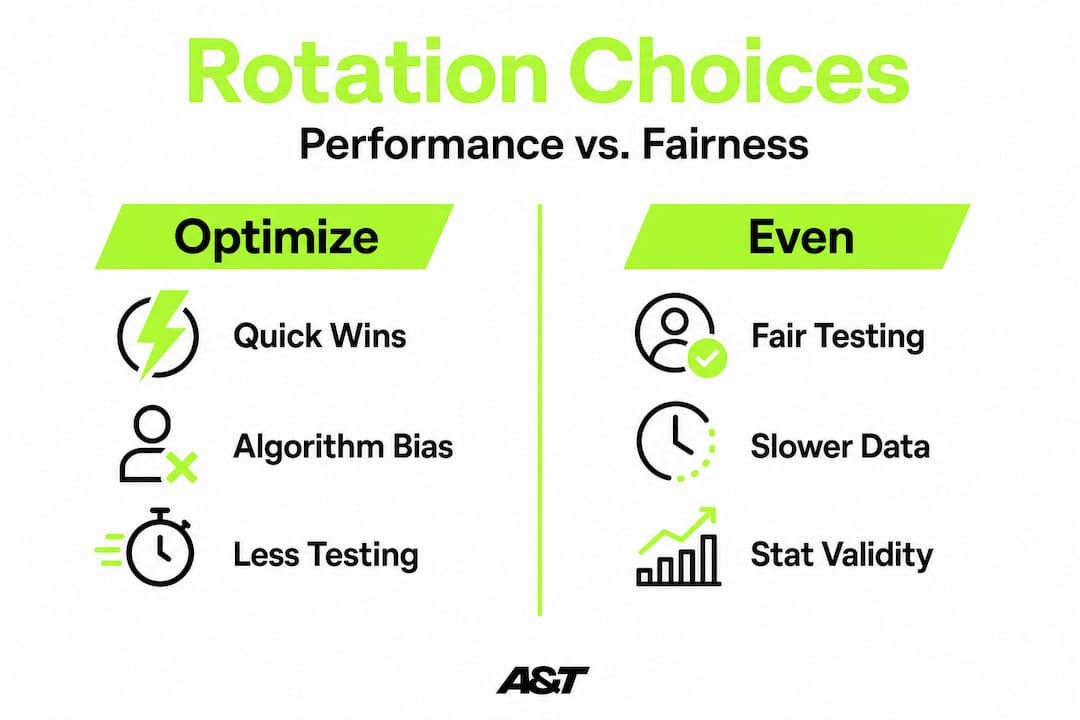
This is a genuine tradeoff. For businesses with limited budgets, running even rotation means some budget goes to ads that may underperform during the test window. That's the cost of accurate data. For businesses in a scaling phase, that cost may not be worth paying, and optimized rotation makes more sense.
How to decide:
Testing phase: Use even rotation. Accuracy matters more than short-term efficiency. You're building knowledge, not just spending budget.
Scaling phase: Switch to Optimize once you have a proven creative. Let the algorithm amplify what works.
Smart Bidding campaigns: Understand that your rotation setting has less power here. Focus instead on running a portfolio of strong creatives and let performance data guide decisions.
Budget-constrained campaigns: Even rotation can extend your test period because spend is spread across ads. Factor this into your timeline.
The goal of testing isn't to find a winner fast. It's to find the right winner. Premature optimization is just another form of guessing.
This principle connects to how we approach A/B testing in ads. Structured testing with the right rotation setting turns ad spend into genuine market research. And when you look at ad creative examples that actually drove conversions, they almost always came from disciplined testing processes, not lucky guesses.
Practical steps to exploit ad rotation in your campaigns
Theory is useful. Action is what moves the needle. Here's how to put rotation strategy to work in your actual campaigns.
Rotation supports testing but doesn't replace it. Ensure you've collected sufficient data before switching rotation modes to avoid crowning suboptimal winners. That's the core principle behind every step below.
Set rotation before launch, not after. Decide whether you're testing or scaling before you build the campaign. Rotation should match that goal from day one.
Limit variables in each test. When testing under even rotation, change one element per test, headline, image, call to action, or offer. Multiple variables make it impossible to know what drove the result.
Define your success metric before looking at data. Decide in advance whether you're optimizing for CTR, conversion rate, or cost per acquisition. Changing the metric after the test starts leads to misleading conclusions.
Wait for statistical significance. As a practical benchmark, aim for at least 100 conversions per ad variant before drawing conclusions in conversion-focused campaigns. For awareness campaigns, aim for at least 1,000 impressions per ad.
Document every rotation change. When you switch from even to optimized, note the date, the reason, and the data that supported the decision. This creates a record you can reference when analyzing performance trends.
Review your ad optimization checklist regularly. Rotation is one setting within a broader optimization process. Keep the full picture in view.
Reset rotation for new creative rounds. When you introduce new ad variants, restart the testing phase with even rotation. Don't assume past winners will always hold up as audiences, seasons, and competition shift.
Pro Tip: Document every time you change your rotation setting in a campaign log, including the date, what triggered the change, and what data supported it. This discipline makes post-campaign analysis far more accurate and helps you build repeatable processes over time.
Why most marketers miss the real power of ad rotation
Here's our honest take, based on running campaigns across dozens of accounts in competitive markets.
Most marketers treat ad rotation as a checkbox, not a strategy. They pick a setting at launch, often the default, and never revisit it. The platform keeps running, the algorithm keeps optimizing, and the marketer assumes the results reflect creative quality. Often, they don't. They reflect which ad won the algorithm lottery early and never got challenged.
The uncomfortable truth is that premature optimization is one of the biggest hidden costs in paid advertising for small to medium-sized businesses. When you let the platform switch to optimized rotation too early, you stop learning. The algorithm picks a winner, pours budget into it, and the other ads starve. You lose the data you paid for.
We've seen this pattern repeatedly. A campaign launches with three strong creatives. The platform favors one within the first week based on early CTR signals. Budget concentrates there. Six weeks later, the account shows a "winning" ad that just happened to get more early exposure. The other two creatives never got a real chance. The "winner" might not actually be the best performer at scale.
Discipline in rotation is what separates good testing from expensive guessing. Use your creative testing guide to build a repeatable framework. Set clear rules for when you'll switch rotation modes, based on data thresholds, not gut instinct or timeline pressure.
The marketers and business owners who get the best long-term ROI from paid ads aren't the ones who optimize fastest. They're the ones who learn fastest. Rotation strategy, used with discipline, is how you build that learning into every campaign you run.
Partner with experts for smarter ad rotation
Knowing the mechanics of ad rotation is one thing. Building it into a repeatable, scalable system across live campaigns takes time, discipline, and experience. If you're managing Google Ads or Meta campaigns in-house and not getting the results your budget deserves, the rotation setup is often part of the problem. Our team at A&T Digital Agency builds performance marketing systems where every setting, including ad rotation, is chosen with a specific goal in mind. From Google Ads management services to Meta Ads management services, we handle the strategy, testing, and ongoing optimization so your spend drives real, measurable results. No guesswork. No unnecessary meetings. Just campaigns built to perform.
Frequently asked questions
What does ad rotation strategy do in Google Ads?
It determines how multiple ads in one ad group are shown to users, controlling whether ads are served evenly or prioritized for best predicted results based on machine learning signals.
Is even ad rotation guaranteed to give equal impressions?
No. Auction dynamics, ad quality, and bids can still lead to uneven distribution, even when "Do not optimize" is selected as the rotation setting.
Should I use Optimize or Do not optimize in Google Ads?
Use Optimize for faster performance gains, but Do not optimize for accurate creative testing. Optimize risks premature bias before statistical significance is reached, while even rotation sacrifices short-term efficiency for cleaner data.
How long should I test ads before changing ad rotation settings?
Wait until ads collect enough statistically significant data before switching modes. Switching too early can crown suboptimal winners and waste the learning value of your ad spend.
Does Smart Bidding override manual ad rotation?
Yes. Smart Bidding algorithms can prioritize ads beyond manual rotation settings, actively focusing on predicted best performers regardless of what your rotation setting specifies.