How to improve ad ROI with proven, smarter strategies
Posted on
Marketing
Posted at

Scaling your digital ad budget without a data-driven system risks wasting money and reducing returns.
Assess your current ROI accurately, set up proper tracking, and optimize campaigns systematically to ensure measurable growth.
Scaling your digital ad budget without a clear system is one of the fastest ways to burn cash. Many small and medium-sized businesses increase their ad spend expecting proportional growth, only to watch returns stay flat or drop. The problem isn't the budget size. It's the lack of a structured, data-driven process behind it. This guide walks you through exactly how to assess your current performance, set up the right measurement tools, execute optimizations that actually work, and verify results over time so every dollar you spend has a measurable purpose behind it.
Table of Contents
Key Takeaways
Point | Details |
|---|---|
Baseline your ROI | Know your starting point using accurate, data-driven metrics before making ad changes. |
Set up tracking right | Adopt robust tracking methods like server-side solutions to measure true performance. |
Focus on high-impact actions | Cut wasted spend and test new strategies incrementally for reliable improvements. |
Human insight matters | Balance automation with ongoing manual oversight to unlock superior returns. |
Keep adapting | Verify, measure, and adapt as platforms and privacy rules shift for long-term ROI growth. |
Assess your current ad ROI: Know where you stand
Before you change anything, you need to understand where you actually are. This sounds obvious, but most businesses skip it. They make adjustments based on gut feel or surface-level metrics like clicks and impressions, without ever calculating their true return on ad spend.
Ad ROI defined: Ad ROI measures how much revenue you generate for every dollar spent on advertising. The basic formula is straightforward.
Ad ROI (%) = ((Revenue from Ads – Ad Spend) / Ad Spend) × 100
If you spent $5,000 on ads and generated $15,000 in revenue attributed to those ads, your ROI is 200%. Simple math, but most businesses don't have clean data to plug into this formula. That's the real problem.
Common pitfalls that distort your baseline
Not tracking conversions properly. If your Google Ads or Meta campaigns aren't firing conversion events correctly, you're flying blind. You can't optimize what you can't measure.
Misattribution. Last-click attribution gives 100% credit to the final touchpoint. If someone saw your Meta ad, clicked a Google search ad a week later, and then converted, that Meta campaign looks worthless when it actually played a key role.
Failure to segment spend. Blending campaign types, audiences, and objectives into a single budget number masks which efforts drive profit and which drain it.
Good campaign data analysis is the foundation of every ROI improvement. Without it, optimization is guesswork.
A simple ROI snapshot table
Campaign | Ad Spend | Revenue | ROAS | Notes |
|---|---|---|---|---|
Google Search | $2,000 | $8,000 | 4.0x | Strong performer |
Meta Prospecting | $1,500 | $2,200 | 1.5x | Needs review |
Meta Retargeting | $500 | $2,800 | 5.6x | Scale candidate |
Google Display | $1,000 | $600 | 0.6x | Cut immediately |
Run this exercise across your actual campaigns. You'll likely find at least one clear budget drain you can cut or pause right away. That immediate action frees budget for what's actually working.
Pro Tip: One of the fastest wins in Google Ads is setting account-level placement exclusions to block irrelevant apps and websites across all campaigns at once. One case study found that account-level exclusions reduced wasted spend by 42% and improved ROAS by 28% in automated campaigns. It takes 20 minutes to set up and the impact is immediate.
Learning to systematically track ad metrics and ROI turns what feels like guesswork into a repeatable process. That's the shift that separates businesses that scale from those that stall.
Set up for success: Tools and tracking essentials
Once you have a baseline, the next step is making sure your measurement infrastructure is solid. In 2026, with ongoing privacy changes and browser restrictions, this matters more than ever.
Your core tracking checklist
Google Tag Manager configured properly for all conversion events
Google Analytics 4 (GA4) linked to your ad accounts with cross-channel attribution enabled
Meta Conversions API running alongside the Pixel for server-side data redundancy
Server-side tagging for more reliable conversion tracking that doesn't depend on browser cookies
UTM parameters applied consistently across all paid campaigns
CRM integration so offline conversions (like phone sales) are fed back to your ad platforms
This isn't optional setup. It's the minimum you need to make confident decisions. When setting up campaigns correctly from the start, you avoid the painful situation of realizing months later that your data is incomplete.
Server–side vs. client–side tracking
Feature | Client-side tracking | Server-side tracking |
|---|---|---|
Data reliability | Lower (blocked by ad blockers, iOS) | Higher (direct server communication) |
Setup complexity | Simple | Moderate to complex |
Privacy compliance | Weaker | Stronger |
Accuracy in 2026 | Declining | More stable |
Cost | Free | Small infrastructure cost |
Privacy changes, particularly Apple's iOS tracking restrictions and evolving browser policies, have made client-side tracking increasingly unreliable. PPC best practices for 2026 highlight that using server-side tracking, full-funnel attribution, and incrementality tests is now essential for understanding true ROI causality rather than just correlations in your dashboard.
Pro Tip: Set up an incrementality test to validate whether your ads are actually driving conversions or just taking credit for sales that would have happened anyway. Run a geo-holdout test where you pause ads in one similar market while running them in another, then compare conversion rates. This gives you real causality data, not just attribution data. It's a technique that campaign planning for ROI should include from the start.
Optimize your campaigns: Execution strategies that work
Accurate measurement gives you something valuable: confidence to make bold moves. This section is about acting on your data in a structured way.
Step–by–step campaign optimization framework
Identify your top 20% of campaigns. Pull 90-day performance data and rank campaigns by ROAS and conversion volume. Your best performers deserve more budget, not the same flat allocation they started with.
Cut or restructure bottom performers. If a campaign has been running for 60 days or more with a ROAS below 1.0, it's costing you money. Pause it or rebuild it with a different audience, creative, or objective before spending another dollar.
Apply account-level exclusions. As we noted earlier, account-level exclusions reduced wasted spend by 42% with a 28% ROAS improvement. Block irrelevant placement categories, parked domain websites, and low-quality mobile apps across your entire Google Ads account in one step.
Audit your audience targeting. Overlapping audiences in Meta campaigns inflate costs and create internal competition. Consolidate and clearly separate prospecting from retargeting budgets.
Review ad creative performance. Underperforming creative drags down the entire ad set. Test at least three creative variants per audience. Pause anything with a below-average click-through rate or cost per conversion after a statistically significant sample size.
Evaluate automation tools carefully. Google's AI-driven campaign features can look attractive, but the data tells a more nuanced story.
A note on AI automation: Powerful but unpredictable
Google AI Max is generating a lot of attention right now. According to a recent study, Google AI Max showed a median revenue increase of 13% but also a median CPA increase of 16%, with ROAS swings ranging from +42% to -35% depending on the account. That's a wide range.
For some businesses, that's a worthwhile trade-off. For others, a rising CPA with tighter margins is a serious problem. The risk of keyword cannibalization and loss of control over placement is real.
"Small, manual audits still outperform blind automation. AI can surface patterns, but it takes a human to understand whether those patterns align with your actual business goals."
Pro Tip: Before scaling any AI-driven feature, test it with no more than 10-15% of your total budget for 30 days. Measure its impact on CPA, ROAS, and total conversion volume separately from your other campaigns. Use a dedicated digital ad campaign guide to structure your evaluation before committing budget. Run the numbers against your full ad optimization checklist before scaling.
Verify results and adapt: Ongoing improvement checklist
Execution without verification is just spending. Long-term ROI improvement depends on building a rhythm of checking, adjusting, and repeating.
Key metrics to verify after every major change
ROAS (Return on Ad Spend). Your primary efficiency metric. Track it by campaign, not just account level.
CPA (Cost Per Acquisition). If ROAS goes up but CPA also rises, you need to check whether your average order value is keeping pace.
Conversion rate. If traffic quality is good but conversion rate drops, the issue may be on your landing page or checkout flow, not the ads.
Impression share. A declining impression share on high-performing campaigns often means a competitor is outbidding you or your Quality Score has slipped.
Attribution path changes. After updating tracking or switching attribution models, verify that the conversion counts across channels still add up correctly.
Troubleshooting volatility
Campaign volatility is frustrating, but it's almost always traceable. If your Google AI Max results show a 42% ROAS gain one month and a 35% drop the next, the algorithm may be over-optimizing for short-term signals. Pull the placement and search term reports to identify what changed. Often you'll find a new placement category or audience expansion that opened up low-quality traffic.
The fix is usually simple: add exclusions, tighten targeting, or reduce the budget allocation to the automated campaign until it stabilizes. Your paid ad strategy for higher ROI needs to account for this kind of volatility with circuit breakers, meaning predetermined rules that pause or reduce budgets when performance drops below a threshold.

Pro Tip: Every quarter, review your full attribution path report, not just last-click data. Traffic sources that look unproductive on a last-click basis often play a significant role in the customer journey. If you see consistent assisted conversions from a channel, don't cut it based on surface numbers alone. Understanding why you should optimize Google Ads for ROI is as important as knowing how.
Split testing should be continuous, not occasional. Run at least one active test at all times, whether it's a headline variation, a landing page change, or an audience segment comparison. The businesses that improve ROI consistently are the ones that treat testing as a permanent part of their workflow, not a one-time project.
Why the best ROI isnʼt just about the numbers
Here's a perspective we hold strongly after working across dozens of campaigns in very different verticals: the businesses that obsess purely over their ROAS percentage often miss the bigger opportunity.
We've seen accounts where a campaign showed a 6.0x ROAS but was cannibalizing organic traffic that would have converted anyway. Strip that out and the real incremental ROAS was closer to 1.8x. The number looked great. The actual business impact was marginal.
This is the hidden cost that Google AI Max's variability exposes clearly. AI tools can boost top-line revenue metrics while quietly raising your cost structure or undermining other channels. Without someone watching the full picture, you can be simultaneously winning on paper and losing in reality.
The more important question isn't "what is my current ROAS?" It's "is my ad spend contributing to sustainable, scalable business growth?" Those are different questions with different answers.
Automation is a tool, not a strategy. It can accelerate what's already working, but it can't replace the judgment needed to define what "working" actually means for your business. The reason behind optimizing ad campaigns for ROI goes beyond dashboards. It's about building a paid ad system that compounds over time, where each improvement makes the next one easier.
Critical thinking, manual audits, and a willingness to challenge what the algorithm tells you are still competitive advantages. In marketing, like in chess, those who calculate their moves ahead win.
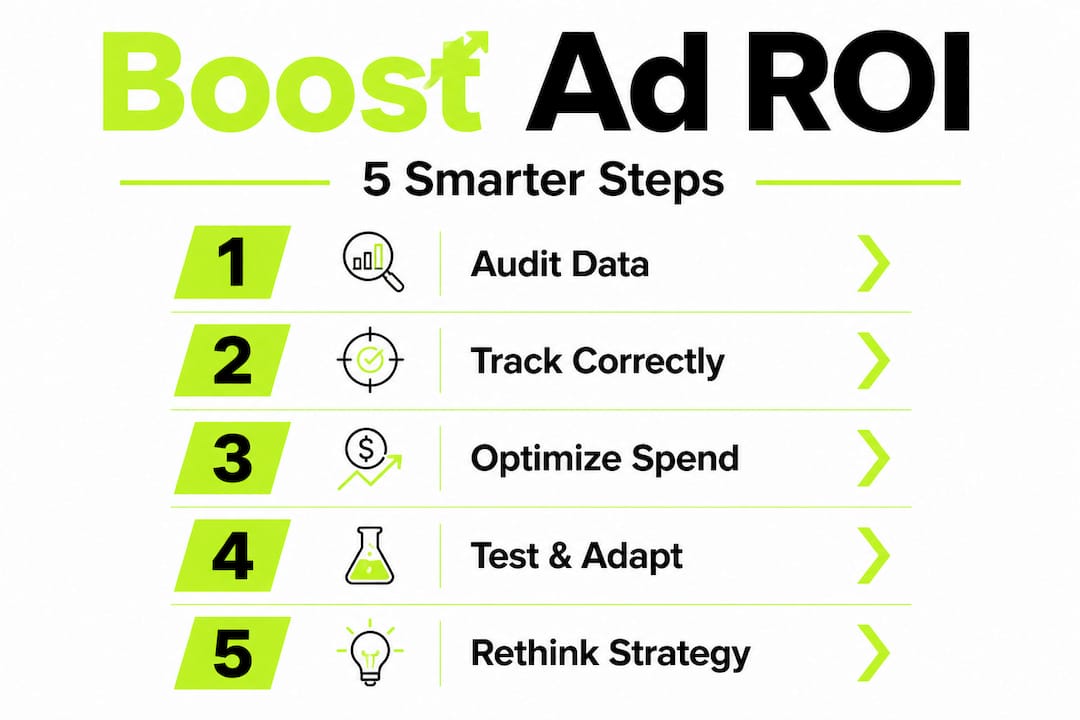
Ready to improve your ad ROI with expert help?
Implementing everything in this guide takes time, skill, and the right tools. If you're managing significant ad spend and want results that are faster and more reliable, working with a performance-focused team makes a real difference. At A&T Digital Agency, we build and manage paid ad systems designed specifically for revenue growth and measurable ROI, without the unnecessary overhead. Our Google Ads management and Meta Ads management services combine data-driven strategy with hands-on execution so your budget works harder from day one. Let's build something that actually scales.
Frequently asked questions
How long does it take to improve ad ROI?
Results can appear in as little as one month when focusing on clear quick wins like exclusions and budget reallocation, but sustained improvement typically takes 2 to 3 months of consistent tracking, testing, and revision.
What is a good ROI for digital ads?
A strong ad ROI is generally 2x or higher, but the right benchmark depends on your industry, margins, and business model. Using account-level exclusions alone has shown a 28% ROAS improvement in automated campaigns, which illustrates how much efficiency gains are possible before even touching your bids or budgets.
Can AI tools guarantee better ad ROI?
No. Google AI Max data shows a median revenue lift of 13% alongside a 16% CPA increase, with results ranging widely by account. AI tools require manual oversight to prevent cannibalization and uncontrolled cost growth.
Whatʼs the simplest way to cut wasted ad spend?
Setting account-level placement exclusions in Google Ads is one of the fastest and most impactful steps, with documented results showing a 42% reduction in wasted spend across automated campaigns.