Audience targeting: how to unlock higher ROI with smart strategies
Posted on
Marketing
Posted at

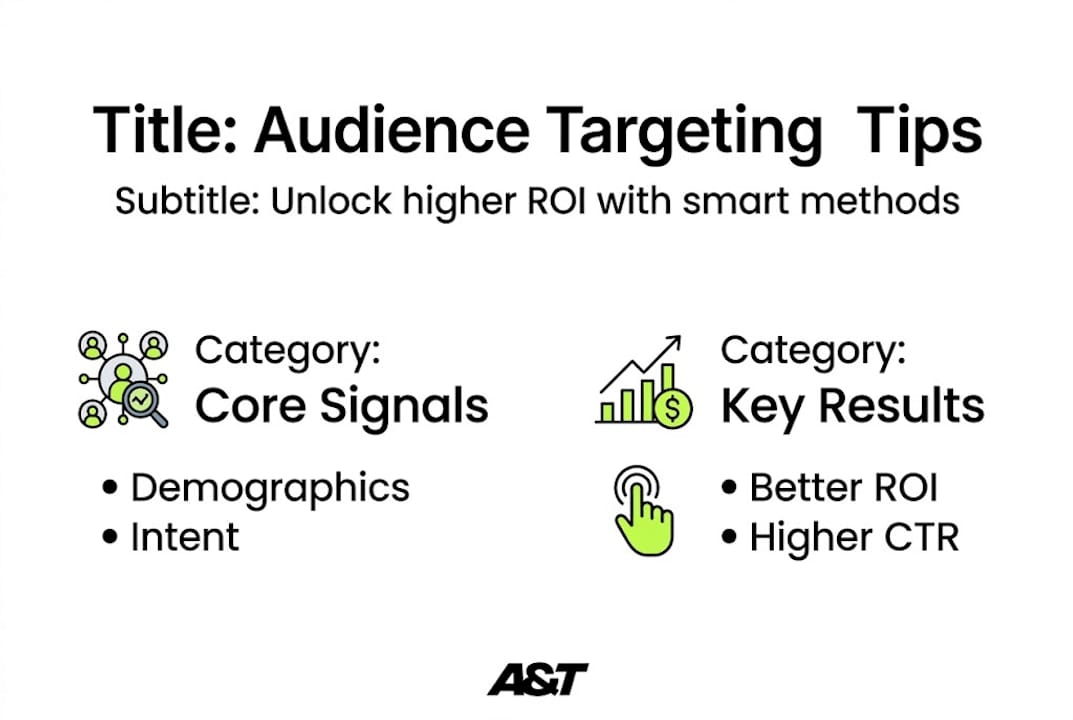
Audience targeting maximizes ad efficiency by focusing on users most likely to convert.
Combining frameworks like retargeting, lookalikes, and AI optimization improves campaign results.
Proper measurement and strategic adjustments are essential for sustained growth and high ROAS.
Spending more on ads to reach more people sounds logical. In practice, it often burns budget on users who will never buy from you. The real advantage in paid advertising comes from precision, not volume. Audience targeting lets you focus every dollar on users who are most likely to convert, turning your ad spend into a predictable growth engine. Whether you're running Google Ads or Meta campaigns, the businesses that win are the ones that know exactly who they're talking to. This guide breaks down what audience targeting is, how the leading frameworks work, and what benchmarks you should expect when you get it right.
Table of Contents
Understanding audience targeting: What it means and why it matters
Audience targeting frameworks: Proven methodologies that drive results
Advanced tactics, pitfalls, and adapting to 2026: What works today
A smarter approach to audience targeting: Lessons from the field
Key Takeaways
Point | Details |
|---|---|
Focus beats reach | Narrow, precise audience targeting delivers higher ROI than broad, unfocused strategies. |
Data-driven frameworks | Layering signals and using lookalike or remarketing audiences make ad budgets go further. |
Benchmarks matter | Track metrics like ROAS and CTR to ensure your campaigns perform above industry averages. |
Stay current | Continuously adapt your tactics as platforms shift toward more automation and AI-driven options. |
Understanding audience targeting: What it means and why it matters
Audience targeting is the practice of delivering your ads to specific groups of users based on shared characteristics, behaviors, or intent signals. Instead of showing your ads to everyone on a platform, you narrow the field to people who match a defined profile. The result is less wasted spend and more conversions per dollar.
For small and medium-sized businesses, this matters more than for large brands with unlimited budgets. When you are working with $5,000 or $15,000 a month in ad spend, every misplaced impression costs you real money. Audience targeting is how you protect that budget and direct it toward people who are actually ready to act.
Here's what makes audience targeting so powerful in practice:
Budget efficiency: You stop paying for impressions that lead nowhere.
Higher conversion rates: Ads shown to relevant users convert at significantly higher rates than broadly targeted campaigns.
Better creative relevance: When you know who you're talking to, you can write copy and design creatives that speak directly to their needs.
Shorter sales cycles: Targeted users are typically further along in the decision process, which speeds up conversion.
Scalable results: Once you identify what works for one segment, you can scale it or replicate the model for other audience groups.
The major techniques used in audience targeting today include layering data signals such as demographics combined with purchase intent, remarketing to past visitors, lookalike audiences built from high-value customers, AI-optimized targeting, and custom segments based on search terms or URLs. These are not mutually exclusive. The strongest campaigns combine several of them.
A few terms worth knowing before we go further. A segment is any defined group of users, such as "women aged 25 to 44 who visited your product page in the last 30 days." A signal is a behavioral or contextual data point the platform uses to place users in segments, such as a recent Google search or a video view on Instagram. Retargeting (sometimes called remarketing) is the process of showing ads specifically to users who have already interacted with your brand. Understanding what is retargeting and how it connects to your broader targeting strategy is a strong starting point for any SMB looking to improve campaign performance.
The shift from broad to precise targeting is not just a tactical preference. It reflects a fundamental change in how digital platforms allocate ad delivery. Platforms like Google and Meta now have enough behavioral data to make intelligent targeting decisions, but only if you give them the right inputs. Without a defined audience strategy, you are essentially handing the algorithm a blank canvas and hoping for the best.
Audience targeting frameworks: Proven methodologies that drive results
Understanding the landscape is one thing. Building a system from it is another. Let's break down the proven frameworks SMBs actually use to drive real results.
The five primary frameworks are:
Layered targeting: Combining multiple audience signals at once. For example, targeting users who are 30 to 55 years old, have shown interest in health products, and recently searched for specific keywords. Layering tightens relevance significantly.
Retargeting: Re-engaging users who visited your site, viewed a product, or abandoned a cart. This is one of the highest-ROI methods available to SMBs because you are reaching people who already know you.
Lookalike audiences: Platforms analyze your best customers and find other users with matching behavioral profiles. This expands reach without sacrificing relevance.
AI-optimized targeting: Letting the platform's machine learning system find converting users based on your campaign goal. This works best when you have solid conversion data feeding the algorithm.
Custom segment targeting: Building audiences based on specific URLs users visited, apps they use, or search terms they entered on Google. This method gives you granular control over who sees your ads.
The process of building a targeting strategy that actually works follows a clear sequence. According to Google's framework, the process runs as follows: define your campaign objective, identify the right segments for that objective, select the data signals you will use to build or refine those segments, activate the audiences across your chosen channels, then measure and refine continuously.
Framework | Core process | Typical ROI impact |
|---|---|---|
Layered targeting | Stack demographic + intent signals | High, especially for niche products |
Retargeting | Pixel-based audience from past visitors | Very high, fastest conversion cycle |
Lookalike audiences | Match top customers, expand reach | Medium to high depending on data quality |
AI-optimized targeting | Feed conversion data, let platform optimize | High for low-AOV products |
Custom segments | Target by URL, app, or search term | High for specific intent matching |
Strong campaign planning for ROI starts with knowing which framework fits your current stage. A brand-new business with no pixel data cannot run effective retargeting yet. But it can run layered or custom segment campaigns from day one and build the data foundation for retargeting later.

The key to sustained results is learning how to measure campaign results at every stage. Without measurement, you cannot refine. Without refinement, your targeting drifts and performance drops.
Pro Tip: Never run a single targeting framework in isolation. Combine lookalike audiences for top-of-funnel discovery with retargeting for bottom-of-funnel conversion. This creates a full-funnel system that nurtures users from awareness to purchase without leaving money on the table.
Benchmarks, metrics, and real world impact: What to expect
Armed with the main frameworks, let's see what the data says. What are realistic performance benchmarks if you get targeting right?
Retargeting delivers some of the strongest numbers in digital advertising. Industry benchmarks show that retargeting campaigns achieve an average return on ad spend (ROAS) of 4.2x, with click-through rates (CTR) ranging from 0.7% to 1.2%, which is roughly ten times higher than standard display advertising. On Meta specifically, well-optimized retargeting campaigns also average a 4.2x ROAS. AI-powered targeting lifts conversions by 18% to 30% and can triple CTR versus traditional manual methods. The average social media cost per acquisition (CPA) sits around $108, though this varies widely by industry and average order value (AOV).
"Retargeting ads generate click-through rates up to 10 times higher than standard display ads, with an average ROAS of 4.2x. AI targeting can boost conversions by 18 to 30 percent compared to traditional methods."
Here's how different strategies compare at a high level:
Strategy | Avg. ROAS | Avg. CTR | Best use case |
|---|---|---|---|
Broad targeting | 1.5x to 2.0x | 0.05% to 0.1% | Brand awareness at scale |
Precise/niche targeting | 2.5x to 3.5x | 0.3% to 0.6% | Mid-funnel consideration |
Retargeting | 3.5x to 4.2x | 0.7% to 1.2% | Bottom-of-funnel conversion |
AI-optimized targeting | 2.8x to 4.0x | Up to 3x baseline | Scalable conversion campaigns |
What do these numbers mean for your business? A few important points:
AOV matters: A 4.2x ROAS is excellent if your average order value is $200. It barely covers costs if your AOV is $15.
Industry affects CPA: A healthcare company will typically pay more per acquisition than a fashion retailer, even with identical targeting quality.
Campaign type shifts benchmarks: Lead generation campaigns and e-commerce campaigns have completely different CPA and ROAS expectations.
Exploring retargeting strategies that match your funnel stage is critical before setting expectations. A lot of SMBs see a 4.2x ROAS benchmark and assume they should hit it in week one. Retargeting performance builds as your pixel collects more data. Patience and consistent measurement are what separate campaigns that scale from ones that stall.
Understanding why retargeting matters beyond just the numbers also helps. Users who see retargeted ads are already familiar with your brand. That familiarity lowers resistance and raises conversion probability significantly compared to cold audiences seeing your brand for the first time.
Advanced tactics, pitfalls, and adapting to 2026: What works today
Now that you know what to expect, let's get into the mistakes to avoid and how to stay ahead as platforms evolve in 2026.
The biggest shift happening right now is the divergence between how Meta and Google handle targeting. On Meta, detailed manual targeting is largely obsolete. The platform's AI has become strong enough that broad targeting combined with compelling creative outperforms manual interest stacking in most cases. On Google, layered audience targeting still plays a significant role, particularly for high-consideration purchases where intent signals carry more weight than behavioral profiling.
This is a critical distinction. SMBs that apply the same strategy across both platforms are leaving performance on the table. Google and Meta are fundamentally different systems. Each one rewards a different approach.
Here are the top five pitfalls SMBs make in audience targeting, and how to avoid them:
Targeting too broadly on limited budgets. Broad targeting requires significant spend before the algorithm learns. With $3,000 per month, a broad Meta campaign will mostly burn learning budget. Solution: Start with tight segments and expand once you have conversion data.
Skipping audience exclusions. Not excluding existing customers from acquisition campaigns means you pay to convert people who are already buyers. Solution: Always build exclusion lists from your CRM or pixel data.
Neglecting frequency management. Showing the same ad to the same user 15 times in a week destroys brand perception. Solution: Set frequency caps and rotate creative consistently.
Treating AI as a set-and-forget system. Automation needs human oversight. Algorithms optimize for the metric you give them, not necessarily the business outcome you actually want. Solution: Review performance weekly and adjust inputs based on what the data tells you.
Ignoring niche segments for loyalty. Broad audiences might grow your top-of-funnel, but niche, high-intent segments are where loyalty and repeat purchase behavior come from. Solution: Create dedicated campaigns for your best customer profiles, not just your largest potential audience.
Pro Tip: Combine AI broad targeting for new customer acquisition with tightly defined custom segments for retention. This two-layer approach captures reach at the top of the funnel while protecting your best customers from generic messaging at the bottom.
Aligning your creative ad strategy to your audience framework is just as important as the targeting itself. The most precisely targeted ad will underperform if the creative does not resonate. Especially on Meta, where the algorithm uses creative signals to find the right users, ad quality directly influences who sees your campaign. Pairing smart targeting with smart remarketing tactics creates a system that grows revenue rather than just impressions.
A smarter approach to audience targeting: Lessons from the field
Here is what we see consistently across campaigns. Most SMBs come to us after spending months trusting automation completely and wondering why results plateaued. The industry conversation around AI-driven targeting is real and important. But there is a risk of overcorrecting. Handing full control to an algorithm without feeding it quality signals, testing creative variables, or reviewing segment performance is not a strategy. It is hope dressed up as efficiency.
The businesses that see sustained growth from paid advertising are the ones that treat targeting as a living system, not a launch setting. They test audience combinations every quarter. They review which segments are generating profitable customers versus just cheap clicks. They adjust based on what the data actually says, not what the platform dashboard wants them to believe.
We are also direct about this: AI excels in lower-consideration, lower-AOV environments. For high-ticket services, B2B campaigns, or complex buying journeys, human oversight and precision targeting still outperform broad automation. Knowing when to trust the machine and when to override it is a skill that comes from experience.
Staying current on ad trends for 2026 matters too. Platforms update their targeting tools frequently. What worked in 2024 may not be the optimal approach today. Quarterly strategy reviews are not optional if you want to stay competitive.
Partner with experts for next level targeting results
The frameworks and benchmarks in this article give you a strong foundation. But building, testing, and optimizing audience targeting systems takes time, data, and platform expertise that most SMBs do not have in-house. We specialize in exactly this. Our team builds performance-driven Google Ads management systems using layered targeting and precise audience signals that match your business goals. On the social side, our Meta Ads management approach balances AI-driven broad reach with niche segment precision for campaigns that actually convert. If you want targeting that works without burning budget on guesswork, we are ready to build that system with you.
Frequently asked questions
What is the main benefit of audience targeting for SMBs?
Audience targeting helps small businesses use their budgets more efficiently by reaching only those most likely to convert, which directly improves ROI without requiring larger ad spend.
How does AI targeting compare to manual targeting?
AI targeting boosts conversions by 18% to 30% and can triple click-through rates versus traditional manual methods, making it especially effective for lower-cost, high-volume products.
Which platforms offer the most targeting options?
Google offers granular audience layering with strong intent signals, while Meta increasingly relies on AI-driven broad targeting, making each platform best suited to different campaign strategies and business types.
What is the typical ROAS for retargeting ads?
Retargeting campaigns deliver an average return on ad spend of 4.2x, which is significantly higher than the 1.5x to 2.0x typically seen with broad, untargeted display campaigns.


