Why retargeting matters: boost conversions and ROI
Posted on
Marketing
Posted at

Most online shoppers won't buy on their first visit. In fact, the vast majority browse, click, and leave without converting, taking their wallet with them. But that traffic isn't gone forever. Retargeted visitors convert 70% more likely than cold audiences, making retargeting one of the highest-leverage tools in your paid media arsenal. This guide breaks down what retargeting actually is, why the numbers are so compelling, where most businesses go wrong, and how to build a strategy that consistently recovers lost revenue.
Table of Contents
Key Takeaways
Point | Details |
|---|---|
Retargeting boosts ROI | Retargeting delivers a higher return on ad spend than standard display campaigns. |
Prevents wasted traffic | It recaptures a significant percentage of visitors who would otherwise never convert. |
Balance is vital | Use retargeting alongside prospecting and avoid overexposure to maximize success. |
Strategy matters | Frequent optimization and audience segmentation are key to sustained results. |
What is retargeting and why it matters
Retargeting is a paid advertising technique that serves ads specifically to people who have already visited your website, engaged with your content, or interacted with your brand in some way. Instead of casting a wide net at strangers, you're re-engaging a warm audience that already knows you exist. That distinction is everything in performance marketing.
Within a paid media strategy, retargeting sits in the middle and lower funnel. It works alongside prospecting campaigns (which build awareness) to move people from consideration to conversion. Think of prospecting as filling a bucket and retargeting as making sure the bucket doesn't leak.
The scenarios where retargeting delivers the most value include:
Abandoned cart recovery: A shopper adds items but leaves before checkout
Product page bouncers: Visitors who viewed a specific product but didn't add to cart
Lead form drop-offs: Prospects who started a form but didn't submit
Past customers: People who bought once and are ripe for a repeat purchase
Video viewers: Users who watched 50% or more of your ad content
One of the most persistent myths is that retargeting is only for large brands with massive budgets. That's simply not true. Platforms like Google and Meta allow you to run retargeting campaigns with modest daily budgets, and the best retargeting strategies are built on precision, not volume.
"Retargeting isn't optional; it's the foundation of an optimized digital funnel."
Another common misconception is that retargeting feels "creepy" to users. In reality, when ads are relevant and well-timed, most consumers appreciate the reminder. The key is relevance and frequency control, which we'll cover shortly. Understanding ad campaign ROI starts with recognizing that retargeting is where your existing traffic investment pays its second dividend.
Key performance benefits of retargeting
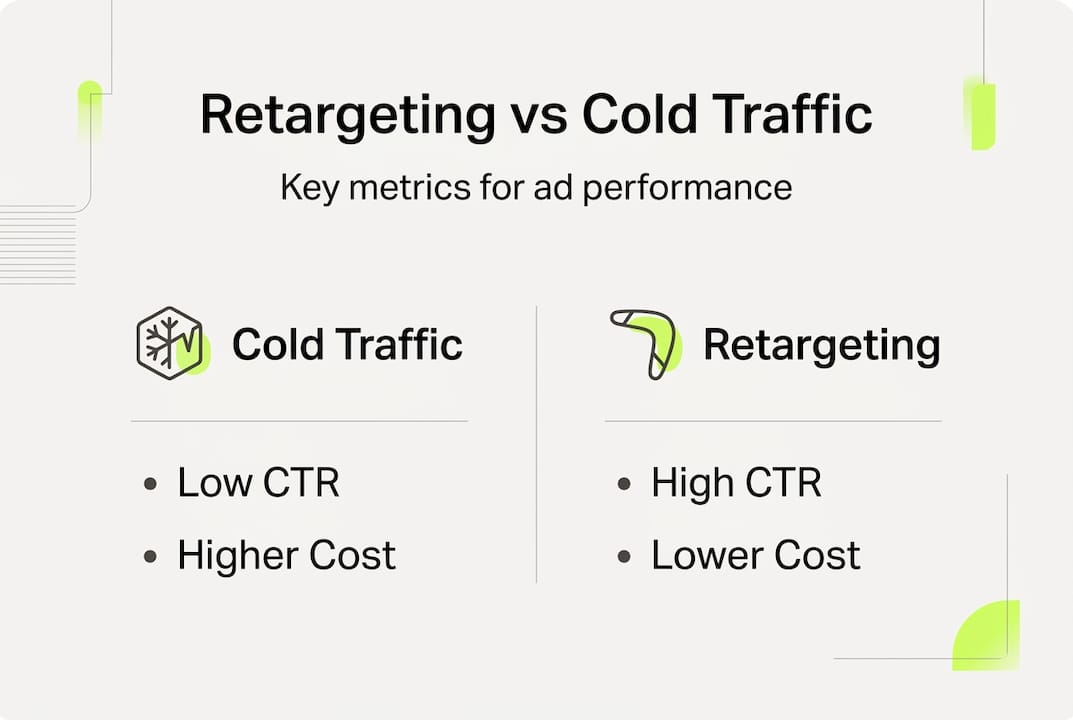
The data behind retargeting isn't just impressive, it's actionable. Retargeted campaigns achieve a 10x higher CTR (0.7%) compared to standard display ads (0.07%), and the average return on ad spend sits at 4:1. Those aren't vanity metrics. They translate directly into revenue.

Here's how retargeting stacks up against cold traffic campaigns across the metrics that matter most to SMB marketing managers:
Metric | Cold traffic campaigns | Retargeting campaigns |
|---|---|---|
Click-through rate | 0.07% | 0.7% |
Average ROAS | 1.5:1 to 2:1 | 4:1 |
Conversion rate | 1-2% | 3-5%+ |
Cost per acquisition | Higher | 30-50% lower |
Audience familiarity | None | Pre-warmed |
Cart abandonment is one of the clearest opportunities retargeting addresses. The average e-commerce site loses roughly 70% of shoppers at checkout. Retargeting recovers 20 to 30% of those abandoned carts, which in real dollars can mean thousands of recovered sales per month depending on your average order value.
The sequential impact of a well-structured funnel looks like this:
Awareness: Prospecting ads introduce your brand to new audiences
Consideration: Retargeting reminds warm visitors of what they viewed
Conversion: Dynamic product ads or offer-based retargeting closes the sale
Retention: Post-purchase retargeting drives repeat orders and upsells
For tracking ad performance across this funnel, you need clear attribution at each stage. Without it, you're flying blind on which touchpoints are actually driving conversions. Personalized ad ROI improves significantly when retargeting ads reflect the exact product or service a visitor already showed interest in, rather than serving a generic brand message.
Key takeaway: Retargeting doesn't just improve metrics in isolation. It amplifies the return on every dollar you've already spent on prospecting.
Common challenges and pitfalls of retargeting
The numbers are compelling, but retargeting done poorly can actively hurt your brand. Understanding the failure modes is just as important as knowing the benefits.
The most common pitfalls include:
Ad fatigue: Showing the same creative to the same person too many times kills engagement and damages brand perception
Excessive frequency: Bombarding users with 10+ impressions per day feels intrusive and drives negative sentiment
Budget over-allocation: Pouring 80% of your ad budget into retargeting while neglecting prospecting starves your top-of-funnel audience pool
Weak creative: Retargeting audiences are warm, but a bland or irrelevant ad still won't convert them
Audience size too small: Retargeting a pool of fewer than 500 users leads to rapid fatigue and limited statistical significance
"Over-reliance on retargeting alone causes budget imbalance and ad fatigue; it's best paired with prospecting for sustainable growth."
This is one of the most important challenging retargeting myths to address: retargeting is not a standalone strategy. It depends entirely on a healthy flow of new traffic from prospecting campaigns. If your top-of-funnel dries up, your retargeting audience shrinks and performance collapses.
Pro Tip: Set a frequency cap of 3 to 5 impressions per user per week as a starting point. Monitor your frequency data weekly and adjust based on CTR trends. A sharp drop in CTR at higher frequencies is a clear signal of fatigue.
Knowing when to de-prioritize retargeting is equally important. If your site receives fewer than 1,000 monthly visitors, your retargeting pool will be too small to generate meaningful results. In that case, focus your budget on optimizing ad spend toward prospecting first to build the audience you need. Understanding digital ad terminology like frequency, reach, and audience overlap will help you diagnose these issues faster.
How to build a high performing retargeting strategy
With the pitfalls mapped out, here's a practical framework for building a retargeting program that actually delivers. This isn't theory. It's the process that drives results for performance-focused SMBs.
Choose your channels: Google Display Network and Meta (Facebook and Instagram) are the two primary platforms. Google excels at intent-based retargeting across the web. Meta excels at behavioral and interest-based retargeting within its ecosystem. Most businesses benefit from running both.
Segment your audiences: Don't treat all visitors the same. Separate your audiences by behavior: cart abandoners, product page viewers, blog readers, and past purchasers. Each segment deserves a different message and offer.
Match creative to intent: A cart abandoner should see the exact product they left behind, ideally with a time-sensitive incentive. A blog reader who never visited a product page needs a softer, value-driven message. Mismatched creative is one of the biggest conversion killers.
Set recency windows strategically: A 7-day window captures high-intent recent visitors. A 30-day window broadens reach but lowers intent. A 90-day window is useful for re-engagement campaigns. Start with 7 to 14 days for your highest-priority segments.
Apply frequency caps: As noted above, 3 to 5 impressions per week is a solid baseline. Adjust based on your data.
Monitor and iterate weekly: Check CTR, conversion rate, frequency, and ROAS every week. Small adjustments compound over time into significant performance gains.
Pro Tip: Refresh your retargeting creatives every 3 to 4 weeks. Even a simple color or headline change can reset engagement levels and extend the life of a campaign. Pair this with brand safety settings to ensure your ads don't appear in contexts that could harm your reputation.
Behavioral triggers add another layer of precision. For example, targeting users who visited your pricing page within the last 7 days signals high purchase intent. That segment warrants a more direct, conversion-focused ad than someone who only read a blog post. Retargeting recovers up to 30% of otherwise lost sales when these behavioral signals are used correctly.
The long-term payoff comes from iteration. Businesses that review and optimize their retargeting campaigns weekly consistently outperform those that set and forget. Advanced retargeting tactics like dynamic product ads, sequential messaging, and cross-device targeting become available once your foundational strategy is stable. Pairing those tactics with disciplined optimize ad spend practices ensures you're not just generating clicks but generating profitable ones. Best paired with prospecting for sustainable growth, retargeting becomes the engine that converts the traffic your prospecting campaigns work hard to generate.
How expert help accelerates your retargeting success
Building a retargeting strategy from scratch takes time, testing, and a deep understanding of platform mechanics. For most SMB marketing managers, the fastest path to measurable results is working with specialists who've already run hundreds of these campaigns across different verticals. At A&T Digital Agency, we handle the full retargeting stack: audience segmentation, creative development, cross-channel execution, and ongoing optimization. Whether you need Google Ads management to capture high-intent retargeting opportunities or Meta Ads support to re-engage your social audience, we build systems designed to recover lost revenue and scale what's working. If you're ready to stop leaving conversions on the table, let's talk about a full-funnel audit for your business.
Frequently asked questions
Does retargeting work for small businesses with limited web traffic?
Retargeting is less effective on extremely low-traffic sites, but it scales rapidly as your audience grows. De-prioritize retargeting if low scale and invest in prospecting first to build a retargetable audience.
How much budget should I allocate to retargeting versus prospecting?
A balanced approach works best, with retargeting amplifying your prospecting investment rather than replacing it. Over-reliance on retargeting alone causes budget imbalance and accelerates ad fatigue across your audience.
How quickly can I see results from retargeting?
Many businesses see noticeable conversion increases within the first two to four weeks of a well-structured campaign. Retargeted visitors convert 70% more likely than cold traffic, so results often appear faster than with prospecting alone.
Is retargeting privacy-compliant in 2026?
Yes. Modern retargeting platforms prioritize privacy through consent-driven tracking, anonymized audience pools, and compliance with regulations like GDPR and CCPA. Always ensure your pixel implementation and cookie consent setup meet current standards in your target markets.