Digital Ad Solutions for Entertainment Venues: 2026 Playbook
Posted on
Marketing
Posted at

Running coordinated Meta, Google, and TikTok campaigns with proper tracking and retargeting is essential for filling seats and avoiding wasted budget.
Prior to launch, key setups include verifying tracking tools, integrating ticketing data, and creating short, captioned videos; starting audiences from past buyers ensures faster ROI.
Run a coordinated mix of Meta (Advantage+/Custom Audiences), Google Search + YouTube, and TikTok campaigns with most of your budget on custom and retargeting audiences, and server-side conversion tracking in place before you spend a dollar on cold traffic. That single decision separates venues that fill seats from those that burn budget on clicks that never convert.
Before launch, four setup items are non-negotiable:
Meta Pixel + Conversions API (CAPI) configured and verified together
Ticketing-platform integration so order data flows back as conversion events
Event feed or CSV export for dynamic ads and sold-out automation
Vertical video creative cut for Reels, Stories, and TikTok (6–15 seconds, captioned)
Pro Tip: Start your first spend on Custom Audiences built from past ticket buyers and email lists. Research from Big Tickets shows these audiences convert 3–10× better than cold audiences, giving you faster ROI on a time-bound event.
Table of Contents
Which paid channels should you prioritize for ticketed events?
How should you split your audience budget to maximize ticket conversions?
What campaign structure and creative formats actually sell tickets?
Which KPIs and tracking practices actually matter for ticketed events?
What does a realistic launch timeline and cost structure look like?
How do you hire the right performance agency for your venue?
Pre-launch checklist: what must be ready before you go live?
Key Takeaways
Why boutique agencies outperform generalists for venue campaigns
A&T Digital runs venue campaigns built to sell tickets
Which paid channels should you prioritize for ticketed events?
Each channel plays a distinct role. See how theatre district event spaces can uniquely benefit from tailored venue strategies. Mixing them without a clear job description for each wastes money.

Google Search + YouTube captures buyers who are already looking. Over 80% of purchase journeys begin on search engines, making Search the highest-intent channel you have. YouTube and the Google Display Network then retarget warm visitors with dynamic creative. For multi-event portfolios, a ticketing feed powers Performance Max campaigns and automatically pauses sold-out inventory.
Meta (Instagram + Facebook) drives the most volume. Festival-scale events running full-effort campaigns allocate 40–60% of total marketing spend to Meta. Custom Audiences, Lookalikes, and Advantage+ Shopping campaigns work together across Reels, Stories, and Feed placements.
TikTok handles discovery and younger-audience acquisition. Pair it with strong short-form creative and artist or creator partnerships for prospecting. It is not a retargeting channel; it is a top-of-funnel engine.
Objective | Channel | Best Placements | Creative Type |
|---|---|---|---|
High-intent capture | Google Search | Search results | Text ads, extensions |
Warm retargeting | Google Display / YouTube | Display, YouTube pre-roll | Dynamic, video |
Volume + retargeting | Meta (Facebook/Instagram) | Reels, Stories, Feed | Vertical video, carousel |
Discovery / prospecting | TikTok | For You Page | Short-form video, creator collab |
Do not silo these channels. Cross-channel remarketing lists and shared first-party data from your ticketing platform are what tie the system together.
How should you split your audience budget to maximize ticket conversions?
Build audiences in sequence, then allocate spend to match conversion probability.
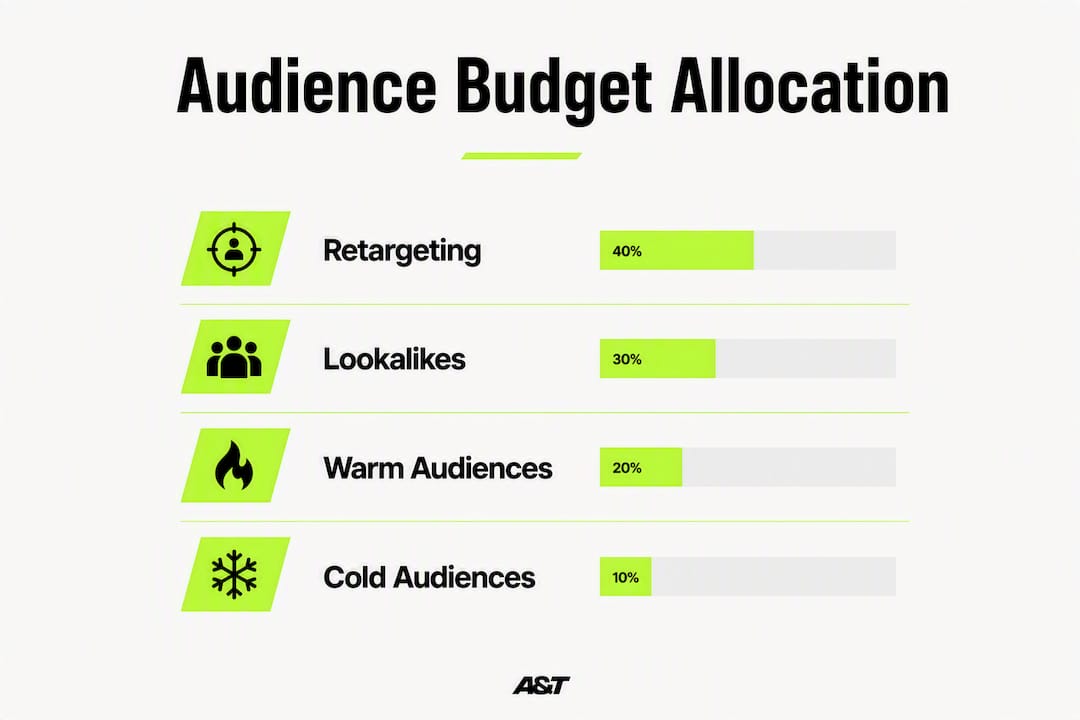
The sequence: Custom Audiences (past buyers, email lists, 30–90 day site visitors) → Lookalikes / Similar Audiences → Advantage+ or broad prospecting. Each tier is colder and less efficient than the one before it, so budget should reflect that.
A practical starting split for a venue-scale campaign:
30–40% to retargeting (Custom Audiences, cart abandoners, past buyers)
40–50% to Lookalikes seeded from high-value purchasers
10–30% to cold/Advantage+ prospecting
Pro Tip: Seed your Lookalike audiences from top-value purchasers, meaning repeat buyers or high average-order-value customers, rather than your full list. The signal quality difference is significant. See the audience segmentation guide for how to structure these tiers.
Worked example: $20,000 campaign
Audience Tier | Budget | Rationale |
|---|---|---|
Retargeting (Custom Audiences) | — | Highest conversion rate, fastest ROI |
Lookalike prospecting | — | Scales efficiently from strong seed list |
Cold / Advantage+ | — | Tests new audiences; scale only after CPA stabilizes |
Build your Custom Audiences from ticketing-platform exports and CRM lists. Use 30–90 day site visitor windows for retargeting; shorter windows tend to be too small, longer ones dilute intent.
What campaign structure and creative formats actually sell tickets?
Keep the architecture simple. Over-segmentation starves the algorithm of data and slows optimization.
Recommended structure:
1–3 retargeting ad sets (site visitors, cart abandoners, past buyers by event type)
2–3 Lookalike ad sets (seeded from top-value purchasers)
One Advantage+ prospecting campaign with broad targeting
Creative playbook:
Hero vertical video (6–15s): Open with the hook in the first 2 seconds, add captions, close with a clear CTA. This format works across Meta Reels, Stories, and TikTok.
Countdown creative: Urgency drives conversions for time-bound events. "3 days left" outperforms generic "buy now" messaging.
Carousel ads: Ideal for showcasing lineups, tiered pricing, or multiple event dates.
Static remarketing creative: Simple, price-forward, with a direct CTA. Warm audiences already know the event; they need a reason to act now.
For A/B testing, run headline variants in parallel: lineup-focused vs. offer-focused vs. social-proof-focused. Test one variable at a time and hold creative for at least 7 days before reading results. For Google, match bidding strategy to campaign maturity: Manual CPC when data is thin, Maximize Conversions once you have history, Target CPA when you know your cost-per-ticket target.
Pro Tip: Use UTM parameters on every ad link. Without them, your ticketing platform and Google Analytics will show different numbers and you will not know which campaign drove the sale.
Which KPIs and tracking practices actually matter for ticketed events?
Vanity metrics fill reports. These are the numbers that tell you whether the campaign is working.
Primary KPIs: Cost per ticket (CPT), ROAS per event, conversion rate on the ticket page, and revenue per visitor. Secondary: CTR, video view-through rate, and engagement rate on short-form video.
Tracking stack:
Meta Pixel + Conversions API together (browser-only tracking is degraded by privacy changes; CAPI dramatically improves attribution accuracy)
Google conversion tags with server-side exports
Ticketing-platform order data as the ground truth for revenue
Expect platform-reported numbers to differ from your ticketing platform. That is normal. Use platform metrics for optimization decisions and ticketing-platform sales as your final ROI source.
For offline and box-office sales, export those transaction records and upload them as offline conversion events or customer list seeds. This closes the attribution loop and improves your Lookalike quality.
KPI | What It Tells You | Benchmark Action |
|---|---|---|
Cost per ticket (CPT) | True acquisition cost | Compare to ticket margin; set as primary target |
ROAS per event | Revenue efficiency | Track by event type to identify top performers |
Ticket page CVR | Landing page quality | Below 2%? Test page copy and load speed |
Customer Lifetime Value | Repeat buyer potential | Use to justify higher CPT for first-time buyers |
What does a realistic launch timeline and cost structure look like?
Typical timeline:
Weeks 1–2: Tracking setup (Pixel, CAPI, Google tags), feed configuration, creative production, audience builds
Weeks 3–6: Initial testing; front-load retargeting and list activation immediately
Weeks 7–12: Optimization to performance benchmarks; scale prospecting only after Lookalike/Advantage+ shows stable CPA
Front-loading retargeting is not optional for time-bound events. You have a deadline. Warm audiences convert faster, and you need early data to optimize prospecting before the event date.
Agency pricing models:
Retainer + media fee: Fixed monthly management fee plus your media budget. Predictable cost, clear deliverables.
Percentage of spend: Agency fee scales with media budget (typically 10–20%). Aligns incentives but can inflate spend.
Performance-based: Fee tied to CPT or ROAS targets. Less common; requires agreed benchmarks upfront.
Medium-venue cost example:
How do you hire the right performance agency for your venue?
Most generalist agencies have never integrated a ticketing platform or managed a sold-out automation rule. That gap costs venues real money.
Vendor checklist:
Verified event ad experience with before/after CPT metrics
Ticketing-platform integration capability (Eventbrite, AXS, Ticketmaster, or custom exports)
Transparent reporting with weekly optimization notes
Feed management and sold-out automation in their workflow
Clear A/B testing roadmap, not just "we'll test things"
Interview questions to ask:
How do you configure CAPI and reconcile conversion discrepancies between Meta and your ticketing platform?
Show a case study where you improved Cost per Ticket. What was the before/after?
How do you handle sold-out inventory in live campaigns to prevent wasted spend?
Red flags: opaque attribution models, no experience with ticketing integrations, no feed-driven dynamic ad capability, and vague answers about testing cadence.
Feld Entertainment's promoted campaigns achieved an average ROAS of 11.1× and sold over 26,000 tickets using centralized analytics and promoted-listing tools. That level of return requires an agency that understands the full ticketing stack, not just ad platforms.
Pro Tip: Ask any agency candidate to walk you through their sold-out inventory workflow. If they do not have one, feed-driven automation is a non-starter for multi-event venues.
A&T Digital's digital marketing approach for venues covers end-to-end campaign management, from tracking setup through creative and feed management, with published case studies across entertainment and retail verticals.
Pre launch checklist: what must be ready before you go live?
48 hours before launch:
Pixel and CAPI firing correctly; test purchase events confirmed in Events Manager
Google conversion tags verified; server-side exports active
Ticketing-platform integration tested with a real or sandbox order
All creative assets uploaded: vertical videos (multiple cuts), thumbnails, copy variants
Event feed or CSV validated for dynamic ads; sold-out automation rules set
24 hours before:
UTM parameters on all destination URLs confirmed
Audience sizes verified (retargeting lists above 1,000 users for Meta)
Budget pacing rules and daily caps set
Frequency caps applied to remarketing campaigns
2 hours before:
Final creative review across all placements
Escalation criteria documented (e.g., CPT exceeds 2× target triggers a review)
Pro Tip: Run a retargeting strategy review against this checklist 48 hours before launch. Missed tracking is the single most common reason campaigns under-report conversions in week one.
Key Takeaways
Custom audiences and server-side tracking are the two highest-leverage investments a venue can make before running paid digital ad campaigns for events.
Point | Details |
|---|---|
Prioritize warm audiences first | Allocate 30–40% of budget to retargeting; custom audiences convert 3–10× better than cold audiences. |
Meta drives volume, Search captures intent | Festival-scale events allocate 40–60% of marketing spend to Meta; Google Search captures high-intent buyers already searching. |
Track with Pixel + CAPI together | Browser-only tracking is degraded; running CAPI alongside the Pixel dramatically improves attribution accuracy. |
Watch Cost per Ticket, not just ROAS | CPT relative to ticket margin is the metric that tells you whether campaigns are actually profitable. |
A&T Digital covers the full stack | From tracking setup and creative to feed management and ongoing optimization, A&T Digital runs end-to-end venue campaigns. |
Why boutique agencies outperform generalists for venue campaigns
The conventional wisdom says a bigger agency means better results. For entertainment venues, the opposite is usually true.
Generalist shops run the same playbook across e-commerce, lead gen, and events without adjusting for what makes ticketed events different: hard deadlines, sold-out inventory, ticketing-platform data that lives outside the ad platforms, and audiences whose purchase window closes the moment the event passes. When a generalist agency misses a sold-out automation rule, you pay for clicks that send buyers to a dead page. When they skip CAPI setup, you lose attribution on a third of your conversions and your Lookalike seeds degrade.
Specialized agencies build workflows around these constraints from day one. Feed management, ticketing integrations, and server-side tracking are not add-ons; they are the foundation. The difference shows up in Cost per Ticket within the first 30 days, not in a quarterly review.
The Feld Entertainment result (11.1× ROAS, 26,000+ tickets sold) did not happen because someone ran a generic awareness campaign. It happened because the tracking, the audience structure, and the creative all pointed at the same outcome: a completed ticket purchase. That is the standard worth holding any agency to.
A&T agency runs venue campaigns built to sell tickets
A&T Digital works with entertainment venues that need campaigns built around real ticket-sales outcomes, not impressions. The service covers Google Ads management, Meta Ads management, TikTok campaigns, conversion tracking setup (Pixel + CAPI), creative development, feed management, and ongoing optimization. Every engagement starts with tracking verification and audience builds before a dollar goes to prospecting.
Venues that run this full-stack approach see faster CPT improvement and cleaner attribution from week one. If you are ready to stop guessing which campaigns are selling tickets, book a discovery call with A&T Digital and get a clear plan for your next event.