Venue Ad Creative Process: A 2026 Guide for Planners
Posted on
Marketing
Posted at

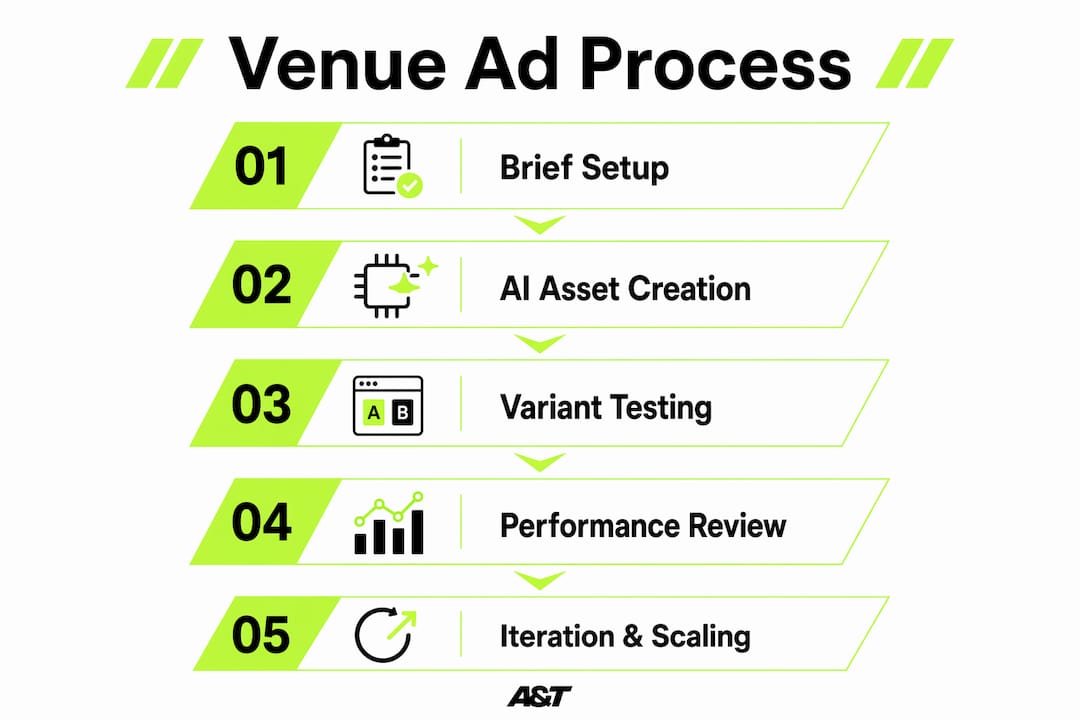
The venue ad creative process is a structured, automated workflow that transforms briefs into high-performing ad variants through testing and data iteration. It relies on detailed, parametric briefs, leveraging AI tools, market signals, and performance analytics to optimize campaigns continuously. This disciplined approach significantly increases engagement, reduces waste, and drives scalable bookings by treating ads as hypotheses to be tested and refined.
The venue ad creative process is a structured, parametric workflow that transforms raw marketing briefs into testable, high-performing ad variants through automated generation, systematic testing, and data-driven iteration. Unlike traditional campaign development built on instinct and one-off design requests, this process treats every creative decision as a variable to be measured and refined. For marketing professionals and event planners, mastering this workflow is the difference between ad spend that guesses and ad spend that converts. A well-executed process produces production-ready ad variants in under 4 hours, giving your team speed without sacrificing quality.
What does the venue ad creative process actually require?
The foundation of any effective venue ad creative process is the creative brief, and not the narrative kind that reads like a mood board. The brief must be parametric, meaning it encodes specific variables: offer details, hook types, visual treatments, calls to action, brand colors, logo usage, and tone. Each variable becomes a slot in a matrix that generates multiple testable ad variants. Without this structure, automated generation without a strong brief produces cheap assets that underperform regardless of the tools used.

The tools that power this process in 2026 fall into three categories. First, AI-powered image and video generators like Adobe Firefly and Midjourney handle visual asset production at scale. Second, Meta's Dynamic Creative Optimization (DCO) automatically assembles and tests combinations of headlines, images, and CTAs within a single campaign. Third, competitive ad research tools feed real market signals into your brief variables, so your hooks and offers reflect what is actually working in your category right now.
Performance dashboards complete the stack. Platforms like Meta Ads Manager and Google Ads provide the engagement metrics, including 3-second video view rates and click-through rates, that tell you which variants win. These numbers are not just reporting. They are the raw material for your next brief.
Here is what a well-structured creative brief must include:
Offer specifics: What is the venue offering, and what is the primary conversion goal (inquiry, booking, tour request)?
Hook types: Question-based, stat-based, social proof, or urgency-driven openers
Visual treatments: Real event footage, behind-the-scenes setup shots, or walkthrough video
CTAs: "Book a tour," "Check availability," or "Get a quote"
Brand guardrails: Color palette, approved fonts, tone descriptors, and logo placement rules
Brief element | Why it matters |
|---|---|
Offer specifics | Defines the conversion goal and shapes every downstream creative decision |
Hook type | Determines whether the ad stops the scroll in the first 3 seconds |
Visual treatment | Authentic footage outperforms stock imagery for trust and engagement |
CTA | Aligns the ad's promise with the landing page action |
Brand guardrails | Prevents off-brand variants from diluting campaign credibility |
How to execute the venue ad creative process step by step
Execution follows a repeatable six-step sequence. Each step builds on the last, and skipping any one of them creates gaps that show up in your performance data.
Prepare the creative brief using competitive signals. Spend 30 to 45 minutes pulling data from competitor ads, top-performing posts in your category, and your own historical campaign results. Encode what you find into your brief variables. This is not creative inspiration. It is structured intelligence gathering.
Build a variant matrix. Map out every combination of hooks, visuals, CTAs, and formats you plan to test. A basic matrix for a venue campaign might include 3 hooks, 2 visual treatments, and 2 CTAs, producing 12 distinct variants. The goal is breadth at the start, not perfection.
Produce testable video ads in the 15 to 30 second range. Video ads perform best with a four-part structure: a 0 to 3 second hook that stops the scroll, a 3 to 12 second vibe segment that establishes atmosphere, a 12 to 20 second value section that addresses planner questions, and a 20 to 25 second CTA. Every second of this structure has a job. Video content is the most effective format for reducing planner uncertainty and accelerating booking decisions.
Launch and test with a focus on 3-second view rate. This single metric tells you whether your hook is working before you commit budget to the full ad. Testing 3 or more hooks is standard practice for identifying what stops the scroll. Pause variants with low 3-second view rates within the first 48 to 72 hours.
Shift budget to winning variants. Once a clear winner emerges from hook testing, consolidate spend behind it. Use Meta's DCO or Google's responsive ad formats to continue testing secondary variables like CTA copy and visual treatment within the winning hook framework.
Retire fatigued creatives on a schedule. Retiring creatives that drop in performance beyond two weeks and feeding those learnings back into future briefs is what separates campaigns that sustain ROI from those that plateau. Track frequency alongside engagement. When frequency rises and CTR falls, that creative is done.
Pro Tip: Use a feedback matrix that monitors drop-off rates at seconds 3, 5, and 12 within your video analytics. These three checkpoints reveal exactly where viewers disengage, giving you precise data on which hook or vibe segment to rewrite in your next brief cycle.
What pitfalls kill venue ad creative performance?
Most venue ad campaigns fail at the same points, and the failures are predictable. Knowing them in advance saves budget and time.
The first and most common mistake is treating the venue as a single product. A conference room, a wedding hall, and a workshop space are three different products with three different buyers. Venues that segment copy and visuals per event occasion see 20 to 40% higher click-through rates over generic venue listings. That is not a marginal gain. It is the difference between a campaign that breaks even and one that scales.
The second mistake is relying on high-gloss, architectural photography. High-gloss, stock-style imagery underperforms compared to authentic, candid event footage showing real setups and behind-the-scenes moments. Planners are not buying a building. They are buying confidence that their event will run smoothly. Real photos of actual events, including setup shots, catering layouts, and AV configurations, answer the questions that polished renders never address.
The third mistake is treating creative as a static asset. One ad, one audience, one hope. This approach ignores the data feedback loop that makes the process work. Without variant matrices and scheduled creative refreshes, campaigns decay within weeks.
"Providing 60 or more real-event photos instead of architectural shots significantly reduces event-day anxiety and boosts conversions." — Tagvenue research on venue advertising
Two more pitfalls deserve direct attention. First, ad copy that ignores planner friction points. Planners want to know about AV inclusions, layout flexibility, catering options, and pricing transparency. Ads and landing pages that skip these details force planners to pick up the phone or move on. Second, slow lead follow-up. The best creative in the world loses its value if an inquiry sits unanswered for 24 hours. Creative and follow-up speed work together as a system.
How does performance feedback sharpen the creative process over time?
The feedback loop is what separates a one-time campaign from a compounding creative system. Every ad you run generates data. The question is whether you feed that data back into your next brief or let it sit in a dashboard.
Competitive ad timeline analysis reveals which hooks and offers are gaining traction in your market before you spend money testing them yourself. Tools like Meta's Ad Library let you see how long competitor ads have been running, which is a reliable proxy for performance. Ads that run for 30 or more days are almost certainly converting. Study their structure and encode what you observe into your brief variables.
Automation accelerates this cycle significantly. AI-driven video generation can produce UGC-style ads and avatar talking-head videos rapidly, enabling large variant matrices for efficient hook testing. What once required a video production team and two weeks of editing now takes a single afternoon with the right tools. This speed matters because the shelf life for social ads is short, and rotation and refreshment of creatives are critical for sustained performance.
Pro Tip: After each testing cycle, update your brief defaults to reflect the highest-performing hook type, visual treatment, and CTA from the previous round. Over three to four cycles, your brief becomes a living document that encodes your audience's preferences, not your assumptions.
Here is how a manual creative workflow compares to an automated, feedback-driven one:
Workflow type | Production time | Variants per cycle | Iteration speed |
|---|---|---|---|
Manual (traditional) | 2 to 3 weeks | 2 to 4 | Slow, dependent on team availability |
Automated with AI tools | Under 2 hours | 10 to 20+ | Fast, driven by brief updates and data |
Hybrid (brief + AI + human review) | 4 to 8 hours | 8 to 15 | Balanced, maintains brand consistency |
The compounding effect of systematic iteration is real. Each cycle produces a slightly better brief, which produces slightly better variants, which generates slightly better data. Over six months, a team running this process consistently will outperform a team spending twice the budget on one-off creative production. The creative process in 2026 is parametric, relying on structured briefs and measurable feedback rather than intuition alone. That shift is not optional for venues competing in crowded digital markets.
For venue marketers, pairing this feedback loop with visual storytelling principles keeps brand consistency intact even as variant volume scales. Automation without guardrails produces volume. Automation with guardrails produces volume and quality.
Key takeaways
The venue ad creative process works because it replaces guesswork with a structured, repeatable system of brief preparation, automated generation, and data-driven iteration.
Point | Details |
|---|---|
Brief quality determines output | A parametric brief encoding offer, hooks, visuals, CTAs, and brand rules is the single most important input. |
Video structure drives engagement | Use the 0-3 second hook, 3-12 second vibe, 12-20 second value, 20-25 second CTA format for every venue video ad. |
Occasion-specific segmentation | Splitting campaigns by event type (corporate, social, workshop) produces 20 to 40% higher click-through rates. |
Retire creatives on a schedule | Track frequency and engagement together; retire any creative that drops in performance beyond two weeks. |
Feedback loops compound results | Feeding analytics back into brief defaults improves every subsequent cycle, building a self-improving creative system. |
What Iʼve learned from running venue ad campaigns at scale
By Ann
The shift I have seen in venue advertising over the past few years is not about better design tools. It is about discipline. The teams that consistently win bookings are not the ones with the biggest budgets or the most polished creative. They are the ones who treat brief preparation as seriously as the ads themselves.
When I started working on venue campaigns, the instinct was always to lead with beauty. Stunning photography, cinematic video, aspirational copy. What the data showed, repeatedly, was that a shaky walkthrough video filmed on an iPhone by the venue manager outperformed a $5,000 production shoot. Not because quality does not matter, but because authenticity answers the questions that beauty cannot.
The other lesson I keep coming back to is this: automation is not a shortcut. It is a multiplier. If your brief is weak, AI tools will produce weak variants faster. If your brief is strong, those same tools will produce a testing matrix that would have taken a team two weeks to build manually. The leverage is real, but it sits entirely in the quality of your inputs.
What I tell every venue marketer I work with is to stop thinking about ads as finished products. Think of them as hypotheses. You are testing whether a specific hook, visual, and offer combination resonates with a specific planner at a specific moment. The ones that do, you scale. The ones that do not, you learn from and retire. That mindset, more than any tool or tactic, is what separates campaigns that grow from campaigns that stall.
— Ann
Ready to scale your venueʼs paid ad performance?
At Atdigiagency, we build and manage paid ad systems for venues that need more than a one-time campaign. Our team handles the full creative and media workflow: brief preparation, variant production, launch, testing, and ongoing optimization across Google and Meta. If you are running venue campaigns and want a team that treats your ad spend as seriously as you do, we are ready to help. Explore our Google Ads management services or our Meta Ads management program to see how we approach performance-driven venue advertising. No unnecessary meetings. Just campaigns that convert.
FAQ
What is the venue ad creative process?
The venue ad creative process is a structured workflow covering brief preparation, AI-assisted asset generation, variant testing, and performance-based iteration. It produces testable ad variants systematically rather than relying on one-off creative production.
How long does it take to produce venue ad creatives?
A structured workflow including a 30 to 45 minute brief and a 45 to 90 minute generation cycle produces production-ready variants in under 4 hours. Automation with AI tools reduces this further for teams running multiple campaigns simultaneously.
What video length works best for venue ads?
The 15 to 30 second format performs best, structured as a 0 to 3 second hook, 3 to 12 second vibe, 12 to 20 second value segment, and a 20 to 25 second CTA. This structure keeps planners engaged long enough to absorb the venue's key selling points.
How do you prevent creative fatigue in venue ad campaigns?
Tracking ad frequency alongside engagement and retiring creatives that drop in performance after two weeks prevents fatigue. Rotating hooks, switching music tempo, and refreshing visual treatments on a scheduled basis sustains campaign performance over time.
Why does occasion-specific creative outperform generic venue ads?
Planners searching for a corporate retreat space and planners booking a wedding have entirely different concerns, budgets, and decision criteria. Segmenting copy and visuals by event type directly addresses those differences, which is why occasion-specific campaigns produce 20 to 40% higher click-through rates than generic venue listings.