Retail Campaign Planning Guide for Marketers in 2026
Posted on
Marketing
Posted at

Effective retail campaign planning involves defining clear objectives, mapping customer journeys, and establishing measurement infrastructure before launch. Without preemptive coordination, campaigns risk fragmenting and failing to demonstrate ROI. Structured calendars, aligned messaging, and robust attribution tools are essential for measurable success.
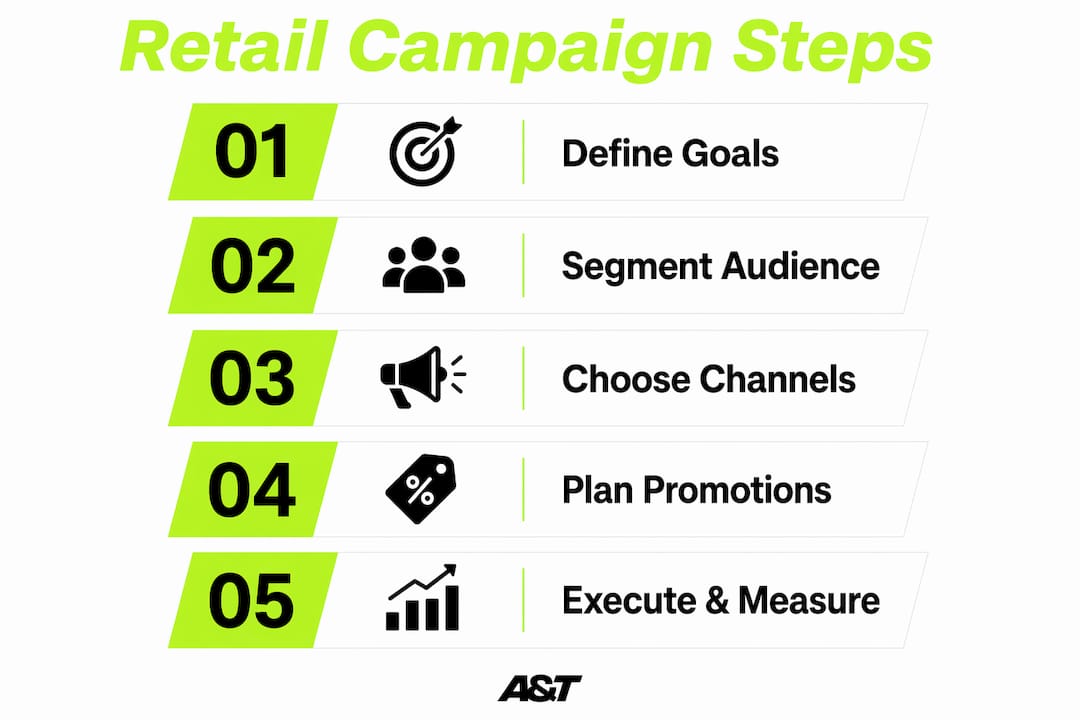
Retail campaign planning is the strategic process of defining objectives, segmenting audiences, allocating resources, and measuring outcomes to drive both digital growth and in-store engagement. Known in the industry as integrated retail marketing strategy, this process separates brands that grow predictably from those that react to every slow quarter. The 7-step retail planning process covers market analysis, demand forecasting, goal setting, resource allocation, marketing execution, and continuous monitoring. Get this structure right, and every promotional dollar you spend has a clear job to do.
What are the essential components of a retail campaign planning process?
A complete campaign plan requires clear objectives tied to business outcomes, audience segmentation, messaging development, channel integration, and ongoing optimization. Without these components working together, individual tactics become disconnected activities that consume budget without moving revenue. Tools like monday.com for project orchestration, Shopify for ecommerce data, and SafetyCulture for operational checklists each play a role in keeping teams aligned across the full planning cycle.
Here is what every retail campaign plan must include:
SMART goals tied to KPIs. Every campaign needs a primary metric, whether that is revenue per store, cost per acquisition, or repeat purchase rate. Vague goals like "increase awareness" give teams nothing to optimize against.
Audience segmentation and persona development. Divide your customer base by purchase frequency, average order value, and channel preference. A loyalty customer and a first-time visitor need different messages, different offers, and different landing experiences.
Messaging and creative consistency. Your Google Ads headline, Meta creative, email subject line, and in-store signage should all feel like they came from the same campaign. Inconsistency breaks trust and dilutes recall.
Channel selection and integration. Choose channels based on where your specific audience actually converts, not where your competitors appear to be active. Then connect those channels so a customer who clicks a Meta ad and visits your store is counted as one journey, not two separate events.
Budget and workforce allocation. Assign a dollar amount and a named owner to each channel and each campaign phase. Unassigned budget gets spent reactively.
Pro Tip: Before finalizing your channel mix, pull 90 days of first-party data from your POS system or ecommerce platform. The channels driving repeat purchases, not just first clicks, deserve a larger share of your budget.
How can customer journey mapping enhance retail campaign effectiveness?

Customer journey mapping is the practice of documenting every touchpoint a shopper encounters from first awareness through post-purchase, then using that map to decide where and how to invest campaign resources. Connecting online and in-store touchpoints using first-party data and qualitative feedback is what separates a useful map from a decorative diagram. Shopify's research confirms that journey maps must be revisited regularly as customer expectations and channels evolve. A map built in 2023 will misrepresent how your customers behave today.
The most useful data sources for building a retail journey map include:
POS transaction data to identify what customers buy, when, and how often
Ecommerce analytics from platforms like Shopify or WooCommerce to track browse-to-purchase paths
Loyalty program records to segment by engagement tier and purchase recency
Customer service logs and reviews to surface friction points that kill conversions
In-store observation and exit surveys to capture qualitative moments that data alone misses
Journey Stage | Data Source | Campaign Application |
|---|---|---|
Awareness | Paid social impressions, branded search volume | Allocate budget to channels with highest reach-to-visit ratio |
Consideration | Product page views, wishlist adds, email opens | Retarget with specific product ads and comparison content |
Purchase | POS and ecommerce conversion data | Optimize checkout flow and in-store associate training |
Retention | Loyalty program activity, repeat purchase rate | Trigger post-purchase email sequences and loyalty offers |
Pro Tip: Run a quarterly "friction audit" by combining your top 10 customer service complaints with your highest cart abandonment pages. The overlap reveals exactly where your campaign messaging is creating false expectations.
What is the role of a promotional calendar in retail campaign planning?
A promotional calendar is the operational backbone of any retail advertising guide. Planning 3 to 12 months ahead with one core monthly campaign theme plus three to five supporting touchpoints creates a repeatable, rhythm-driven marketing system. This approach prevents the reactive discounting trap, where retailers slash prices in slow weeks because they have no planned offer ready to deploy.
Structure your promotional calendar around five campaign types:
Traffic campaigns. Designed to pull new customers into the store or site. These run best in the weeks before a major seasonal event, not during it, when competition for attention peaks.
Seasonal campaigns. Tied to cultural moments like back-to-school, holiday, or summer. Build creative assets at least eight weeks in advance so you are not rushing production in peak season.
Loyalty campaigns. Reward your best customers with early access, exclusive pricing, or member-only events. These protect your highest-margin revenue from competitor discounts.
Reactivation campaigns. Target customers who have not purchased in 60 to 180 days. A well-timed offer to a lapsed customer costs far less than acquiring a new one.
Community campaigns. Local events, partnerships, and cause-related promotions that build brand affinity beyond transactional relationships.
Calendar Approach | Strength | Risk |
|---|---|---|
Reactive (no calendar) | Flexible to market changes | Inconsistent spend, missed seasonal windows |
Annual calendar, fixed | Strong alignment and lead time | Slow to adapt to unexpected opportunities |
Rolling 90-day calendar | Balances planning with agility | Requires monthly review discipline |
Pro Tip: Color-code your promotional calendar by campaign type. When you look at a full quarter and see nothing but traffic and seasonal campaigns, you know your loyalty and reactivation programs are being neglected.
How to execute and measure retail campaigns for optimal ROI?
Execution quality determines whether a well-planned campaign actually delivers results. Pre-launch checklists that verify KPI alignment, finalized timelines, UTM parameters, and tested email templates directly improve conversion rates. Small oversights, like a broken landing page URL or an untested mobile email template, compound into measurable revenue loss on launch day. This is not a detail-oriented preference. It is a financial discipline.
The non-negotiables before any campaign goes live:
Confirm all UTM parameters are applied consistently across every paid channel
Test every email template on mobile and desktop before scheduling
Verify landing pages load correctly and match the ad creative's offer
Assign a minute-by-minute launch schedule with named owners for each task
Confirm your analytics platform is recording conversions from all traffic sources
Beyond launch mechanics, measurement infrastructure must be built before the campaign runs, not after. A capture layer that includes branded search coverage, dedicated landing pages, store locators, and call tracking connects your media spend to actual sales impact. Without it, you are guessing which channels drove results.
Measurement Layer | What It Tracks | Tool Examples |
|---|---|---|
Digital attribution | Clicks, conversions, ROAS by channel | Google Analytics 4, Meta Ads Manager |
Offline capture | Store visits, calls, in-store purchases | CallRail, Google Store Visits, POS integration |
Omnichannel attribution | Full customer journey across online and offline | Epsilon, multi-touch attribution models |
Multi-touch attribution modelsreconstruct the full omnichannel customer journey, including offline conversions, to give you an accurate picture of marketing impact. Platforms like Epsilon have builtin-store attributiontools that link digital retail media exposure directly to point-of-sale transactions. This level of measurement is no longer reserved for enterprise retailers. It is accessible to any brand willing to set it up before launch day.
For practical examples of how retail brands have built these capture layers and driven measurable results, the retail ad campaigns driving results in 2026 case studies from A&T Digital show exactly how this works across different verticals.
Pro Tip: Assign one primary KPI to each campaign before launch. Teams that track 12 metrics simultaneously optimize for none of them. Revenue per campaign, cost per acquisition, or return on ad spend. Pick one, then report the others as context.
Key takeaways
Effective retail campaign planning requires structured objectives, journey-mapped audiences, a forward-looking promotional calendar, and measurement infrastructure built before launch, not after.
Point | Details |
|---|---|
Plan before you promote | A 7-step planning process covering goals, audience, channels, and measurement prevents reactive spending. |
Map the full customer journey | Connect POS, ecommerce, and loyalty data to identify where campaigns should focus and where friction exists. |
Use a promotional calendar | Structure 3 to 12 months of campaigns around five types: traffic, seasonal, loyalty, reactivation, and community. |
Build measurement before launch | UTM parameters, landing pages, and capture layers must be verified before any campaign goes live. |
Attribute online and offline results | Multi-touch attribution models and tools like Epsilon connect digital media spend to in-store sales outcomes. |
Why most retail campaigns fail before they launch
I have worked with retail marketers across health and wellness, entertainment, and ecommerce, and the pattern is almost always the same. The strategy is solid. The creative is good. The campaign fails anyway because the measurement infrastructure was an afterthought.
The uncomfortable truth is that most retail campaign failures are pre-launch failures. A team spends six weeks building creative assets and two days setting up tracking. Then they wonder why they cannot prove ROI to leadership. Planning should be iterative, with ongoing monitoring built into the process from day one, not bolted on after the campaign runs.
The second pattern I see consistently is fragmentation without alignment. A brand runs Google Ads, Meta campaigns, email, and in-store promotions simultaneously, but each channel has a different offer, a different message, and a different team managing it. Customers experience this as noise. The fix is not more budget. It is a single campaign brief that every channel executes from.
AI-powered omnichannel campaign orchestration is changing how fast teams can adapt. Translating briefs into channel-level tactics, localizing by store cluster, and updating plans daily based on performance signals used to require a large team. Tools now handle much of this automatically, but only if your measurement layer is clean enough to feed them accurate signals. Garbage in, garbage out still applies.
The brands I have seen grow consistently treat their promotional calendar as a living document, reviewed monthly, adjusted quarterly, and owned by a single person with cross-functional authority. Clear ownership is the variable most planning frameworks leave out. Without it, even the best retail marketing strategy stalls at execution.
— Ann
Ready to plan retail campaigns that actually convert?
At A&T Digital, we build and manage paid advertising systems for retail brands that need measurable results, not just impressions. Our team handles everything from strategic campaign planning and audience segmentation to Google Ads and Meta campaign execution, tracking setup, and ongoing optimization. We work with retail clients across health and wellness, ecommerce, and entertainment venues, and we bring the same measurement discipline to every campaign we run. If you are ready to move from reactive promotions to a structured, ROI-driven system, our performance marketing team is ready to build it with you.
FAQ
What is a retail campaign planning guide?
A retail campaign planning guide is a structured framework covering objective setting, audience analysis, channel selection, promotional scheduling, and measurement setup. It gives retail marketers a repeatable process for executing campaigns that connect to business outcomes rather than running in isolation.
How far in advance should retail campaigns be planned?
Planning 3 to 12 months ahead is the standard practice for retail promotions planning, with seasonal campaigns requiring creative assets at least eight weeks before launch. This lead time prevents reactive discounting and allows for proper tracking and measurement setup before any campaign goes live.
What metrics should I track in a retail campaign?
Assign one primary KPI per campaign, such as return on ad spend, cost per acquisition, or revenue per store, then track supporting metrics like store visits, call volume, and email conversion rate as context. Multi-touch attribution models that include offline conversions give the most accurate picture of true campaign impact.
How do I connect digital campaigns to in store sales?
Build a capture layer that includes branded search coverage, dedicated landing pages, store locators, and call tracking before the campaign launches. Platforms like Epsilon link digital retail media exposure directly to point-of-sale transactions, making omnichannel attribution measurable rather than estimated.
What is the biggest mistake in retail campaign execution?
The most common mistake is treating measurement as an afterthought rather than a pre-launch requirement. Missing UTM parameters, untested landing pages, and unverified analytics connections mean that even a well-executed campaign produces data you cannot trust or act on.