What is digital campaign planning? A clear 2026 guide
Posted on
Marketing
Posted at

Many business owners believe digital campaign planning is just launching ads and hoping they work. This mindset leads to wasted budgets and poor results. True campaign planning aligns your brand identity, SMART goals, and execution strategy into a roadmap for success. Without this foundation, you're essentially gambling with your ad spend. This guide reveals how to structure your digital campaigns from initial strategy through execution to maximize ROI and eliminate guesswork.
Table of Contents
Key takeaways
Point | Details |
|---|---|
Unified brand messaging | Consistent identity across channels boosts ROI by 340% and reduces acquisition costs by 58%. |
SMART goals drive success | Specific, measurable objectives provide clear direction and increase campaign performance. |
Strategy and execution alignment | Disconnected planning wastes resources and creates missed opportunities. |
AI technology multiplies ROI | AI-powered optimization can double campaign returns for small businesses. |
Planning prevents wasted spend | Addressing structural weaknesses before launching saves money and improves results. |
Understanding digital campaign planning
Digital campaign planning combines strategic thinking with tactical execution for your online advertising efforts. It's not simply setting up ads and pressing launch. You're building a comprehensive roadmap that defines your brand identity, messaging, target audience, goals, and channel selection before spending a dollar.
The core elements work together as a system. Brand identity establishes who you are. Messaging communicates your value. Target audience analysis identifies who needs your solution. SMART goals provide measurable benchmarks. Channel selection determines where to reach your audience most effectively.
A proper digital marketing strategyaddresses structural weaknesses first before optimizing creative or bidding logic. This prevents the common mistake of fixing symptoms while ignoring root problems. You might spend thousands improving ad copy when your fundamental positioning needs work.
Planning differs from simply launching ads in several critical ways:
Strategic planning identifies your competitive advantage before creating campaigns
Audience research reveals customer pain points that drive messaging
Goal setting establishes clear success metrics instead of vague aspirations
Channel strategy allocates budget based on data rather than guesswork
Timeline development creates realistic milestones for testing and optimization
The benefits compound quickly. Improved ROI comes from targeting the right people with the right message. Lower costs result from avoiding ineffective channels and creative approaches. Clearer direction keeps your team focused on what matters. When you need tactical guidance, resources like step by step ad campaign setup provide actionable frameworks.

Without planning, you risk burning budget on campaigns that never had a chance to succeed. The foundation determines everything that follows.
The importance of unified brand identity and messaging
Disconnected digital assets destroy campaign performance faster than almost any other mistake. A tech company discovered this truth when analyzing their struggling campaigns. Before unifying their brand, they faced brutal numbers: 0.8% conversion rate, 73% bounce rate, and only 12% brand recall among their target audience.
These metrics reflect what happens when your Google Ads promise one thing, your landing page says another, and your social media presents a third identity. Potential customers get confused and leave. They can't remember you because there's nothing consistent to remember.
Unified messaging and visual branding across channels creates recognition that multiplies your effectiveness. Your audience sees the same colors, tone, and value proposition whether they encounter you on Facebook, Google, or your website. This consistency builds trust exponentially faster than fragmented approaches.
Moving beyond vague claims requires focusing on core differentiators and specific outcomes. Instead of "quality service," you promise "24-hour response times with dedicated account managers." Instead of "better results," you deliver "average 3.2x ROAS in first 90 days." Specificity separates you from competitors making empty promises.
The transformation speaks for itself:
Metric | Before Unification | After Unification | Change |
|---|---|---|---|
Conversion Rate | 0.8% | 2.7% | +238% |
Qualified Leads | Baseline | +340% | 340% increase |
Acquisition Cost | Baseline | -58% | 58% reduction |
Bounce Rate | 73% | 41% | -44% |
Pro Tip: Create a simple brand guide with your core message, visual standards, and tone of voice. Share it with everyone touching your campaigns. Consistency compounds your ad spend effectiveness by making every impression reinforce the last.
This foundation makes every subsequent optimization more powerful. When you test ad variations, you're improving a coherent system rather than random elements. Understanding SMART objectives importance and aligning strategy with execution becomes significantly easier with unified brand identity.
Setting SMART goals for your digital campaigns
Vague goals like "boost brand awareness" or "get more customers" fail your team before campaigns even launch. They provide no clear direction, no measurable benchmarks, and no way to know if you're succeeding. Your team can't align around fuzzy objectives.
SMART goals solve this problem by forcing clarity. The framework stands for Specific, Measurable, Achievable, Relevant, and Time-bound. Each element serves a purpose in creating objectives that actually guide decision making.
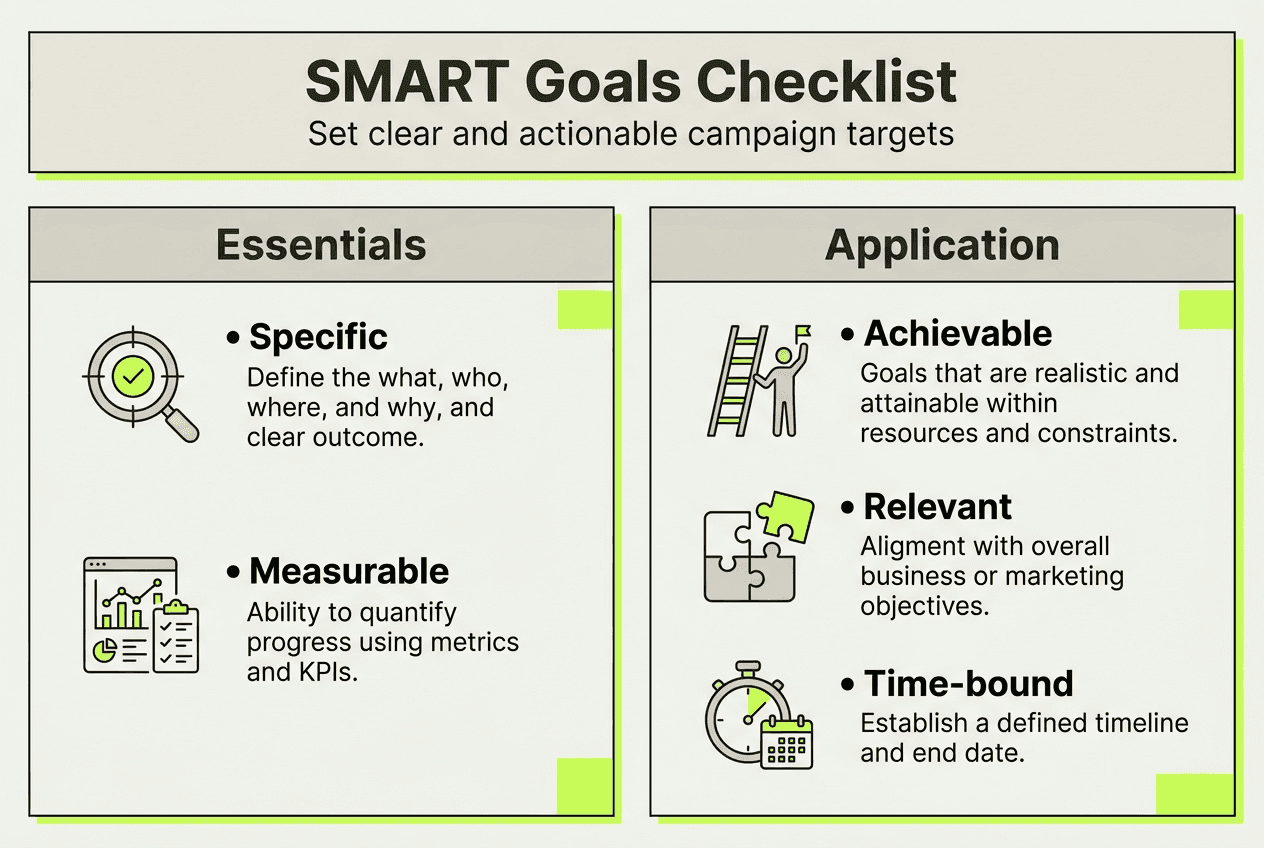
Specific goals identify exactly what you want to accomplish. "Increase qualified leads" becomes "generate 50 sales-qualified leads from decision makers at companies with 20 to 200 employees." The precision eliminates ambiguity.
Measurable objectives include concrete numbers you can track. "Improve conversion rate" transforms into "achieve 3.5% landing page conversion rate." You know immediately whether you hit the target.
Achievable targets push your capabilities without being impossible. Setting a goal to increase website traffic by 20% in Q1 based on historical data makes sense. Aiming for 500% growth in the same period sets you up for failure and demoralization.
Relevant goals connect directly to business objectives that matter. More social media followers might boost vanity metrics, but generating qualified leads drives revenue. Focus on what moves your business forward.
Time-bound deadlines create urgency and enable evaluation. "Within 90 days" or "by end of Q2 2026" gives you a finish line to assess performance and adjust.
Here's your process for creating effective SMART goals:
Start with your business objective and work backward to campaign requirements
Quantify the specific metric you'll track (leads, revenue, conversion rate, ROAS)
Review historical performance to set realistic but challenging targets
Assign clear ownership so someone is accountable for results
Establish checkpoints at 30, 60, and 90 days to monitor progress
Without clear, measurable goals, your team cannot coordinate efforts effectively or allocate resources efficiently. SMART objectives transform vague aspirations into actionable targets that everyone understands.
This clarity becomes essential when moving from planning to execution. Resources like SMART objectives importance provide deeper frameworks for implementation.
From strategy to execution: aligning your plan for success
The gap between a brilliant strategy document and actual campaign results destroys more marketing initiatives than poor tactics ever could. Your plan might be perfect on paper, but failure to execute causes wasted resources and missed opportunities.
Misalignment creates predictable problems. Your creative team builds ads based on outdated positioning. Your media buyer targets the wrong audience because they never saw the customer research. Your landing page designer creates experiences disconnected from ad messaging. Each person works hard but in different directions.
Ensuring your team understands roles, timelines, and actions requires systematic communication. Start by walking everyone through the complete plan before execution begins. Explain the why behind decisions so people can make smart choices when situations change.
Key alignment actions include:
Schedule kickoff meetings where every team member presents their understanding of objectives and responsibilities
Create shared documentation accessible to all stakeholders with campaign details, timelines, and success metrics
Establish weekly check-ins during launch phase to identify disconnects early
Build feedback loops where execution insights inform strategy adjustments
Assign a single point person who owns campaign coordination across all functions
Set clear approval processes so everyone knows decision authority
Pro Tip: Treat your plan as a living document that evolves based on real world results. The best strategy adapts when execution reveals new insights. Schedule formal plan reviews every 30 days to incorporate learnings.
Solid alignment transforms strategy into tangible outcomes. When everyone understands the plan and their role, execution becomes smooth and coordinated. Your creative reinforces positioning. Your targeting reaches the right people. Your landing pages convert traffic efficiently. Everything works together.
This coordination becomes especially important when working with specialists. Teams offering performance marketing services excel at alignment because they own the complete process from strategy through execution.
Leveraging AI and technology for better campaign outcomes
AI tools have moved from experimental to essential for digital campaign optimization. The technology handles complex tasks that would take humans hours while making decisions based on patterns across millions of data points.
A local bakery demonstrated AI's practical impact when they implemented AI-powered ad management. Their previous campaigns relied on manual bidding and basic demographic targeting. Results were mediocre and required constant attention. After adopting AI tools for targeting, bidding optimization, and creative testing, they achieved a 200% ROI increase while reducing management time by 60%.
The transformation came from AI's ability to optimize in real time:
Metric | Before AI | After AI | Improvement |
|---|---|---|---|
ROI | 100% (baseline) | 300% | +200% |
Cost Per Acquisition | $45 | $28 | -38% |
Conversion Rate | 1.8% | 3.4% | +89% |
Management Hours/Week | 15 | 6 | -60% |
Practical AI-powered tactics work for businesses of any size:
Use predictive analytics to identify high-value customer segments before spending budget on broad targeting
Implement automated bidding strategies that adjust in real time based on conversion likelihood
Deploy dynamic creative optimization that tests hundreds of ad variations simultaneously
Leverage lookalike modeling to find new audiences similar to your best customers
Apply sentiment analysis to ad comments and feedback for messaging refinement
Utilize chatbots for immediate lead qualification and customer service
You don't need to adopt everything at once. Start with one AI tool that addresses your biggest bottleneck. Master it, measure results, then expand. Google and Meta platforms offer built-in AI features that require no additional software.
The key is combining AI efficiency with human strategy. AI optimizes execution brilliantly but still needs your insight on positioning, messaging, and brand identity. You provide direction, AI handles optimization at scale. Understanding frameworks like digital ad campaign guides and why personalization matters helps you direct AI tools effectively.
Boost your digital campaign results with expert help
You now understand the core components of effective digital campaign planning. Implementing these strategies requires both expertise and time that many business owners simply don't have. That's where professional support makes the difference between mediocre and exceptional results.
Specialized teams handle the complete planning and execution process while you focus on running your business. They bring experience across industries, access to advanced tools, and proven frameworks that maximize every dollar of ad spend. Whether you need Google Ads management, Meta Ads management, or comprehensive marketing strategy services, expert help accelerates your results and eliminates costly mistakes. The right partner transforms your digital campaigns from expense into growth engine.
Frequently asked questions
What is digital campaign planning?
Digital campaign planning is the strategic process of defining your brand identity, goals, target audience, messaging, and channel selection before launching online advertising. It creates a roadmap that aligns all campaign elements to maximize ROI and prevent wasted ad spend.
How much time should small businesses allocate for planning?
Small businesses should invest 2 to 4 weeks in comprehensive campaign planning before launch. This includes 1 week for goal setting and audience research, 1 to 2 weeks for strategy development and messaging, and 1 week for execution planning and team alignment. Rushing this process typically costs more in wasted ad spend than the time saved.
How do AI tools integrate with campaign planning?
AI tools enhance campaign planning by analyzing customer data to identify high-value segments, predicting campaign performance before launch, and optimizing targeting and bidding in real time. You still create the strategic foundation (positioning, messaging, goals), while AI handles execution optimization at scale to improve results.
How can I measure digital campaign success?
Measure success by tracking metrics tied directly to your SMART goals: conversion rate, cost per acquisition, return on ad spend, qualified leads generated, and revenue attributed to campaigns. Set up conversion tracking in your ad platforms, use UTM parameters to track traffic sources, and review performance against benchmarks every 30 days to identify what's working.
What are common pitfalls to avoid in campaign planning?
Avoid these critical mistakes: launching campaigns without unified brand messaging across channels, setting vague goals that provide no clear direction, failing to align strategy with execution team understanding, neglecting audience research before creating messaging, and treating your plan as fixed rather than adapting based on performance data. Each pitfall wastes budget and limits results.


