Strategic campaign planning for performance marketing ROI
Posted on
Marketing
Posted at

Strategic campaign planning focuses on running the right ads to achieve measurable ROI.
Market analysis tools like SWOT, buyer personas, and customer journeys are essential before campaign execution.
Ongoing measurement, optimization, and strategic discipline drive predictable growth beyond tactical hustle.
Most small and medium-sized businesses treat marketing like a sprint. They launch campaigns, chase clicks, and measure likes instead of revenue. The result? Wasted budget and unpredictable growth. Structured campaign planning is essential for achieving measurable ROI and business outcomes. This guide walks you through the exact stages, frameworks, and tools that turn scattered marketing activity into a predictable growth engine. Whether you run Google Ads, Meta campaigns, or a mix of channels, strategic planning is what separates brands that scale from brands that stall.
Table of Contents
Building winning strategies: Channel selection, budgeting, and execution
A fresh perspective: Why strategic planning beats tactical hustle
Ready to implement strategic campaign planning? Unlock expert help
Key Takeaways
Point | Details |
|---|---|
Strategy drives ROI | Structured campaign planning ensures that every marketing dollar delivers measurable outcomes. |
Frameworks matter | Using data-driven frameworks like SWOT and customer journey mapping sets your campaigns up for success. |
Channel and budget optimization | Prioritize high-ROI channels and allocate budgets using a proven split for growth and experiments. |
Measure and improve | Continuous tracking and optimization are critical for maximizing returns and scaling your marketing efforts. |
Defining strategic campaign planning: From vision to ROI
Strategic campaign planning is not about running more ads. It is about running the right ads with the right message, to the right audience, at the right time. For SMBs and e-commerce brands, this distinction is everything.
At its core, strategic campaign planning is a five-stage process: situation analysis, objective setting, strategy development, tactical execution, and measurement and optimization. Each stage builds on the last. Skip one and the whole structure weakens.
Here is how the hierarchy works:
Vision sets the direction for your brand and business
Objectives define what success looks like in measurable terms
Initiatives are the major programs designed to hit those objectives
Tactics are the specific actions, ads, content, and channels you deploy
Many SMBs jump straight to tactics. They build an ad, set a budget, and hope for results. That is activity, not strategy. As strategy sits above tactics in the campaign hierarchy, your objectives and vision must come first. Tactics without strategy are just noise.
SMART goals (Specific, Measurable, Achievable, Relevant, Time-bound) are the bridge between vision and execution. Instead of "grow sales," a SMART goal looks like: "Increase e-commerce revenue by 20% in Q3 2026 through paid search and email retargeting." That goal gives your team direction, your budget a purpose, and your reporting a clear benchmark.
Predictive ROI frameworks take this further. Before you spend a dollar, you model expected returns based on historical data, channel benchmarks, and customer lifetime value. This is how you move from guessing to planning. For strategic planning for marketing ROI, the payoff is significant: brands that plan strategically consistently outperform those that react.
"Confusing activity with progress is the most common mistake we see. Strategy is not a buzzword. It is the roadmap that keeps every dollar working toward a real outcome."
Pro Tip: Before launching any campaign, write down your top three business objectives for the quarter. Every tactic you consider should map directly to one of them. If it does not, cut it.
Analyzing your market: Tools and frameworks for SMBs
You cannot plan a winning campaign without knowing your market, your customers, and your competitive position. This is where analysis pays off.

SWOT analysis, buyer personas, and customer journey mapping are the foundational methodologies every SMB should use before allocating a single dollar. SWOT (Strengths, Weaknesses, Opportunities, Threats) gives you an honest picture of where you stand. Buyer personas define exactly who you are targeting. Journey mapping shows how customers move from awareness to purchase.
Here is a comparison of foundational versus advanced analysis methods:
Method | Foundational | Advanced |
|---|---|---|
Market analysis | SWOT, competitor research | Predictive modeling, share of voice |
Audience insight | Buyer personas | Behavioral segmentation, lookalike audiences |
Customer journey | Basic funnel mapping | Full-funnel attribution, touchpoint analysis |
Performance data | Channel-level ROAS | Incrementality testing, predictive CLTV |
E-commerce benchmarkssupport the need for full-funnel attribution and a retention focus. Typical benchmarks to track include:
ROAS (Return on Ad Spend): 2.5 to 4:1 for paid channels
Email ROI: $36 to $42 per dollar spent
SEO ROI: Up to 3.8x return at 18 months
LTV:CAC ratio: Aim for 3:1 or higher for sustainable growth
CAC (Customer Acquisition Cost): Varies by vertical, but always benchmark against LTV
Channel selection flows directly from this analysis. Once you know who your customer is and where they spend time, you can prioritize channels that match both your audience and your budget. Do not spread thin across every platform. Focus on two or three channels where your audience is most active and where your data shows the strongest returns.
For analytics in SMB campaign planning, the goal is to build a clear picture before you act, not after. And for data-driven advertising for SMBs, this analysis stage is what separates brands that grow predictably from those that burn budget chasing trends.
Pro Tip: Prioritize retention and lifetime value over short-term acquisition. Acquiring a new customer costs five times more than retaining one. Build your analysis around LTV:CAC, not just conversion rate.
Building winning strategies: Channel selection, budgeting, and execution
Once your market analysis is complete, it is time to turn insights into a concrete plan. This means choosing your channels, setting your budget, and mapping out your execution approach.
Channel priorities for most SMBs and e-commerce brands follow a clear order:
Paid search (Google Ads): High intent, measurable, scalable
Email and SMS: Highest owned-channel ROI, direct audience access
Paid social (Meta Ads): Broad reach, strong for awareness and retargeting
SEO: Slower to build but delivers compounding returns over time
New channel testing: Allocate a small portion for emerging platforms
For budget allocation, a proven methodology is the 60/25/15 split: 60% to proven channels, 25% to experiments, and 15% to exploration of new opportunities. Owned channels like email and SEO consistently outperform paid channels on a cost-per-return basis. This split lets you protect core revenue while still testing what is next.
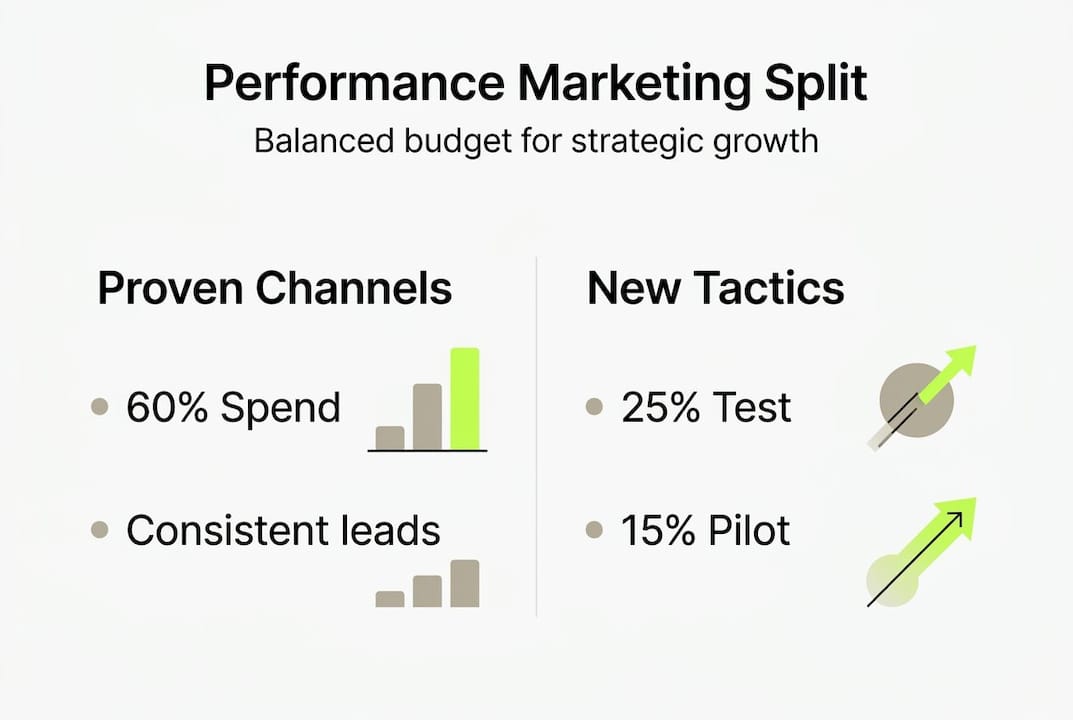
Budget category | Allocation | Purpose |
|---|---|---|
Proven channels | 60% | Drive consistent revenue and leads |
Experiments | 25% | Test new creatives, audiences, offers |
Exploration | 15% | New platforms, formats, partnerships |
Execution tactics fall into three categories. Always-on campaigns keep your brand visible and your funnel active year-round. Seasonal or promotional campaigns capture demand spikes. New channel tests let you gather data without overcommitting budget.
For proven performance marketing tactics, the execution layer is where strategy becomes revenue. But execution without a clear plan leads to fragmented spend and inconsistent results. Understanding performance marketing terminology like CPL, ROAS, and LTV:CAC ensures your team speaks the same language when reviewing results.
Pro Tip: Email and SEO deliver the highest ROI for growing brands. If you are not investing in both, you are leaving compounding returns on the table. Start with a basic email nurture sequence and a content calendar before scaling paid spend.
Measurement and optimization: Making campaign results count
Campaigns without measurement are just expenses. Measurement without action is just data. The goal is a feedback loop that continuously improves performance.
Start with clear KPIs (Key Performance Indicators) tied directly to your business objectives. If your goal is revenue growth, your primary KPI is ROAS. If your goal is customer acquisition, track CAC and LTV:CAC. If you want brand growth, measure reach, share of voice, and new customer rate.
Key tools and processes for effective measurement include:
Closed-loop attribution: Connects every touchpoint to a final conversion, showing exactly which channels and ads drove revenue
Incrementality testing: Measures the true lift from a campaign by comparing exposed versus unexposed audiences
Predictive CLTV (Customer Lifetime Value): Forecasts future revenue from current customers, helping you prioritize retention spend
Channel-level ROAS tracking: Breaks down performance by platform so you can reallocate budget with confidence
Typical ROAS benchmarks sit between 2.5 and 4:1 for paid channels, with email delivering $36 ROI per dollar and SEO reaching up to 3.8x returns at 18 months. These benchmarks give you a baseline. If your campaigns fall below them, you know exactly where to investigate.
Statistic callout: Email marketing achieves up to $42 ROI for every $1 spent, making it one of the highest-returning channels available to SMBs.
Closed-loop attribution and full-funnel measurement are not optional extras. They are the foundation of sustainable growth. Without them, you are making budget decisions based on incomplete information.
For measuring campaign results for ROI, the process should be weekly at minimum. Review performance, identify what is working, cut what is not, and double down on winners. For measurable marketing for SMBs, this discipline is what separates brands that scale from those that plateau.
Continuous optimization is not a one-time event. It is a system. Build it into your campaign calendar from day one.
A fresh perspective: Why strategic planning beats tactical hustle
Here is the uncomfortable truth: most SMBs are addicted to tactical hustle. New campaign. New creative. New offer. Repeat. It feels productive. It rarely is.
Tactical hustle creates diminishing returns. Each new campaign without a strategic foundation pulls budget in a different direction. You end up with data that does not connect, audiences that overlap, and results that cannot be replicated.
We have seen brands spend six figures on paid ads with no clear attribution model and no retention strategy. They grow fast, then plateau, then wonder why. The answer is always the same: tactics without strategy.
AI and automation are rising, but human oversight and strategic decision-making remain essential. Automation can optimize bids. It cannot set your brand vision. It can personalize emails. It cannot decide which customer segment is worth acquiring at a loss today for a higher LTV tomorrow. That requires judgment.
In marketing, like in chess, those who calculate their moves ahead win. Strategy is not a quarterly document you file and forget. It is the live framework that guides every budget decision, every creative brief, and every channel test. For performance marketing ROI insights, the brands that win long-term are the ones that plan deliberately and execute with discipline.
Stop chasing tactics. Build the system.
Ready to implement strategic campaign planning? Unlock expert help
If this guide has shown you anything, it is that strategic campaign planning is not a one-time task. It is an ongoing system that requires the right frameworks, the right data, and the right team. At A&T Digital Agency, we build and manage exactly that. Our Google Ads management team and Meta Ads management team combine strategic planning with data-driven execution to deliver measurable results for SMBs and e-commerce brands. Whether you need full campaign strategy or hands-on channel management, our digital marketing experts are ready to help you turn planning into predictable growth.
Frequently asked questions
What is the difference between strategic campaign planning and tactical marketing?
Strategic campaign planning sets the vision, objectives, and frameworks that guide all marketing activity, while tactical marketing focuses on the day-to-day execution of specific actions like running an ad or sending an email.
How can SMBs measure the ROI of their campaign planning?
SMBs can measure ROI by tracking KPIs like ROAS, LTV:CAC, and conversion rates, and by using closed-loop attribution to connect every dollar spent to a measurable business outcome.
What are the best channels for performance marketing according to recent benchmarks?
Email and SEO offer the highest ROI for SMBs, with email averaging $36 to $42 for every dollar spent and SEO delivering up to 3.8x returns after 18 months of consistent investment.
How important is human oversight versus AI in campaign planning?
AI and automation are valuable for scaling and optimizing campaigns, but human oversight and strategic thinking remain essential for making the judgment calls that drive sustainable, long-term growth.


