Performance Marketing Terminology: Driving ROI Impact
Posted on
Marketing
Posted at

Mastering the complex vocabulary of performance marketing can feel like a barrier between your e-commerce brand and real ROI growth. Choosing the right strategy starts with a clear understanding of foundational terms that shape every campaign decision. With platforms like Google Ads and Meta presenting unique terminology, a strong grasp of essential marketing performance metrics is the difference between guessing and executing with confidence. This overview helps demystify the language behind performance marketing so you can connect your ad spend to measurable business outcomes.
Table of Contents
Key Takeaways
Point | Details |
Performance Marketing Focuses on Measurable Results | Marketers pay only for specific outcomes like clicks and conversions, allowing for precise investment optimization. |
Understanding Key Metrics is Essential | Metrics such as Conversion Rate and Return on Ad Spend (ROAS) enable marketers to effectively assess campaign performance and ROI. |
Strategic Terminology Guides Campaign Planning | Terms related to performance marketing help define objectives, allocate budget, and enhance audience targeting for improved outcomes. |
Avoid Common Misconceptions for Success | Businesses should not focus solely on short-term results, but instead integrate both immediate and long-term metrics into their strategies. |
Defining Performance Marketing Terms and Concepts
Performance marketing represents a data-driven approach to digital advertising where marketers pay only for specific, measurable results. Unlike traditional advertising models that charge for impressions or exposure, performance marketing focuses on concrete outcomes like clicks, conversions, or sales. This strategic framework enables businesses to track, analyze, and optimize their marketing investments with unprecedented precision.
Key performance marketing concepts include:
Conversion Tracking: Monitoring specific user actions that represent business value
Cost Per Acquisition (CPA): The total cost of acquiring a single customer through marketing efforts
Return on Ad Spend (ROAS): Calculating the revenue generated for every dollar spent on advertising
Attribution Modeling: Determining which marketing channels contribute most effectively to conversions
Understanding these essential marketing performance metrics helps marketers connect advertising activities directly to business outcomes. Performance marketing transforms advertising from a cost center into a strategic growth engine by emphasizing measurable results and continuous optimization.
Pro tip: Always establish clear, trackable goals before launching any performance marketing campaign to ensure you can accurately measure and improve your results.
Types of Terms for Google Ads and Meta
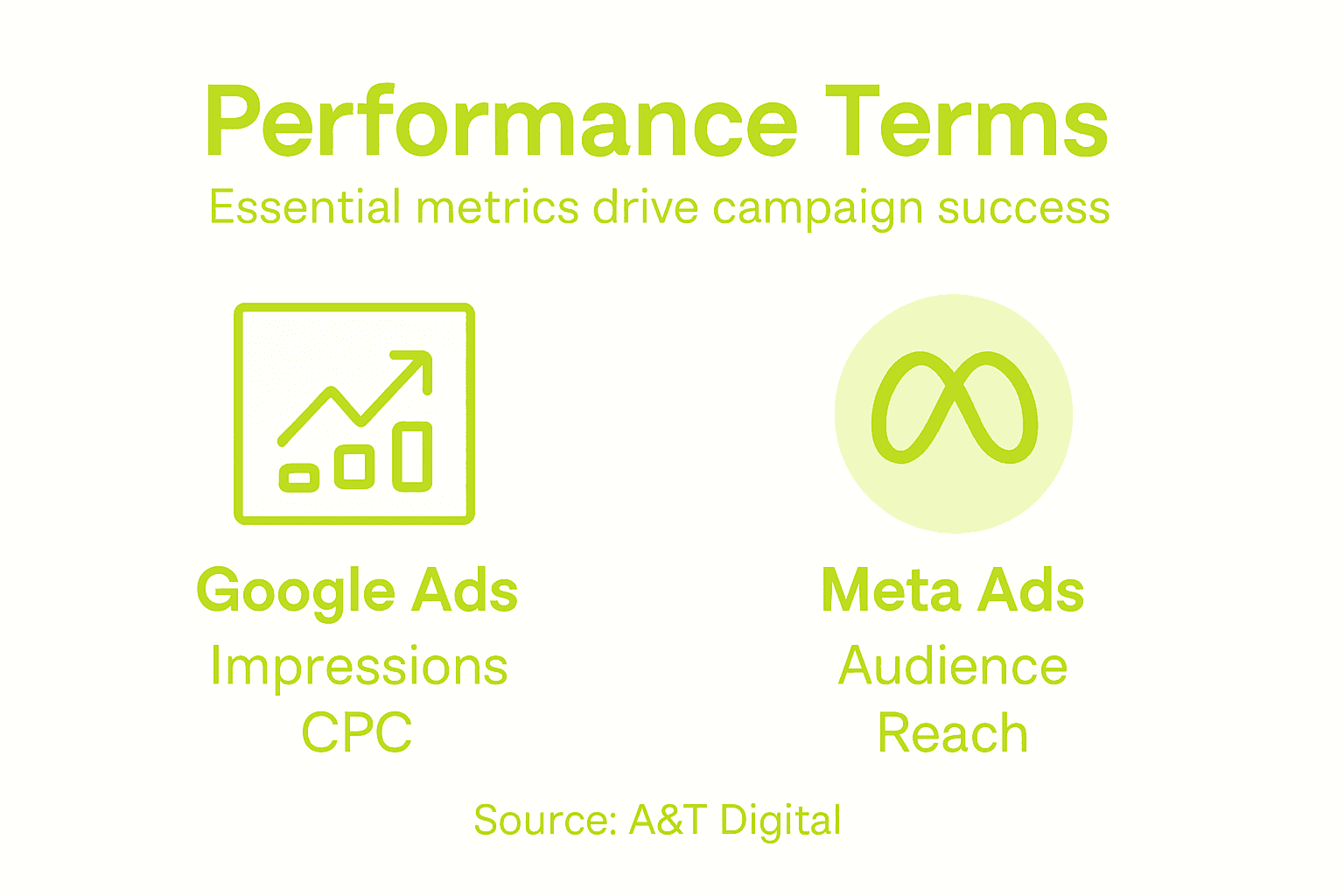
Performance marketing relies on specialized terminology specific to digital advertising platforms like Google Ads and Meta (Facebook) Ads. Understanding digital marketing vocabulary allows marketers to effectively navigate and optimize their advertising strategies across these complex platforms.
Key terminology for Google Ads includes:
Cost Per Click (CPC): Amount paid when a user clicks an advertisement
Quality Score: Google’s rating of ad relevance and expected click-through rate
Bid Strategy: Approach for managing how much you’ll pay for ad placements
Conversion Rate: Percentage of users completing a desired action after clicking an ad
Ad Rank: Determines your ad’s position in search results based on bid amount and quality
Meta Ads platform introduces additional unique concepts such as Audience Targeting, which allows advertisers to reach specific demographic groups based on interests, behaviors, and detailed characteristics. Google Ads platform mechanics demonstrate how these digital advertising systems create complex ecosystems for precise marketing targeting.
Here’s a quick reference comparing how Google Ads and Meta Ads approach core performance marketing functions:
Function | Google Ads Approach | Meta Ads Approach | Business Impact |
Audience Targeting | Keyword and location-based | Detailed demographic profiling | Greater precision in reaching customers |
Ad Placement | Search and display networks | Social feeds and placements | Varied exposure across digital platforms |
Optimization Metrics | Quality Score, Ad Rank, CPC | Engagement, relevance, audience size | Direct effect on cost and conversion rate |
Conversion Tracking | Tag-based, integrated analytics | Pixel-based, multi-channel tracking | Improved measurement of campaign results |
Pro tip: Regularly audit your advertising platform terminology to ensure you’re leveraging the most current features and understanding emerging performance marketing definitions.
Essential Metrics and KPIs for Paid Campaigns
Performance marketing metrics transform digital advertising from guesswork into a precise science. By tracking specific key performance indicators (KPIs), marketers can systematically measure campaign effectiveness and optimize return on investment (ROI) across different stages of the marketing funnel.
Critical performance marketing KPIs include:
Conversion Rate: Percentage of users completing a desired action
Customer Acquisition Cost (CAC): Total expense of acquiring a new customer
Return on Ad Spend (ROAS): Revenue generated per advertising dollar spent
Click-Through Rate (CTR): Percentage of users clicking an advertisement
Cost Per Lead (CPL): Expense incurred for generating a potential customer inquiry
Understanding these metrics requires developing a comprehensive measurement framework that aligns with specific business objectives. Advanced marketers use sophisticated dashboards to track performance across multiple channels, enabling real-time optimization and strategic decision-making.

Pro tip: Create a standardized dashboard that consolidates your most critical KPIs, allowing for quick performance assessment and rapid strategic adjustments.
How Performance Terms Shape Campaign Strategy
Strategic campaign planningtransforms performance marketing from a tactical exercise into a structured, goal-oriented approach. Performance marketing terms provide a critical language that enables marketers to articulate objectives, design targeted strategies, and measure outcomes with unprecedented precision.
Key strategic elements shaped by performance marketing terminology include:
Audience Segmentation: Defining precise target demographics using behavioral and psychographic data
Campaign Objective Mapping: Aligning specific marketing terms with measurable business goals
Budget Allocation: Strategically distributing resources based on predicted performance metrics
Channel Selection: Choosing advertising platforms that best match target audience characteristics
Performance Benchmarking: Establishing clear standards for evaluating campaign success
By integrating performance marketing terminology into strategic planning, businesses can create more intentional, data-driven campaigns that optimize resource utilization and maximize return on investment. Advanced marketers leverage these terms to build comprehensive frameworks that connect short-term tactical execution with long-term organizational objectives.
Below is a summary of how strategic planning uses performance marketing terms to guide campaign decisions:
Strategic Element | Role of Terms | Decision Impact |
Audience Segmentation | Defines target groups, behaviors | Increases message relevance |
Budget Allocation | Uses cost and ROI metrics | Optimizes resource spending |
Channel Selection | Matches platforms to objectives | Boosts engagement and conversions |
Performance Benchmarking | Sets measurable standards | Enables ongoing improvement |
Pro tip: Develop a standardized performance marketing glossary within your team to ensure consistent strategic communication and alignment across different campaign initiatives.
Common Misconceptions and Costly Pitfalls
Marketing performance measurement requires a sophisticated understanding beyond simplistic metrics. Performance marketing is frequently misunderstood, leading businesses to make critical strategic errors that can dramatically undermine campaign effectiveness and overall marketing investment.
Common misconceptions in performance marketing include:
Short-Term Fixation: Prioritizing immediate sales over long-term brand building
Metric Tunnel Vision: Focusing on single KPIs instead of holistic performance assessment
Oversimplified Attribution: Using rudimentary tracking that fails to capture complex customer journeys
Unbalanced Investment: Allocating budgets without considering channel-specific performance nuances
Reactive Rather Than Predictive Strategy: Making decisions based on historical data without forward-looking analysis
Businesses often fall into dangerous traps by treating performance marketing as a mechanical process rather than a strategic discipline. Successful marketers recognize that meaningful measurement requires understanding deeper connections between metrics, customer behavior, and broader organizational objectives. Advanced practitioners integrate sophisticated analytical approaches that balance quantitative performance tracking with qualitative strategic insights.
Pro tip: Develop a comprehensive measurement framework that balances immediate performance indicators with long-term brand development metrics to create a more nuanced marketing strategy.
Elevate Your Performance Marketing with Precision and Strategy
Struggling to translate complex performance marketing terms like CPA, ROAS, or Attribution Modeling into real business growth? You are not alone. Many businesses face challenges aligning these concepts with effective campaign strategies and measurable results. The key is mastering these terms to optimize every advertising dollar and avoid costly pitfalls such as short-term fixation or metric tunnel vision. At A&T Digital Agency, we specialize in turning these performance marketing principles into actionable campaigns focused on driving revenue growth, lead generation, and increased conversions.
Our boutique team combines deep strategic insight with creative execution, delivering personalized, data-driven solutions that align with your goals. Whether you need expert help with Google Ads or Meta campaigns, we handle campaign strategy, launch, analysis, and optimization to ensure your ad spend works smarter. Explore how our tested methods can transform your marketing efforts at A&T Digital Agency and discover more about our approach at Performance Marketing Campaign Strategy and Creative Development for Paid Ads.
Unlock the full potential of your digital advertising now with experts who understand the vital role of clear terminology and measurable KPIs.
Take control of your advertising ROI today.
Ready to move beyond confusion and start scaling your paid campaigns with confidence. Visit A&T Digital Agency to schedule a personalized consultation and turn performance marketing into your business growth engine.
Frequently Asked Questions
What is performance marketing?
Performance marketing is a data-driven approach to digital advertising where marketers pay only for specific, measurable results, such as clicks, conversions, or sales, rather than impressions or exposure.
What are the key metrics to track in performance marketing?
Key metrics include Conversion Rate, Customer Acquisition Cost (CAC), Return on Ad Spend (ROAS), Click-Through Rate (CTR), and Cost Per Lead (CPL). These help assess and optimize campaign effectiveness.
How can I optimize my performance marketing campaigns?
To optimize your campaigns, establish clear, trackable goals, regularly review performance metrics, use advanced analytics tools, and adjust strategies based on real-time data and insights.
What common misconceptions exist about performance marketing?
Common misconceptions include focusing too much on short-term sales instead of long-term brand building, ignoring holistic performance metrics, and oversimplifying the customer journey when measuring success.
Recommended
Performance Marketing Agency | Multi-Channel Paid Ads || A&T Agency
Performance Marketing Agency | Multi-Channel Paid Ads || A&T Agency
Performance Marketing Agency | Multi-Channel Paid Ads || A&T Agency
Performance Marketing Agency | Multi-Channel Paid Ads || A&T Agency
Conversion Rate Optimization 101: Transform Visitors into Customers


