Performance Marketing vs Traditional Marketing ROI Impact
Posted on
Marketing
Posted at

Every founder aiming to grow online sales faces a crucial decision about where to invest marketing dollars. The difference between performance marketing and traditional marketing could determine your profitability and scalability. While performance marketing connects spending directly to measurable actions like clicks or purchases, offering high ROI and accountability, traditional marketing leans on broader brand visibility without direct revenue attribution. This article helps you clearly see which approach drives tangible results for your American e-commerce business.
Table of Contents
Key Takeaways
Point | Details |
Performance Marketing is Results-Driven | Focusing on measurable outcomes allows for effective tracking of ROI and real-time adjustments to strategies. |
Traditional Marketing Builds Brand Equity | Emphasizes long-term brand visibility, often lacking direct attribution to sales or measurable results. |
Budget Flexibility Differs | Performance marketing allows for scaling based on results, while traditional marketing requires upfront commitments. |
Use Cases Vary | Direct-response scenarios favour performance marketing, while brand-building efforts benefit more from traditional approaches. |
Defining Performance and Traditional Marketing
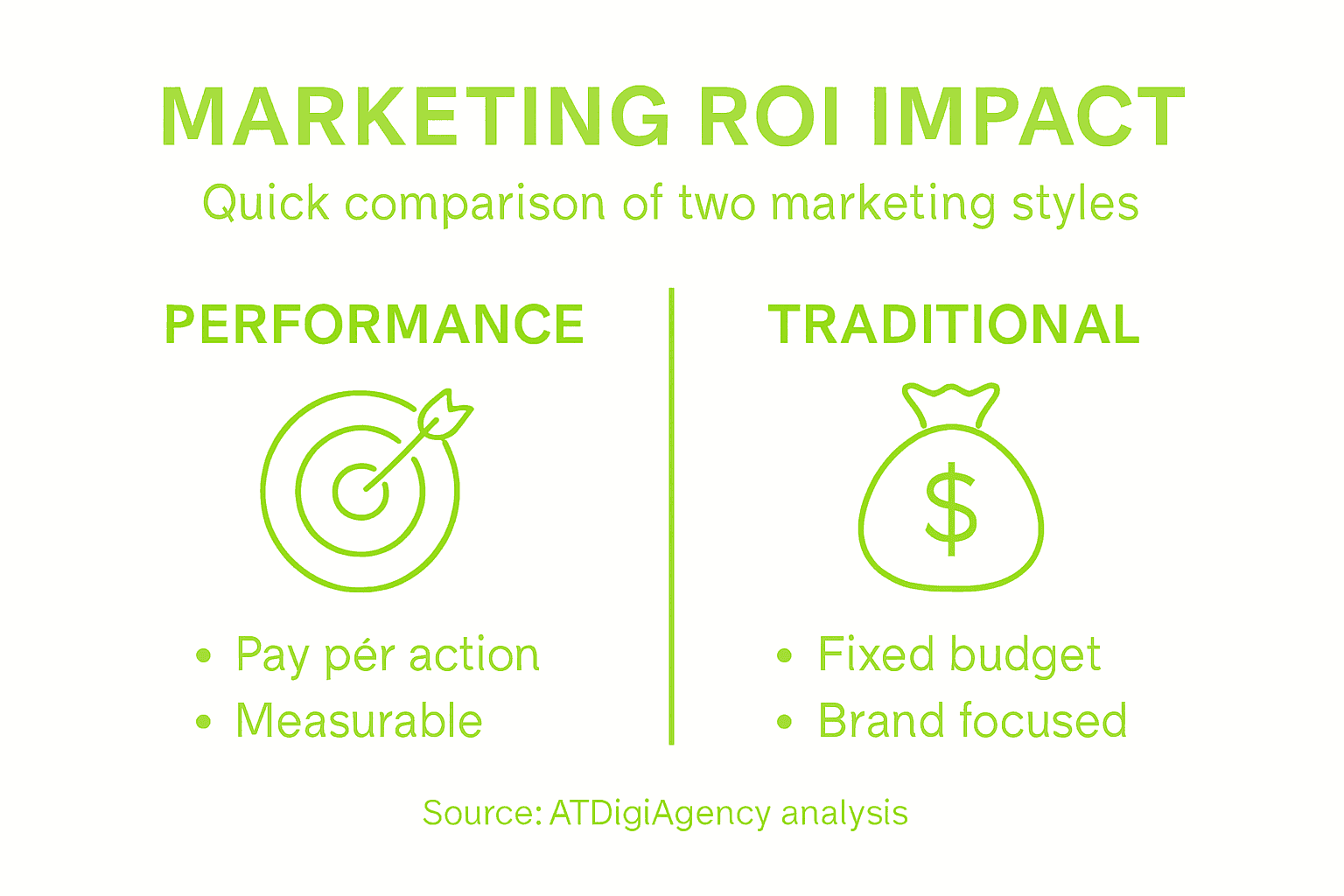
Performance marketing and traditional marketing represent two fundamentally different approaches to reaching customers, and understanding the distinction is critical for e-commerce founders trying to maximize ROI. Performance marketing is a results-driven approach focused on acquiring, converting, and retaining customers by allocating resources based on measurable and continuously updated evidence of incremental business outcomes. You pay for specific actions: a click, a lead form submission, and a purchase. The money flows only when something measurable happens. Traditional marketing, by contrast, primarily focuses on creating brand visibility and presence through offline and broad advertising channels, often measured by impressions, reach, and engagement without direct attribution to specific sales.
Here’s where the rubber meets the road for your business. Performance marketing centers on measurable results with payment tied to specific actions like clicks or purchases, offering high ROI and accountability. You know exactly what each customer acquisition costs and which campaigns generated revenue. Traditional marketing builds long-term brand equity through broader brand-building activities aimed at enhancing customer perceptions. A billboard campaign might boost brand awareness, but it cannot be directly connected to five specific product sales last Thursday. That gap between effort and attribution is where things get murky.
For e-commerce founders scaling online sales, this difference matters enormously. When you’re running Google Ads or Meta campaigns, you’re operating in the performance marketing space. You set a budget, launch the campaign, and within hours, you have data showing clicks, conversions, cost-per-acquisition, and return on ad spend. You can adjust strategy based on real-time performance. Traditional marketing typically requires patience and faith. You run a campaign, wait weeks or months for results, and rely on broader brand metrics that don’t directly tell you whether that spend generated revenue.
Pro tip: Start by mapping out which revenue drivers in your business lend themselves to performance marketing (product launches, seasonal promotions, competitive keywords) and which benefit from traditional brand building (long-term customer loyalty, category authority). Most successful e-commerce companies blend both, but understand where each dollar is going and what it’s supposed to achieve.
Here’s a comparison to help distinguish performance marketing from traditional marketing:
Aspect | Performance Marketing | Traditional Marketing |
Payment Model | Pay-per-action (CPC, CPA) | Upfront, fixed budget |
Measurability | Real-time, direct tracking | Indirect, proxy metrics |
Budget Flexibility | Scalable by results | Large upfront commitment |
Optimization Speed | Immediate, ongoing tweaks | Post-campaign adjustments |
Primary Objective | Direct acquisition/sales | Brand awareness, long-term value |
ROI Attribution | Highly precise | Often unclear, indirect |
Core Differences: Measurement and Accountability
This is where performance and traditional marketing truly diverge. Measurement in performance marketing is straightforward. You launch a Google Ads campaign, and within 24 hours, you know how many people clicked your ads, how many added items to their cart, and how many completed purchases. You can calculate your cost per acquisition, return on ad spend, and lifetime value of customers acquired through that specific campaign. Every dollar spent connects to a measurable outcome. Traditional marketing operates in a different universe. You run a television commercial or print advertisement, and you rely on proxy metrics like impressions, reach, and brand recall surveys. These tell you something happened, but they don’t prove causation. Did that billboard actually drive sales, or would those customers have bought anyway?

Performance marketing provides measurable ROI by linking marketing spend directly to results such as sales, leads, or clicks, solving the issue of vague attribution in marketing spend. This creates accountability that most e-commerce founders crave. If you spent $5,000 on a Facebook campaign last month and generated $25,000 in revenue from that campaign, you have a 5x return. You know this number with precision. Traditional marketing struggles with measuring effectiveness precisely, often relying on proxies such as impressions or brand recall, which makes accountability for specific results more challenging. A brand awareness campaign might be valuable long-term, but your CFO wants to know: what did we get for that $50,000?
Performance measurement enables organizations to track inputs, outputs, and outcomes systematically to evaluate program efficiency and effectiveness. Unlike traditional evaluation approaches that may be ad hoc or infrequent, this ongoing measurement offers timely data for real-time management and accountability. For your e-commerce business, this means you can spot an underperforming campaign on Wednesday and reallocate that budget to a winner by Friday. Traditional marketing demands patience. You commit to a quarterly campaign, wait for results, and adjust next quarter. By then, thousands of dollars have already been spent on a strategy you now realize wasn’t working.
The accountability difference also shapes how teams think about risk. Performance marketing teams own their numbers. They know that poor creative or bad targeting will show up instantly in the metrics. Traditional marketing teams have a buffer. They can point to intangible brand benefits or long-term customer value that doesn’t manifest in this quarter’s sales.
Pro tip: Set up conversion tracking properly from day one across all your paid channels, then establish a weekly reporting routine where you review cost per acquisition, return on ad spend, and average order value by campaign. This discipline reveals which marketing channels actually drive profitable growth versus which ones drain budget.
Cost Models and Campaign Management
The way you pay for marketing reveals everything about how each approach actually works. Performance marketing operates on a pay-for-performance model. You don’t pay upfront for the right to advertise. Instead, you only pay when something happens: a click costs money, a lead submission costs money, and a purchase costs money. This is why it appeals to bootstrapped founders and scaling e-commerce businesses. Your risk is directly tied to results. If a campaign doesn’t work, you stop spending. If it works exceptionally well, you can scale spending up aggressively because you know the unit economics are profitable. Traditional marketing, by contrast, requires upfront commitment and fixed costs. You contract with a billboard company for three months, you produce a television commercial and buy media slots, and you commit to a magazine placement. The money goes out regardless of whether anyone notices your ad or takes action. The cost structure is set before you have any proof of effectiveness.
This cost model difference fundamentally changes how you manage campaigns. Performance marketing emphasizes paying for measurable results, while traditional marketing often involves fixed or upfront costs without guaranteed outcomes. When you’re running Google Ads or Facebook campaigns, campaign management means constant optimization. You’re monitoring which keywords convert, which audiences engage, and which creative variations perform best. You adjust bids daily or weekly. Not only that, but you pause underperforming segments and increase spending on winners. This is active, data-driven management. Traditional campaign management is more about execution and brand building. You plan the campaign months in advance, execute it according to the plan, and evaluate results after the campaign concludes.
For e-commerce founders, this distinction matters when budgeting. With performance marketing, you can start with $1,000 and scale to $10,000 monthly as you prove the model works. With traditional marketing, you often need $10,000 committed upfront to make a billboard or radio campaign worthwhile. Campaign management involving strategic planning and real-time optimization allows performance marketing to adapt quickly to market changes. Economic shifts, competitor moves, seasonal demand spikes, or inventory changes require adjustments. Your team can respond within hours. Traditional campaigns locked in for a quarter cannot pivot as easily.
There’s also a psychological difference in how teams approach risk. Performance marketing teams are incentivized to optimize and test constantly. Every underperforming campaign has visible data. Traditional marketing teams often take a longer view, betting that brand awareness today builds customer loyalty tomorrow. Both approaches can work, but they require different organizational mindsets and different financial commitments upfront.
Pro tip: When planning your campaign strategy, allocate at least 20% of your monthly paid advertising budget to testing new channels, audiences, or creative approaches. Performance data from these tests informs your optimization strategy and prevents your winning campaigns from stagnating.
Best Use Cases for Electronic Commerce Brands
Performance marketing and traditional marketing excel in different scenarios. Understanding where each approach delivers the strongest ROI helps you allocate your budget strategically. Performance marketing dominates in direct-response scenarios where your goal is immediate sales conversion. If you sell a specific product with clear demand and a healthy profit margin per unit, performance marketing is your primary tool. Someone searches for “leather wallets under 50 dollars” on Google, your ad appears, they click, and they buy. That transaction traces directly to your ad spend. This is where performance marketing shines. Email campaigns promoting flash sales, social media ads targeting specific demographics, and retargeting campaigns showing ads to people who visited your site but didn’t buy all fall into this category. These tactics generate measurable, attributable revenue.
E-commerce brands benefit most from performance marketing channels, including paid search, social media, and affiliate marketing, which offer precise targeting, real-time ROI tracking, and scalable campaigns. This works especially well during product launches, seasonal promotions, and inventory clearance events. You have a deadline, a specific goal, and finite inventory. Performance marketing lets you move that inventory fast while measuring every dollar spent. Traditional marketing still supports brand-building and long-term trust but is less efficient for direct sales attribution. A luxury e-commerce brand selling high-end furniture might use Instagram ads (performance marketing) to generate immediate sales while simultaneously running a glossy magazine feature (traditional marketing) to build aspirational brand perception over time. Digital marketing strategies such as social media, SEO, email, and pay-per-click advertising provide e-commerce brands with highly targeted and measurable campaigns, enabling cost-effective and adaptable marketing efforts compared to traditional methods. For most e-commerce founders, this is your starting point. You have a limited budget, you need to prove the business model works, and you need to see ROI quickly. Performance marketing lets you validate assumptions with real customer data. Does your target audience actually want this product? Will they pay your price point? Are there keyword opportunities competitors are missing? Traditional marketing cannot answer these questions quickly enough. However, combining both approaches improves brand recall and broadens audience reach when aligned with business goals. A growing online retailer might allocate 70% of its marketing budget to performance channels and 30% to brand-building activities like content marketing and public relations.
The key distinction is timing and certainty. Performance marketing works best when you need measurable results fast and can optimize based on data. Traditional marketing works best when you can afford a longer payoff period and want to build lasting brand equity. Most successful e-commerce brands use both, but they weight performance marketing more heavily because they need to grow revenue consistently and sustainably.
Pro tip: Audit your current e-commerce business by product category and profit margin. High-margin products with clear search intent should drive performance marketing budgets. Lower-margin products or brand-new categories benefit more from traditional brand-building to establish trust and awareness first.
These scenarios highlight when to use each marketing approach for your e-commerce brand:
Scenario | Best Approach | Why This Works |
Flash sales and promotions | Performance Marketing | Immediate measurable impact |
New product category launch | Traditional Marketing | Builds trust and authority |
High-search-demand products | Performance Marketing | Captures in-market buyers |
Building long-term loyalty | Traditional Marketing | Reinforces brand perception |
Inventory clearance events | Performance Marketing | Drives rapid conversions |
Entering new geographic markets | Traditional Marketing | Raises broad awareness |
Choosing the Right Mix for Growth
There is no one-size-fits-all answer to whether you should prioritize performance marketing or traditional marketing. The right choice depends on your business stage, budget constraints, product type, and long-term vision. Startups and early-stage e-commerce brands typically lean heavily on performance marketing because it aligns with resource scarcity. You cannot afford to spend $50,000 on a brand campaign with uncertain returns. You need to prove your business model works profitably before investing in brand equity. Performance marketing lets you validate product-market fit with real revenue data. You learn which customer segments buy, at what price point, and through which channels. This information is gold when you eventually scale.
Established brands with proven sales velocity can afford to blend both approaches more evenly. Companies that prioritize marketing as a core part of their growth strategy significantly outperform competitors by aligning marketing objectives with business goals and investing in both measurable marketing activities and brand-building efforts to drive sustainable growth. A mature e-commerce brand selling beauty products might allocate 60% of its budget to Google Shopping ads and Meta retargeting campaigns (performance marketing) because these channels directly drive revenue. Simultaneously, they invest 40% in influencer partnerships, branded content, and community building (traditional brand marketing) because these activities strengthen customer loyalty and reduce customer acquisition costs over time.
The marketing mix balances multiple elements like product, price, place, and promotion to meet customer needs and business goals effectively. This principle applies to your performance versus traditional decisions. Your product determines channel viability. A niche luxury product might require traditional brand-building to establish credibility. A commodity product with massive search volume might succeed almost entirely through Google Ads. Your price point matters too. Low-priced, high-volume products benefit from performance marketing efficiency. High-priced products sold to businesses require relationship-building and trust-establishment that traditional channels support better.
Consider your growth trajectory. In year one, your marketing budget might be entirely performance marketing-focused because you need to learn what works. By year three, as you scale, you might shift to 70% performance and 30% brand-building. By year five, as you face increased competition, you might move toward 60% performance and 40% brand to differentiate. The evolution is natural. New businesses validate product-market fit. Growing businesses scale proven channels. Mature businesses protect market share through brand strength.
Pro tip: Create a simple spreadsheet tracking your customer acquisition cost by channel alongside your customer lifetime value by source. If Google Ads customers have a 3x lifetime value while brand awareness visitors have a 1.5x lifetime value, your budget allocation should reflect that data, not intuition.
Unlock Measurable Growth With Expert Performance Marketing
Navigating the complex landscape between performance marketing and traditional marketing can feel overwhelming. With your core challenge being the need for clear ROI, precise cost tracking, and agile campaign management, you want more than just brand awareness — you need measurable revenue growth that supports your e-commerce scaling goals. The struggle to balance upfront commitment with flexible, data-driven optimization is real. That is why aligning your marketing spend with actual customer acquisition costs and tangible outcomes can transform your business.
A&T Digital Agency specializes in exactly this type of challenge. Through tailored Google Ads and Meta campaigns, we help you reallocate budget and strategy to focus on what truly drives performance and sales. From strategic planning to creative development and continuous optimization, our boutique team blends expert insight with personalized service to deliver campaigns that maximize returns without wasting precious resources. Whether you are launching a new product or needing to convert traffic into loyal customers, our proven systems bring accountability and real growth to your marketing efforts.
Take control of your marketing ROI now to move beyond budget guessing games and guesswork.
Ready to shift your marketing dollars to channels that deliver measurable results and sustainable growth? Visit A&T Digital Agency to start your journey toward smarter, data-driven marketing today. Discover how our campaign strategy and execution can amplify your sales and shrink your cost per acquisition with precision. Your business deserves marketing that works as hard as you do.
Frequently Asked Questions
What is the main difference between performance marketing and traditional marketing?
Performance marketing focuses on acquiring, converting, and retaining customers with measurable results, where payment is tied to specific actions like clicks or purchases. Traditional marketing primarily aims for brand visibility through broader channels but lacks direct attribution to sales.
How does measurement differ between performance marketing and traditional marketing?
Performance marketing offers real-time, direct tracking of measurable results, allowing businesses to see how their ads perform immediately. In contrast, traditional marketing relies on proxy metrics such as impressions and brand recall, making it harder to link spend to specific outcomes.
When should an electronic commerce brand use performance marketing instead of traditional marketing?
E-commerce brands should use performance marketing for direct-response scenarios, such as flash sales or product promotions, where immediate sales conversion is the goal. It excels in situations with clear demand and measurable ROI.
Can an electronic commerce brand successfully blend both performance and traditional marketing strategies?
Yes, successful e-commerce brands often blend both strategies. They may allocate a larger portion of their budgets to performance marketing for direct results while also investing in traditional marketing to build brand awareness and long-term customer loyalty.
Recommended
Performance Marketing Agency | Multi-Channel Paid Ads || A&T Agency
Performance Marketing Agency | Multi-Channel Paid Ads || A&T Agency
Performance Marketing Agency | Multi-Channel Paid Ads || A&T Agency
Performance Marketing Agency | Multi-Channel Paid Ads || A&T Agency
Advertising Performance Metrics: Complete Guide - playablemaker.com


