Paid Advertising Trends 2026: Maximizing ROI in Performance Marketing
Posted on
Marketing
Posted at

Every United States marketing director knows how quickly advertising trends shift as technology advances and consumer expectations evolve. Staying ahead in 2026 demands a deep grasp of new tools like AI-powered targeting and privacy-compliant tracking. With digital advertising now accounting for about 65% of American ad spending and driving nearly 20% of economic activity, the stakes are high for anyone aiming to improve ROI and conversion rates with smarter, more efficient strategies.
Table of Contents
Key Takeaways
Point | Details |
Hyper-personalization and AI | Advancements in data analytics and AI are driving hyper-personalization, enhancing precision targeting over broad-reach campaigns in paid advertising. |
Emerging Ad Formats | Innovative formats like short-form video and augmented reality are essential for creating engaging, interactive advertising experiences. |
Compliance and Privacy | Navigating data privacy regulations is crucial; strategies such as consent-based data collection can build user trust and reduce legal risks. |
Advanced Targeting Strategies | Employing techniques like predictive audience modeling and behavioral intent mapping is key for effective, data-driven advertising performance. |
What Defines Paid Advertising Trends in 2026
Paid advertising is transforming dramatically, driven by technological innovation and shifting consumer behaviors. Digital advertising’s economic significance continues to expand, representing a crucial component of modern marketing strategies.
The key characteristics defining paid advertising trends in 2026 encompass several critical dimensions:
Hyper-personalization through advanced data analytics
AI-driven targeting capabilities
Privacy-compliant tracking mechanisms
Cross-platform integration strategies
Real-time performance optimization
These trends reflect a sophisticated understanding of consumer engagement. Marketers now recognize that precision targeting matters more than broad-reach campaigns. Advertising’s economic impact demonstrates how strategic digital advertising drives substantial economic activity, supporting nearly 29 million jobs and generating significant market value.
Technology is fundamentally reshaping paid advertising approaches. Machine learning algorithms can now predict consumer behaviors with unprecedented accuracy, enabling marketers to craft messaging that resonates on a deeply personal level. The integration of predictive analytics, behavioral tracking, and contextual understanding creates a more nuanced advertising ecosystem.
Pro tip: Invest in advanced audience segmentation technologies to maximize your paid advertising performance in 2026.
Emerging Ad Formats and Platform Innovations
The landscape of digital advertising continues to evolve rapidly, with emerging media technologies transforming how brands connect with audiences. Innovative platforms are pushing the boundaries of traditional advertising, creating more immersive and interactive experiences that capture consumer attention.
Key emerging ad formats for 2026 include:
Short-form video content
Augmented reality advertising experiences
AI-generated personalized ad creative
Interactive mobile ad formats
Voice-activated advertising platforms
These emerging formats reflect a fundamental shift toward more engaging, personalized advertising strategies. Machine learning and artificial intelligence are enabling unprecedented levels of targeting precision, allowing marketers to craft messages that resonate deeply with specific audience segments.

Here’s a concise comparison of emerging ad formats and their consumer engagement potential:
Ad Format | Consumer Engagement Level | Creative Opportunities |
Short-form video | Very high | Viral content, storytelling |
Augmented reality | High | Interactive brand experiences |
Voice-activated ads | Moderate | Seamless, hands-free interaction |
Interactive mobile | High | Gamification, instant feedback |
AI-generated creative | Very high | Personalized messaging at scale |
Platform innovations are driving this transformation, with social media and streaming channels continuously updating their algorithms to prioritize relevant, compelling content. The rise of immersive technologies like augmented and virtual reality is creating new advertising canvases that go beyond traditional display and video formats, offering brands more creative ways to engage potential customers.
Pro tip: Experiment with multiple emerging ad formats to discover which resonates most effectively with your target audience.
Automation and AI in Campaign Execution
The future of digital marketing is being redefined by AI-driven campaign automation, transforming how businesses approach performance marketing. Machine learning algorithms are now capable of making sophisticated decisions that were once exclusively in the human domain, dramatically reshaping campaign strategies and execution.
Key aspects of AI-powered campaign automation include:
Real-time performance optimization
Dynamic audience segmentation
Predictive budget allocation
Automated creative testing
Intelligent bidding strategies
These technological advances enable marketers to create more nuanced, responsive campaigns that adapt instantaneously to changing market conditions. AI governance frameworks are emerging to ensure the responsible and ethical implementation of these powerful automation technologies, addressing potential challenges like data privacy and algorithmic bias.
The most advanced AI systems are now capable of autonomously negotiating ad placements, analyzing complex performance metrics, and generating personalized ad creatives with unprecedented precision. This shift represents more than just technological innovation - it’s a fundamental reimagining of how marketing intelligence can be applied to drive business growth.
Pro tip: Implement incremental AI automation, starting with low-risk campaign elements to build organizational confidence and expertise.
Data Privacy, Compliance, and Measurement Challenges
The digital advertising landscape is undergoing a profound transformation with privacy regulation trends reshaping how businesses collect, process, and leverage consumer data. Marketers must navigate an increasingly complex regulatory environment that demands unprecedented levels of transparency and user consent.
Key compliance challenges for performance marketing include:
Consent-based data collection
Anonymization of user information
Cross-border data transfer restrictions
AI-specific privacy protocols
Transparent tracking mechanisms
Understanding these challenges requires recognizing the broader context of global data protection developments. Regulatory frameworks are becoming more sophisticated, addressing not just data collection but also the ethical use of artificial intelligence in marketing technologies.
The emerging compliance landscape creates both obstacles and opportunities for performance marketers. Larger organizations with robust compliance infrastructures may have advantages, but innovative approaches to data privacy can become significant competitive differentiators. Companies that proactively develop transparent, user-centric data practices will likely gain greater consumer trust and loyalty.
Below are key compliance strategies and their impact on user trust in digital advertising:
Strategy | Effect on User Trust | Business Advantage |
Consent-based data collection | Builds transparency | Reduces legal risks |
Data anonymization | Increases privacy | Enhances reputation |
Clear cross-border data policies | Instills confidence | Facilitates global operations |
Transparent tracking mechanisms | Promotes accountability | Improves customer retention |
Pro tip: Develop a comprehensive privacy compliance strategy that goes beyond minimum legal requirements to demonstrate a genuine commitment to user data protection.
Maximizing ROI Through Advanced Targeting Strategies
Precision in audience targeting has become the cornerstone of successful digital advertising, with advanced targeting strategies transforming how businesses approach performance marketing. Modern marketers must move beyond traditional demographic segmentation to create highly nuanced, data-driven targeting approaches.
Key components of advanced targeting strategies include:
Behavioral intent mapping
Predictive audience modeling
Micro-segmentation techniques
Cross-platform user profiling
Dynamic audience recalibration
The evolution of targeting goes far beyond simple demographic categorizations. AI-powered personalization now enables marketers to develop granular insights that capture not just who consumers are, but how they behave, what they desire, and when they are most likely to convert.
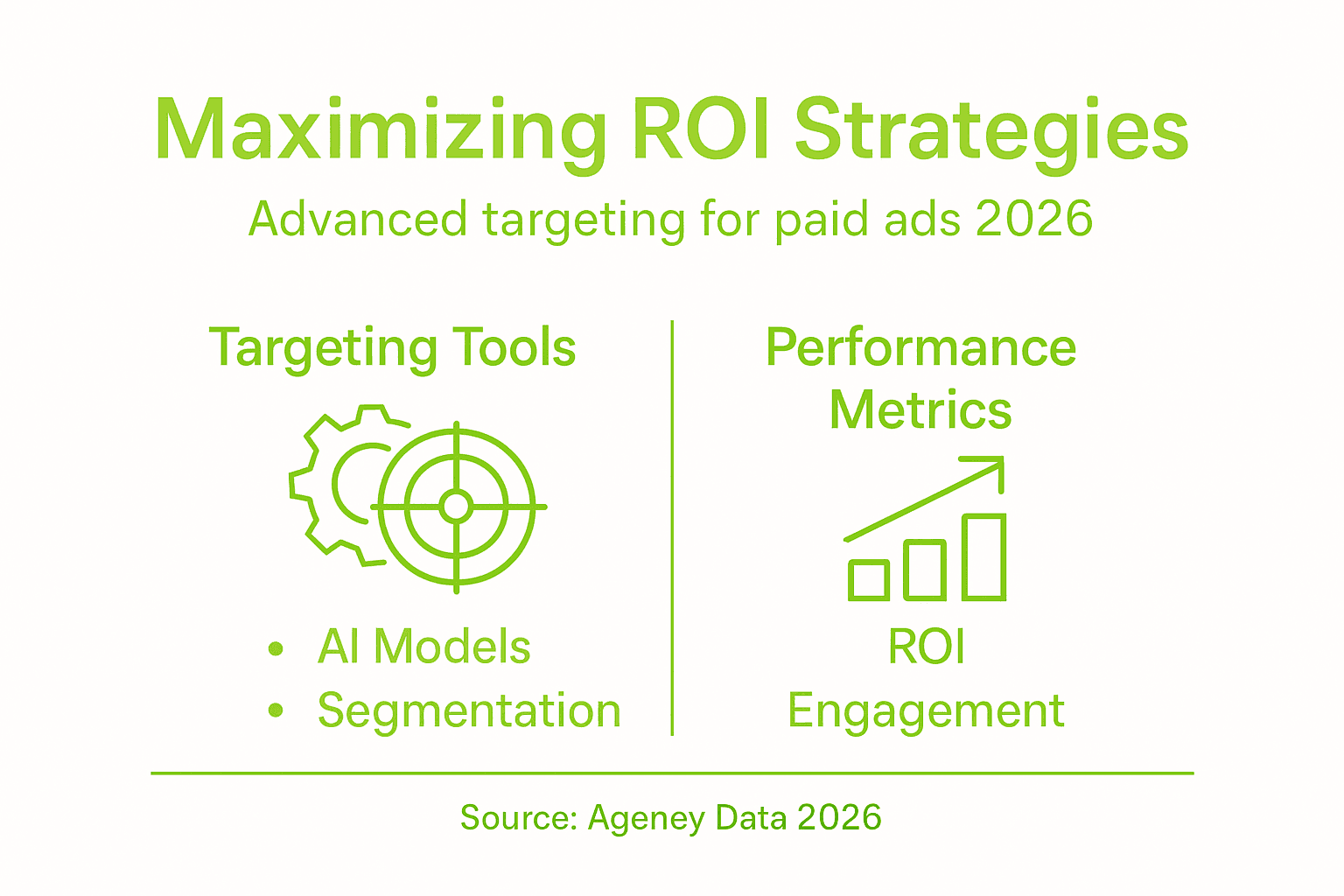
Successful targeting requires a delicate balance between technological capability and ethical considerations. While advanced algorithms can dramatically improve campaign performance, marketers must remain vigilant about potential algorithmic biases and maintain transparency in their targeting methodologies. The most effective strategies integrate sophisticated data analysis with a genuine understanding of consumer preferences and privacy concerns.
Pro tip: Continuously validate and refine your targeting models by tracking performance metrics and conducting regular audience sensitivity analyses.
Elevate Your Paid Advertising Strategy for 2026 and Beyond
The article highlights critical challenges in paid advertising, such as mastering AI-driven targeting, embracing privacy-compliant data practices, and leveraging emerging ad formats to maximize ROI. If you are feeling overwhelmed by navigating advanced audience segmentation, real-time campaign optimization, or privacy regulations, you are not alone. Achieving measurable results requires precision, creativity, and a trusted partner who can skillfully balance data-driven insight with innovative execution.
At A&T Digital Agency, we specialize in building and scaling effective paid advertising systems tailored for your unique business goals. Our boutique team combines strategic planning with expert management of Google Ads and Meta campaigns, ensuring every dollar spent drives revenue growth, lead generation, and conversion improvements. We understand the urgency of staying ahead in performance marketing by implementing the latest trends like AI-powered automation and hyper-personalized messaging.
Ready to transform your digital marketing with tested strategies that put ROI first
Explore how our focused approach can help your business thrive in a competitive digital landscape by visiting A&T Digital Agency. Don’t wait to capitalize on 2026’s paid advertising innovations – start your journey to higher performance today with expert campaign strategy, launch, and optimization at your side.
Frequently Asked Questions
What are the key advertising trends to watch for in 2026?
Key trends include hyper-personalization through advanced data analytics, AI-driven targeting capabilities, privacy-compliant tracking mechanisms, cross-platform integration strategies, and real-time performance optimization.
How can automation and AI enhance my paid advertising campaigns?
Automation and AI can help with real-time performance optimization, dynamic audience segmentation, predictive budget allocation, automated creative testing, and intelligent bidding strategies, leading to more efficient and effective campaigns.
What emerging ad formats should I consider for my marketing strategy in 2026?
Consider incorporating short-form video content, augmented reality advertising experiences, AI-generated personalized creative, interactive mobile ads, and voice-activated platforms to engage consumers more effectively.
How can I ensure compliance with data privacy regulations in my advertising efforts?
To comply with data privacy regulations, implement consent-based data collection, anonymize user information, establish clear cross-border data policies, and maintain transparent tracking mechanisms to build user trust.


