Ad Creative Optimization Workflow for SMB Marketers
Posted on
Marketing
Posted at

An ad creative optimization workflow involves producing, testing, and refining ad assets based on performance data. It relies on concept-level testing, AI tools, and a disciplined weekly cycle to drive campaign success for SMBs.
An ad creative optimization workflow is a disciplined, repeatable system for producing, testing, and refining ad assets based on performance data. Creative quality drives 49% to 89% of total digital campaign performance, making it the most controllable variable in your paid media mix. Google's data puts the creative impact on performance at 70%, while Nielsen attributes 56% of sales ROI to creative quality alone. For SMB digital marketers working with lean budgets and limited team bandwidth, a structured creative workflow is not optional. It is the difference between ad spend that compounds and ad spend that disappears.
What are the key components of an ad creative optimization workflow?
A functional ad creative optimization workflow starts with the right tools, a clear brief, and a tracking setup that gives you reliable data from day one.
Tools you need:
An AI image generation tool (such as Midjourney or Adobe Firefly) for rapid visual production
A copywriting assistant (such as ChatGPT or Claude) for headline and body copy variations
A video editor for short-form content (CapCut works well for SMBs)
An ad manager with dynamic creative features, such as Meta Ads Manager or Google Ads
A shared folder or project management tool to catalog creative assets and test results
The creative brief is non-negotiable. Every asset you produce should trace back to a brief that defines the campaign objective, the audience's current awareness state, the core offer, the hook angle, required brand elements, and the ad formats needed. Without this, you produce volume without direction.
Brief Element | What to Define |
|---|---|
Campaign objective | Conversions, leads, traffic, or awareness |
Audience state | Cold, warm, or retargeting |
Core offer | What the ad is selling or promoting |
Hook angle | The specific problem or desire being addressed |
Brand elements | Logo, color palette, tone of voice |
Ad formats | Static, video, carousel, or story |
Pro Tip: Set up a simple spreadsheet to log every creative concept you test, including the hook angle, format, launch date, and key metrics. This catalog becomes your most valuable asset over time.
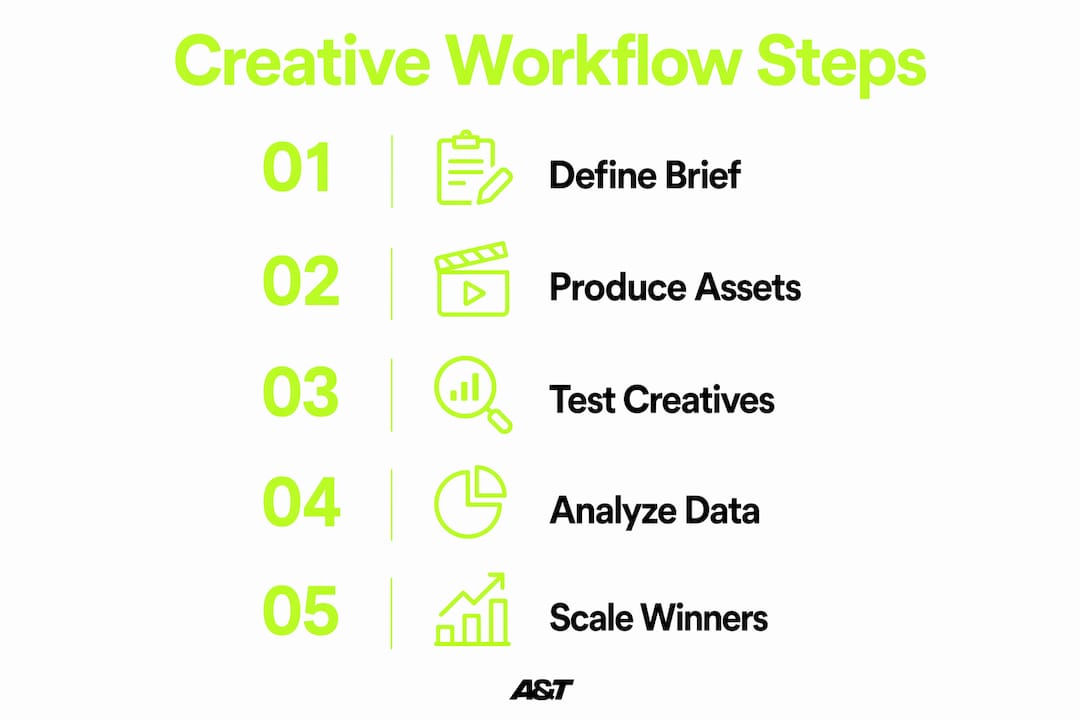
Solo marketers and small teams can run this workflow effectively. The key is batching production tasks rather than creating one ad at a time. AI enables SMBs to produce competitive creative volume that was previously impossible without large teams. That shift changes the economics of creative testing entirely.

How to execute an ad creative optimization workflow step by step
A weekly rhythm keeps your creative pipeline full without burning out your team. A sustainable SMB workflow runs in about 2 hours per week: roughly 90 minutes for production and 30 minutes for review and upload. Here is how to structure it.
Review last week's batch. Pull CTR, CPA, ROAS, and frequency data for every active creative. Flag winners, flag fatigue signals, and note what the data tells you about which hook angles or formats resonated.
Produce a new batch of concepts. Focus on 3–5 fundamentally different creative concepts per batch, not minor design tweaks. Testing fundamentally different concepts yields the highest impact before moving to execution-level or element tests. Changing a button color is not a concept test. Changing the hook from "save money" to "get results faster" is.
Use AI tools to accelerate production. Generate multiple visual directions and copy angles in parallel. A single concept can produce 3–4 variants in different formats (square, vertical, story) without starting from scratch each time. Aim for 15–20 new variants monthly to maintain enough volume for meaningful learning.
Upload and launch with broad targeting. Broad targeting combined with multiple creatives outperforms multiple ad sets with the same creative but different targeting. The algorithm finds the right audience when you give it enough creative variety to work with. Use dynamic creative optimization to let the platform mix and match elements, but run at least some manual controlled tests alongside it to understand what is actually driving performance.
Monitor and retire underperformers. Check performance every 3–4 days during the first week of a new batch. Do not touch campaigns during the platform's learning phase. Once a creative has enough data, make a clear call: scale it, iterate on it, or retire it.
Iterate on winners, not losers. When a concept performs well, build variations around the same hook angle and format. Replicate the structure, change the visual treatment or the copy, and test whether the concept holds up across different audience segments or placements.
Pro Tip: When testing copy for your ads, structured copy testing is just as important as visual testing. Read more about why testing ad copy directly affects your ROI before you finalize your next batch.
How do you troubleshoot common ad creative workflow problems?
Even a well-built workflow hits walls. Knowing the warning signs early saves budget and keeps your campaigns from stalling.
Creative fatigue is the most common problem. Track it through these signals:
Frequency above 4.0 impressions per user
CTR drops greater than 20% week over week
CPM rising without a corresponding increase in conversions
Engagement rate declining on previously strong creatives
When you see two or more of these signals together, the creative is fatigued. Retire it and rotate in a fresh concept.
Avoid testing too many variables at once. Isolate one variable per test for reliable results. If you change the headline, the image, and the call to action simultaneously, you cannot know which change moved the needle. This is the most common testing mistake SMB marketers make.
Archive losing creatives instead of deleting them. A creative that failed in january may reveal exactly why a winning concept works in march. Failure data is pattern data. Over time, your archive becomes a map of what your audience does not respond to, which is just as useful as knowing what they do.
Balancing budget between testing and scaling is another common challenge. A practical split is to allocate roughly 20–30% of your budget to new creative testing and the remainder to scaling proven winners. This keeps your pipeline active without starving your best performers.
Avoid micro-managing live campaigns during learning periods. Every time you edit a live ad set, the platform resets its learning. Let campaigns run for at least 7 days before making structural changes. For SMBs working with tight budgets, a marketing automation checklist can help you build guardrails that prevent impulsive edits during learning phases.
How do you measure success and scale winners in a creative workflow?
Measuring creative performance correctly is what separates marketers who scale profitably from those who guess. Define your success criteria before a campaign launches, not after.
Set clear thresholds upfront. Decide what CPA, ROAS, and CTR benchmarks a creative must hit to be considered a winner. These thresholds should reflect your business economics, not platform averages.
Measure at the concept level, not the variant level. Individual variants generate noise. Group variants by concept and evaluate the concept's aggregate performance. This gives you a cleaner signal about whether the underlying idea works.
Scale budgets gradually. Scale in 20–30% increments every few days rather than doubling overnight. Aggressive budget jumps destabilize platform delivery and reduce ROI. Gradual scaling preserves the algorithm's learning and keeps your CPA stable.
Expand placement and format coverage. When a concept wins in one format, adapt it for other placements. A winning static ad often translates well into a short video or a story format. This multiplies your return on a single strong idea.
Build a creative portfolio around winning archetypes. Identify the hook angles and formats that consistently outperform, then build a library of variations around those archetypes. This is how you create winning ad creatives that compound over time rather than starting from zero each month.
Automate routine decisions. Automated rules in ad platforms handle pausing, budget changes, and creative rotations faster than manual review. Set rules to pause creatives below your CTR threshold and increase budgets on creatives above your ROAS target.
Scaling Signal | Recommended Action |
|---|---|
ROAS above target for 7+ days | Increase budget by 20–30% |
Frequency above 4.0 | Rotate in a new concept |
CTR drop of 20%+ week over week | Pause and archive the creative |
New concept beats control | Shift budget toward the winner |
Pro Tip: Apply creative best practices consistently. Strong creative execution produces 1.2x to 7.4x short-term sales lift. That range reflects the difference between marketers who test systematically and those who run one ad until it dies.
Key Takeaways
A disciplined ad creative optimization workflow, built around concept-level testing, AI-assisted production, and data-driven scaling, is the most reliable path to sustained campaign ROI for SMB marketers.
Point | Details |
|---|---|
Creative drives campaign performance | Creative quality accounts for up to 70% of campaign performance, making it your highest-leverage variable. |
Test concepts, not just elements | Testing fundamentally different hook angles delivers far greater impact than tweaking colors or fonts. |
Run a weekly 2-hour rhythm | Review, produce, upload, and monitor in a structured weekly cycle to maintain creative volume without burnout. |
Archive losers, scale winners gradually | Archive failed creatives for pattern insights and scale winning budgets in 20–30% increments to protect learning. |
Automate routine decisions | Use platform automation rules to pause underperformers and boost winners faster than manual review allows. |
What Iʼve learned from watching SMBs get creative workflows right (and wrong)
The SMBs that consistently outperform their competitors on paid ads share one habit: they treat creative production like a manufacturing process, not a creative event. They show up every week, produce a batch, review the data, and repeat. They do not wait for inspiration. They build systems.
The biggest mindset shift I see SMB marketers struggle with is moving from "let's find the perfect ad" to "let's run enough concepts to let the data decide." AI tools have made this shift accessible. What used to require a design team and a copywriter can now happen in an afternoon. The constraint is no longer production capacity. It is discipline.
The marketers who fail at this are usually the ones who test one creative for a month, declare it a failure, and blame the platform. The real issue is almost always insufficient volume and insufficient patience. You need enough concepts running simultaneously to generate a meaningful signal, and you need to give each concept enough time to exit the learning phase before judging it.
Start small. Build the weekly rhythm first. Add volume as your confidence in the process grows. The workflow compounds. The results follow.
— Ann
How A&T agency helps SMBs build profitable creative workflows
Running a disciplined creative workflow takes time, structure, and experience most SMB teams do not have in-house. A&T Digital builds and manages these systems for growing businesses across Google Ads and Meta Ads, from creative brief development through testing, analysis, and scaling. The team handles the weekly production rhythm, monitors fatigue signals, and makes data-backed decisions on what to scale and what to retire. If your ad spend is not producing consistent returns, the issue is likely your creative process. A&T Digital's Google Ads management and Meta Ads management services are built to fix that.
FAQ
What is an ad creative optimization workflow?
An ad creative optimization workflow is a repeatable system for producing, testing, and refining ad creatives based on performance data. It typically runs on a weekly cycle covering review, production, launch, and monitoring.
Why does creative quality matter more than targeting?
Creative quality drives 49% to 89% of total digital campaign performance, according to Nielsen and Google research. Targeting determines who sees your ad, but creative determines whether they act on it.
How many creatives should an SMB test per month?
SMBs should aim for 15–20 new creative variants per month, organized into batches of 3–5 fundamentally different concepts. This volume generates enough data to identify winners reliably.
How do you know when a creative is fatigued?
Creative fatigue shows up as a CTR drop greater than 20% week over week, frequency above 4.0 impressions per user, or rising CPMs without a corresponding lift in conversions. Two or more signals together confirm fatigue.
How should you scale a winning ad creative?
Scale winning creatives by increasing budgets in 20–30% increments every few days. Larger jumps disrupt platform learning and raise your CPA. Expand to additional placements and formats once the concept proves stable at the original budget level.