How to Track ROI Advertising: A Practical 2026 Guide
Posted on
Marketing
Posted at

Most marketing budgets experience leaks where ad spend flows out without clear returns, making accurate ROI tracking essential. Implementing structured UTM discipline, CRM integration, and advanced attribution models ensures measurement reflects true revenue, guiding confident scaling decisions. Regular data hygiene, reporting cadence, and combining methodologies like MMM and incrementality testing improve overall accuracy, enabling more effective campaign optimization.
Most marketing budgets have at least one leak. Ad spend flows out, leads come in, and somewhere between the click and the closed deal, the numbers stop making sense. Knowing how to track ROI advertising accurately is what separates teams that scale with confidence from those that guess and hope. Without a structured system, you're not measuring ad campaign effectiveness. You're measuring noise. This guide walks through the exact framework: from building your tracking infrastructure, to calculating true advertising return on investment, to using advanced attribution methods that reveal what's actually driving revenue.
Table of Contents
How to track ROI advertising: the setup that makes it possible
My honest take on ROI tracking after years of paid campaigns
Key Takeaways
Point | Details |
|---|---|
UTM discipline is non-negotiable | Consistent UTM naming conventions prevent data fragmentation that silently corrupts GA4 reports. |
ROAS is not ROI | Good ROAS can coexist with negative ROI when fully-loaded costs are ignored in the calculation. |
CRM integration closes the loop | Connecting ad click IDs to CRM outcomes enables true pipeline ROI measurement, especially for B2B. |
Attribution models have real limits | Last-click and platform-reported data overstate performance; MMM and incrementality tests give a clearer picture. |
Reporting cadence drives decisions | Daily anomaly checks, monthly ROI reviews, and quarterly strategic analysis keep measurement aligned with goals. |
How to track ROI advertising: the setup that makes it possible
Before you calculate a single number, your tracking infrastructure has to work correctly. Most ROI problems are actually data problems in disguise.
UTM parameters: the foundation of campaign attribution
UTM parametersare the five URL tags that tell GA4 and other analytics platforms where your traffic came from and which campaign drove it. The five parameters are "utm_source,utm_medium,utm_campaign,utm_content, andutm_term`. Every paid link that leaves your ad platform needs all of them, without exception.
The most common mistake is inconsistency. GA4 is case sensitive with UTMs, which means "Email," "email," and "EMAIL" register as three different sources. One inconsistent tag fragments your data across multiple rows in your reports, making it impossible to see total campaign performance at a glance. Enforce lowercase across every team member and every tool.
Build a naming convention document and treat it like company policy. Your convention should specify the exact values for source, medium, and campaign format before any campaign goes live. Tools like a shared UTM builder spreadsheet or a URL builder platform enforce this without relying on anyone's memory.
Use lowercase for all UTM values
Define a consistent separator (underscores work well:
spring_sale_2026)Tag every paid URL, including retargeting, remarketing, and email links
Store all UTM combinations in a master tracking document
Configuring GA for accurate ROI data
GA4's event-based model gives you more flexibility than Universal Analytics ever did, but it requires deliberate setup. Out of the box, GA4 tracks basic events. What you need are conversion events: purchases, form submissions, phone call clicks, and any other action that ties directly to revenue or pipeline.
Mark your key events as conversions inside GA4's admin panel. Then verify they fire correctly using GA4's DebugView before the campaign goes live. A purchase event that misfires, fires twice, or never fires at all corrupts every downstream ROI calculation you attempt.
Pro Tip: Set up a dedicated GA4 property for paid traffic only, or use a custom channel grouping that separates paid channels clearly from organic and direct. This makes your tracking marketing performance reports cleaner and faster to read.
Calculating advertising ROI the right way
The formula looks simple. The execution is where most marketers get it wrong.
ROAS versus true ROI: understanding the difference
ROAS measures revenue per ad dollar, but it ignores creative costs, agency fees, and software tools. A 4x ROAS sounds great until you account for the $8,000 in production costs and $3,000 in platform fees sitting outside the ad spend line. Understanding ROI metrics means accounting for all of it.
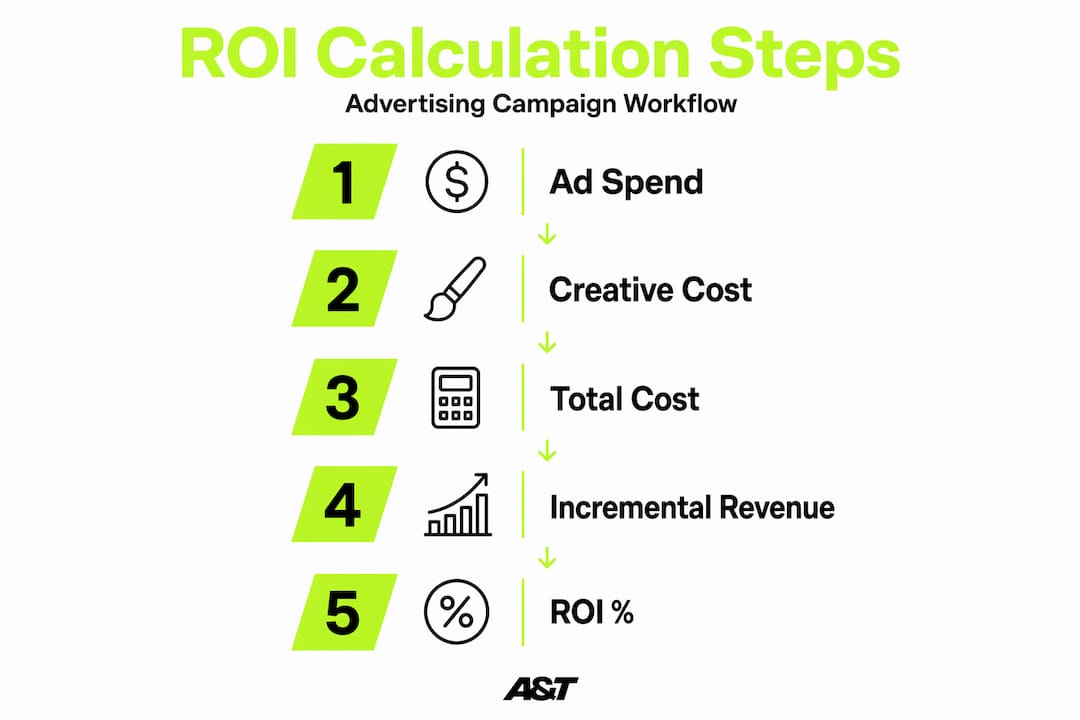
True ROI uses fully-loaded costs:
Ad spend (across all platforms)
Creative production costs (video, copy, design)
Agency or contractor fees
Analytics and attribution tools
Any promotional discounts tied to the campaign
The formula is:
ROI = (Incremental Revenue − Fully-Loaded Ad Cost) / Fully-Loaded Ad Cost × 100
Note the word incremental. Incremental revenue means the revenue you generated because of the ad. Not total attributed revenue. Not all revenue during the campaign window. Just the portion that would not have happened without the ad.
A worked example
Say you run a Google Ads campaign for one month. Ad spend: $10,000. Creative and agency costs: $4,000. Total fully-loaded cost: $14,000. Attributed revenue from conversions: $60,000. But your baseline sales without ads (based on a prior period) were $40,000. Incremental revenue is $20,000.
ROI = ($20,000 − $14,000) / $14,000 × 100 = 42.8%
That's a solid positive ROI. But if you had used total attributed revenue ($60,000), your ROI would have appeared to be 328%. The inflated number would have told you to keep spending. The accurate number tells you to scale carefully and test whether that baseline holds.
Pro Tip: A 5:1 ROAS (or roughly 400% ROI before fully-loaded costs) is a general industry benchmark for healthy paid campaigns, but your breakeven ROI depends entirely on your margins. Calculate your minimum acceptable ROI before the campaign launches, not after.
Connecting ad data to CRM and offline conversions
A click is not a sale. For most businesses with any sales cycle longer than 30 seconds, the gap between a form submission and closed revenue is where ROI measurement breaks down.

Why CRM integration changes everything
B2B campaigns require connecting ad data to CRM stagesto measure qualified pipeline and revenue, not just website leads. When a lead comes in through a Google Ads click, that click carries a GCLID (Google Click ID). If your CRM captures that GCLID alongside the contact record, you can eventually pass the closed revenue amount back to Google Ads as an offline conversion.
This closes the loop completely. Your ad platform now knows which keywords, ad groups, and creatives generated actual revenue. Not form fills. Revenue. This information feeds directly into Smart Bidding algorithms, so your campaigns start optimizing toward outcomes that matter.
For Meta campaigns, the process works similarly using Facebook's lead ID or via Meta's Conversions API.
Offline conversion tracking tools and methods
Dynamic phone numbers (via call tracking platforms): Assign a unique number per campaign so inbound calls are attributed back to the specific ad that drove them
Unique meeting links: Use individual Calendly or similar links per campaign for consultation bookings, then mark completed calls as offline conversions
Server-side events: Send conversion data directly from your server to Google or Meta using their APIs, bypassing browser-level tracking limitations from iOS restrictions
Offline conversion imports via Google Ads and Meta's native tools support CRM-based CSV uploads or direct API connections
Pro Tip: Store the GCLID or fbclid in a hidden field on every landing page form. Most CRMs can capture hidden fields automatically. Without this step, closed-loop attribution is not possible regardless of which tools you use.
Accurate revenue signals fed back into ad platforms also improve automated bidding. When Google's Smart Bidding learns from real revenue data instead of lead proxies, campaign bids align with actual sales outcomes, often producing meaningful efficiency gains within a few weeks.
Advanced attribution and media mix modeling
Platform-reported conversions are optimistic by design. Every channel takes credit. Your total attributed revenue across Google Ads, Meta Ads, and email frequently adds up to more than your actual revenue. That's the attribution overlap problem, and last-click models make it worse.
When last click attribution fails you
Last-click gives 100% of the credit to the final touchpoint before conversion. A customer could have seen five Meta ads, clicked a Google search ad, and then converted via a direct visit. Under last-click, Google gets all the credit. Meta gets none. Your budget decisions follow that distorted signal straight into misallocation.
Attribution approach | Best used for | Main limitation |
|---|---|---|
Last-click | Simple, short-cycle purchases | Ignores upper-funnel contributions |
Data-driven attribution | Mid-funnel analysis in GA4 or Google Ads | Requires sufficient conversion volume |
Media Mix Modeling (MMM) | Cross-channel strategic budgeting | Lags; not real-time; needs historical data |
Incrementality testing | Isolating true causal impact of a channel | Resource-intensive; requires geo or time-based holdout |
MMM uses Bayesian regression on historical spend and sales data, incorporating seasonality and external variables to estimate each channel's true contribution. It works across walled gardens because it operates at the aggregate level, not the user level. After iOS privacy changes dismantled user-level tracking, MMM has become the most reliable method for strategic budget allocation across channels.
Incrementality tests, such as geo holdouts and ghost ads, go one step further. Geo holdout tests turn off ads in a matched set of geographic regions while keeping them running in others, then compare revenue outcomes to isolate causal impact. This is the most rigorous way to answer the question: "Would these customers have bought anyway?"
Combining attribution models, MMM, and incrementality testinggives you a foundation for budget decisions that no single method can provide on its own.
Pro Tip: You don't need to run MMM every month. Run it quarterly, alongside your incrementality test. Use data-driven attribution in your ad platforms for day-to-day optimization, and reserve MMM for major budget reallocation decisions.
Verification, reporting cadence, and data quality
Tracking setup is not a one-time project. Data quality degrades. Tags break. Campaigns launch without UTMs. The only way to maintain reliable ROI measurement is a structured reporting cadence with specific checks at each level.
A reporting cadence tied to actionability looks like this:
Daily: Check for anomalies. Sudden drops in conversion volume or spikes in cost per conversion signal a tracking issue, not just a performance issue. Investigate before optimizing.
Weekly: Review trend data. Are CPAs trending up? Is revenue per campaign holding? Catch problems before they compound.
Monthly: Run the full ROI calculation with fully-loaded costs. Update payback period estimates. Review attribution data for any platform discrepancies.
Quarterly: Run incrementality tests, update MMM inputs, and analyze customer lifetime value across cohorts acquired through each channel.
Beyond cadence, UTM discipline must remain an ongoing operational priority because one untagged link in a major campaign throws off months of trend data. Assign one person as the UTM quality owner on every campaign.
Watch for inflated platform conversions. If Google Ads reports 300 conversions and GA4 shows 180, the gap usually means double-counting, view-through attribution overlap, or events firing on page load instead of on actual submission. These discrepancies are fixable, but only if you look for them.
Pro Tip: Use a blended ROAS metric that aggregates spend and attributed revenue across all platforms in a single view. A simple spreadsheet pulling from each platform's API or a tool like analytics-driven reporting gives you a cross-channel picture no single platform dashboard can provide.
My honest take on ROI tracking after years of paid campaigns
I've watched smart marketers make expensive decisions based on ROAS numbers that looked great on screen and meant almost nothing in practice. The metric is not wrong. The reliance on it alone is.
In my experience, the single biggest shift in ROI accuracy comes when you close the loop between the ad platform and the CRM. Before that connection exists, you're measuring proxies. After it exists, you're measuring reality. For B2B campaigns especially, that shift can change your entire budget allocation.
What I've also learned is that data hygiene is not glamorous, but it compounds. One sloppy UTM in January quietly corrupts your quarterly trend analysis. Most teams don't catch it until they're trying to explain a number that doesn't match anything. Building UTM enforcement into your launch process, not your review process, is the fix.
The advanced methods, MMM and incrementality testing, are genuinely worth the investment once your ad spend reaches a level where a 10% misallocation means real money. Before that threshold, data-driven attribution in GA4 combined with a clean CRM connection gets you 80% of the way there. Don't let perfect be the enemy of good measurement.
Finally, I've seen teams optimize their tracking to a high degree of accuracy and still watch ROI plateau. The tracking tells you what is working. Creative velocity, offer testing, and audience expansion are what move the number up. Measurement is the scoreboard. You still have to play the game.
— Ann
Ready to make your ad spend actually make sense?
At Atdigiagency, we build paid advertising systems around one thing: measurable results. Our team manages Google Ads campaigns and Meta Ads programs with full attribution setup included. That means UTM frameworks, GA4 configuration, offline conversion tracking, and CRM integration so your ROI numbers reflect real revenue. We work with businesses that are serious about optimizing ad spending and want a partner that reads the data as carefully as they do. If you want campaigns tracked and managed the right way, we'd like to talk.
FAQ
What is the correct formula for calculating advertising ROI?
The correct formula is ROI = (Incremental Revenue minus Fully-Loaded Ad Cost) divided by Fully-Loaded Ad Cost, multiplied by 100. Fully-loaded costs include ad spend, creative production, agency fees, and analytics tools.
What's the difference between ROAS and true ROI?
ROAS measures revenue generated per dollar of ad spend, while true ROI accounts for all costs and only incremental revenue. A campaign can show positive ROAS while delivering negative ROI when fully-loaded costs are included.
How do UTM parameters improve ROI tracking?
UTM parameters tell your analytics platform exactly which campaign, channel, and ad drove each visit and conversion. Consistent UTM tagging prevents data fragmentation in GA4 and makes attribution accurate enough to calculate ROI by campaign.
When should I use Media Mix Modeling instead of last-click attribution?
Use MMM for quarterly budget allocation decisions, especially when spending across multiple channels where each platform claims overlapping credit. Last-click attribution works for simple, short-cycle campaigns where one touchpoint typically drives the purchase.
How does CRM integration improve advertising ROI measurement?
Connecting ad click IDs to CRM records and importing closed revenue back into ad platforms closes the attribution loop between ad clicks and actual sales, giving you true pipeline ROI rather than just lead counts.


