What Is Campaign Hierarchy? A Marketer's Guide
Posted on
Marketing
Posted at

A campaign hierarchy is a structured framework that organizes advertising campaigns by goals, audiences, and budgets. Without a clear hierarchy, campaigns compete against each other, wasting budget and hindering machine learning. Consolidating campaigns and maintaining consistent naming and organization improves performance and scalability.
Campaign hierarchy is defined as a structured, multi-level framework that organizes advertising campaigns by goals, audiences, budgets, and creative assets to control how ad platforms allocate spend and optimize results. Every major paid media platform, including Google Ads, Meta Ads, and Microsoft Ads, uses this framework as the foundation for machine learning and budget control. Without a clear hierarchy, your campaigns compete against themselves, waste budget, and starve the algorithm of the data it needs. Understanding what is campaign hierarchy is the first step toward building paid ad systems that actually scale.
What is the typical campaign hierarchy structure?
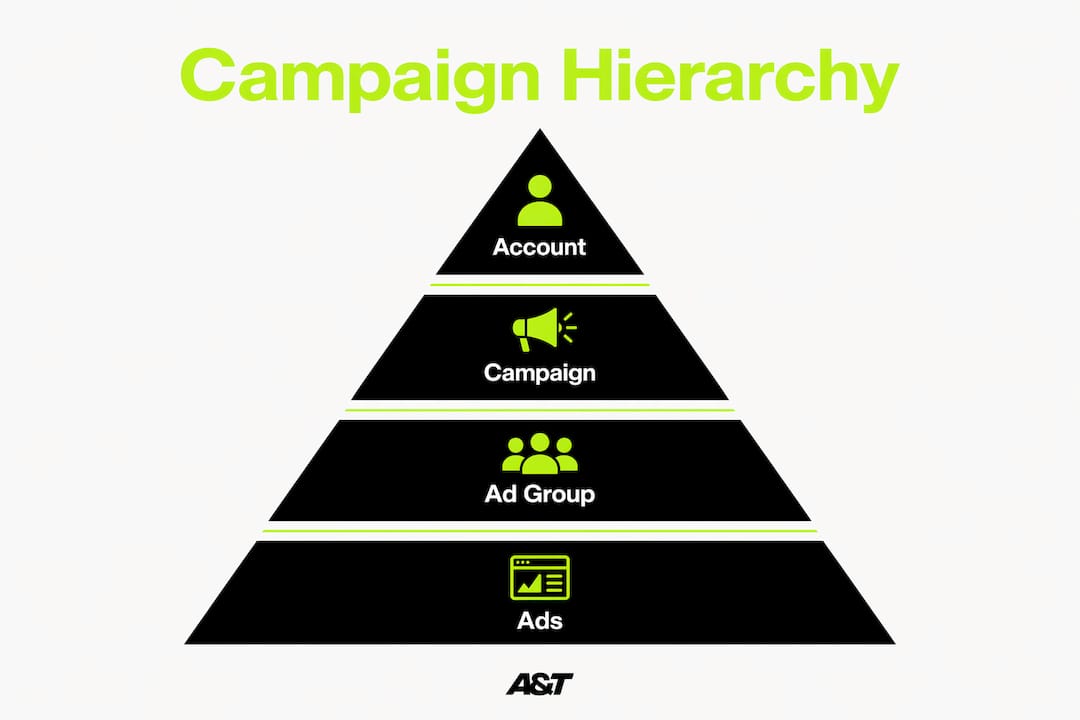
The advertising hierarchy on major platforms follows a four-layer, top-down framework: Account, Campaign, Ad Group or Ad Set, and Ads or Creatives. Settings cascade downward, meaning decisions made at the campaign level control what is possible at the ad group and ad level. Think of each layer as a container. The account holds everything. Campaigns hold budgets and objectives. Ad groups hold targeting. Ads hold the creative.
Here is how each layer functions in practice:
Account: The master container. Billing, access permissions, and conversion tracking live here.
Campaign: Sets the objective (awareness, traffic, conversions), budget, and bidding strategy. This is where you define what success looks like.
Ad Group or Ad Set: Groups related keywords or audiences. Controls targeting parameters within the campaign's budget.
Ads or Creatives: The actual content shown to users. Performance data at this level feeds back up to inform the algorithm.
The cascade matters. A campaign set to "Maximize Conversions" with a $50 daily budget limits every ad group inside it to compete within that constraint. Change the objective at the campaign level and every ad beneath it shifts accordingly.
Platform | Campaign Level | Ad Group Level | Ad Level |
|---|---|---|---|
Google Ads | Objective, budget, bidding | Keywords, audiences | Text, responsive, display |
Meta Ads | Objective, budget type | Audience, placement | Image, video, carousel |
Microsoft Ads | Objective, budget, bidding | Keywords, audiences | Text, responsive |

Pro Tip: On Meta Ads, you can set budgets at the campaign level using Campaign Budget Optimization (CBO) or at the ad set level. CBO lets Meta distribute spend across ad sets automatically, which works well once your structure is clean and your ad sets are not overlapping.
How does campaign hierarchy affect machine learning and optimization?
Campaign structure is the foundation for Google Ads performance, directly impacting Smart Bidding, Performance Max, and audience targeting effectiveness. The algorithm learns from conversion signals. When your structure is fragmented, those signals get split across too many campaigns, and the algorithm cannot learn fast enough to bid accurately.
This problem has a name: signal starvation. Signal starvation occurs when too many campaigns divide conversions, impairing the machine learning that requires volume to optimize efficiently. A campaign with three conversions per month teaches the algorithm almost nothing. A campaign with 40 conversions per month gives it real data to work with.
The threshold matters. Algorithms generally require 30–50 conversions per campaign monthly to exit the learning phase and optimize reliably. Below that threshold, Smart Bidding is essentially guessing. That means your budget is being spent on guesses.
The practical implication for campaign organization levels is this: use ad groups for segmentation, not separate campaigns, unless you have a specific reason to separate budgets or objectives. Consolidating ad groups and campaigns improves data density and algorithmic learning. More data per campaign means faster learning, better bids, and lower cost per conversion.
Fragmented structure = split signals = slower learning = worse results
Consolidated structure = dense signals = faster learning = better bids
The fix is structural, not tactical
Pro Tip: Before splitting a campaign into two, ask whether each new campaign will hit 30 conversions per month on its own. If the answer is no, use an ad group instead. This single question prevents most signal starvation problems.
For a deeper look at how hierarchy affects Meta campaign performance, the same principles apply across platforms.
Common mistakes in campaign hierarchy and how to avoid them
The most damaging mistake in campaign structure is over-segmentation. A fractured account structure cannot be fixed by micro-optimizations. Structural flaws cause algorithm confusion, making bid adjustments and creative tests ineffective until the hierarchy itself is corrected. Marketers often spend weeks tweaking bids on a campaign that simply does not have enough data to respond.
Here are the four most common hierarchy mistakes and how to fix them:
Over-segmentation by product or audience. Running 20 campaigns when 5 would do splits your conversion volume too thin. Consolidate campaigns with similar objectives and use ad groups to separate audiences or products.
Inconsistent naming conventions. A campaign named "Brand_Search_US_Q1" and another named "brand search usa jan" are the same thing to a human but chaos in a reporting filter. Pick a format and enforce it across every campaign.
Conflicting conversion goals. Campaigns should have clear boundaries and exclusive negative keyword lists to avoid competing for the same auctions. Two campaigns bidding on the same keywords with different goals will cannibalize each other's budget.
No negative keyword strategy. Without negatives, campaigns bleed into each other's territory. This creates bidding conflicts and inflates cost per click without improving results.
Pro Tip: Run a search term report monthly and cross-reference it across campaigns. If the same search term appears in two campaigns, you have a boundary problem. Add negatives to the campaign where that term should not appear.
How to organize campaigns to align with marketing goals
Effective campaign organization starts with a single question: what is the business objective this campaign must serve? The answer determines the segmentation logic. Budget allocation flows downward from campaign to ad groups based on competitiveness and the volume of ad sets or keywords. Get the campaign objective wrong and the budget flows in the wrong direction.
The four most common segmentation approaches are:
By funnel stage: Separate campaigns for awareness, consideration, and conversion. Each stage needs a different objective, bid strategy, and creative. Mixing funnel stages in one campaign confuses the algorithm.
By product line or service: If you sell three distinct products with different margins and conversion rates, separate campaigns let you control budget and bidding per product.
By geography: Markets with different languages, price points, or competition levels benefit from separate campaigns. A campaign targeting New York and rural Kansas with the same bid is wasting money in one of those markets.
By audience type: Prospecting campaigns and retargeting campaigns have fundamentally different goals. Keeping them separate gives you clean data and clear budget control.
Organized ad groupsenable ads to match specific keywords, which boosts click-through rates and improves what the algorithm learns about user behavior. Within each campaign, group keywords or audiences by theme. A single ad group should represent one clear intent or audience segment, not a catch-all bucket.
For practical guidance on planning digital campaigns that align structure with growth goals, the same segmentation logic applies whether you are running paid or organic programs.
Tools and best practices for managing campaign hierarchies
Clean hierarchy management at scale requires two things: a naming system and a reporting system. Without both, even a well-built structure becomes unmanageable as campaigns multiply.
Naming conventions like CampaignType_Objective_TargetAudience_Date are critical for scalable campaign management and automation. Consistent naming speeds up filtering, reporting, and bulk changes, saving hours of manual data cleaning each month. A name like "Search_Conversions_Retargeting_2026Q2" tells you the channel, goal, audience, and time period at a glance.
Beyond naming, these practices keep hierarchy clear at scale:
Segment your reporting by hierarchy level. Review account-level trends weekly, campaign-level performance biweekly, and ad group or ad-level data when diagnosing specific issues.
Use labels in Google Ads and Meta Ads. Labels let you tag campaigns by funnel stage, test status, or budget tier without changing the campaign name.
Automate with rules. Clean hierarchy enables automation. Campaigns with consistent naming and clear objectives can use automated rules to pause underperformers, adjust bids, or flag anomalies without manual review.
Audit structure quarterly. Campaigns accumulate clutter. A quarterly audit removes duplicate ad groups, consolidates thin campaigns, and updates negative keyword lists.
Well-enforced naming conventions also facilitate automated campaign management at scale by enabling targeted reporting, filtering, and bulk edits. This is not a cosmetic preference. It is a functional requirement for any account running more than 10 active campaigns.
Pro Tip: Build your naming convention in a shared document before launching any campaign. Include the format, approved abbreviations, and examples. When a new team member or contractor joins, the naming system is already documented and enforced.
For a broader view of top ad management platforms that support hierarchy visualization and reporting, platform choice matters as your account scales.
Key Takeaways
A well-built campaign hierarchy is the single most important structural decision in paid media. Without it, machine learning cannot function, budgets leak, and no amount of bid adjustment fixes the underlying problem.
Point | Details |
|---|---|
Four-layer structure | Every major platform uses Account, Campaign, Ad Group, and Ad levels with settings cascading downward. |
Signal starvation threshold | Campaigns need 30–50 monthly conversions to exit the learning phase and optimize reliably. |
Consolidate before segmenting | Use ad groups for segmentation unless distinct budgets or objectives require a separate campaign. |
Naming conventions matter | A consistent naming format like CampaignType_Objective_Audience_Date enables automation and clean reporting. |
Audit quarterly | Remove duplicate ad groups, consolidate thin campaigns, and refresh negative keyword lists every quarter. |
Why structure beats tactics every time
I have audited accounts where the client was convinced their creative was the problem. They had tested dozens of ad variations, cycled through multiple copywriters, and still saw flat results. The real issue was always the same: 15 campaigns splitting 40 monthly conversions across the account. No creative test can fix that.
The mindset shift that changes everything is moving from "what should I tweak?" to "is my structure giving the algorithm what it needs?" Once you make that shift, the decisions become clearer. You stop chasing marginal bid adjustments and start asking whether your campaigns have enough volume to learn. You stop creating new campaigns for every audience segment and start using ad groups the way they were designed.
The other thing I have learned is that hierarchy is not a one-time setup. It needs to evolve as your business changes. A structure built for a $5,000 monthly budget looks very different from one built for $50,000. What worked at launch may actively hurt performance six months later. The accounts that perform consistently are the ones with owners who review structure, not just metrics.
If you want to go deeper on campaign optimization tactics that build on a clean structure, that is where the real performance gains live.
— Ann
How A&T agency can help you build a campaign structure that performs
A&T Digital specializes in performance marketing across Google Ads and Meta, with a focus on building paid ad systems that are structured to scale. The team audits existing account hierarchies, identifies signal starvation, consolidates fragmented campaigns, and rebuilds structures aligned with your actual business objectives. Every engagement starts with a clear picture of what your current structure is doing and what it should be doing. If your campaigns are running but not learning, the problem is almost always structural. A&T Digital fixes that at the foundation, not the surface.
FAQ
What is campaign hierarchy in simple terms?
Campaign hierarchy is the layered structure of an advertising account, organized from Account down to Campaign, Ad Group, and Ad. Each level controls settings and data for the levels below it.
How does campaign hierarchy affect ad performance?
A well-built hierarchy gives the algorithm enough conversion data per campaign to optimize bids accurately. Fragmented structures split that data too thin, causing signal starvation and poor performance.
How many campaigns should I run at once?
Run as few campaigns as your objectives require. Each campaign should realistically generate 30–50 conversions per month. If it cannot, consolidate it with a similar campaign and use ad groups for segmentation.
What is the difference between a campaign and an ad group?
A campaign sets the budget, objective, and bidding strategy. An ad group organizes keywords or audiences within that campaign. Use campaigns to separate distinct goals or budgets, and ad groups to separate themes within the same goal.
Can hierarchy affect campaign success?
Yes. A fractured campaign structure is one of the leading causes of poor Google Ads and Meta Ads performance. Structural flaws prevent machine learning from functioning correctly, which no amount of creative testing or bid adjustment can overcome.