Why Analyze Competitor Campaigns: A Marketerʼs Guide
Posted on
Marketing
Posted at

Competitor campaign analysis involves examining rivals' advertising strategies to inform your own marketing decisions. It replaces guesswork with evidence by analyzing long-running ads and identifying patterns in creative, budget, and messaging tactics. Regular analysis helps teams stay proactive, optimize campaigns, and discover market gaps for strategic advantage.
Competitor campaign analysis is the practice of systematically examining rivals' advertising strategies, creative executions, and channel choices to extract intelligence that sharpens your own marketing decisions. If you've ever wondered why analyze competitor campaigns matters beyond simple curiosity, the answer is direct: it replaces guesswork with evidence. Platforms like Meta Ad Library and TikTok Creative Center make this research accessible to any marketing team. The marketers who do it consistently outpace those who rely on instinct alone.
Why analyze competitor campaigns: core insights youʼll gain
Studying competitor campaigns is not about copying. It's about reading the market through the lens of what's already working. When a competitor runs the same ad for 30 or more days, that's a signal. Only 15–20% of ads in platform libraries qualify as high-signal, meaning the vast majority are tests, not proven performers. That filter alone saves you weeks of misdirected creative work.
Here's what structured competitor research actually reveals:
Winning creative patterns. Repeated visual formats, hooks, and offer structures signal what resonates with a shared audience. If three competitors all lead with a price anchor in their Meta ads, that's a market-wide creative signal worth testing.
Budget priorities. Campaign duration and variation volume indicate where competitors are concentrating spend. A competitor running 12 variations of a single product ad is telling you that product is their growth priority.
Market gaps. When you map competitor messaging, you see what they're not saying. Those silences are positioning opportunities. If no one in your category addresses a specific pain point, you own that angle by default.
AI visibility gaps. Proactive monitoring of where competitors appear in AI-generated search results can turn white spaces into positioning wins within two quarters. This is one of the most underused benefits of competitor analysis in 2026.
"In marketing like in chess, those who calculate their moves ahead win." Competitor campaign analysis is how you calculate.
Understanding competitor tactics at this level shifts your team from reactive to deliberate. You stop chasing trends and start setting them.
How do you filter competitor ads for real intelligence?
Viewing competitor ads is not the same as analyzing them. Good analysis extracts commercial intent and strategic priorities, not just surface-level creative assets. A screenshot collection is not a strategy.
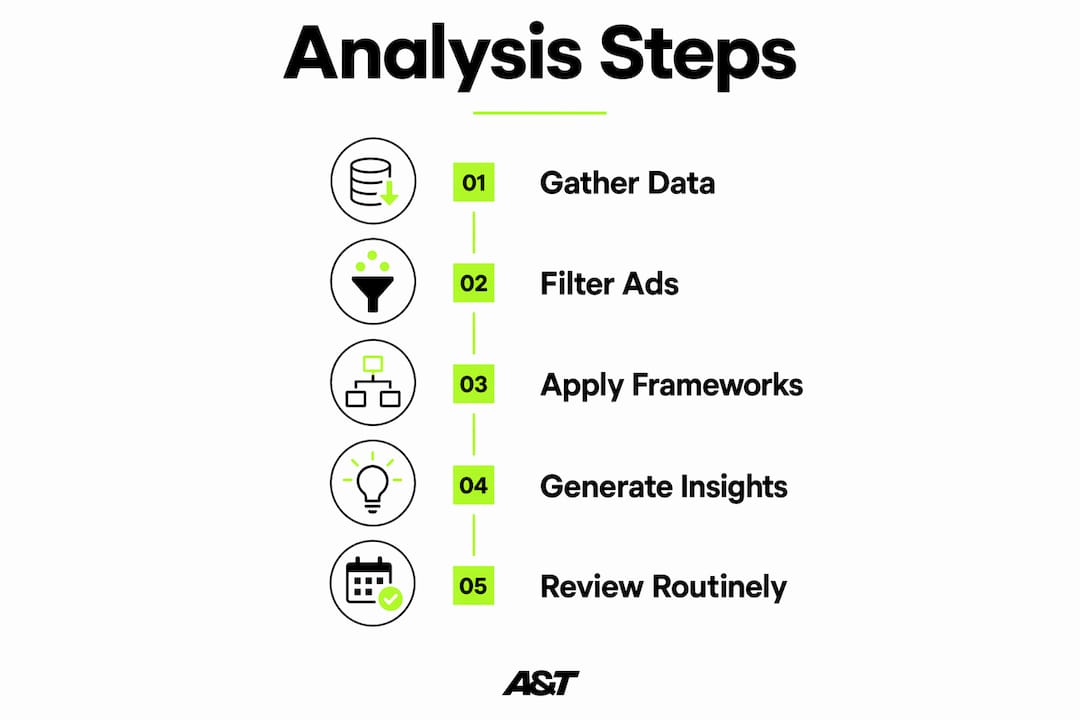
Here's a practical four-step workflow for turning raw competitor data into usable intelligence:
Filter aggressively by run duration. Only study ads that have been active for 30 or more days. Short-run ads are tests. Long-run ads are investments. Filtering this way saves hours and improves the quality of every insight you extract.
Look for variation patterns. A competitor running multiple versions of the same core message is scaling a winner. Note the angle, the format, and the offer structure. That's the hypothesis worth testing on your side.
Convert findings into creative briefs. Don't write reports. Write briefs. Every insight should map to a testable concept your creative team can execute within one sprint cycle. Weekly workflow cycles allow faster validation and scaling of winning concepts.
Build a recurring review cadence. One-time audits decay fast. Set a monthly or biweekly review to catch new campaigns before they dominate. Assign ownership so the workflow doesn't collapse after the first cycle.
Pro Tip: Patterns of avoidance reveal strategy as clearly as patterns of emphasis. If a competitor never mentions price, they're signaling a premium positioning play. If they never mention speed, that's your opening.
The goal is to avoid what practitioners call the "documentation trap." Treating analysis as an ongoing process that feeds creative briefs and testable concepts, rather than static reports, is what separates teams that learn from teams that just observe.

Which frameworks and tools work best for this research?
Structured competitor campaign research requires both the right tools and the right frameworks. Using the wrong combination produces noise, not intelligence.
Tool or Framework | Best Use | Limitation |
|---|---|---|
Meta Ad Library | Free access to active Facebook and Instagram ads | No performance data, only creative and run dates |
TikTok Creative Center | Top-performing TikTok ads by category and region | Limited to TikTok ecosystem |
LinkedIn Ad Library | B2B campaign research by company | Sparse data on smaller advertisers |
Porter's Five Forces | Industry-level competitive positioning | Too broad for campaign-level creative decisions |
Strategic Group Analysis | Mapping competitors by strategy cluster | Requires significant research time to build accurately |
Enterprise competitive intelligence recognizes three data tiers: public data (Tier 1), analyst reports (Tier 2), and primary research (Tier 3). Public ad libraries are Tier 1. They're free, fast, and sufficient for most campaign-level decisions. Tier 3 primary research, such as customer interviews and win/loss analysis, delivers decision-grade insights but requires more resources.
For most marketing teams, using two analytical frameworks per review cycle increases insight quality without adding unnecessary complexity. Pair a broad framework like Porter's Five Forces for context with a tactical tool like Meta Ad Library for execution-level data. That combination covers both strategic positioning and creative direction.
Scope creep is the biggest risk in this process. Failure in competitive intelligence often stems from one-time reports and expanding scope. Define your research boundaries before you start. Limit each cycle to two or three direct competitors and three to five specific questions you need answered.
For a deeper look at how competitor presence in AI search results factors into this research, the SEO competitor analysis guide from BabyLove Growth covers AI visibility tracking in practical detail.
What are the real benefits of competitor campaign analysis?
The practical benefits of analyzing competitor campaigns go well beyond creative inspiration. They affect budget allocation, sales cycle length, and overall campaign ROI.
Smarter ad spend decisions. Rigorous competitive analysis guides resource allocation and enables strategic ad spend shifts. Mid-market firms that apply this approach see measurable impact within two quarters. You stop funding channels your competitors have already proven don't work.
Shorter sales cycles. When your messaging clearly differentiates from competitors, prospects make faster decisions. Clear competitor pricing knowledge increases seller confidence and win rates. That clarity comes directly from knowing what competitors are and aren't communicating.
Stronger creative strategy. Competitor research reveals which hooks, formats, and offers your shared audience already responds to. That's not copying. That's market research with a faster feedback loop. Pair these findings with your own creative strategy to build campaigns that stand out rather than blend in.
Avoiding costly mistakes. Knowing what competitors are spending on tells you what's already saturated. You avoid entering a bidding war on keywords or placements where the margin is already compressed.
Pro Tip: Never copy a competitor ad directly. Instead, identify the underlying mechanism: the fear it addresses, the desire it activates, or the objection it handles. Then build your own version of that mechanism with your brand's voice and offer.
One counterintuitive benefit of competitor analysis: it validates your market. No competition usually signals a market education challenge. Competitors help confirm that demand exists and that paid channels are viable. Seeing them spend consistently is a green light, not a warning sign.
Understanding ad relevance in campaign performance becomes sharper when you know what your competitors are running. You can position your creative to score higher on relevance by addressing angles they're ignoring.
Key takeaways
Competitor campaign analysis works because it replaces assumption with market evidence, turning creative decisions into tested, data-informed investments.
Point | Details |
|---|---|
Filter for high-signal ads | Only study ads running 30 or more days; they represent real investment, not tests. |
Convert insights into briefs | Every finding should map to a testable creative concept, not a static report. |
Use two frameworks per cycle | Pair a broad framework with a tactical tool to cover both strategy and execution. |
Monitor AI visibility gaps | Track where competitors appear in AI results to find positioning opportunities. |
Analysis validates your market | Active competitor spending confirms demand exists and paid channels are viable. |
What Iʼve learned from running this process every month
I've been running competitor campaign reviews for clients across telehealth, retail, and entertainment for years. The single biggest mistake I see is treating this as a quarterly project. Markets move faster than that. A competitor can test, validate, and scale a new angle in six weeks. If you're reviewing quarterly, you're always behind.
The second mistake is confusing volume with insight. I've seen teams pull 200 competitor ads and produce a 40-slide deck that no one acts on. The better approach is to pull 20 ads, filter down to the 3–4 that have been running the longest, and ask one question: what is this ad doing that ours isn't? That question produces a brief. A brief produces a test. A test produces data.
The uncomfortable truth is that most competitor analysis is done to feel informed, not to act. The teams that actually benefit are the ones who connect every finding to a specific campaign decision within the same week. Analysis without a deadline is just research theater.
I'd also caution against over-indexing on what competitors are doing at the expense of what your customers actually need. Competitor data is a signal, not a directive. The best campaigns I've seen come from teams that used competitor research to identify a gap and then filled it with something original. That's the combination that wins.
— Ann
Ready to put competitor intelligence to work?
Atdigiagency builds and manages paid ad systems on Google Ads and Meta that are grounded in real market data, including structured competitor research. Our team integrates competitor campaign intelligence directly into creative development and budget planning, so your spend reflects what the market has already validated. We work with small to mid-sized businesses that need campaigns built to convert, not just to run. If you want a performance marketing team that treats competitor analysis as a standard part of the process, not an afterthought, explore our paid ads service and let's build something that works.
FAQ
What does competitor campaign analysis actually mean?
Competitor campaign analysis is the structured review of rivals' advertising strategies, creative formats, and channel choices to extract intelligence for your own marketing decisions. It goes beyond viewing ads to identifying patterns in messaging, budget priorities, and market positioning.
How often should you analyze competitor campaigns?
Monthly review cycles are the minimum for fast-moving paid ad markets. Weekly cycles work best for teams actively testing new creative, since weekly workflow cadences allow faster validation and scaling of winning concepts.
Which tools are best for analyzing competitor ads?
Meta Ad Library, TikTok Creative Center, and LinkedIn Ad Library are the most accessible free tools for campaign-level research. Third-party platforms add performance estimates, but public libraries are sufficient for most creative and positioning decisions.
How do you avoid copying competitors instead of learning from them?
Focus on the mechanism behind the ad, not the execution. Identify the fear, desire, or objection the ad addresses, then build your own version using your brand's voice and differentiated offer.
Does competitor analysis work for small businesses?
Yes. Small businesses benefit most from competitor analysis because it reduces the cost of market testing. Seeing what larger competitors have already validated lets smaller teams allocate limited budgets toward proven angles rather than unproven experiments.