Unlock campaign success with creative strategy in 2026
Posted on
Marketing
Posted at

Small businesses pour thousands into ads that generate clicks but few conversions. The problem isn't lack of creativity—it's the absence of strategic alignment. Creative strategy bridges this gap by connecting audience insights, business goals, and campaign execution into a cohesive plan that drives measurable results and maximizes ROI.
Table of Contents
How Data And Creativity Combine To Boost Campaign Performance
Key Components Of An Effective Creative Strategy For Small Businesses
Enhance Your Campaigns With Expert Creative Strategy Support
Key takeaways
Point | Details |
|---|---|
Strategic creativity drives results | Data-informed creative decisions boost engagement by 30% and ROI by 20% compared to unstructured approaches. |
Personalization increases conversions | Tailored creative content based on audience segmentation improves conversion rates by 15%. |
Testing optimizes performance | A/B testing creative elements improves click-through rates by 10-20% and conversions by 5-15%. |
Consistent branding builds trust | Unified creative execution across channels increases revenue by up to 23%. |
AI enhances structured execution | Organizations using generative AI in marketing see 66% revenue increases through structured creative processes. |
What is creative strategy and why it matters
Creative strategy transforms abstract business objectives into concrete creative decisions that resonate with your audience. It's the blueprint connecting what you want to achieve with how you communicate it through visuals, messaging, and channel selection.
Many marketers confuse creative strategy with simply producing eye-catching content. Real creative strategy involves strategic planning in marketing ROI by analyzing audience behavior, competitive positioning, and business goals before a single ad is designed. Creative strategy is the blueprint that turns business goals into creative decisions that drive measurable results.
Effective creative strategy balances three essential elements:
Deep audience understanding through behavioral data and psychographic insights
Clear commercial objectives tied to revenue, leads, or brand awareness metrics
Creative execution that emotionally connects while supporting measurable outcomes
The most common pitfall? Prioritizing creativity without strategic foundations or relying solely on data without emotional appeal. Beautiful ads that don't align with audience needs waste budgets. Data-driven campaigns lacking creative spark fail to capture attention in crowded digital spaces.
Dr. John Smith, Professor of Marketing at Stanford University, emphasizes: "Creative strategy is not just about making pretty ads; it's about crafting experiences that resonate and drive results." This distinction matters because small businesses can't afford campaigns that look good but don't convert.
Pro Tip: Document your creative strategy before production begins. A one-page brief outlining audience insights, core message, desired action, and success metrics keeps teams aligned and prevents scope creep.
How data and creativity combine to boost campaign performance
The tension between data and creativity is false. Top-performing campaigns use analytics to inform which stories to tell and how to tell them, then measure creative impact to refine continuously.

Data analytics reveals patterns in audience behavior, purchase triggers, and content preferences. These insights guide creative decisions about messaging tone, visual style, and offer positioning. Organizations using generative AI in marketing see 66% revenue increases by structured, data-led execution that removes guesswork from creative development.
Technology enhances creative strategy through:
Predictive analytics identifying which creative themes resonate with specific segments
Dynamic creative optimization automatically matching ad variations to audience preferences
Sentiment analysis revealing emotional responses to messaging and visual elements
Attribution modeling connecting creative decisions to revenue outcomes
Campaigns integrating creative storytelling and strategic targeting achieve up to 30% higher engagement rates compared to campaigns using either approach alone. The magic happens when emotional narratives align with precision targeting based on behavioral data.
Consider the performance difference:
Approach | Average CTR | Conversion Rate | ROI Lift |
|---|---|---|---|
Creative only | 1.2% | 2.1% | Baseline |
Data only | 1.8% | 2.8% | +15% |
Combined strategy | 2.3% | 3.6% | +35% |
Data-driven creative strategies result in 20% higher ROIon average because they eliminate the waste of untested assumptions. You're not guessing what might work—you're building on proven insights while maintaining creative differentiation.
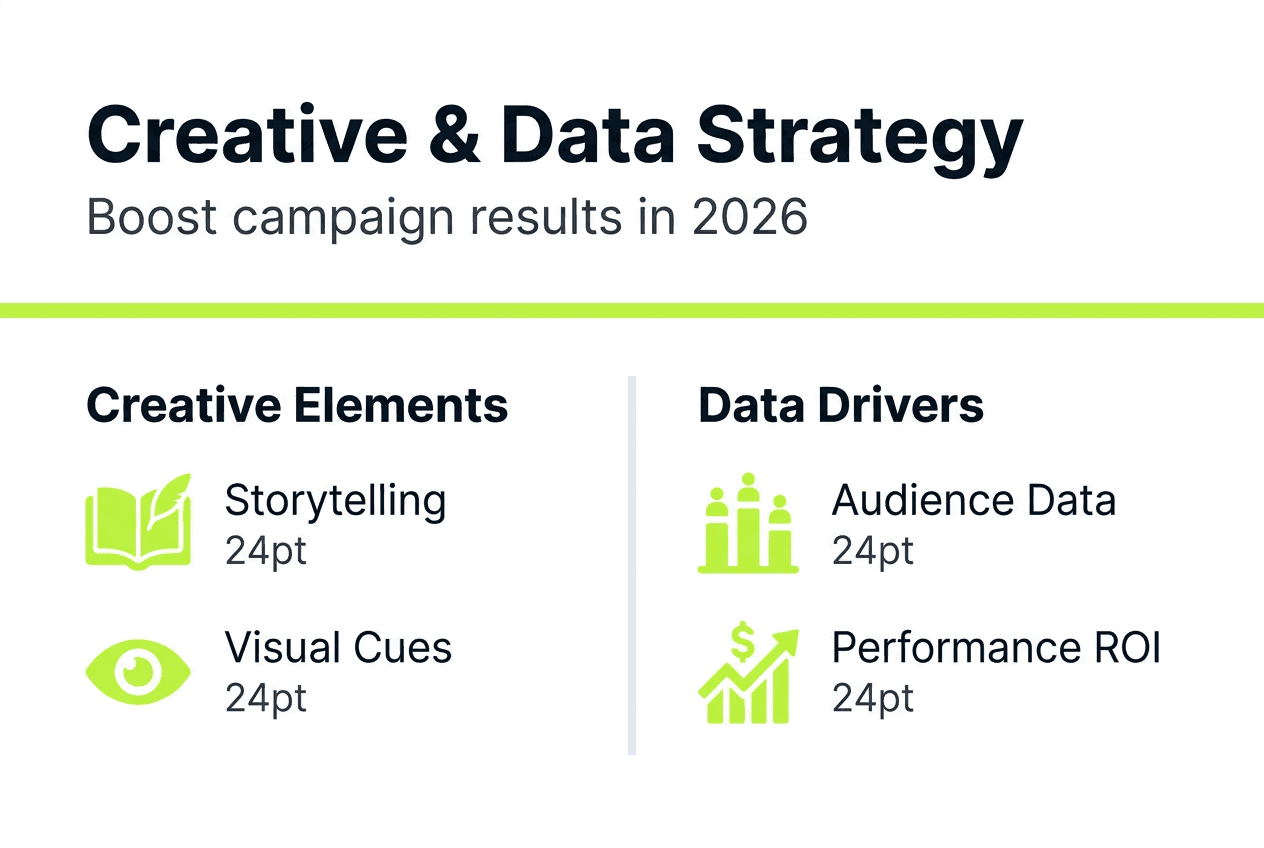
The key is balancing structure with flexibility. Use data to understand why personalize ad campaigns ROI improves, but allow creative teams room to interpret those insights in unexpected ways. Rigid adherence to data kills innovation; ignoring data wastes resources.
Pro Tip: Create audience personas based on actual customer data, not assumptions. Then challenge your creative team to develop three dramatically different campaign concepts for each persona. Test all variations to discover which creative approach data didn't predict.
Key components of an effective creative strategy for small businesses
Building an effective creative strategy requires focusing on elements that directly impact campaign performance. Small businesses need frameworks that are comprehensive yet manageable without large marketing teams.
Audience understanding through segmentation: Divide your target market based on behavioral data, demographics, and psychographics. Personalized creative content boosts conversion rates by 15% because messaging speaks directly to specific needs and pain points. Map customer journeys to identify which creative messages work best at awareness, consideration, and decision stages.
Alignment with business objectives: Every creative decision should trace back to measurable business goals. If your objective is lead generation, creative strategy emphasizes capturing contact information through compelling offers. Revenue growth requires creative that highlights product value and competitive advantages. Understand campaign strategy ROI digital marketing connections before committing to creative directions.
Brand consistency across channels: Unified visual identity, messaging tone, and value propositions build recognition and trust. Consistent branding can increase revenue by up to 23% because audiences develop familiarity that reduces decision friction. Create brand guidelines covering logo usage, color palettes, typography, and voice principles that inform all creative executions.
Strategic storytelling with emotional appeal: Data informs which stories to tell, but emotion drives action. Develop narratives that connect product benefits to customer aspirations or problem resolution. Use testimonials, case studies, and before-after scenarios that demonstrate transformation while remaining authentic to your brand values.
Testing protocols for optimization: Plan systematic testing of creative elements before full launch. Well-defined creative strategies can increase click-through rates by 20% and conversion rates by 15% through iterative refinement. Document which headlines, visuals, and calls-to-action perform best for future campaign development.
Compare approaches:
Element | Basic Approach | Strategic Approach | Impact |
|---|---|---|---|
Targeting | Broad demographics | Behavioral segmentation | +40% relevance |
Messaging | Generic benefits | Personalized pain points | +25% engagement |
Visuals | Stock imagery | Custom brand assets | +30% recognition |
Testing | Post-launch fixes | Pre-launch validation | +50% efficiency |
Small businesses have an advantage: agility. You can pivot creative strategies faster than large competitors. Use this to test bold creative concepts, learn quickly, and optimize based on real performance data rather than committee opinions.
Pro Tip: Build a swipe file of competitor and industry creative executions. Analyze what makes certain ads memorable or persuasive, then adapt successful patterns to your brand voice. Inspiration differs from imitation—use insights to inform original creative directions.
Optimizing and measuring creative strategy impact
Creative strategy isn't static. Continuous measurement and optimization separate campaigns that plateau from those that scale profitably. Establish systems for evaluating creative performance and implementing improvements systematically.
A/B testing creative elements can improve click-through rates by 10-20% and conversion rates by 5-15% by identifying which variations resonate strongest with your audience. Test one variable at a time for clear insights:
Headlines: Test benefit-focused versus curiosity-driven approaches
Visuals: Compare product-focused images versus lifestyle photography
Calls-to-action: Evaluate urgency-based versus value-based prompts
Color schemes: Test contrast ratios and emotional associations
Ad formats: Compare static images, carousels, and video content
Track metrics that directly connect creative decisions to business outcomes:
Metric | What It Reveals | Optimization Action |
|---|---|---|
Click-through rate | Creative relevance and appeal | Refine headlines and visuals |
Conversion rate | Message-market fit | Adjust value propositions |
Cost per acquisition | Campaign efficiency | Reallocate budget to top performers |
Engagement rate | Audience interest depth | Enhance storytelling elements |
Return on ad spend | Overall creative ROI | Scale winning creative themes |
Regular analysis of campaign data refines creative strategiesto adapt to market trends, seasonal shifts, and competitive dynamics. Review performance weekly for paid campaigns, adjusting creative rotation based on fatigue indicators like declining engagement rates.
Customer journey mapping enhances creative strategy by revealing how different creative messages perform at various funnel stages. Awareness-stage creative prioritizes brand differentiation and problem identification. Consideration-stage content emphasizes product benefits and social proof. Decision-stage creative removes final objections through testimonials and guarantees.
Implement structured feedback loops:
Monitor comment sections and customer service inquiries for messaging insights
Survey customers about which creative elements influenced their decision
Analyze heat maps showing which ad components attract attention
Review sales team feedback on lead quality from different creative campaigns
Understand why test paid campaigns ROI matters and why optimize ad campaigns ROI drives sustainable growth. Testing provides the insights; optimization implements them systematically.
Pro Tip: Small businesses can pivot faster than large competitors. When testing reveals a winning creative approach, scale it immediately while monitoring for audience fatigue. Prepare new variations before performance declines to maintain momentum.
Enhance your campaigns with expert creative strategy support
Developing effective creative strategies requires balancing analytical rigor with creative intuition. Many small businesses lack the internal resources to execute both effectively while managing daily operations.
Professional Google Ads management and Meta Ads management services provide access to experienced strategists who've optimized creative campaigns across industries. These experts bring proven frameworks for audience segmentation, creative development, and performance optimization that accelerate results.
Partnering with specialists in performance marketing guide boost ROI proven tactics allows you to focus on core business operations while ensuring your marketing investment generates maximum returns. Expert teams handle everything from initial creative strategy development through testing, optimization, and scaling successful campaigns across multiple channels.
Frequently asked questions
What is the main difference between creative strategy and marketing strategy?
Marketing strategy defines your overall approach including target markets, positioning, pricing, and distribution channels. Creative strategy focuses specifically on how you communicate with audiences through messaging, visuals, and storytelling to support those broader marketing objectives. Creative strategy translates marketing goals into actionable creative decisions that resonate emotionally while driving measurable results.
How can small businesses balance creativity and data in their campaigns?
Start with audience data to understand behavioral patterns and preferences, then use those insights to guide creative storytelling that connects emotionally. Test multiple creative variations to identify which approaches resonate best with specific segments. Maintain agility to adjust strategies quickly based on performance data while preserving authentic brand voice and creative differentiation.
What are the most effective creative elements to test in a campaign?
Headlines, visuals, and calls-to-action deliver the highest impact when tested systematically. Headlines determine whether audiences engage with your message initially. Visuals capture attention and communicate brand personality instantly. Calls-to-action directly influence conversion rates by clarifying the desired next step. Testing these three elements can improve click-through rates by 10-20% and conversions by 5-15% through continuous optimization.
How long does it take to see results from improved creative strategy?
Initial performance indicators like click-through rates and engagement metrics typically show improvement within one to two weeks of implementing strategic creative changes. Conversion rate improvements and ROI gains often become measurable within four to six weeks as sufficient data accumulates for statistical significance. Long-term brand building through consistent creative strategy requires three to six months to demonstrate full impact on revenue and customer acquisition costs.
Do I need a large budget to implement effective creative strategy?
Effective creative strategy depends more on strategic thinking than budget size. Small businesses often achieve better results by focusing resources on well-researched, targeted creative campaigns rather than spreading budgets across untested approaches. Start with thorough audience research, develop clear creative hypotheses, test systematically with modest budgets, then scale investments in proven creative concepts. Strategic efficiency matters more than total spend for maximizing ROI.