Why Test Campaign Timing: A 2026 Guide for Marketers
Posted on
Marketing
Posted at

Testing campaign timing through structured experiments can significantly boost engagement and conversions by identifying optimal delivery windows. Many marketers overlook timing, leading to inflated costs and skewed data, but reliable results require controlling variables, avoiding biases, and running tests over multiple cycles. Matching timing strategies to buying cycles and operational realities ensures that advertising efforts lead to genuine results.
Campaign timing testing is the practice of systematically experimenting with when your ads and messages are delivered to determine which moments drive the highest engagement and conversions. Most marketing teams focus heavily on creative and targeting while treating timing as an afterthought. That's a costly mistake. Research shows a 15% minimum engagement lift is achievable simply by optimizing delivery windows, and platforms like Meta Ads and Google Ads each carry their own timing dynamics that compound or cancel out your results. Understanding why test campaign timing matters is the difference between spending on reach and spending on results.
Why testing campaign timing directly affects performance
The relationship between timing and campaign outcomes is not theoretical. It is measurable, platform-specific, and often counterintuitive. When you run ads at the wrong time, you do not just get fewer clicks. You get distorted data, inflated costs, and conclusions that lead your next campaign in the wrong direction.

On Meta Ads, for example, weekend late-night delivery between 11 PM and 3 AM UTC can cause infrastructure delays exceeding eight hours. That means an ad you scheduled for Saturday night may not reach your audience until Sunday morning, shifting your performance window entirely without any signal in the platform dashboard. If you are measuring results against the scheduled time rather than actual delivery, your timing data is wrong from the start.
The effects of timing on campaigns extend beyond delivery mechanics. Audience behavior shifts by day, hour, and even season. A B2B software buyer browsing LinkedIn at 7 AM Tuesday is in a fundamentally different decision state than the same person scrolling Instagram at 10 PM Friday. Timing tests let you isolate those behavioral windows and match your message to the moment your audience is most receptive.
Key performance indicators that shift with timing include:
Click-through rate (CTR): Audiences in active decision-making windows click more.
Cost per click (CPC): Off-peak windows often carry lower auction competition.
Conversion rate: Lower-funnel intent spikes at predictable times for most verticals.
Return on ad spend (ROAS): Timing-optimized campaigns consistently outperform unoptimized baselines when creative and targeting are held constant.
Data-driven timing strategies must integrate commercial context, customer behavior data, and platform analytics together. Relying on any single source, especially platform efficiency reports, can push you toward lower-funnel intent windows that look efficient but do not represent your full audience opportunity.
What are the common pitfalls when testing campaign timing?
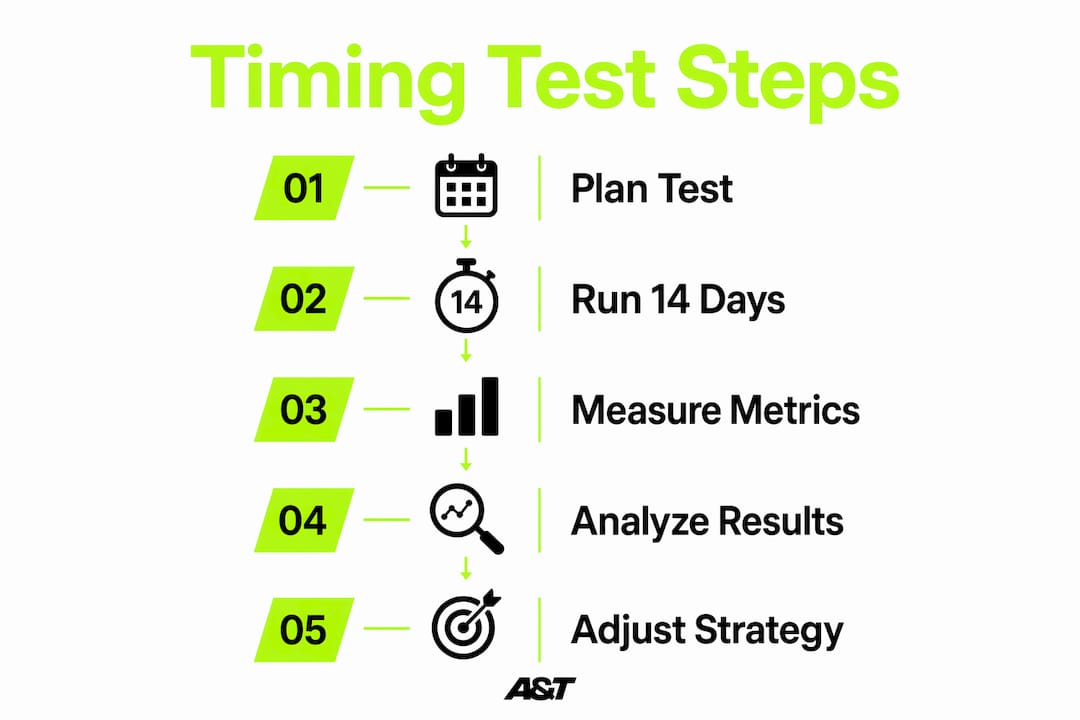
Most timing tests fail not because the concept is flawed, but because the execution introduces errors that corrupt the data. Knowing these pitfalls before you design your test saves weeks of wasted effort.
Confusing delivery speed with timing effect. ISP throttling delays batch email deliveries in ways that shift when messages actually land in inboxes. If your test group receives emails 45 minutes after your control group simply due to server load, any performance difference reflects delivery infrastructure, not timing preference. This is one of the most common and least-discussed errors in send-time optimization.
Machine-inflated open rates. Apple's Mail Privacy Protection (MPP) and similar technologies pre-load email content, registering opens that no human ever initiated. Open rates inflated by MPP make certain send times appear dramatically more effective than they are. One agency spent three months optimizing send times based on open rate data, only to discover the winning window was driven entirely by machine opens, not human engagement.
The novelty effect. When you introduce a new creative variant or a new send time, early performance inflates for 24 to 72 hours due to audience novelty. If you stop a test after two days because one timing window looks like a clear winner, you are likely measuring novelty, not genuine timing advantage. This is peeking bias in action.
Platform data bias toward lower-funnel windows. Google Ads and Meta Ads optimization algorithms favor conversion-dense windows. Their built-in reports will show those windows as your best performers. But that efficiency often reflects existing intent, not timing-driven lift. You are measuring where buyers already were, not where your ads moved them.
Pro Tip: Segment your email test groups into micro-batches to mimic natural delivery curves. This controls for ISP throttling without disrupting your send-time optimization logic, giving you cleaner timing signal from the start.
How to design and analyze robust timing tests
A timing test that produces reliable results requires deliberate structure. Here is a proven framework for building one.
Define your metric before you start. Use click-to-open rate (CTOR) or downstream conversion events rather than raw open rates. CTOR and conversion metrics measure human engagement, not machine activity, making them far more reliable for timing analysis.
Use identical creative across all test groups. Timing is the only variable you are testing. If Group A sees a video ad and Group B sees a static image at a different time, you cannot attribute performance differences to timing alone. Hold creative, audience segment, and budget constant.
Run the test for at least two full business cycles. Two weeks minimum controls for weekday versus weekend traffic variation and accounts for weekly behavioral patterns. Many verticals have Tuesday spikes or Friday drops that a one-week test will misread as timing signal.
Avoid peeking at results mid-test. Premature stopping dramatically increases false positives. Set your evaluation date before the test begins and do not check results until you reach it. Early statistical significance is almost always a mirage.
Normalize for external events. A product launch, a competitor promotion, or a news cycle can shift audience behavior during your test window. Flag those periods and exclude them from your analysis, or extend the test to compensate.
Isolate timing from channel and creative influence. Multi-touch attribution models that integrate timing as a variable give you the clearest picture of how delivery windows interact with other campaign elements.
The table below summarizes the core test design parameters:
Parameter | Recommended standard |
|---|---|
Test duration | Minimum 2 full business cycles (14 days) |
Primary metric | CTOR or downstream conversion rate |
Creative variation | None. Identical across all groups |
External event handling | Flag and exclude or extend test window |
Evaluation timing | Set date before launch. No mid-test peeking |
Pro Tip: After your test concludes, run a cohort analysis segmenting converters by the time they first engaged with your ad. This reveals whether your winning timing window drives new buyers or simply captures existing intent faster.
Continuous presence vs. burst campaigns: which timing strategy wins?
These two approaches represent opposite philosophies about how timing should structure your overall campaign cadence. Testing tells you which one fits your specific buying cycle.
Continuous presence means running ads at consistent, lower intensity across extended periods. The logic is recency. Recency often outperforms frequency for purchase decisions because buyers who encounter your brand close to their decision moment convert at higher rates than buyers who saw your ad frequently but weeks ago. This approach works well for considered purchases, subscription services, and categories where the buying window is unpredictable.
Burst campaigns concentrate budget and delivery into short, high-intensity windows. This suits product launches, seasonal promotions, and events with defined decision deadlines. The risk is that 95% of new products fail partly due to poor timing, and a burst campaign launched outside the audience's active consideration window burns budget without building purchase intent.
The choice between these strategies is not permanent. It is a hypothesis you test. Consider these factors when designing your timing strategy test:
Buying cycle length: Short cycles (impulse purchases, event tickets) favor burst. Long cycles (B2B software, telehealth services) favor continuous presence.
Budget constraints: Continuous presence requires sustained allocation. Burst campaigns allow concentrated spend with recovery periods.
Competitive intensity: High-competition windows during burst periods drive up CPCs. Continuous presence can capture off-peak inventory at lower cost.
Brand awareness level: New brands benefit from burst campaigns to build recognition. Established brands often extract more value from continuous presence near decision moments.
Continuous presence campaigns can outperform burst strategies by maintaining ad recency, but they require careful budget allocation and category-specific testing to confirm the advantage. The only way to know which approach fits your audience is to run a structured campaign timing test with both strategies against the same conversion goal.
Key takeaways
Testing campaign timing is the most underutilized lever in paid advertising, and the marketers who treat it as a structured experiment consistently outperform those who rely on platform defaults.
Point | Details |
|---|---|
Timing affects more than clicks | Delivery windows influence CPC, ROAS, and conversion rate simultaneously. |
Open rates are unreliable | Use CTOR or conversion events to measure true human engagement in timing tests. |
Run tests for at least two weeks | Shorter tests capture novelty effects and weekly variance, not real timing signal. |
Platform data has built-in bias | Efficiency reports favor existing intent windows. Test independently to find true lift. |
Match strategy to buying cycle | Continuous presence suits long cycles. Burst campaigns suit defined decision deadlines. |
What Iʼve learned about timing tests that most guides wonʼt tell you
I have seen timing tests run correctly on paper and still produce misleading conclusions. The reason is almost always the same: the team treated timing as an isolated variable when it was actually entangled with budget pacing, creative fatigue, and audience overlap across channels.
The most common real-world error I encounter is running a Google Ads timing test while a Meta campaign is simultaneously hitting the same audience at different hours. The attribution model credits the last click, the timing test sees a performance difference, and the team concludes that Tuesday mornings are their best window. What actually happened is that the Meta campaign warmed up the audience on Monday evening, and Google captured the intent the next morning. The timing advantage belonged to the sequence, not the hour.
This is why I always push for multi-channel coordination before any timing test begins. If you cannot control the full media environment your audience experiences, your single-channel timing test is measuring noise. That does not mean you should not test. It means you should optimize across channels and document what else is running before you interpret results.
The other thing most guides skip: business context overrides data. I have seen clients with statistically significant timing wins that they could not act on because their sales team was unavailable to follow up on leads during the winning window. A timing test that ignores operational reality produces a recommendation that sits in a slide deck and changes nothing. Build your test around windows you can actually execute before you invest in finding out which one wins.
— Ann
Ready to put your campaign timing to the test?
At Atdigiagency, we build paid ad systems where timing is a deliberate variable, not an assumption. Our team manages Google Ads campaigns and Meta Ads programs with structured testing built into every launch. We track delivery windows, measure human engagement metrics, and adjust cadence based on what the data actually shows, not what the platform dashboard suggests. If you are spending on ads without a timing strategy, you are leaving measurable performance on the table. We can help you find it.
FAQ
Why does campaign timing matter for paid ads?
Campaign timing determines whether your ad reaches your audience when they are ready to act. Delivery windows directly affect CTR, CPC, and conversion rate, making timing one of the highest-leverage variables in any paid campaign.
What metrics should I use to test campaign timing?
Use click-to-open rate (CTOR) and downstream conversion events rather than open rates. Open rates are heavily inflated by machine tracking technologies like Apple's Mail Privacy Protection, which makes them unreliable for timing analysis.
How long should a campaign timing test run?
Run timing tests for a minimum of two full business cycles, typically 14 days. Shorter tests are vulnerable to the novelty effect and weekly traffic variance, both of which produce false winners.
What is the difference between continuous presence and burst campaign timing?
Continuous presence runs ads at steady, lower intensity over extended periods to capture recency near decision moments. Burst campaigns concentrate spend in short, high-intensity windows suited to launches or seasonal promotions with defined deadlines.
Can platform analytics tell me the best time to run my ads?
Platform efficiency reports identify windows where existing buyer intent is highest, but they do not measure timing-driven lift. Independent testing with controlled variables gives you a more accurate picture of which windows your ads actually influence.