The Role of Personalization in Ads: A Marketerʼs Guide
Posted on
Marketing
Posted at

Personalization in ads increases relevance, drives measurable engagement, and lifts conversion rates when it is built on clean first-party data, modular creative, and sound privacy governance. A meta-analysis of 53 experimental studies confirms that perceived relevance, not ad frequency or creative polish alone, is what makes personalized advertising persuasive. Industry data shows companies that execute personalization well generate up to 40% more revenue than those that do not.
The primary ways personalization delivers value:
Relevance: Ads match the user's current intent, context, or stage in the buying cycle.
Reduced media waste: Budget concentrates on audiences most likely to convert.
Conversion lift: Tailored offers and creative outperform generic messages at the decision stage.
Loyalty: Relevant post-purchase messaging extends lifetime value and reduces churn.
Stat: 87% of brands plan to invest more in personalization, and DCO campaigns have produced conversion uplifts of up to 48% in documented implementations.
Table of Contents
What counts as ad personalization, and what does not?
Why personalization matters for real marketing outcomes
How personalized ads actually work, end to end
Personalization strategies and creative examples you can adapt
How to measure whether personalization is actually working
Privacy, ethics, and U.S. regulations you cannot ignore
A practical checklist for implementing personalization at scale
What the research actually says about personalization's effectiveness
Key Takeaways
Why creative-led personalization outperforms data-led personalization alone
A&T Digital builds personalized ad programs that perform
Useful sources and further reading
What counts as ad personalization, and what does not?
Ad personalization means tailoring the message, creative, offer, or timing of an ad to an individual or micro-moment, using behavioral, contextual, or declared signals. It goes beyond placing the same ad in front of a defined demographic bucket.
Personalization vs. segmentation: Segmentation divides an audience into groups and serves each group the same creative. Personalization adapts the creative itself, or the offer within it, based on signals specific to that user or moment. A campaign targeting "women 25–44 interested in fitness" is segmentation. A campaign that shows a user a dynamic ad featuring the exact product category they browsed yesterday, with a headline that reflects their location and the time of day, is personalization.
What personalization includes:
Behavioral retargeting based on site visits, product views, or cart activity
Dynamic Creative Optimization (DCO) that assembles ads from modular components in real time
Contextual personalization that matches ad content to the page or app environment
Lifecycle-triggered messaging tied to where a customer sits in the purchase funnel
Lookalike and propensity-based prospecting using first-party audience signals
What personalization does not include:
Generic demographic-only placements with no signal-based creative adaptation
Broad contextual buys where the same static ad runs across a topic category
Frequency-capped retargeting with no creative variation
Pro Tip: If your "personalized" campaign serves the same creative to everyone in a segment, you are running segmentation, not personalization. The test: does the ad change based on what this specific user did or signaled? If not, there is room to go further.
Why personalization matters for real marketing outcomes
The business case for ad personalization is grounded in measurable outcomes, not theory. Perceived relevance drives persuasiveness more than any other factor in personalized advertising, which means the ROI case starts with getting relevance right, not just with deploying more data.
Stat: Research cited by CDP.com found that personalization can reduce customer acquisition costs substantially and improve marketing spend efficiency.
Benefits tied to measurable KPIs:
Higher CTR from relevance-matched creative and offers
Lower CPA as qualified audiences self-select into the funnel
Improved ROAS when dynamic offers align with purchase intent signals
Stronger LTV through lifecycle-based retention messaging
Use cases by objective:
Awareness: Contextual personalization matches ad content to editorial environment, improving brand recall without requiring behavioral data.
Consideration: Behavioral signals surface the right product category or feature benefit to users who have already shown category interest.
Conversion: Cart-abandonment dynamic ads with personalized offers close the gap between intent and purchase.
Retention: Post-purchase sequences personalized by product category and repurchase cycle reduce churn and increase repeat order rates.
The importance of ad relevance in campaign performance compounds over time. Brands that build relevance into every stage of the funnel see compounding gains in both paid efficiency and organic brand equity.
How personalized ads actually work, end to end
Understanding the mechanics helps decision-makers allocate budget and build the right team before committing to a personalization program.

Data inputs
Data Type | Source | Typical Use |
|---|---|---|
Zero-party | Declared preferences, quizzes, surveys | High-trust personalization with no inference risk |
First-party | CRM, site behavior, purchase history | Core signal for retargeting and lifecycle triggers |
Second-party | Partner data sharing agreements | Audience extension beyond owned channels |
Third-party | Data brokers, audience platforms | Prospecting; declining utility post-cookie deprecation |
Contextual | Page content, app category, time/location | Privacy-safe relevance without user-level tracking |
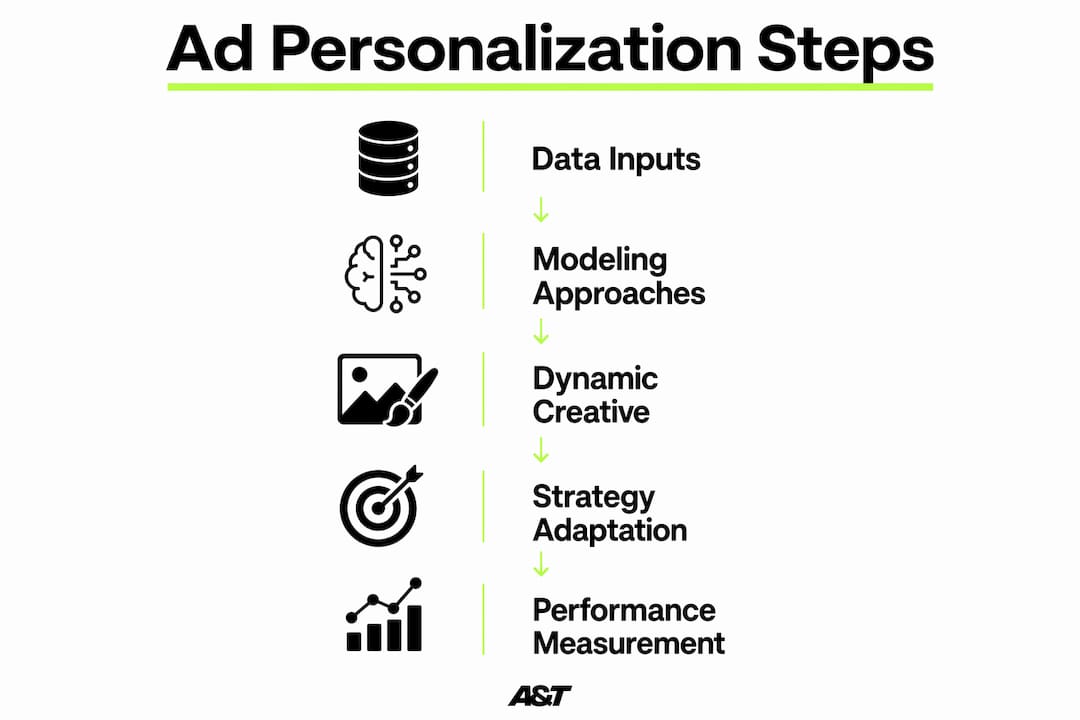
First-party data is now the most durable signal. Third-party cookie deprecation across major browsers has shifted the industry toward owned data assets and contextual targeting as the primary personalization inputs.
Modeling approaches
Rule-based systems apply fixed logic: "If user viewed product X, show ad for product X with a discount." Machine learning models go further, using classification, propensity scoring, and real-time predictive models to determine which creative, offer, and channel combination maximizes the probability of conversion for each user. Lookalike modeling extends first-party audiences to net-new prospects who share behavioral and demographic patterns with existing customers.
Dynamic Creative Optimization
DCO assembles ads from modular components, such as headlines, images, offers, and CTAs, at the moment of ad serving. Creative rules define which combinations are valid, and the system selects the highest-probability combination based on available signals. This is how a single campaign can serve thousands of creative variations without manually building each one.
Delivery stack essentials:
Customer Data Platform (CDP) or Data Management Platform (DMP) for audience unification
Ad server for creative trafficking and frequency management
Programmatic DSP for real-time bidding and audience targeting
Consent Management Platform (CMP) for opt-in/opt-out enforcement
Identity resolution layer for cross-device matching
Pro Tip: Creative fatigue arrives faster in personalized campaigns than in standard ones because users see the same dynamic combination repeatedly once the model converges. Build rotation rules into your DCO setup from day one, and schedule creative refreshes every 3–4 weeks for high-frequency audiences.
Personalization strategies and creative examples you can adapt
The gap between knowing personalization works and running it well usually comes down to execution specifics. These strategies are practical starting points for teams at any scale.
Core strategies:
Behavioral retargeting: Serve ads to users who visited specific product pages, with creative that reflects what they viewed. Pair with a time-decay rule so the ad stops showing after 14–21 days without a conversion.
Cart-abandonment dynamic offers: Trigger a personalized ad within 1–2 hours of cart abandonment, featuring the exact items left behind. A modest incentive, such as free shipping, often closes the gap.
Time-of-day and location triggers: Adjust headline and offer based on when and where the user sees the ad. A restaurant chain showing a lunch offer at 11 AM to users within five miles outperforms a generic brand ad.
Lifecycle-based messaging: Map creative to customer stage. New visitors get awareness-level messaging; past purchasers get replenishment or upsell offers tied to their purchase history.
Micro-segmentation for high-value customers: Identify your top 10–15% of customers by LTV and build a dedicated creative track with exclusive offers and early access messaging.
Creative examples by funnel stage:
Prospecting: Headline focuses on the category benefit ("Run faster. Recover smarter."), image matches the contextual environment, CTA is low-commitment ("See the collection").
Retargeting: Headline references the specific product or category viewed ("Still thinking about the Trail X500?"), offer adds urgency or value ("Free shipping, today only"), CTA is direct ("Buy now").
Retention: Headline acknowledges the relationship ("You've been with us a year"), offer rewards loyalty ("Your exclusive 20% off"), CTA drives the next purchase or referral.
Mini-play: launching a small DCO test
Pick one campaign with sufficient volume (at least 5,000 impressions per day).
Identify three signal-based creative variations: one for new visitors, one for product-page viewers, one for cart abandoners.
Build modular assets: three headlines, two images, two CTAs per variant.
Set a holdout group of 10–15% to receive a non-personalized control ad.
Run for three weeks minimum before reading results.
Pro Tip: Cross-channel sequencing prevents overexposure. If a user converts on Google Search, suppress them from the Meta retargeting pool within 24 hours. Without suppression, you pay to re-advertise to customers you already won, which inflates CPA and frustrates buyers.
For more on personalization tactics and early test setups, the A&T Digital blog covers practical frameworks teams can apply immediately.
How to measure whether personalization is actually working
Measurement is where most personalization programs fall short. Correlation between a personalized campaign and a conversion spike does not prove the personalization caused it.
Core KPIs to track:
CTR by creative variant and micro-segment
Conversion rate (CVR) by audience signal type
Cost per acquisition (CPA) compared to non-personalized control
Return on ad spend (ROAS) at the segment and campaign level
Engagement depth (scroll depth, video completion, time on site post-click)
LTV and retention rate for lifecycle-personalized audiences
Testing methodology:
A/B tests compare a personalized creative against a generic control within the same audience. Keep the test clean: change one variable at a time.
Holdout/incrementality tests are the gold standard. Withhold the personalized ad from a randomly selected 10–20% of the eligible audience and measure the conversion difference. This isolates the causal effect of personalization from organic behavior.
Multi-armed bandit tests allocate more budget to winning variants in real time, useful when you need faster optimization than a fixed A/B split allows.
Measurement checklist:
Set a minimum data collection window of 14–21 days to account for conversion lag.
Align attribution model to the buying cycle length (last-click undervalues upper-funnel personalization; data-driven attribution is more accurate for multi-touch journeys).
Account for cross-device matching limits when reporting on mobile-first audiences.
Segment reporting by micro-segment, creative variant, and channel to surface where personalization is driving lift versus where it is neutral.
Stat: Analytics-driven marketing is associated with 57% better ROI, underscoring why measurement infrastructure is not optional for personalization programs.
Privacy, ethics, and U.S. regulations you cannot ignore
Personalization operates inside a tightening legal and ethical framework. Getting this wrong is not just a compliance risk; it erodes the consumer trust that makes personalization work in the first place.

U.S. privacy landscape: California's CCPA and its amendment, the CPRA, are the most comprehensive state-level frameworks currently in effect. Under these laws, processing personal data for targeted advertising can require a Data Protection Assessment and a conspicuous opt-out mechanism. Several other states, including Virginia, Colorado, and Connecticut, have enacted similar comprehensive privacy laws. Advertisers operating nationally should treat CPRA-level compliance as the practical floor.
Industry guidance: The IAB's risk-based approach recommends applying stricter controls to sensitive data categories, such as health, financial status, and precise location, while preserving practical opt-out rights for standard behavioral signals. The NAI similarly distinguishes between interest-based advertising and sensitive-segment targeting, requiring explicit consent for the latter.
Ethical guardrails:
Never target based on inferred sensitive attributes (health conditions, financial distress, political affiliation).
Make the value exchange transparent: tell users what data you collect and what they get in return.
Honor opt-outs within the required timeframes under applicable state law.
Apply data minimization: collect only what you need for the specific personalization use case.
Avoid retargeting cadences that feel surveillance-like; frequency caps protect both user experience and brand perception.
Pro Tip: Before launching any campaign that uses behavioral signals for targeting, run a privacy-impact check against your CMP configuration. If your consent records do not cover the specific use case, the campaign should not run. A Data Protection Assessment is required under several state laws when processing personal data for targeted advertising, and many advertisers skip it until an audit surfaces the gap.
Stat: About 80% of consumers prefer ads relevant to their interests and view personalized advertising as a fair trade for free content.
A practical checklist for implementing personalization at scale
Moving from a single DCO test to a governed, multi-channel personalization program requires coordinated decisions across data, technology, creative, and compliance.
Implementation checklist:
Data audit: Map all first-party data sources (CRM, site analytics, purchase history, email engagement). Identify gaps and data quality issues before building any audience models.
CDP selection: Choose a Customer Data Platform that unifies identity across channels and integrates with your ad platforms. Key capabilities: real-time profile updates, audience activation, and consent flag propagation.
Consent Management Platform (CMP): Deploy a CMP that captures, stores, and enforces user consent at the signal level. Consent records must be auditable.
Creative modularization: Restructure creative briefs to produce modular assets (headlines, images, offers, CTAs) rather than finished ads. This is the prerequisite for DCO.
Testing plan: Define holdout groups, test durations, and success metrics before launch. Do not start a personalization program without a measurement baseline.
Measurement setup: Implement conversion tracking, cross-device matching, and attribution model selection before the first campaign goes live.
Suggested 90-day pilot timeline:
Phase | Weeks | Milestones |
|---|---|---|
Foundation | 1–3 | Data audit complete, CDP configured, CMP live, consent records auditable |
Pilot launch | 4–6 | First DCO campaign live, holdout group active, baseline KPIs recorded |
Optimization | 3–10 | Creative refresh cycle initiated, A/B results reviewed, model retrained |
Scale and governance | 11–12 | Frequency caps set, incident playbook drafted, second channel added |
Governance bullets:
Set frequency caps per user per day and per week across all channels combined, not per platform.
Schedule creative cadence reviews every 3–4 weeks for high-frequency audiences.
Retrain audience models when conversion rates drop more than 15% from baseline.
Maintain an incident playbook covering data breach notification, consent withdrawal, and model bias discovery.
A&T Digital typically enters at the strategy and execution layer, helping clients configure their creative modularization, set up measurement infrastructure, and manage campaign optimization across Google, Meta, and TikTok. The data-driven marketing guide on the A&T Digital blog covers CDP selection and measurement setup in more detail.
What the research actually says about personalization's effectiveness
The evidence base for personalization is strong but nuanced. Leaders who understand the limits of the research make better investment decisions than those who cite only the headline numbers.
Key findings from high-quality sources:
The HKBU meta-analysis of 53 studies found that perceived relevance is the primary driver of personalization's persuasive effect. Intrusiveness is a real risk, but relevance consistently outweighs it when the signal-to-creative match is strong.
Academic and practitioner reviews confirm that mismatched personalization, where the ad references data in a way that feels surveillance-like rather than helpful, can reduce purchase intent. Relevance is the mediating variable in both directions.
The NAI's consumer research shows that most consumers accept the data-for-free-content exchange when ads are relevant and when opt-out is simple. Transparency and control are the conditions under which the trade-off holds.
The IAB's January 2025 consumer privacy report recommends a risk-based regulatory approach: apply stricter rules to sensitive data categories while preserving the practical benefits of interest-based advertising for standard signals.
Personalized content consistently outperforms generic content on engagement metrics across channels, with the strongest effects in email, paid social, and display retargeting.
Stat: A survey cited in academic research found that 80% of consumers were more likely to shop with brands that offer personalized communications.
For marketing leaders building internal business cases, the HKBU meta-analysis and the IAB consumer privacy report are the two most citable sources. Both are peer-reviewed or produced by a recognized industry body, which gives them credibility in executive presentations.
Key Takeaways
Personalization in ads delivers measurable ROI when it is built on first-party data, modular creative, rigorous measurement, and privacy-first governance from day one.
Point | Details |
|---|---|
Relevance drives persuasion | Meta-analytic evidence confirms perceived relevance, not frequency, is what makes personalized ads convert. |
Revenue impact is real | Companies executing personalization effectively generate significantly more revenue than those that do not. |
Privacy compliance is mandatory | U.S. state laws including CCPA/CPRA require Data Protection Assessments and opt-out mechanisms for targeted advertising. |
Measurement requires holdouts | Incrementality testing with a 10–20% holdout group is the only way to isolate the causal effect of personalization. |
A&T Digital as your execution partner | A&T Digital manages strategy, creative DCO, and measurement across Google, Meta, and TikTok for performance-focused brands. |
Why creative led personalization outperforms data led personalization alone
Most personalization programs fail not because of bad data, but because of bad creative. Teams spend months building CDPs, configuring consent management, and standing up audience models, then hand the whole system a static image and a generic headline. The data does the work of finding the right person at the right moment, and then the creative squanders it.
At A&T Digital, our recommendation is always to start with the creative brief, not the tech stack. Before you configure a single audience rule, ask: what does this person need to see, hear, or feel to take the next step? The answer to that question determines how you modularize assets, which signals you actually need, and where the real lift will come from.
We have seen this play out across verticals. A telehealth client came to us with a sophisticated retargeting setup and flat conversion rates. The audience targeting was precise. The creative was a single static banner with a generic CTA. We rebuilt the creative layer with three modular variants tied to the user's stage in the intake flow, and conversion rates moved within the first two weeks. The data infrastructure was already there. The creative was the constraint.
The same principle applies to privacy. Brands that treat consent as a legal checkbox rather than a trust signal tend to see personalization performance degrade over time as opt-out rates climb. Brands that make the value exchange explicit, and that serve ads relevant enough to justify the data trade, retain consumer trust and see sustained engagement. That is not a compliance argument. It is a performance argument.
The 2026 advertising trends point consistently toward AI-assisted creative generation, privacy-preserving personalization, and first-party data as the durable foundation. The teams that build those capabilities now will have a structural advantage over those still relying on third-party signals and static creative.
A&T agency builds personalized ad programs that perform
If your team knows personalization should be working harder but is not sure where the gap is, that is exactly where A&T Digital starts. We run performance marketing across Google Ads, Meta, and TikTok, covering strategy, creative development, campaign execution, and measurement. Our approach is practical: first-party data as the foundation, modular creative built for DCO, and holdout-based measurement so you know what is actually driving results.
Services most relevant to personalization programs include paid advertising strategy, dynamic creative development, multi-channel media buying, conversion tracking setup, and ongoing campaign optimization. Whether you are launching a first DCO test or scaling a full lifecycle personalization program, we can help you move faster and spend smarter.
See how we run performance marketingand get in touch to discuss what a personalization audit or discovery call looks like for your campaigns.
Useful sources and further reading
How persuasive is personalized advertising? A meta-analytic review — HKBU, 53-study meta-analysis on relevance and persuasion
Benefits of Tailored Advertising — NAI consumer research on preference and the data-for-content exchange
IAB Consumer Privacy Report, January 2025 — IAB risk-based framework for privacy and behavioral advertising
Privacy compliance in the United States: laws for advertisers — Infotrust overview of CCPA/CPRA and Data Protection Assessment requirements
Personalization in digital marketing: How to do it in 2026 — StackAdapt practical guide including investment trends and DCO tactics
AI-powered ad personalization for maximum ROI — Admocker guide on DCO mechanics and conversion lift benchmarks
Advancement of personalization in contemporary marketing — Academic review of personalization effectiveness and the personalization paradox
The future of personalization in digital marketing — CDP.com on revenue impact, McKinsey data, and omnichannel trends
Source | Type | Best for |
|---|---|---|
HKBU meta-analysis | Peer-reviewed academic | Justifying relevance-first creative strategy |
NAI tailored advertising | Industry body | Consumer attitude and opt-out data |
IAB Privacy Report 2025 | Industry body | Governance and risk-based compliance framework |
Infotrust compliance guide | Legal/compliance practitioner | CCPA/CPRA and DPA requirements |
StackAdapt personalization guide | Practitioner | Tactics, investment trends, DCO setup |
Admocker DCO guide | Practitioner | Creative mechanics and conversion benchmarks |
CDP.com personalization future | Practitioner | Revenue impact and omnichannel strategy |