The Role of Ad Relevance in Campaign Performance
Posted on
Marketing
Posted at

Ad relevance is crucial for reducing ad costs and increasing conversion likelihood by matching user intent accurately. Platforms like Google and Meta evaluate relevance through Quality Score and diagnostic rankings, influencing ad placement and spend efficiency. Focusing on creative alignment, high-quality conversion data, and proactive testing enables better outcomes than keyword optimization alone in 2026.
Most marketers pour budget into bidding strategies and ignore the one variable that can triple their ad effectiveness without spending an extra dollar. The role of ad relevance goes far beyond getting your ad seen. It determines what you pay per click, how often your ad actually delivers, and whether the person seeing it ever becomes a customer. Platforms like Google and Meta are not neutral auctioneers. They reward advertisers whose ads genuinely match what users want. Get relevance right, and the auction works for you. Get it wrong, and you are overpaying for impressions that never convert.
Table of Contents
Key Takeaways
The role of ad relevance in platform auctions
How AI is redefining ad relevance in 2026
Diagnosing and fixing ad relevance problems
Ad relevance and customer engagement
Building a relevance-driven campaign strategy
My take on where most marketers go wrong
Work with a team that understands ad relevance
FAQ
Key Takeaways
Point | Details |
|---|---|
Relevance drives auction costs | Higher ad relevance reduces your cost per click and cost per acquisition by improving your position in platform auctions. |
Diagnostics reveal the real problem | Ad relevance diagnostics pinpoint whether underperformance comes from the creative, the hook, or the landing page. |
AI has replaced keyword matching | Platforms now use intent modeling and behavioral signals, making first-party conversion data more valuable than keyword tuning. |
Consumer engagement depends on relevance | 88% of consumers prefer ads aligned with their interests, making relevance central to engagement and brand trust. |
Business outcomes matter more than scores | Diagnostic scores are competitive signals, not absolute grades. Focus on ROAS and CPA as your real performance benchmarks. |
The role of ad relevance in platform auctions
Ad relevance is the degree to which your ad matches what a user is actually looking for or interested in at the moment they see it. That sounds simple. The mechanics behind it are not.
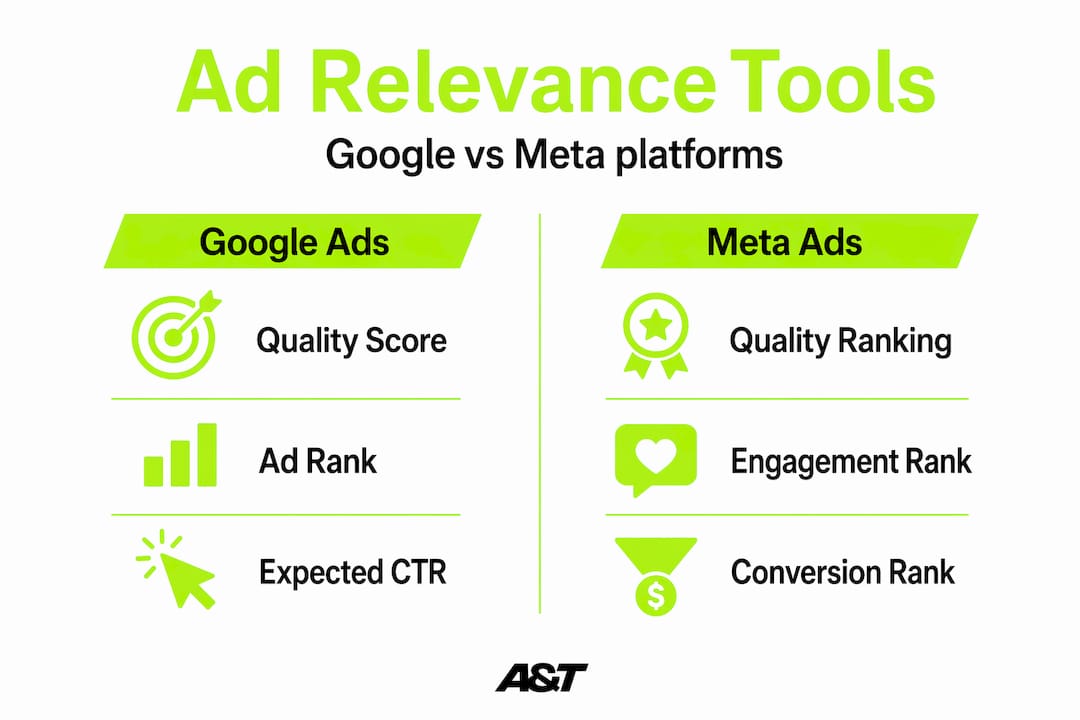
On Google Ads, relevance is baked into Quality Score, a composite metric covering expected click-through rate, ad relevance, and landing page experience. Quality Score feeds into Ad Rank, which determines both your ad placement and the price you pay. The math is straightforward: a higher relevance score means a better Ad Rank at a lower bid. A lower relevance score means you need to overbid just to compete. Understanding how auctions work is the foundation for understanding why relevance is so financially consequential.
Meta uses a parallel system. Instead of a single Quality Score, Meta's platform uses three separate rankings to assess ad performance in each auction:
Quality Ranking: How your ad's perceived quality compares to ads competing for the same audience
Engagement Rate Ranking: How your expected engagement rate compares to competing ads
Conversion Rate Ranking: How your expected conversion rate compares to ads targeting the same audience and optimization goal
These three rankings feed into Meta's Total Value calculation, the score that determines whether your ad wins the impression. Ad relevance metrics directly influence cost-efficiency by affecting this Total Value, meaning better relevance reduces both CPC and CPA. The importance of ad relevance is not abstract. It shows up in your monthly ad spend.
Pro Tip: Do not treat Quality Score as a grade to chase. Treat it as a diagnostic signal. A score of 7 in a highly competitive vertical may mean your ads are performing well. A score of 7 in a low-competition category may signal real creative problems.
How AI is redefining ad relevance in 2026
The way platforms measure and reward relevance has fundamentally changed. Five years ago, relevance was largely about keyword matching. You put the search term in your headline, matched it to your ad group, and called it relevant. That model is dissolving fast.
Traditional keyword targetingis becoming obsolete as AI models shift focus to "synthetic keywords" representing broader intent. Google's systems now interpret what a user actually wants, not just what they typed. A search for "fix sore knee" and "knee pain relief" may trigger the same intent cluster, even though the keywords differ. Your ad's relevance is now evaluated against the inferred intent, not the literal query.
This shift has real consequences for how you think about relevance optimization:
Manual keyword segmentation matters less than it used to
Broad match with smart bidding often outperforms tightly controlled exact match campaigns
AI-driven intent modeling and first-party data integration outperform manual keyword matching in driving results
The quality of your conversion signals is now your primary competitive lever
Pinterest's recent AI overhaul makes the scale of this change concrete. Their Contextual Sequential Two Tower Model increased ad relevance per user by 3x to 10x, with median relevance rising by 275 to 300%. That is not a marginal improvement. That is a platform-wide transformation in how ads match to user context in real time.
Automated bidding performs best when fed high-quality conversion data reflecting actual revenue, not low-intent leads. The AI needs to know what a real customer looks like, not just what a form submission looks like.
Pro Tip: If you are still spending significant time managing keyword match types, redirect that energy toward building a clean conversion data feed. That is where the actual relevance leverage lives in 2026.
Diagnosing and fixing ad relevance problems
Knowing your ad has a relevance problem is not enough. You need to know which layer of the funnel is causing it. This is where ad relevance diagnostics become genuinely useful, if you read them correctly.
Here is a practical framework for interpreting Meta's three diagnostic rankings:
Low Quality Ranking only: The creative itself is the issue. The ad looks low-effort, feels generic, or does not stand out against competing content in the feed. Test new visuals and tighten your copy.
Low Engagement Rate Ranking: Your hook is failing. Users are not stopping to engage with the ad even when they see it. Test the first three seconds of video or the opening line of your static ad.
Low Conversion Rate Ranking: This is the most commonly misdiagnosed signal. Marketers assume it means the ad is weak. Often, it means the landing page does not match what the ad promised. The click happened. The conversion did not. Fix the post-click experience first.
All three rankings are low: Audience targeting is likely misaligned. You may be showing relevant ads to the wrong people, or an audience that has simply seen your creative too many times.
Here is a quick comparison of how the two major platforms surface relevance issues:
Platform | Relevance Tool | What It Measures | Primary Action |
|---|---|---|---|
Google Ads | Quality Score | CTR, ad relevance, landing page | Align keywords, copy, and page content |
Meta Ads | Ad Relevance Diagnostics | Quality, engagement, conversion | Identify which funnel layer is underperforming |
A critical point: relevance scores are relative, not absolute. "Below Average" means you are losing to competitors in that auction segment, not that your ad is broken. Context matters.
Pro Tip: When optimizing for ad relevance best practices, pair every creative refresh with a landing page audit. Mismatched messaging between ad and page is one of the most common causes of low conversion rankings, and it is invisible unless you check both together.
Ad relevance and customer engagement
The business case for relevance goes beyond auction mechanics. It reaches into how consumers actually feel about your brand.

88% of consumers prefer adsaligned with their interests, and 87% say they are more likely to engage with such ads. Those are not marginal differences in preference. They represent the gap between an ad that builds brand equity and one that actively erodes it.
Ad relevance and customer engagement are directly linked for several reasons:
Relevant ads reduce avoidance. When an ad feels out of place, users scroll past, install ad blockers, or develop negative associations with the brand. Relevance removes that friction.
Relevant ads build trust. An ad that shows up at the right moment with the right message signals that a brand understands its customers. That perception compounds over time.
Irrelevant ads create fatigue. Serving the same untargeted creative to the same audience repeatedly is one of the fastest ways to burn goodwill.
The data on loyalty adds another dimension. 84% of customers say being treated as an individual is key to brand loyalty. Generic campaigns do not just waste budget. They actively work against long-term customer relationships.
How ad relevance affects sales is therefore not only a short-term conversion question. It is a brand equity question. The campaigns that drive the best ROAS over 12 months are almost always the ones that felt genuinely relevant to the people who saw them.
Building a relevance driven campaign strategy
Putting all of this into practice requires a framework, not a checklist. Here is how to build one that actually holds up under pressure.
Start with audience insight, not creative instinct. Before writing a single line of ad copy, map what your audience is trying to accomplish. What problem are they solving? What objection do they have? Align your creative to that moment, not to your product features.
Feed the algorithm clean conversion data. If you are running Google Ads, connect your CRM or offline conversion data to track revenue, not just leads. Quality conversion signals help AI bidding prioritize the users who actually become customers.
Test ad copy and creative systematically. One version is not a strategy. Testing ad copy against real audience segments reveals what resonates, and what just sounds good in a brainstorm session.
Refresh creatives before fatigue sets in. Do not wait for engagement rates to drop before updating your ads. Monitor frequency and optimize ad campaigns proactively when numbers start flattening.
Monitor diagnostics alongside business metrics. Watch Quality Score and Meta's rankings as early warning signals. But hold yourself accountable to ROAS and CPA as your real performance measures. A campaign with average diagnostic scores and strong revenue is a good campaign.
Pro Tip: Use the ad optimization checklist approach: audit your creative, landing page, and conversion data feed together every 30 days. Relevance problems rarely live in one place.
My take on where most marketers go wrong
I have seen a lot of campaigns come through with the same core problem. The marketer is obsessing over keyword-level relevance while ignoring the actual conversation happening between the ad and the user.
Getting every keyword perfectly themed into tightly grouped ad groups felt like real optimization five years ago. Today, it is mostly noise. AI has moved past it. What I have found actually drives sustainable performance is the alignment between three things: the creative, the landing page, and the conversion signal you are sending to the platform.
When all three are coherent, the platform understands exactly who to target and what a good outcome looks like. The relevance takes care of itself. When one is off, no amount of keyword sculpting fixes it.
The counterintuitive lesson I keep coming back to: sometimes "average" ad relevance scores are completely fine. If your ROAS is strong and your CPA is below target, the platform is finding the right people regardless of what the diagnostic dashboard says. Content relevance strategies matter across channels, but obsessing over scores at the expense of outcome data is a losing game. Chase the business result. Use the diagnostics as clues, not verdicts.
— Ann
Work with a team that understands ad relevance
At A&T Digital, we build paid advertising systems where relevance is built into every layer: the creative, the audience targeting, the landing page, and the conversion data feeding the algorithm. Our team manages Google Ads campaigns and Meta Ads programs with a focus on measurable outcomes, using ad relevance diagnostics as working tools, not dashboard decorations. Clients see lower CPAs, stronger engagement rates, and ad spend that actually scales. If your current campaigns are underperforming and you are not sure which layer is the problem, we can help you find it. No unnecessary meetings. Just clear diagnosis and a plan that works.
FAQ
What is the role of ad relevance in Google Ads?
Ad relevance is one of the three components of Google's Quality Score, alongside expected click-through rate and landing page experience. Higher relevance improves Ad Rank, which means better placement at a lower cost per click.
What are ad relevance diagnostics on Meta?
Meta's ad relevance diagnostics include three rankings: Quality Ranking, Engagement Rate Ranking, and Conversion Rate Ranking. Each one identifies a different layer of the funnel where your ad may be underperforming relative to competitors.
How does ad relevance affect sales and conversions?
Relevant ads reach users who are already aligned with the offer, which increases both click-through and conversion rates. Improving relevance can reduce CPA by 20 to 30% by lowering delivery costs in the auction.
Does a low Quality Score mean my campaign is failing?
Not necessarily. Quality Score and relevance metrics are relative competitive signals, not absolute grades. A lower score may reflect strong competition in your auction segment rather than a fundamental problem with your ads.
What are the most important ad relevance best practices in 2026?
The highest-leverage practices are aligning your creative with landing page messaging, feeding first-party conversion data to your bidding algorithm, and refreshing creatives before fatigue causes engagement to drop. Keyword tuning alone no longer moves the needle the way it once did.